Eight Minutes of Arc
In 1609 Kepler threw out the circle, two thousand years of it, over an error of eight minutes of arc: about a quarter of the width of the full Moon. He said nobody could have seen it before Tycho Brahe, and that Tycho's observations were good enough that it could not be ignored. Both halves of that are checkable now. We checked them against where Mars really was.
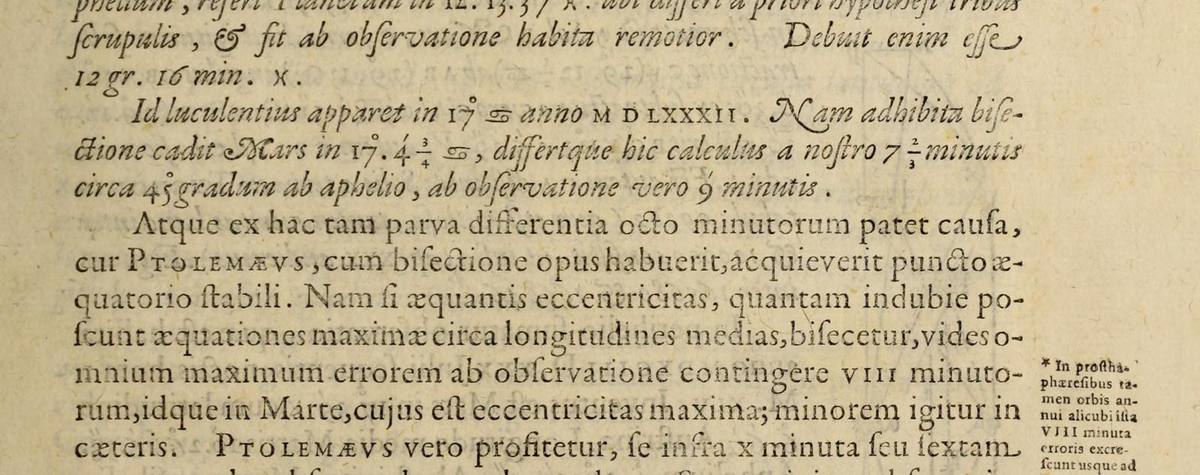
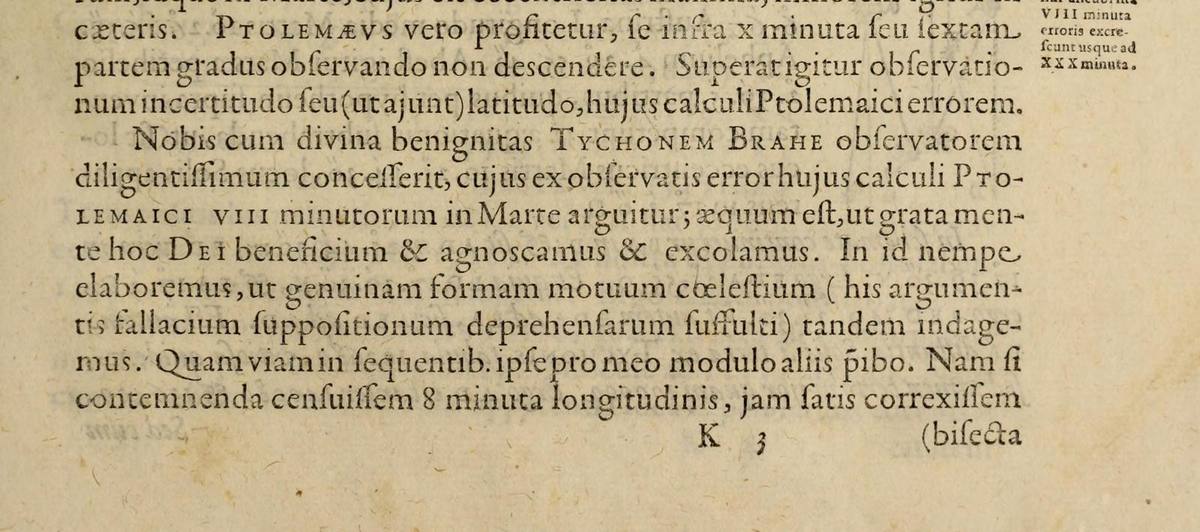

What the pages say, translated here from the Latin (the translation is ours; the Latin is under it, as printed, with the long s made short):
And from this small difference of eight minutes it is plain why Ptolemy, needing the bisection, was content with a fixed equant point. For if the eccentricity of the equant, as large as the greatest equations around the mean longitudes undoubtedly demand, is bisected, you see that the greatest error of all from the observation comes to 8 minutes, and that in Mars, whose eccentricity is the greatest; smaller, then, in the others. But Ptolemy declares that in observing he did not go below 10 minutes, a sixth part of a degree. So the uncertainty of the observations (their "latitude", as they say) exceeds the error of this Ptolemaic computation.
Since the divine kindness has granted us Tycho Brahe, a most diligent observer, from whose observations the 8-minute error of this Ptolemaic computation in Mars is shown, it is right that we acknowledge this gift of God with a grateful mind, and make use of it. [...] For if I had judged that 8 minutes of longitude could be disregarded, I would already have corrected well enough (by bisecting the eccentricity, that is) the hypothesis found in chapter 16. Now, because they could not be disregarded, these eight minutes alone have led the way to reforming the whole of astronomy, and have been made the material for a great part of this work.
Atque ex hac tam parva differentia octo minutorum patet causa, cur Ptolemæus, cum bisectione opus
habuerit, acquieverit puncto æquatorio stabili. Nam si æquantis eccentricitas, quantam indubie poscunt
æquationes maximæ circa longitudines medias, bisecetur, vides omnium maximum errorem ab observatione
contingere VIII minutorum, idque in Marte, cujus est eccentricitas maxima; minorem igitur in cæteris.
Ptolemæus vero profitetur, se infra X minuta seu sextam partem gradus observando non descendere. Superat
igitur observationum incertitudo seu (ut ajunt) latitudo, hujus calculi Ptolemaici errorem.
Nobis cum divina benignitas Tychonem Brahe observatorem diligentissimum concesserit, cujus ex
observatis error hujus calculi Ptolemaici VIII minutorum in Marte arguitur; æquum est, ut grata mente hoc
Dei beneficium & agnoscamus & excolamus. [...] Nam si contemnenda censuissem 8 minuta longitudinis,
jam satis correxissem (bisecta scilicet eccentricitate) hypothesin cap. XVI inventam. Nunc quia contemni
non potuerunt, sola igitur hæc octo minuta viam præiverunt ad totam Astronomiam reformandam, suntque
materia magnæ parti hujus operis facta.
The elided sentence says: let us work to track down at last the true form of the heavenly motions, and I will go ahead of others on that road in what follows. The margin beside the first paragraph adds that seen from the Earth ("in the prosthaphaereses of the annual orb"), these 8 minutes of error grow in places to as much as 30.
Read it as an argument about noise, because that is what it is. An error is only visible if your instrument is better than the error. Ptolemy's was not (ten minutes against eight), so his shortcut was safe for him. Tycho's, Kepler says, was. That is two claims, and each can be put to the sky:
- Was Tycho that good? His notebooks survive. We took 923 of his Mars readings and asked where Mars actually was at each moment.
- Were the eight minutes really there? The best circle that obeys Ptolemy's rule can be fitted to the real Mars, and its worst miss measured.
1. Tycho's hand
Wayne Pafko typed 923 of Tycho's Mars declinations out of J. L. E. Dreyer's edition of the notebooks in 2000, each with its date, its hour and the Latin as printed. We did not use his numbers. We read every reading again from the Latin, twice, with two parsers written separately, and they agree on all of them. Then for each one we computed where Mars was in the sky over Hven at that moment, from JPL's DE440 ephemeris, and subtracted.
887 readings have both an hour and a legible declination. Five of them Tycho labels as already corrected ("a refr. libera", "vera", "emend."); the other 882 are what his instruments read. This is them.
Every reading, minus the sky
one reading ±8′ (Kepler's error) ±10′ (Ptolemy's floor). Tap a dot.
With the dates as written and the air's bending allowed for, half of Tycho's readings are within 0.87′ of the real Mars and 86% within two minutes. The spread of the bulk, measured robustly so that a few wild readings cannot inflate it, is 1.19′. 38 readings miss by more than 8′; they are listed below and they are not hidden anywhere in these numbers. So Kepler's premise holds, and holds with room: an 8′ error sits six or seven times Tycho's typical scatter outside it. Ptolemy's 10′ would have swallowed it whole.
Four things the sky settled on the way
The calendar. Denmark kept the Julian calendar until 1700. Read Tycho's Hven dates as Gregorian instead and the median miss becomes 44′: the sky is ten days out. The seven readings from 1600 are the exception. By then Tycho was in Bohemia, which had taken the Gregorian calendar in 1584, and the four that carry an hour agree: as Julian dates they miss by 35.8′, as Gregorian by 1.6′. His notebook changed calendars when he changed countries. (Kepler met him at Benátky on 4 February 1600 and stayed about two months; the March readings fall in those weeks.)
The air. The atmosphere lifts a low planet by a few minutes. Against the airless sky the readings sit 1.6′ high in the median; against the refracted sky, nearly on it. Regress the miss on the size of the refraction and the slope is 0.86 (95% bootstrap interval 0.80 to 0.93): the notebook numbers are raw readings carrying most of the air's bending, not corrected ones. Why not all of it, we do not know. A colder, denser Danish night would bend more, not less.
The month. Pafko doubted eight readings from 1587, dated January, and wrote "(FEB???)" beside them. As January they miss by at most 1.2′; as February by at least 18′. January.
The digits. In 23 readings Pafko's typed number differs from his own typed Latin. In 19 the Latin lands closer to the real Mars, and in 10 the difference is over 5′, mostly a whole degree (a run of readings from September and October 1591 was entered one degree high). Switch the instrument to "Pafko's" to see them jump.
The hour needs saying too. Tycho wrote local sundial time, evening readings counted from noon and morning ones (MANE) from midnight. Where that put Mars below the horizon or the Sun above it, we tried the reading twelve hours away, deciding by visibility alone and never by the miss; that moved 86 hours. His clocks were poor (one night in January 1585 about 17 minutes slow), but it hardly matters here: Mars's declination changes slowly, and a 30-minute error in the hour costs at most 0.4′ on any of these readings.
2. The circle that cannot do both
Now the eight minutes themselves. Ptolemy's device for a planet is a circle whose centre sits off the Sun (here, translated to the Sun) and a second off-centre point, the equant, about which the planet turns at a steady rate. Ptolemy put the centre exactly halfway between the two: the bisection. Kepler, in chapter 16, freed it. From four of Tycho's oppositions he got the Sun 11332 parts from the centre and the equant 7232 beyond it (the radius being 100000), which is not halfway: the centre sits 39% of the way from the equant. In chapter 18 this "vicarious hypothesis" put Mars within 2′12″ of all twelve oppositions he tested it on, 1580 to 1604.
It still failed, because it got the distances wrong, which Kepler saw through Mars's latitudes. Distances wanted the bisection. Bisect, and the directions go wrong by eight minutes. Try it: every setting of the slider below is a circle fitted, with every other number free, to where Mars truly was as seen from the Sun, 1580 to 1604 (DE440, in Mars's own orbital plane).
Where the centre sits
direction (arcminutes) distance (per cent)
the chosen shape's miss in direction, 1580 to 1604 ±8′
The two errors pull against each other. At Kepler's own setting the circle's worst direction miss is 1.8′, inside Tycho's scatter, but its worst distance miss is 2.4%. At the bisection the distance comes right (0.24%) and the direction misses by 8.4′. Kepler said eight. No circle gets both, and the ellipse gets both at once: 1.1′ and 0.01%. What is left in the ellipse is what no single fixed ellipse can hold: the other planets tug Mars off it, and DE440 includes their pull.
Kepler's own numbers, with no data at all: his vicarious circle (11332, 7232) against the same equant with the centre halfway (9282, 9282) differ by at most 7.2′ round the orbit, and by 6.0′ near 45° from aphelion. His worked example on the same page, Mars in 1582 near 17° of Cancer, prints 7⅔′ against his vicarious calculation and 9′ against the observation. We have not reproduced his 7⅔′ exactly; he may have re-fitted the bisected circle's other numbers rather than keeping them, and we have not worked through his chapter to find out.
3. The same shapes, seen from the Earth
Kepler's margin says the eight minutes grow to thirty seen from the Earth, and this is where the comparison with Ptolemy and Copernicus belongs, because every one of them needs the Earth's path as well as Mars's. (Ptolemy's epicycle is the Earth's path seen backwards, so his geocentric model translates exactly.) Pick a shape for each, fit it to Mars's real position in the sky every fourth day from 1580 to 1604, and see its worst miss. These are the shapes at their very best, with numbers no astronomer of the time had: the floor each could never get under.
Choose the machinery
±8′ ±30′ Tycho's spread (±1.2′)
At their best, Ptolemy's machinery misses Mars by up to 74′, and Copernicus's by up to 77′. That is not a slip. Copernicus gave the Earth an off-centre circle but laid Mars's orbit out around that circle's centre (the "mean Sun"), and the arrangement is the same geometry as Ptolemy's, relabelled: choose "off-centre circle" and "the centre of the Earth's circle" with Ptolemy's Mars and the miss is his to the arcminute. Moving the Sun to the middle did not make Mars more accurate. What did was Kepler's first, quieter reform: an equant for the Earth, and Mars laid out around the true Sun. That alone brings the worst miss down to 23′ with bisected circles, which is his marginal "up to thirty". With Kepler's ellipse for Mars it is 1.5′ even with the Earth still on an equant circle, and with both ellipses 1.1′.
4. Tycho as the judge
The last question is the one Kepler actually faced. Not "is the ellipse right?", which we can answer from DE440, but "could Tycho's readings, on their own, tell?" Two ways to put it. First: take each shape at its best from the real sky, and hold Tycho's 882 raw readings up against it. Second: give each shape nothing but Tycho's readings and let it fit them as well as it can. (Mars's orbital plane and the Earth's are fixed from DE440 for every shape alike, so only the shapes in the plane are on trial; the 38 readings more than 8′ from the real Mars are left out of the second fit, the same ones for every shape.)
Tycho's readings, against each shape
| shape | spread vs its best (σ) | within 2′ | spread when fitted to Tycho only |
|---|---|---|---|
| Ptolemy | 9.5′ | 17% | 5.4′ |
| Copernicus | 10.8′ | 15% | 6.5′ |
| Kepler, free equant | 4.9′ | 31% | 2.5′ |
| Kepler, bisected circles | 4.9′ | 29% | 2.5′ |
| Kepler, 1609 ellipses | 1.17′ | 86% | 1.06′ |
| (the real Mars, DE440) | 1.19′ | 86% |
Tycho minus the chosen shape Tycho minus the real Mars
Only the ellipse sits inside Tycho's own scatter: against it his readings spread by 1.17′, the same as against the real Mars. Every circle leaves him visibly out, and even when the circles are allowed to fit his readings alone, the best of them leaves a spread of 2.5′ where the ellipse, fitted the same way, reaches 1.06′. So the eight minutes were there, and Tycho's declinations alone were enough to see that no circle would do.
A caution about that last sentence. Kepler did not work from these raw declinations. He worked from Tycho's reduced longitudes and latitudes, above all a table of oppositions, and a 2025 paper by Christián Carman asks whether some of those reductions were adjusted toward Tycho's own model; we have not read it and test nothing here about that table. What is tested here is the raw record underneath it.
The check
check.zip holds everything needed to recompute every number on this page
without Python or an ephemeris: unzip it and run node verify.mjs (Node 22 or later, no
packages; verify.mjs is also here on its own, to read). It reads Tycho's Latin again with its own parser; recomputes every residual statistic;
runs this page's own engine (engine.js) on this page's own truth file against
all 28 fitted combinations of shapes; recomputes the dilemma and Kepler's two circles; grades every shape by
Tycho's 882 readings; and checks every figure printed here against the data, so that changing one
digit on this page makes it fail.
What it cannot redo is the part that needs JPL's 114 MB ephemeris and SciPy: the positions and the fits. The Python that made them (parse, reduce, analyze, dilemma, fitall) is in the zip too. The positions were checked a second way, with astropy and ERFA's analytic theories of the planets rather than JPL's integration: over all 887 readings the two routes agree to 12.9″ at worst, a fifth of an arcminute. (JPL's own Horizons service could not be the second route: it has no Mars before 1600.)
What this does not show
- The historical tables. Every shape here was given its best numbers from the real sky. The tables astronomers actually used (the Alfonsine, the Prutenic, Kepler's own Rudolphine) had worse numbers than their shapes allowed, and this page does not measure them.
- The planes. Mars's orbital plane and the Earth's are taken from DE440 for every shape. The Earth's plane in 1580 to 1604 is tilted 3.2′ to today's reference ecliptic, and ignoring that alone put seven minutes into Mars's latitude at close approaches until we noticed.
- The refraction shortfall. The slope of 0.86 rather than 1 is unexplained.
- The wild readings. 38 readings miss the real Mars by more than 8′, twelve by more than half a degree, several by almost exactly one or two degrees. Whether the slip is Tycho's, Dreyer's, Pafko's or ours needs Dreyer's printed page, and we could not reach the scans from here. The worst are below, with volume and page, for anyone who can.
- Prior work. Christophe Yamahata's Observable notebooks (2022 to 2024) plot Pafko's data against JPL Horizons and fit orbital elements to it with Skyfield and DE440. We found no per-reading error analysis of the kind above, but that is a statement about our search.
| date (as written) | reading | miss | Dreyer |
|---|
Sources
- J. Kepler, Astronomia Nova (1609), ch. 16 to 19; scan at the Internet Archive. The ch. 16 numbers are also in Frisch's edition, Opera Omnia vol. 3 (1860), p. 250, archive.org.
- Tycho Brahe's observations: J. L. E. Dreyer (ed.), Tychonis Brahe Dani Opera Omnia, vols. 10 to 13 (1913 to 1929), HathiTrust; transcribed by Wayne Pafko, pafko.com/tycho (2000), file mars.xls.
- JPL DE440 (Park et al. 2021), via Skyfield. Second route: astropy 8.0.1 with ERFA.
- O. Gingerich and J. R. Voelkel, "Tycho Brahe's Copernican Campaign", JHA 29 (1998): the clock 17 minutes slow in January 1585.
- Calendar dates: Denmark to the Gregorian calendar in 1700, Bohemia and Moravia in 1584; Kepler's arrival at Benátky, 4 February 1600 (Wikipedia, citing Caspar's Kepler).
- C. C. Carman, "Did Tycho (or his assistants) manipulate his observations?", Historia Mathematica 73 (2025), doi:10.1016/j.hm.2025.09.006 (not read).