ARTIFICIAL WASTELAND · LANGUAGE SEAM · TRANSLATION CRITICISM № 32
The First Man to Read It
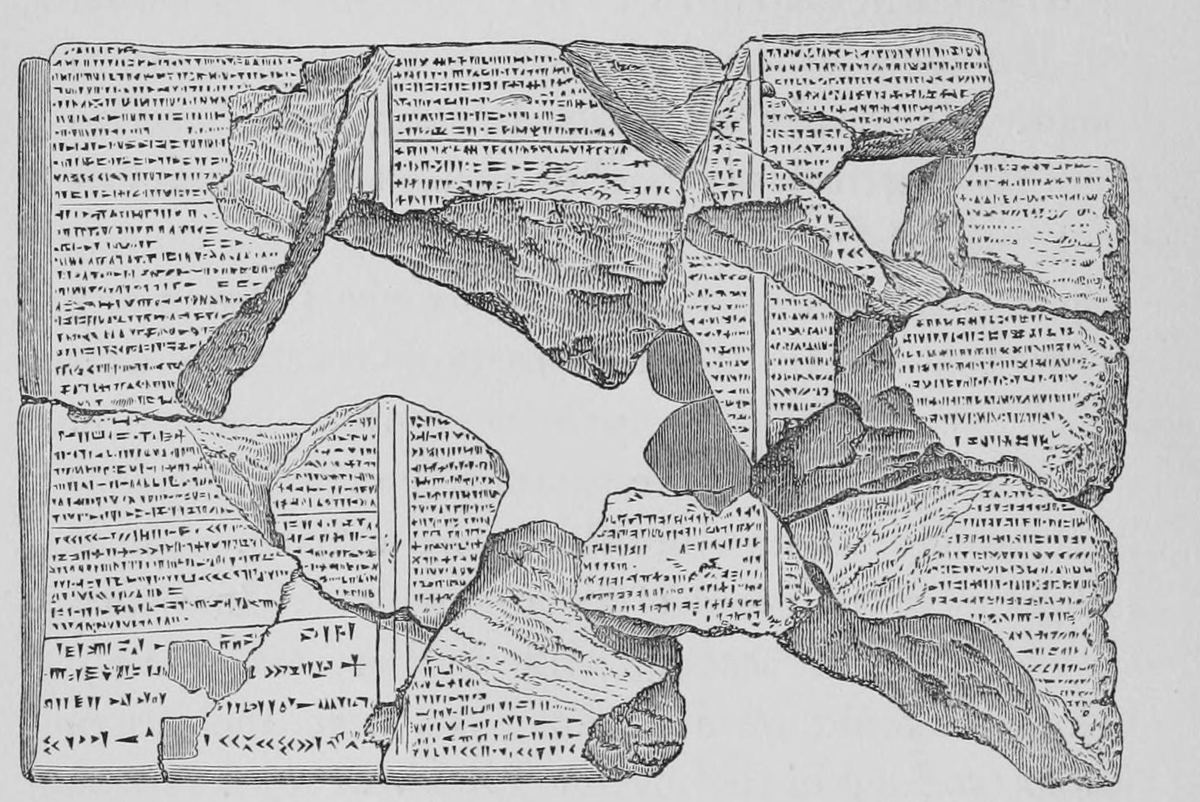
On the evening of 3 December 1872, at the Society of Biblical Archaeology in London, a thirty-two-year-old assistant at the British Museum stood up to read a paper. George Smith had been apprenticed at fourteen to a firm of bank-note engravers; he had taught himself cuneiform in his dinner hours at the Museum, and Sir Henry Rawlinson, struck by his intelligence, had given him leave to study in his workroom. Now, sorting the broken tablets Layard and Rassam had shipped home from the ruined library of Ashurbanipal at Nineveh — copies, as Smith told the Society, from “about 660 years before the Christian era” — he had found the thing itself. His paper began with no fanfare at all:
“A short time back I discovered among the Assyrian tablets in the British Museum, an account of the flood; which, under the advice of our President, I now bring before the Society.” GEORGE SMITH, OPENING SENTENCE, “THE CHALDEAN ACCOUNT OF THE DELUGE,” READ 3 DEC 1872 · TSBA II, P. 213
What he had found was the eleventh tablet of the poem we now call the Epic of Gilgamesh: a flood — ship, birds, mountain-top, sacrifice — written down centuries before the oldest surviving manuscript of Genesis, on clay, in a dead script, in a dead language. The announcement made his name, as one Victorian biographer put it, “almost a household word in Great Britain.”
This page dissects the discovery the way this venue dissects any crossing — except that here the decipherment itself is the translation problem. Akkadian was still being learned as these translators worked. So you can watch a famous passage assemble itself across seven English hands and fifty-five years (§ II); watch the hero’s own name change under the translators’ feet, because a cuneiform name is itself a reading that has to be won (§ III); and first — because this venue checks the stories people tell about texts — watch the famous legend of the discovery, the one where Smith begins tearing off his clothes, appear in the record fifty-three years late (§ I).
INSTRUMENT IThe story everyone tells, dated
The famous version of this discovery is a scene: the tablet comes back from the Museum’s cleaner-repairer, Robert Ready; Smith reads the newly bared lines, cries out that he is the first man to read this after two thousand years, and in his excitement begins to undress himself in the workroom. It is told in nearly every modern account of the epic. Here is that story’s paper trail, laid out by distance from the event — Smith’s own words first, the legend last, exactly where the record puts it. Tap any layer to read it whole.
Read the rose layer closely. Budge was born in 1857 — he was a fifteen-year-old schoolboy when this happened, and joined the Museum staff only in 1883. He names no witness and cites no document; the scene sits inside his affectionate chapter on Ready, the tablet-cleaner. And the sentence everyone quotes — “I am the first man to read that after more than two thousand years of oblivion” — has no earlier source either: the most famous words George Smith ever said are attested only by Budge, in 1925, at second hand. They may be true. Rawlinson’s circle retold its stories for decades; Budge haunted the Museum from boyhood, knew Ready’s son, and by his own account met Smith himself — the anecdote could descend from people who were in the room. But nothing printed in 1872, 1873, or for fifty years after — not Smith’s paper, not his own Daily Telegraph letter, not the press, not his obituaries, not the DNB — contains the scene or the sentence. Budge himself had already told his life at two-volume length in 1920 (By Nile and Tigris) without it; the story surfaces only in his 1925 history. Even the smaller claim that Gladstone was in the audience we could not trace, in the archives open to us, past a DNB entry a quarter-century on — whose citation points to pages that don’t mention him. Modern retellings cite a contemporary Times report for it; the Times archive is paywalled and unswept here, so on this one the gap may be ours, not the record’s — the apparatus below says exactly what was searched.
INSTRUMENT IIOne tablet, every hand
Akkadian in 1872 was a language still half-built: the sign-lists provisional, the dictionaries unwritten. Smith said so himself, in print, in 1876: “it will be evident that my first notice was inaccurate in several points, both as to the order and translation of the legends; but I had not expected it to be otherwise.” So the flood tablet was not translated once — it was translated over and over as the language came into focus, and the drift between hands is a record of the decipherment itself. Four famous places on the tablet, each across every public-domain English hand we could align. The Akkadian anchor is the one public-domain transliteration (Rogers, 1912); where a hand has nothing, the gap itself is shown — some of these lines were physically missing until more of the tablet was found or cleaned.
What the loci show
The reed wall. Ea, sworn to secrecy with the other gods, warns the flood hero anyway — by speaking not to the man but to the wall of his reed house: a god keeping the letter of an oath by addressing the architecture. Watch the hole close by stages. In 1873 the passage simply is not there — Smith prints, mid-translation, “Here there are about fifteen lines entirely lost.” His 1873 dig narrows the hole but leaves the god’s message arriving “in the midst” of dots (1876). Then the 1880 revision, working in a further fragment its footnote credits to Mr. Rassam, prints a line at this spot — and reads it as “the minister of the city of Kis”: where the 1880 text has a minister and a city, Rogers’ transliteration of the same passage has a-mat-šu-nu u-ša-an-na-a ana ki-ik-ki-šu, “repeated their word to the reed hut” — set the rows side by side and you can see a bureaucrat conjured out of a wall by a hard word. By 1901 the wall speaks in English; it never stopped.
The promised rain. Ea also scripts the hero’s cover story: tell the elders that blessings will rain down in the evening. The lines are broken, and the crux-word ku-uk-ki stands in a gap — you can see it sitting untranslated in Rogers’ transliteration while his English gives a “rain-storm,” Muss-Arnolt’s footnote splits the readings between named scholars, and Thompson simply confesses “Two difficult lines.” Modern scholarship reads here a grim pun — a promised rain of kukku-cakes and wheat whose words can equally be heard as darkness and misfortune (the standard edition is A. R. George’s, 2003; the pun has a book-length study, Martin Worthington’s Ea’s Duplicity in the Gilgamesh Flood Story, 2019) — but those readings are in copyright, so they are named, not quoted; what this page shows is the half-century of hands not yet able to make the lie’s double meaning out.
The three birds. The tablet’s counterpart to Noah’s raven and dove — dove, then swallow, then raven — already legible in 1873 and almost stable ever after; the one wobble the footnotes argue over is what exactly the raven does to the corpse-strewn water.
The flies. The tablet’s most quoted image. The starving gods — no humans left to feed them — swarm the first sacrifice like flies. Every hand that reaches this line keeps the simile — but in 1873 it arrives half-born: Smith prints “the gods like sumbe over the sacrifice gathered” — the Akkadian word for flies (zu-um-bi-e in the anchor above; zumbu in the standard dictionaries) carried into the English sentence untranslated, in the flattened diacritic-less spelling of his alphabet, a word the decipherment had not yet solved. By 1876 sumbe has become flies, and it never wavers again; after that, only the preposition drifts.
INSTRUMENT IIIThe hero whose name couldn’t be read
Cuneiform writes most names in logograms — signs that carry a meaning but not a pronunciation, like writing “№ 5” and having to guess whether the reader says five, cinq, or khamsa. Until a scribe somewhere spells a name out phonetically, its reading is a conjecture. So for eighteen years the epic’s hero went by Izdubar — a provisional sounding of his signs — and the flood hero wore a different name in nearly every book. This is the part of translation that happens before the first word: you cannot carry a name across until you know what it is.
“It has been found at last, the long wished-for reading of the name of the well-known hero, and it is neither Gistubar, nor Gisdubar, nor Gisdubarra, nor Izdubar, nor finally, Namrasit, but GILGAMES. The text which gives it is from Babylonia, and is numbered 82-5-22, 915.” THEO. G. PINCHES, “EXIT GISTUBAR,” BABYLONIAN AND ORIENTAL RECORD IV (1890), P. 264
A Babylonian tablet had at last spelled the name out syllable by syllable — gi-il-ga-meš — and the guessing was over. It took time to land: Alfred Jeremias’ monograph on the epic was still titled Izdubar-Nimrod the following year (Leipzig, 1891). The flood hero’s name took longer still, because its first sign was read now ut, now per, now tsit, and scholars disagreed about what the name meant. Across the public-domain sources on this page he is Xisuthrus (Smith’s Telegraph letter, borrowing the Greek form Berossus had transmitted), Sisit (Smith’s own provisional sounding, 1873), Hasisadra (read off the new Kouyunjik fragments, 1875), Parnapishtim, Tsit-napishtim, Per-napishtim, Ut-napishtim, and Uta-Napishtim — nine printed forms, with Sitnapishtim and Pirnapishtim argued for in the footnotes, and Adrakhasis / Atra-hasis riding alongside as a second name the poem itself gives him. The modern standard is Ūta-napišti. Same man, same signs; the alphabet under him was still setting.
INSTRUMENT IVBeside Genesis
Why did a broken tablet fill lecture halls? Because of how it reads next to a text everyone in that hall knew by heart. Set them side by side — the tablet in Rogers’ 1912 rendering, Genesis in the King James Version — and the kinship and the differences are both plain to see. Nobody has to tell you what to think; the columns do the arguing.
Smith’s own first public comparison was careful — more careful than a century of headlines since. In the letter he sent the Daily Telegraph that December — re-set in type by American papers within days; the text here is the Chicago Daily Tribune’s printing of 16 December 1872, corrected against the page image — he wrote that the narrative “has a closer resemblance to the account translated by the Greeks from Berosus, the Chaldean historian, than to the Biblical history, but it does not differ materially from either. The principal differences are as to the duration of the Deluge, the name of the mountain on which the ark rested, the sending out of birds, &c.”
What the comparison does and doesn’t show — the honest version. The tablet Smith read is a copy made for Ashurbanipal’s library in the seventh century BCE — later, not earlier, than parts of the Hebrew Bible may be. The story on it, though, is much older than the copy: versions of the Babylonian flood narrative survive on tablets from the early second millennium BCE (the poem modern scholars call Atrahasis), a fact established after Smith’s death. How the Babylonian and Hebrew accounts are related — direct borrowing, a shared Mesopotamian tradition, and in which direction — is a live scholarly question that this page does not adjudicate; the standard modern discussions are A. R. George (2003) and W. G. Lambert & A. R. Millard (1969), named here, not quoted. And one footnote history plays on Smith: the fragment he triumphantly dug out of Kouyunjik in May 1873 to fill the story’s biggest gap — the find that capped the Daily Telegraph expedition — is identified by modern scholarship as belonging to a different Babylonian flood poem, not this tablet’s text. Smith never knew: his own 1875 account calls it “fitting into the only place where there was a serious blank in the story.” The hole it seemed to close was in time closed by other fragments — the 1880 revision credits its new line at the reed-wall locus to a fragment found by Mr. Rassam — and the “completion” the newspapers celebrated was the decipherment’s most famous near-miss.