Calibration · native field first
Make the gauge block come back
Before the JCGM procedure touches an archive, it has to reproduce the core outputs of its published end-gauge example. Press once. The page evaluates the model, checks analytic sensitivities against finite differences, then sends 1,260,000 seeded trials through all nine input distributions.
Ready. The foreign target remains locked.
| check | published | this browser |
|---|---|---|
| GUM estimate | 838 nm | pending |
| GUM standard uncertainty | 32 nm | pending |
| component variance | reported 1002 nm² | pending |
| effective degrees of freedom | 16.7, truncated to 16 | pending |
| 99 percent expanded uncertainty | 93 nm | pending |
| relative standard uncertainty | 6.4 × 10⁻⁷ | pending from reconstructed source-precision components |
| reported length | (50.000 838 ± 0.000 093) mm | pending |
| second-order standard uncertainty | 34 nm | pending |
| analytic versus finite difference sensitivities | must agree | pending |
| pending | GUM framework | first-order model |
| Monte Carlo estimate | 838 nm | pending |
| Monte Carlo standard uncertainty | 36 nm | pending |
| GUM shortest interval | [745, 931] nm | pending |
| Monte Carlo shortest interval | [745, 932] nm | pending |
| pending | pending trials | seed pending |
A precision wrinkle: the four one-decimal contributions shown in Annex H.1 are 25, 9.7, 2.9, and 16.6 nm, whose squares sum to 1003.06 nm². Reconstructing from the source equations gives 1002.25 nm², 16.7 effective degrees of freedom, and 6.3 × 10⁻⁷ relative standard uncertainty. The source prints 1002 nm² and 6.4 × 10⁻⁷. The core 32 nm result is unchanged, so the page labels rather than hides the remaining display mismatch. The source's 93 nm is 2.92 × 32 nm (93.44 nm) to the nearest nanometre; from the unrounded 31.66 nm this page gets 92.44 nm and reaches the same 93 nm with a ceiling to a whole nanometre, a reporting rule of its own, not the source's.
Open the nine-input home model
| input | assigned distribution | pinned information |
|---|---|---|
| reference length lS | scaled Student t, 18 df | 50,000,623 nm, scale 25 nm |
| mean difference D | scaled Student t, 24 df | 215 nm, scale 6 nm |
| comparator random d1 | scaled Student t, 5 df | 0 nm, scale 4 nm |
| comparator systematic d2 | scaled Student t, 8 df | 0 nm, scale 7 nm |
| alphaS | rectangular | [9.5, 13.5] × 10-6 per degree C |
| theta0 | normal | -0.1 ± 0.2 degree C |
| cyclic Delta | arcsine | [-0.5, 0.5] degree C |
| delta alpha | curvilinear trapezoid | a=-1.0, b=1.0, d=0.1 × 10⁻⁶ per degree C |
| delta theta | curvilinear trapezoid | a=-0.050, b=0.050, d=0.025 degree C |
l = lS + D + d1 + d2 - lS(delta alpha × (theta0 + Delta) + alphaS × delta theta)
Layer one · ten-second archival audit
Close every envelope, or stop
The ordinary spread of repeated values is one envelope. Cavendish also judged a difference of 1/14 of the whole very unlikely. That is numerical information, but it does not uniquely say whether 0.38 is a 95 percent expanded uncertainty, a bound, or a component separate from variability already in the table. This page therefore applies a deliberately conservative adapter rule: stop unless the component-wise distribution and dependence treatment are explicit. JCGM 100 permits scientific judgment and does not require this exact rule.
UNDERDETERMINED · · transcription check:
Under this page's conservative adapter, the physical-result budget is underdetermined: the archive does not select one component-wise distribution and dependence model for Cavendish's possible common air-current effect. Other JCGM practitioners could reasonably model his 1/14 judgment differently.
Rival baselines · different measurands made explicit
The smaller question still has an answer
The primary historical rival follows Cavendish's own judgment: 5.48 ± 1/14 of the whole, approximately 5.48 ± 0.38 or [5.10, 5.86]. Merkatas and colleagues interpreted 0.38 as an approximate 95 percent expanded uncertainty. That interpretation is informative but not forced by Cavendish's prose. The other intervals below answer narrower process or sampling questions and do not include an unknown common apparatus effect.
center 5.48
expanded amount 0.38
component decomposition and coverage meaning not uniquely specified
cluster SE locked
equal experiment-weighted mean locked
within-experiment correlation is tested as a sensitivity, not asserted as fact
iid Student t interval locked
row mean locked; sample SD locked; SEM locked
median locked; 10 percent trimmed mean locked
sampling plus optional independent rounding u locked
Huber estimate locked; row-wise Huber BCa locked
locked resamples, seed locked
The baseline runs when the archive audit is unlocked.
These are distinct outputs, not interchangeable estimates of the same thing. The finite printed mean is exact for those 23 numbers. Iid and cluster intervals concern a repeatable process. A partially identified statement is mu_physical = mu_process + b_common, with the sampling part numerical and the common correction left symbolic. Cavendish's 1/14 judgment concerns the physical result. The conservative completeness gate asks whether a modern component-wise physical-result model is uniquely specified.
Layer two · source against adapter
Look at what the reduction discarded
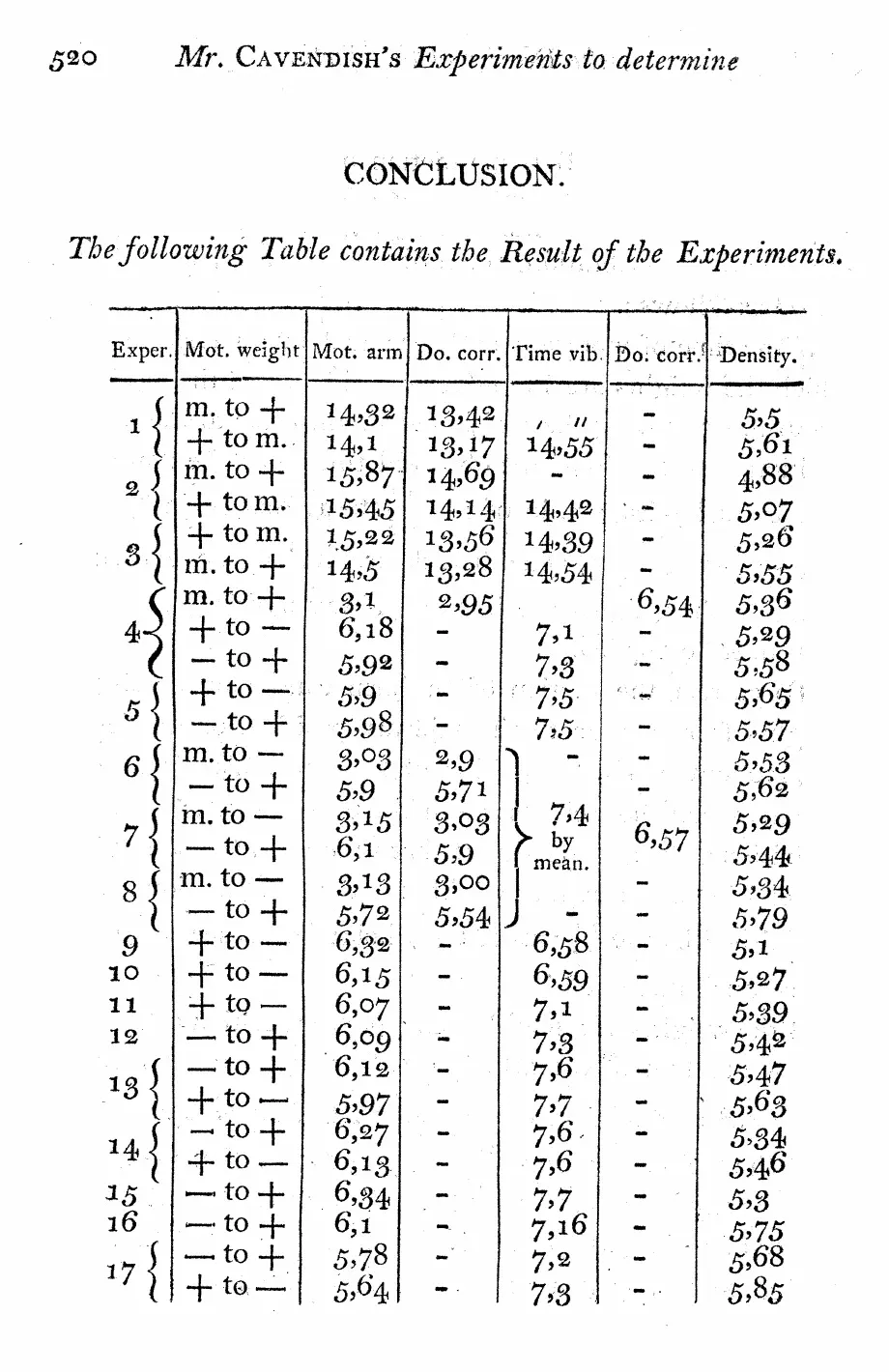
| row | cohort | density |
|---|
Four mappings enter the collision
| source | formal object | what is lost |
|---|---|---|
| Printed final density | Repeated output Di | Upstream covariance and the input responsible for each residual. |
| Rows 7 to 29 after the wire change | Primary wire_2 cohort | Conditioning, creep, ageing, and gaps inside the cohort. |
| Two-decimal printing | Optional independent rectangular rounding inputs | Truncation, recomputation, and editorial intervention cannot be recovered. Rows 1, 18, and 26 are printed to one decimal (half-width 0.05), but this switch gives every row 0.005. |
| Air-current warning | Possible common Type B effect or model discrepancy | The 1/14 judgment survives, but its component-wise distribution, coverage meaning, and overlap with observed scatter do not. |
Dropped on purpose
- the first six first-wire densities from the primary estimate
- the unresolved 4.88 to 5.88 hypothesis
- today's accepted density as a tuning target
- qualitative weather notes as invented numbers
- weight motion, arm motion, corrected arm, vibration time, and corrected vibration time
Conventions supplied here
- the physical result, finite printed table, and later-wire process are kept as different measurands
- blank means missing, never zero
- target coverage is 95 percent and intervals are shortest unless labeled otherwise
- rounding is one independent rectangular input per printed value only when its switch is on
- absent covariance is not renamed zero covariance
- the stop rule is this page's conservative adapter choice, not a command quoted from JCGM
Disable each mapping
Each button clones the current adapter data, disables one mapping, and reruns the same auditTarget, propagation, and endpoint-validation path. An ablation survives only if the verdict stays the same and the mean, trimmed, and Huber centers each move by less than 0.01 density unit. The rounding ablation explicitly starts from the enabled rounding branch. If a mapping removal makes the calculation undefined, the row says so.
Secondary reproduction · sealed until reader-state freeze
Reproduce Lauginie's narrower calculation
Lauginie's 2007 reanalysis helped motivate the later-wire cohort, so it is not independent validation of that choice. After freezing the reader's current options, this panel deliberately recomputes the immutable later-wire comparison: mean 5.48 and twice the standard error about 1.50 percent. It is a reproduction of a secondary calculation, not evidence that the adapter was untuned.
The printed-table values reproduce the rounded secondary results. This checks arithmetic only. It does not validate the cohort choice or turn the incomplete contribution ledger into a complete budget.
The Royal Society manuscript is a provenance trail, not a held-out numerical validator or a correction key. Its first provisional density is 5.53 where print has 5.50. The manuscript's six first-wire values average 5.43, not 5.53. Manuscript values have not been independently double-transcribed for this page and are not fed to the engine.
Fault bench · one catch, one miss
Break what the instrument can see
The nonlinear branch is explicitly synthetic. It doctors the model input consumed by the production audit to use a positive denominator-like quantity with 50 percent relative uncertainty. The same unmodified completeness, propagation, and endpoint-validation path then checks a first-order interval against 200,000 Monte Carlo draws. The frozen target record is untouched.
Agreement between two propagation methods is not truth. A common bias can move every result together while leaving scatter, interval width, and method agreement intact.
The check
What is fixed, free, and still missing
Source acquisition and file identities
| source | retrieved | response and hash | licence decision |
|---|---|---|---|
| JCGM 100:2008 | 2026-09-10 | HTTP 200, 1,888,806 bytes41bbf068fbc0d7986c98691b2d1af6680cb3044f6a1a89b3560933ed9ef9626c | JCGM 2008, all rights reserved; linked, not redistributed |
| JCGM 101:2008 | 2026-09-10 | HTTP 200, 1,489,478 bytes6d8548af875df112dfc5cf14eb974f5544341f4a31cbbdfc19fc5ed155d8fa20 | JCGM 2008, all rights reserved; linked, not redistributed |
| JCGM 100 Amendment 1:2026 | 2026-09-10 | HTTP 200, 620,150 bytesce50a6ba8b5a338d81082494e81988f137c89d951c8dcb647a1fc856b7b5f809 | JCGM 2026, all rights reserved; linked, not redistributed |
| Cavendish printed paper | 2026-09-10 | HTTP 200, 14,601,468 bytescc1054b89a9494e8977daef89b873519b990648c4134d56ac84882a502d5cdf9 | Public Domain Mark 1.0 |
| HistData CSV | 2026-09-10 | HTTP 200, 516 bytesdf2d7b063f3bae5fd518e4cc313280d37e14f833dc26a43148ce397bae797c3d | GPL-2 or GPL-3 |
| Royal Society manuscript object | 2026-09-10 | HTTP 200, 18,255,161 bytes1654026949ba2cbce5fe055cbcbed997b7d52da23cbc0ea17df3b3d4ba4c6ef0 | Research access; permission required for web reproduction, so no image is shipped |
We searched the general web, Crossref Works, and OpenAlex Works on 10 September 2026 for an application of JCGM 100 and JCGM 101 to Cavendish's 1798 published observation tables, and did not find a source that constructs a source-audited Type A and Type B budget and validates its linear propagation against Monte Carlo. This reports the search, not universal priority.
The check that stands behind this page recomputes the page's numerical results, imports the browser engine, compares the independent frozen transcription, checks the manifest ledger, reads a set of the displayed figures back out of this HTML (not every one: among those it does not read back are the trial counts, the experiment count, the manuscript's first provisional 5.53, Lauginie's mean 5.48 and 1.50 percent, and the Huber constant), validates the share surface, and carries mutation controls that must turn those assertions red.
Sources
The documents, not substitutes for them
- Henry Cavendish, Experiments to Determine the Density of the Earth, Philosophical Transactions 88 (1798), 469 to 526. Conclusion table at original page 520.
- JCGM, JCGM 100:2008 and JCGM 101:2008. The 50 mm end-gauge example is Annex H.1 and Supplement 1 section 9.5.
- Pierre Lauginie, Weighing the Earth, weighing the Worlds (2007), reproduced as a secondary rounded calculation.
- Merkatas, Toman, Possolo, and Schlamminger, Shades of dark uncertainty and consensus value for the Newtonian constant of gravitation, Metrologia 56 (2019) 054001. They interpret Cavendish's 0.38 as an approximate 95 percent expanded uncertainty.
- JCGM, JCGM GUM-6:2020. Its hierarchical-model guidance motivates the experiment-cluster sensitivity without asserting that within-experiment correlation is proven.
- Stephen M. Stigler, Do Robust Estimators Work with Real Data?, Annals of Statistics 5(6), 1977, 1055 to 1098. Huber and trimmed centers are retained as secondary robustness diagnostics, not privileged as the strongest rival.
- Michael Friendly, HistData Cavendish documentation, machine-readable comparison path for the density column.
Corrections
Corrected 2026-10-18: This page said the check behind it "reads every static displayed figure back out of this HTML" (and, in the page source, that it "string-matches every static claim"). It does not: several displayed figures, among them the 1.26 million and 200,000 trial counts, the 14 printed experiments, the manuscript's first provisional 5.53, Lauginie's 1.50 percent and the Huber constant 1.345, can be changed without the verifier failing. The sentence now says it reads a set of the displayed figures, not every one. Found by the assay line, 2026-10-18.
Corrected 2026-10-18: The note under the 4.88 to 5.88 switch called the hypothesis "Lauginie's". It did not start with him: the discrepancy in Cavendish's row 3 was first noticed by Baily in 1843 (Rlab's cavendish documentation, after Stigler 1977). The note no longer names Lauginie. Found by the assay line, 2026-10-18.