Theatre and rhetoric · a writing system for the body
With Sudden Start
In 1806 Gilbert Austin wrote out part of a fable in letters for the hands, arms, head and feet, then explained his own marks in prose. Using the union of his four printed keys, the marks agree with all 14 of those explanations in the Oxford and UNCG copies and with 10 in the damaged Wikimedia Commons scan, while 4 marks stay unexplained across four witnesses in the page's robustness sweep. That sweep varies five rule readings and the three DLI readings while holding the modern step emendations as printed.
The Reverend Gilbert Austin's Chironomia is a treatise on delivery: the voice, the face and, above all, gesture. Its new idea is a way of writing gesture down. Small italic letters go over the words for the hands and arms, capitals for the head and eyes, and letters under the line for the feet. To show it working he marked the opening of Gay's fable The Miser and Plutus in 30 numbered figures, had every figure drawn and engraved, and then explained several of his own marks in prose.
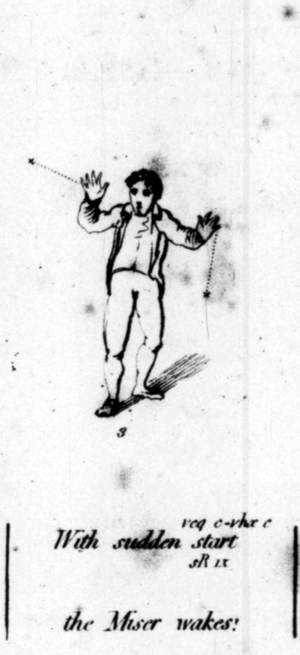
Under the word start, in the line that gives this page its name, he wrote the step sR1x. None of his four keys has a step s.
Loading the record: the fable, the keys and the glosses are computed in your browser.
Using the union of Austin's four printed keys, the fable matches all 14 of his glosses in Oxford and UNCG, 10 in the damaged DLI and Commons scan, and leaves 4 marks unexplained across four witnesses after the page's declared robustness sweep.
I
The fable as he marked it
Press any mark. Each letter is looked up in the key you have chosen, with Austin's own word for it and the page he prints it on, and Plate 12's drawing of that moment appears beside it. Red marks break a printed rule or use a letter the key does not define. A struck-through numeral or a dashed rule is one this copy does not show.
The Miser and Plutus. Gay. As printed on pages 369 to 370, read from the Oxford and UNCG copies collated
Choose a mark in the fable.
II
What he says his marks mean
Austin glosses his own marks in prose: the worked examples on p. 360, the Observations on the Notation after the fable, and two cross references in chapter XIII. Each gloss is turned into claims about particular letters, and the engine checks each claim with the same parser that draws the fable. A gloss agrees only if the chosen key gives Austin's word for every letter it names.
This is an anchor inside one book: one author explaining his own marks. It does not show that anyone ever moved like this. What it tests is the parser and the transcribed keys, which is where a page like this goes wrong.
Two glosses that do not fit in the readable Oxford and UNCG copies
These are reported beside the anchor, never inside it. In Observation XXI Austin says the gesture at figure 21 "ends elevated as in the figure", and cites the letters Bvhf for it. Read through his own key the h of Bvhf is horizontal; the set printed over weak is vef, whose e is elevated. The observation repeats the first set's letters where the figure has vef. On p. 345 he names figure 26 as an example of clinching: both hands there are c, clinched, but the manner letter printed is sh, shaking, not cl. That one is a partial agreement, not a slip.
III
"It can only agree with itself"
A parser built from a key and run on the example written for that key can only agree with itself. Any errors are transcription noise.
That would be true if the record could not disagree. This one can, in three ways: the prose glosses above, several copies of the book, and an engraved plate that repeats every mark under its drawing. Change the copy, the key or any reading below and the same engine gives different answers. The grid runs every copy against every key at your current readings; press a cell to read the fable that way.
Cells count the anchor glosses that agree, out of those that apply to that copy. The plate has no perpendicular rules, and the verse on it is broken differently, so two claims do not apply to it.
What the scan lost
The copy on Wikimedia Commons, which the Digital Library of India scanned, is the one with the open licence badge, and a large part of why this book is easy to find at all. It is a two-tone scan: every pixel is black or white. On the two pages of the fable it shows 29 figure numerals where the Oxford and UNCG copies print 30, and 22 perpendicular rules where they print 30. The rule and the separated letter at figures 18 and 20 are gone, and at figure 21 the letter over weak has lost its eye, so it reads as either c or e. On p. 364 its key prints "a. across" where the other copies print "c. across".
Whether those marks were faint on that sheet or fell below the scanner's threshold cannot be told from the scan. Either way the losses belong to the copy. Read alone, it agrees with 10 of the 14 glosses, 3 fail and 1 cannot be settled; taking the damaged letter as e gives 11. With the synoptical table alone it agrees with 8. None of this is Austin's error, and the page will not call it one.


What stays red in every copy
The residue is what the engine flags in the Oxford copy, the UNCG copy, the DLI scan and the plate alike, under every key, and then again under every combination of the five rule-reading choices and the three DLI readings in the panel above: 96 combinations, 1536 runs. The modern step emendations (sStep and tr) are held as printed for this sweep, and the letter-count choice does not affect residue. 4 marks survive all of it.
- The step s under start and trembles (figures 3 and 6). The steps on p. 365 are a, r, tr, c, st, sp and sk, and chapter XI gives "starts, (st.)" on p. 303. The plate engraves the same s. Choosing the emendation st clears both; that emendation is ours, not Austin's.
- tr over trembles (figure 6). tr is the step traverse, a letter for below the line. No key has it among the motions of the hands, and Austin's letter for "a tremulous motion" is sh (p. 345).
- The B over Looks (figure 5), apart from the pair of sets over back. Read as the both-hands prefix, as p. 529 writes "the set of letters B pef", it gives both hands one gesture while the short dash gives them two different ones. Read as a look, it matches p. 543, where Austin glosses another B standing alone: "At the beginning at B, the speaker looks back". No key lists B among the looks of the eyes. Under either reading it is flagged.
Austin's own repair, visible in the keys
Under the synoptical table alone, the fable uses 3 letters it does not define: o and i at figure 8 and rj at figure 28. The Additions on p. 551 include exactly the three missing entries used by this fable, "found necessary in the illustrations" (p. 550); the full table also adds rt and bn. With the synoptical table alone the collated text agrees with 13 glosses, with the alphabetical table alone 12, and under the printed rules without the Observations 12. The alphabetical table prints words rather than letters, so to use it as a key this page matches a letter to a word in its row that contains the letter's other letters in order, and refuses a match to a word the other tables letter differently. That rule is ours.
IV
Austin's own audit, rerun
Austin says he added the Additions because they were "found necessary in the illustrations". The illustrations he means are in chapter XXIII, which notates three more pieces: Gray's Elegy, a speech of Brutus and a passage of Young's Night Thoughts. Rerunning his audit on them would ask which letters they use that no earlier key defines, whether the Additions caught them all, and whether tr or s comes back.
This version does not ship the chapter XXIII audit. The chapter XXIII pieces have not been transcribed in two copies at a quality this page will sign, so no number here comes from them. What the page offers in their place is the copy switch in section III and the two printed claims about length, tested on the fable below. One thing chapter XXIII did settle is used above: its gloss of a detached B as a look back, read in two copies.
How many letters a gesture needs
Austin makes two printed claims about length. On p. 359 the combined positions and motions of the arms and hands are expressed "by four, or fewer symbolic letters for each movement"; on p. 543 the method "requires for each gesture not more than five symbolic letters, sometimes fewer". Whether they hold depends on how you count. In the fable the longest gesture has 5 symbols counting B and 4 without it, so the four-letter claim holds only if B is not counted.
V
What this page will not do
This control checks the parsed witness records for a mark present in every copy; it does not decide that Austin made an error.
The check
Waiting for the record to load.
| figure | computed | against the page |
|---|
| readout | shown | against the browser computation |
|---|
| file | SHA-256 | against record.json |
|---|
| choice | options | effect |
|---|
What is uncertain, and every free choice
- The transcription is the instrument. Every mark was read by hand from page images of each copy, the Oxford copy first, then the UNCG copy, the DLI scan and the plate. A second reader, blinded to the first, read the UNCG copy, the DLI scan and the plate. They disagreed on the damaged letter at figure 21 of the DLI scan, which the page keeps unreadable, and on dash lengths where the plate breaks a rule across two lines of its caption. Every disagreement is listed in the research notes.
- Dashes on the plate. The engraver cuts dashes and dotted lines alike as broken lines, so the plate is read with the dash classes the letterpress prints.
- The alphabetical table. It prints no letters; the rule that matches letters to its words is this page's.
- Placement. The key says capitals for the head and eyes stand "at the commencement of Sentences"; the default window of two words follows "towards the beginning of the sentence" on p. 361.
- The four keys disagree with each other in places the fable does not reach, and the page does not choose between them: breast is B on p. 341 but br on p. 365; enumerating is en on p. 340 but nu on p. 365; the front positions of the feet are noted F. R. and F. L. on p. 300 but numbered first and second on p. 365.
- Not checked: whether every one-handed set carries the short dash that p. 361 says is "always marked"; the voice, which the fable does not note; the significant gestures noted in the margin; and the poses drawn on the plate, which are shown, not measured.
Sources, licences and what came before
Gilbert Austin, Chironomia; or, a Treatise on Rhetorical Delivery (London: T. Cadell and W. Davies, 1806). Three copies were read, all through the Internet Archive:
- The UNCG copy, a University Microfilms film, item per_british-and-continental-rhetoric-and-elocution_austin-gilbert_1806. The item states no licence; the book and its plates are in the public domain by date. Its crops are the page's images.
- The DLI copy, item dli.ministry.11126, mirrored on Wikimedia Commons, which marks it public domain. Its crops are shown where it differs.
- The Oxford copy scanned by Google, item chironomiaoratr00austgoog, marked NOT_IN_COPYRIGHT. Its first leaf asks for personal, non-commercial use of the files, so it is cited here by leaf number and none of its images is shown.
Prior work this page builds beside: Roderick Laird's "Austin's Gesture Notation: A working grammar" (2012), a formal grammar of the letters that already notes some conflicts between the keys and does not discuss the fable; Steven Smith's "The Digital Chironomia" in enculturation (2019), an installation that recognises held poses; and, not re-checked here, Sara Newman and Sigrid Streit's Gilbert Austin's Chironomia Revisited (2020), Philippa Spoel's essay in Rhetoric Society Quarterly (1998), Jed Wentz on Austin and acting (2015), a filmed performance of the fable by Ian Caddy, and the successor manuals of Jonathan Barber and Albert Bacon.
The prospector and the spec writer for this page searched the open web, the Internet Archive, Laird's working grammar, the Digital Chironomia article and the Wasteland corpus on 2026-09-14 and did not find a public tool that parses Austin's printed notation of the fable under each of his keys, reproduces his own glosses of it, and collates the letterpress in three copies with the engraved captions. The builder re-ran only the corpus search, on 2026-09-15. Nobody here has checked the notes of the 1966 Southern Illinois edition or Newman and Streit's chapters.