1938 florin
au-florin-1938
A coin of this date, photographed
Museums Victoria holds 2 of these and photographs each one, which is a documented proof that a coin bearing this date exists. It says nothing about how many were struck, and is not counted as a mintage anywhere here.
What they hold: proof. None of these is a circulating strike, so this date is attested only by pieces that were never issued for use.
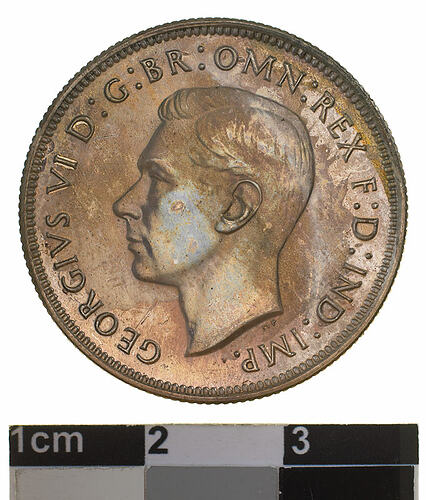
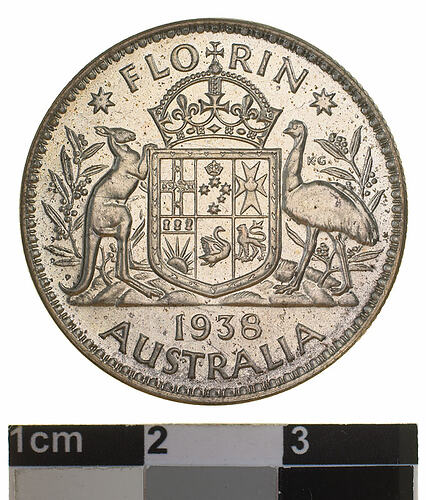
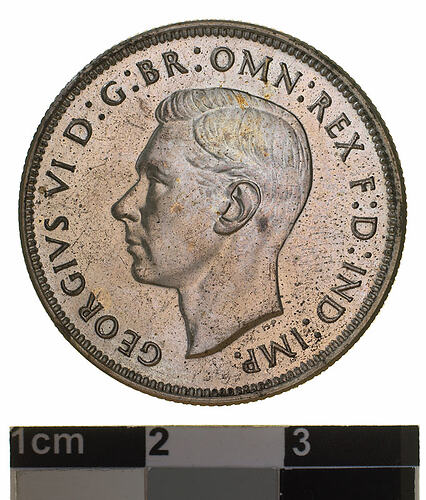
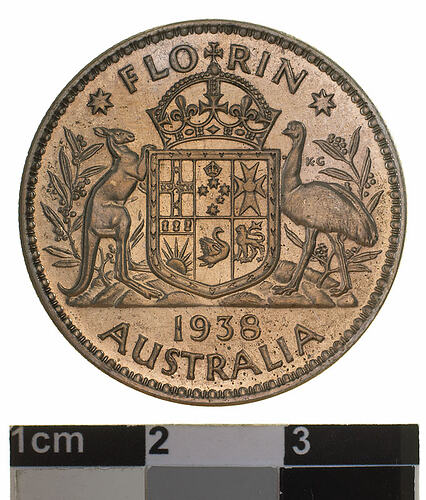
Proof Coin - Florin (2 Shillings), Australia, 1938 proof
Proof Coin - Florin (2 Shillings), Australia, 1938 proof
Mintage
no-coin-dated-figure 2,990,000 pieces
No document names how many coins were struck bearing the date 1938. These are report-year figures, counted as issued, and a coin dated 1938 was drawn from deliveries like these. Treating one of them as the mintage of a 1938 coin is what most published figures do, and it is the conflation this catalogue exists to document: the reports themselves record dates carrying over from one report year into the next.
| Figure | Mint | What was counted | Source, and its own words |
|---|---|---|---|
| 2,990,000 | Melbourne | issued what the Melbourne mint issued during report year 1938 |
Reports of the Deputy Master and Comptroller of the Royal Mint, Australian branch sections
processes of coining being, Australian crowns, 25,400l., florins, 2990001., £299,000 x 10 coins per pound |
| 2,172,000 | not stated | issued what the Commonwealth Treasury issued across the whole of Australia during 1938 |
Reports of the Deputy Master of the Royal Mint, Australian branch memoranda and appendices
es from the Commonwealth Treasury for the whole of Australia were :~ SILVER. . . £ £ Crowns... 25,000 Florins 217,200 Shillings . . . . . . . . . 67,400 Sixpences ... ... ... 62,400 Threepences 56,200 428,200 BRONZE. £ Pence 32,720 Halfpenc £217,200 x 10 coins per pound |
What can be said instead
No document names a figure for coins dated 1938. The reports do say what the branch mints delivered in the report years around it, and a coin of this date had to come from one of those deliveries.
| Report year | As the report prints it | In pieces | Mint |
|---|---|---|---|
| 1938 | 2990001. | 2,990,000 | Melbourne |
So at most 2,990,000 pieces can bear the date 1938, if Coins dated 1938 were struck in report year 1938 or 1939.
The reports describe dates lagging by a year, but not always by only one: the 1939 report records that Melbourne went on using 1936 dies throughout 1937. Where a date persisted, the true figure can exceed this ceiling.
Where the usual figure comes from. A figure near 2,990,000 for 1938 is what you get by taking the report year 1938 delivery and treating it as the coin’s date. That is not a guess about what other sources do: on fourteen penny years where a widely used public guide could be checked against these reports, five reproduce exactly as the pound figure times its coins per pound with the last three digits dropped, the residuals being 200, 400, 600, 800 and 800. The other nine differ by millions, which is what happens when the report year and the coin’s date genuinely come apart. The working is here.
What this page does not tell you
It does not tell you what the coin is worth. A catalogue can honestly report how many were struck, what metal is in one, and what the documents say. It cannot report a market price without either inventing it or copying someone who might have. So this catalogue reports the first three and stays quiet about the fourth.