1902 half sovereign
au-half-sovereign-1902
A coin of this date, photographed
Museums Victoria holds one of these and photographs each one, which is a documented proof that a coin bearing this date exists. It says nothing about how many were struck, and is not counted as a mintage anywhere here.
What they hold: circulating.
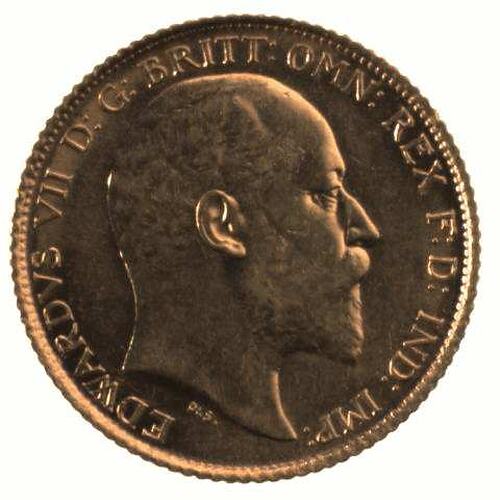
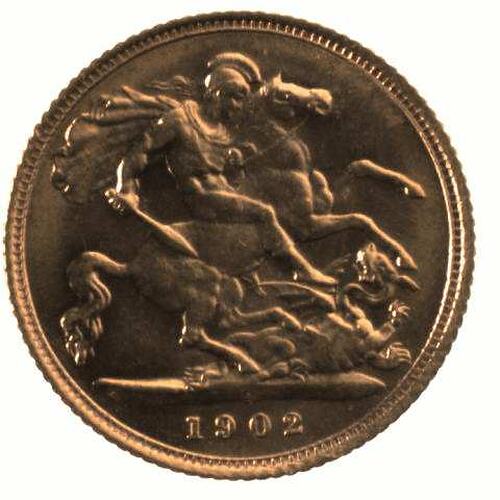
Coin - Half Sovereign, New South Wales, Australia, 1902 circulating
Mintage
summed-from-components 84,000 pieces
Australia's whole coinage of this denomination for 1902, summed across 2 branches (Melbourne, Sydney). Every part counts the same thing, issued, which is what makes the sum meaningful; it is still a report-year quantity and not a count of coins bearing the date 1902. 2 of 2 parts are confirmed by its own table: the sovereign and half sovereign figures imply the total value, which the table prints. The branch figures are on their own pages.
| Figure | Mint | What was counted | Source, and its own words |
|---|---|---|---|
| 0 | Melbourne | issued the return prints a dash against this row, meaning the Melbourne branch issued none in 1902checksum confirmed |
Reports of the Deputy Master of the Royal Mint, Australian branch gold returns 1870 to 1909
1902‘ .. '1 4,470,378 9 4,267,157 —— 4,267,157 46,4(‘7'360 195,40913 ‘ 462,56613 2 9,487 ' , " ' 3,229 ‘ 16,863 7 |
| 84,000 | Sydney | issued gold coin issued from the Sydney branch during the calendar year 1902, the unit on that page being pounds sterlingchecksum confirmed |
Reports of the Deputy Master of the Royal Mint, Australian branch gold returns 1870 to 1909
1902 796,326‘67 2,870,753 6 2,813,000 42,000 2,855,000 603'058 2,552 2,357,552 108 14 9 15,396 8 |
What this page does not tell you
It does not tell you what the coin is worth. A catalogue can honestly report how many were struck, what metal is in one, and what the documents say. It cannot report a market price without either inventing it or copying someone who might have. So this catalogue reports the first three and stays quiet about the fourth.