Fourteen Tudor plays promise how few players they need. Each promise, held to its play
Four May Play It
Fourteen Tudor plays, printed between 1548 and 1598, tell the buyer how few men can stage them. The Artificial Wasteland held each promise to its own text, the speeches and the printed stage directions, and assumed nothing they do not say. The texts allow ten of the numbers. Two more they allow only if a player can change parts with no line spoken, and two they rule out: Wealth and Health needs six men, not four. Of the eleven printed divisions of the parts, seven hold.
Fowre persons may easily play it
In 1576 Hugh Jackson printed George Wapull’s The Tide Tarrieth No Man at the sign of Saint John the Evangelist, beneath the Conduit in Fleet Street. Under the title, where a book now carries its praise, he set a promise, and then the arithmetic that keeps it: eighteen parts, from the Prologue to Despair, divided among four men.
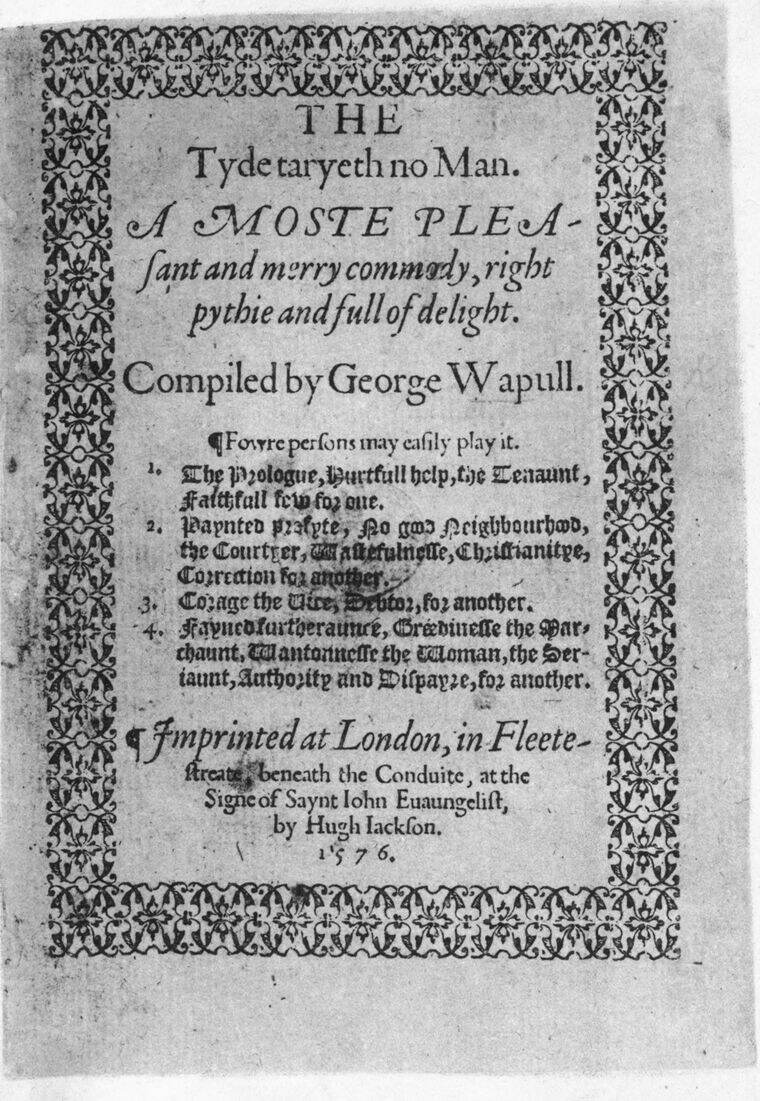
THE Tyde taryeth no Man.
A MOSTE PLEAsant and merry commedy, right pythie and full of delight.
Compiled by George Wapull.
¶Fowre persons may easily play it.
- 1. The Prologue, Hurtfull help, the Tenaunt, Faithfull few for one.
- 2. Paynted prafyte, No good Neighbourhood, the Courtyer, Wastefulnesse, Christianitye, Correction for another.
- 3. Corage the Uice, Debtor, for another.
- 4. Frayued furtheraunce, Gréedinesse the Marchaunt, Wantonnesse the Woman, the Seriaunt, Authority and Dispayre, for another.
¶Imprinted at London, in Fleetestreate, beneath the Conduite, at the Signe of Saynt Iohn Euaungelist, by Hugh Iackson. 1576.
A promise like that is written to a buyer, and it is also a claim about a play, which the play can be asked to keep. Is any of the four men ever wanted in two places at once? When one of his parts goes off and the next comes on, how long does he have? The play holds the answers, in who speaks when and in the stage directions its printer set. This page reads all of that for the fourteen plays, printed between 1548 and 1598, in which a search of the Text Creation Partnership’s transcriptions of early English books finds a promise of this kind, and holds each promise to its play: 4,339 speeches and 626 printed stage directions (with 51 headings and 30 notes in the margin), on a clock of 20,294 spoken lines.
The casting board
Each lane is one player. Each mark is a speech one of his parts speaks, or a printed stage direction that names that part on stage, laid along the play’s spoken lines. Between his marks for different parts he is changing, and the figure at the end of the lane is his tightest change: the fewest lines anyone speaks while he makes it. Pick a part (tap it, then tap a player’s name, or drag it) and the board measures again.
The board needs scripts. The table below carries every result.
So that any one take of those partes that be not in place at once
R. Wever’s Lusty Juventus, printed about 1565, does not divide its parts. It states the rule instead, after naming its nine speaking parts: Foure maye playe it easely, takyng such partes as they thinke best: so that any one take of those partes that be not in place at once.
That sentence is the whole of the problem. A part is “in place” while it is on the stage, two parts that are never in place at once can share an actor, and a company that can sort every part onto its four men without breaking the rule can play the piece.
What the sentence leaves to the company is the hard part: knowing when each part is in place. A printed play of this date says little about it. It gives the speeches, each under its speaker’s name, and a few stage directions, often in Latin or in English shorthand (Exiunt
, Enter Corage
), and leaves most comings and goings to be inferred. So the check here takes only what the text makes certain, and nothing else:
- a part is on stage for the whole of every speech it speaks;
- a part is on stage at the moment of every printed direction that names it there (
Faythfull few plucketh him agayne
), read one by one, with the reading shown on the board; - time is counted in spoken lines, from the first line to the last;
- no exit or entrance the text does not print is supplied, and a speech whose speaker the text does not settle (its heading lost in the only copy transcribed, or spoken from off stage) puts nobody on stage.
An actor playing two parts must leave as one and come back as the other somewhere between the last mark of the first and the next mark of the second, and the lines spoken in between are all the time he has. Because the check assumes nothing the text does not say, every figure it gives runs one way only: a change it measures at twenty-four lines took at most twenty-four lines of stage time, and a company it says needs five players needed at least five. When it finds no time at all, two parts in place at once or one answering the other with nothing printed between, that is the text saying so.
Wever’s rule, taken at its word, is kinder than that. It forbids two parts in place at once and nothing more, and by it Lusty Juventus can be played by four: the text allows 144 ways to do it. But every one of them asks the same thing at the same moment, the direction They go fourth. Here entreth god counsell
, where Hypocrisy, Fellowship and Abominable Living go out with Youth and Good Counsel comes in: one of the three must go out and come straight back as Good Counsel, with no line spoken. Allow every change a single line and the play needs five.
While Wantonnesse maketh her ready
Wapull’s fourth man has six parts (so does his second): Feigned Furtherance, Greediness the Merchant, Wantonness the Woman, the Sergeant, Authority and Despair. One of his changes the play admits to in print. Greediness leaves for Paul’s Cross to catch his debtors at the sermon (Towardes Powles Crosse, from hence I doe goe,
… Therefore syrs adew to long I do chat.
), and Courage, left with Hurtful Help, says Now that here is none but you and I, I pray thée deliuer to me my part
: his share of the takings. They quarrel over it, and the direction says what the quarrel is for: And sighteth to prolong the time, while Wantonnesse maketh her ready.
(The transcription reads sighteth
; the British Museum’s copy, in Farmer’s facsimile, has fighteth.) Wantonness is a woman, and the man who has just gone off as a merchant is putting on her gown. The board gives him 48 lines from Greediness’s exit to Wantonness’s first line, and a fight in the middle of them that the author wrote in to fill the time. W. J. Lawrence read the direction the same way in 1927: it apparently shows that it had been found in the performance of the play that more time was necessary for the actor’s change from male to female attire than the mere delivery of the dialogue provided
.
Wapull’s arithmetic is as good as it could be. The text allows 252 ways to divide the eighteen parts among four men with at least a line for every change. In Wapull’s, the tightest change has 24 lines, and no division into four can give every change more than 24: 36 of the 252 tie with his, and none does better.
Fourteen promises
The table holds each play to its own number. It gives two counts of the fewest players the text allows. The first lets a player change parts with no line spoken wherever the print sets a direction, since the business of a direction (an exit, a fight, a song, a body carried off) can take time that no line records; the second asks at least one spoken line for every change. A number stands when the second count is no larger. The room is the most lines that some division into the promised number can give every change. A printed division holds when each of its players has at least a line for every change.
| Play | The promise | Players | Parts | Fewest | The number | The printed division | Open |
|---|---|---|---|---|---|---|---|
| Three Laws John Bale, c. 1548 | Into fyue personages maye the partes of thys Comedy be deuyded. | 5 | 14 | 5 / 5 | allowed; room 30 lines | holds; tightest change 2 lines | board |
| Impatient Poverty Anonymous, c. 1561 | Foure men may well and eaſely playe it. | 4 | 10 | 4 / 4 | allowed; room 24 lines | holds; tightest change 3 lines | board |
| Wealth and Health Anonymous, c. 1565 | Foure may easely play this Playe. | 4 | 7 | 6 / 6 | ruled out: at least six | none printed | board |
| Lusty Juventus R. Wever, c. 1565 | Foure maye playe it easely, takyng such partes as they thinke best: so that any one take of those partes that be not in place at once. | 4 | 9 | 4 / 5 | allowed only if a change can be made with no line spoken | none printed | board |
| The Life and Repentance of Mary Magdalene Lewis Wager, 1566 | Foure may easely play this Enterlude. | 4 | 15 | 5 / 5 | ruled out: at least five | none printed | board |
| The Trial of Treasure Anonymous, 1567 | The names of the plaiers, | 5 | 15 | 4 / 5 | allowed; room 18 lines | holds; tightest change 18 lines | board |
| Horestes John Pickering, 1567 | The names deuided for vi. to playe. | 6 | 23 | 4 / 7 | allowed only if a change can be made with no line spoken | Idumeus, King of Crete is listed for two players; read at its best, one silent change | board |
| Cambises Thomas Preston, c. 1570 | The diuiſion of the partes. | 8 | 40 | 5 / 6 | allowed; room 30 lines | needs two silent changes | board |
| Enough is as Good as a Feast W. Wager, c. 1570 | Seuen may eaſely play this Enterlude. | 7 | 18 | 4 / 6 | allowed; room 31 lines | needs one silent change | board |
| The Tide Tarrieth No Man George Wapull, 1576 | Fowre persons may easily play it. | 4 | 18 | 4 / 4 | allowed; room 24 lines | holds; tightest change 24 lines | board |
| The Most Virtuous and Godly Susanna Thomas Garter, 1578 | Eyght persons may easyly play it. | 8 | 16 | 6 / 7 | allowed; room 20 lines | holds; tightest change 16 lines | board |
| The Conflict of Conscience Nathaniel Woodes, 1581 | The Actors names, deuided into ſix partes, moſt conuenient for ſuch as be diſpoſed, either to ſhow this Comedie in priuate houſes, or otherwiſe. | 6 | 18 | 5 / 5 | allowed; room 44 lines | holds; tightest change 6 lines | board |
| Like Will to Like Ulpian Fulwell, 1587 | Fiue may easily play this Enterlude. | 5 | 16 | 4 / 4 | allowed; room 30 lines | two parts of one player on stage at once | board |
| Mucedorus Anonymous, 1598 | Eight persons may easily play it. | 8 | 15 | 5 / 7 | allowed; room 119 lines | holds; tightest change 35 lines | board |
Every count of fewest players on this page comes with its own proof. Some set of parts in each play clash pairwise: every two of them are on stage at once somewhere, or one speaks the moment the other stops with nothing printed between. However the parts are dealt out, such a set needs a player for each part in it. For each of the fourteen plays, and for each allowance for a change from none to 60 lines, 854 cases in all, the check finds the largest such set, and in every one it is exactly as large as the fewest players the text allows. The text proves each count from below, and a division proves it from above.
The small charts follow each play as the time a change is allowed to need grows from none to sixty lines. The stepped line is the fewest players the text then allows; the amber rule is the promise, and the shading runs for as long as the promise is enough.
These charts are drawn by the page’s script; the table above carries their numbers.
Fiue may easily play this Enterlude
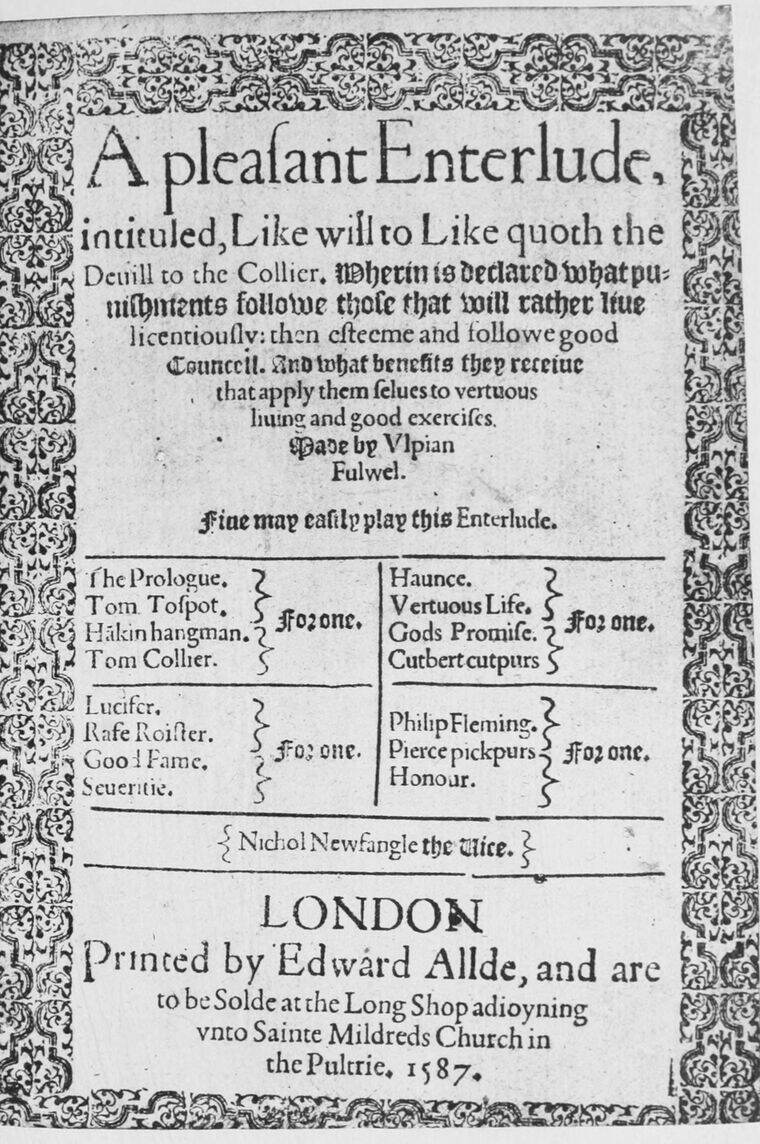
Edward Allde’s 1587 printing of Ulpian Fulwell’s Like Will to Like sets its division in four ruled boxes, each closed by a brace and For one.
, with the Vice, Nichol Newfangle, in a fifth line of his own. The top right box is Haunce, Virtuous Life, God’s Promise and Cuthbert Cutpurse. Near the end of the play, Honour crowns Virtuous Life (I crowne you with it as one moste woorthy,
) and proposes a song: Let vs three sing vnto God with one accord.
God’s Promise answers To sing praises vnto God it liketh wel me:
, Virtuous Life answers him in the next line, And I also with you therto doo agree.
, and the direction reads They sing this song following.
No one man can be both. The bottom left box has a smaller fault: Ralph Roister and Severity are one man, and the direction that takes Roister off brings Severity on in the same breath, Rafe roister and Tom Tospot goeth out, and Seueritie the Iudge entreth
, with no line between, so the change would have to be made in silence while Nichol Newfangle lieth on the ground groning.
The number survives its division. The text allows Like Will to Like to be played by four, in 24 ways that each leave a line for every change, and a division into five can leave every change 30 lines. The board’s “As printed” shows the boxes as Allde set them; move God’s Promise and see what it costs.
Foure may easely play this Playe
Two promises cannot be kept by their texts at all, even if every change may be silent. Wealth and Health, printed about 1565, lists seven players and promises Foure may easely play this Playe.
W. J. Lawrence saw in 1927 that four could not play it, since at one particular juncture Health, Wealth, Liberty, Ill Will, and Shrewd Wit, five characters in all, occupy the stage at once
; he thought the promise designedly mendacious
, and the play first acted by five. Its text needs at least six, because Good Remedy meets each of those five as well. The proof is six parts, every two of which the text keeps apart, and a company needs a man for each of them. Only Hance, the Fleming, can share a player, with any of three of the others.
| Part | 1 | 2 | 3 | 4 | 5 | 6 |
|---|---|---|---|---|---|---|
| 1. Wealth | back to back at line 16 | back to back at line 200 | back to back at line 280 | back to back at line 664 | back to back at line 532 | |
| 2. Health | back to back at line 16 | back to back at line 212 | on stage together at line 672 | back to back at line 471 | back to back at line 567 | |
| 3. Liberty | back to back at line 200 | back to back at line 212 | back to back at line 296 | on stage together at line 680 | back to back at line 525 | |
| 4. Ill Will | back to back at line 280 | on stage together at line 672 | back to back at line 296 | back to back at line 370 | back to back at line 604 | |
| 5. Shrewd Wit | back to back at line 664 | back to back at line 471 | on stage together at line 680 | back to back at line 370 | back to back at line 612 | |
| 6. Good Remedy | back to back at line 532 | back to back at line 567 | back to back at line 525 | back to back at line 604 | back to back at line 612 |
Lewis Wager’s The Life and Repentance of Mary Magdalene, printed in 1566, promises Foure may easely play this Enterlude.
Its editor, F. I. Carpenter, wrote in 1902 that “Foure” is obviously a misprint for five
, and E. K. Chambers gave it as intended for four [five] actors
. The text agrees: it needs five, and again the proof is a set of parts that clash pairwise, here five: Infidelity the Vice; Mary Magdalene; Simon the Pharisee; Malicious Judgement; Christ Jesus.
| Part | 1 | 2 | 3 | 4 | 5 |
|---|---|---|---|---|---|
| 1. Infidelity the Vice | back to back at line 162 | back to back at line 1,659 | on stage together at line 1,067 | back to back at line 1,319 | |
| 2. Mary Magdalene | back to back at line 162 | back to back at line 1,951 | back to back at line 1,935 | on stage together at line 1,763 | |
| 3. Simon the Pharisee | back to back at line 1,659 | back to back at line 1,951 | back to back at line 929 | back to back at line 1,571 | |
| 4. Malicious Judgement | on stage together at line 1,067 | back to back at line 1,935 | back to back at line 929 | back to back at line 1,579 | |
| 5. Christ Jesus | back to back at line 1,319 | on stage together at line 1,763 | back to back at line 1,571 | back to back at line 1,579 |
Go out. Enter Horestes
Three printed divisions ask for changes with no line spoken, at moments when the print sets a direction and something is happening on stage. John Pickering’s Horestes (1567) prints The names deuided for vi. to playe.
and lists Idumeus twice, for the second player and for the fifth. Its text allows six only if some change is silent (that way it allows four); with a line for every change it needs seven. Given to the second player alone, Idumeus and Menelaus speak to each other with no line between. Given to the fifth alone, the division needs two silent changes. Alois Brandl read the double listing in 1898 as a hand-over, eine Rolle, die des Idumeus, unter zwei Darsteller aufgetheilt
(one part, Idumeus, divided between two players): the second plays him early and the fifth late. Read that way, with the second player taking Idumeus up to line 537 and the fifth from line 947, every change but one has at least 22 lines. Brandl found time to change everywhere, obwohl öfters nur durch einige Verse
(though often only a few lines). The one is the first player’s: the Vice, Revenge, goes out (Go out.
) at the moment the court comes in, Enter Horeſtes & Hermione Nobilytye and Cominyalte truth & Dewty
, and Duty, who comes in with it, is the same man’s part.
W. Wager’s Enough is as Good as a Feast (about 1570) promises Seuen may eaſely play this Enterlude.
The text allows seven, and even six with a line for every change, but not the printed division. Its third player is Contentation, Temerity, Ignorance and Satan, and near the end Satan claims Worldly Man for hell (Come on mine owne Boy, go thou with me,
). The direction is Bear him out vp on his back.
, and the next line is Contentation’s: He that toucheth pitch, ſhalbe defiled with the ſame,
. There are eight ways to mend it by moving one part to another player, and the roomiest gives Contentation to the seventh player, the Vice’s, leaving every change 10 lines.
Thomas Preston’s Cambises (about 1570) heads its table The diuiſion of the partes.
and divides 38 of the play’s 40 speaking parts among eight men; the two it leaves out are a waiting maid and Hob’s wife, Marian-may-be-good. The text allows six, but the printed division asks for two silent changes. The King dies, the stage clears at Exeūt. All
, and the man who played him must at once be the Epilogue (an epilogue may need no costume). And the fifth player is Cruelty and the First Lord. In the scene in which the Queen is condemned, Cruelty and Murder answer the King together, With couragious harts (O King) we will obey:
; the King turns to his lords, Then come my Lords let vs departe away.
; the two lords answer, With heuy harts we wil doo all, your grace dooth ſay,
; and at Exeunt king, & Lords
Cruelty speaks again. By the check he has at most a line to become the Lord, and none to become Cruelty again. Nothing printed takes either of them off before that exit.
For one man
Seven printed divisions give every player at least a line for every change, and two of them do it with almost nothing to spare. John Bale’s Three Laws (about 1548; its imprint says 1538), the oldest of the fourteen, prints its division at the end of the book, Into fyue personages maye the partes of thys Comedy be deuyded.
, and gives its fifth player God and God’s vengeance: Deus pater. Vindicta Dei The fift.
Vindicta Dei drives Infidelity out with fire (Ignis flamma Infidelitatem locum exire coget
), Infidelity has two lines on his way to the devil (Credo, credo, credo, I saye, Credo, credo, credo,
), and God the Father speaks: As ye haue seane here, how I haue strycken with fyre
. The change has 2 lines, and God speaks of the vengeance as his own. W. J. Lawrence, who took Bale’s table for a mere list of the dramatis personae
, worked it out as an allotment in 1927 and found it was impossible to double some of the characters grouped together in one or two of the divisions
. He did not say which, and the text does not bear him out: held to its speeches and printed directions, every one of Bale’s five has at least two lines for every change, and the tightest is this one.
Impatient Poverty (about 1561) gives its third player Impacient pouerte, Proſperyte, & pouerte, for one.
, one man in three fortunes, and makes its tightest change in front of the audience. Peace hands him a garment, Holde this veſture and put it on thee
/ From henceforth thou ſhalt be called proſperytie
, and 3 lines after Impatient Poverty’s last, Prosperity thanks him: I thanke god and you I am in felicite
.
At the other end, The Trial of Treasure (1567) does what Wapull did: its tightest change has 18 lines, and no division into five can give every change more than 18 (64 divisions tie). The others hold with room they did not use. Thomas Garter’s Susanna (1578) leaves 16 lines where 20 were possible; Nathaniel Woodes’s The Conflict of Conscience (1581) leaves 6 where 44 were; and Mucedorus (1598), whose list stands on the back of its title page, leaves 35 where 119 were.
ffoure men and a boy Sir
In the manuscript play of Sir Thomas More (British Library, Harley MS 7368), the Lord Cardinal’s players come to More’s house to offer him a play, and More asks how manie are ye ?
The player answers ffoure men and a boy Sir.
, and More, told that the boy plays all three women: And one boy play them all ? bir Lady, hees loden.
Their repertory includes impacient pouertie
and Lustie Iuuentus
, two of the fourteen, and the interlude they play for him is, as W. W. Greg noted in his 1911 edition, a somewhat altered version of a scene from Lusty Juventus
. Partway through, the company stops: fforsooth we can goe no further, till our fellowe Luggins come,
because Luggins plays Good Counsel and has run to the wigmaker’s for a beard. More plays Good Counsel himself until he comes back. In Lusty Juventus, Good Counsel is the part that four men can manage only with a change that has no line in it.
Who the printed numbers were for is an old argument. E. K. Chambers took Four men and a boy
to be a normal troupe, and thought that the early printed moralities were in the main not drawn from the actual repertories of companies, but were literary products, written with a didactic purpose, and printed in the hope that they would be bought both by readers and by schoolmasters in search of suitable pieces for performance by their pupils
. Lawrence answered that there is no reason to doubt that what was stated as practicable on these tables had already been done
. Woodes offers his six parts as moſt conuenient for ſuch as be diſpoſed, either to ſhow this Comedie in priuate houſes, or otherwiſe
. The check cannot say who bought these books or who acted from them. It can say which of the numbers their texts allow.
What the check cannot see
- Exits and entrances the print leaves out. The check never supplies them, so every change it measures is at most that long, and every count of players is at least that many. A division it passes may still have been impossible on the day. When it finds two parts on at once, or one answering the other with nothing printed between, no unprinted exit can help.
- Time that is not speech. A song, a fight, a dumb show or a procession takes time that no line counts. Where the print sets a direction, the check allows a change of no lines at all, and calls it silent.
- Headings it had to read. A speech whose heading is missing, damaged or shared (
Bothe.
) was read by hand, one at a time, each reading with its reason, shown on the board: 296 speeches read or corrected that way. 74 could not be settled, or are spoken from off stage, and put nobody on stage. In Susanna, the transcription has almost no speech headings on the left-hand pages, where only the ends of a few survive at the margin, and those speeches were read from the dialogue. - The clock. Time is counted in the transcription’s verse lines; prose and directions set as verse were counted at the play’s usual words to a line.
- The editions. Each play is read in the edition the Text Creation Partnership transcribed: Like Will to Like in its 1587 edition, not the first of 1568; Cambises in John Allde’s edition of about 1570, whose division of the parts matches, cell for cell, the later edition’s photographed by Farmer.
- The plays not found. The fourteen are the plays in which a search of the Text Creation Partnership’s transcriptions finds a casting promise. The search takes the texts dated 1500 to 1610 whose catalogue entries carry a playbook’s word in the title or drama in the subject terms. It is published beside the check (
search.mjs); run, it lists every text it hits, with the words around each hit in the front or back matter or the opening of the play, for a reader to judge. That rule missed at least one: The Fayre Mayde of the Exchange (1607), whose entry carries neither, printsEleauen may easily acte this Comedie.
, and E. K. Chambers names it. It is Jacobean, later than the fourteen, and is not checked here. Five more plays of the time print such a promise and are not among the transcriptions, so they are not here: King Darius (Syxe perſons may eaſely play it.
), The Longer Thou Livest (Foure may playe it eaſely.
), New Custom (Fower may Play this Enterlude.
), Common Conditions (Six may play this Comedie.
) and Patient Grissell (Eight perſons maye eaſely play this Commody.
). Their editors have doubted several of them: the Malone Society’s editors of Patient Grissell called its arrangementfaulty
.
The check
verify-four-may-play-it.mjs needs only Node. From an empty directory it downloads this page, data.json and the board’s engine.mjs, recomputes every figure on the page with its own arithmetic (it measures the gap between every two marks of every two parts, where the board walks each player’s marks in order), and fails if a sentence, a table cell or a grid says otherwise. With --online it also fetches the fourteen transcriptions from the Text Creation Partnership, checks them against the hashes the data records, and finds in them every quotation this page takes from the plays.
curl -sSO https://artwaste.land/checks/verify-four-may-play-it.mjs
node verify-four-may-play-it.mjs --online
The data holds, for every speech, its first words, its heading as transcribed and, where the heading had to be read, the reading and its reason; for every direction, its words and who it names.
Sources
- The fourteen plays, in the transcriptions of the Text Creation Partnership (EEBO-TCP, released under Creative Commons 0), each with its STC number:
- Three Laws, John Bale (c. 1548; STC 1287): EEBO-TCP A02738
- Impatient Poverty, Anonymous (c. 1561; STC 14113): EEBO-TCP A04055
- Wealth and Health, Anonymous (c. 1565; STC 14110): EEBO-TCP A04052
- Lusty Juventus, R. Wever (c. 1565; STC 25149.5): EEBO-TCP A14846
- The Life and Repentance of Mary Magdalene, Lewis Wager (1566; STC 24932): EEBO-TCP A14625
- The Trial of Treasure, Anonymous (1567; STC 24271): EEBO-TCP A13962
- Horestes, John Pickering (1567; STC 19917): EEBO-TCP A09651
- Cambises, Thomas Preston (c. 1570; STC 20287): EEBO-TCP A10041
- Enough is as Good as a Feast, W. Wager (c. 1570; STC 24933): EEBO-TCP A14627
- The Tide Tarrieth No Man, George Wapull (1576; STC 25018): EEBO-TCP A14715
- The Most Virtuous and Godly Susanna, Thomas Garter (1578; STC 11632.5): EEBO-TCP A01509
- The Conflict of Conscience, Nathaniel Woodes (1581; STC 25966.5): EEBO-TCP A68918
- Like Will to Like, Ulpian Fulwell (1587; STC 11474): EEBO-TCP A01353
- Mucedorus, Anonymous (1598; STC 18230): EEBO-TCP A07859
- John S. Farmer, ed., Tudor Facsimile Texts: the title pages of The Tide Tarrieth No Man (1910) and Like Will to Like (1909) shown here, from the Internet Archive’s scans of the University of Toronto’s copies, whose records mark them not in copyright in the United States.
- W. W. Greg, ed., The Book of Sir Thomas More, Malone Society Reprints, 1911: pp. xix, 31, 32, 37 and 38.
- E. K. Chambers, The Mediaeval Stage, 1903, vol. II, p. 188; The Elizabethan Stage, 1923, vol. III, pp. 179 and 504.
- W. J. Lawrence, Pre-Restoration Stage Studies, 1927, chapter III, “The Practice of Doubling and its Influence on Early Dramaturgy”, pp. 46 to 52.
- Alois Brandl, Quellen des weltlichen Dramas in England vor Shakespeare, 1898, p. xcvii.
- F. I. Carpenter, ed., Lewis Wager, The Life and Repentaunce of Marie Magdalene, 1902, pp. xiv to xv.
- [R. B. McKerrow and W. W. Greg, eds.], John Phillip, The Play of Patient Grissell, Malone Society Reprints, 1909, p. xiii; Tucker Brooke, ed., Common Conditions, 1915; and the Tudor Facsimile Texts of King Darius (1909), The Longer Thou Livest (1910) and New Custom (1908), for the five promises not transcribed.