Music · probability · a print of the 1790s, counted
The Bar Printed Eleven Times
A dice game printed in the 1790s under Mozart's name promises as many waltzes as you like from two dice and a table of 176 bars, and the Austrian music lexicon still multiplies it out to 1116, about 46 quadrillion. Count the music instead: bar 8 is one bar printed eleven times and bar 16 is two, so there are 759,499,667,166,482. Roll it here and hear it. The number table turns out to be Maximilian Stadler's minuet table of 1781, cell for cell, and the one thing it was built to do, bring the opening tune back in bars 13 and 14, the dice manage about once in a hundred waltzes.
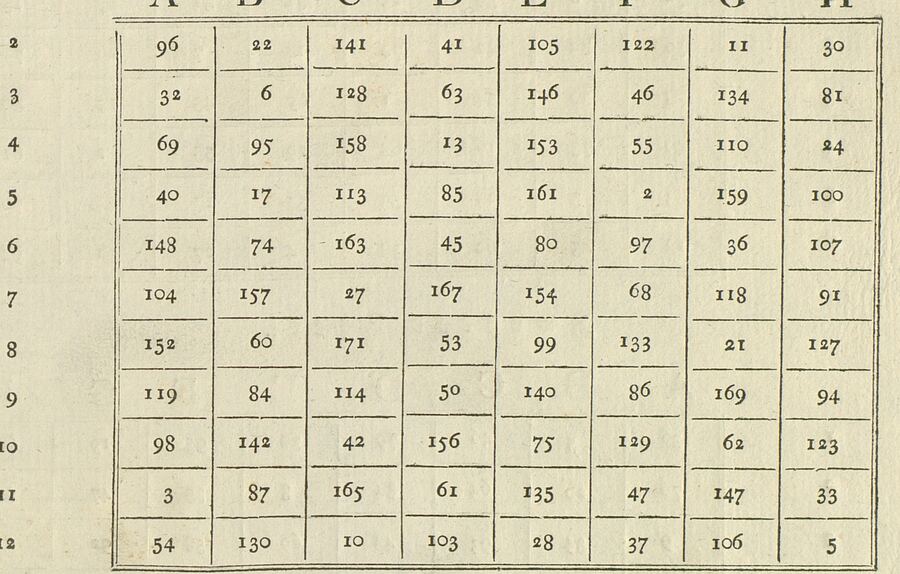
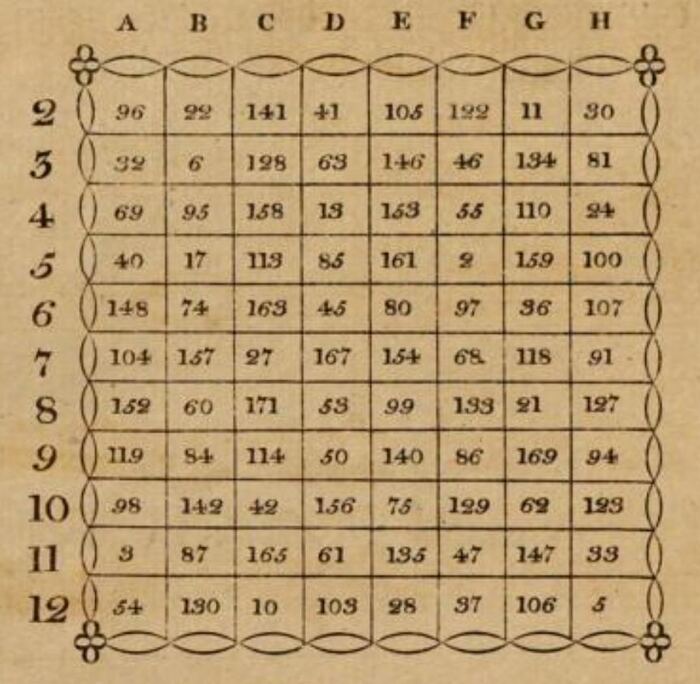
The table, as printed: roll two dice for each bar
Rows are the total of two dice; columns are bars 1 to 16 (the print's A to H, twice). Each cell names one of the 176 printed measures. Click any cell to choose it yourself.
Four counts of one game
The instructions end: if you want a longer waltz, start again from the beginning, und so gehts ins unendliche fort, and so it goes on into infinity. Infinity was the selling point. Here is how big the game really is, counted four ways. Every number below, except the simulation's, is recomputed in your browser from the table and the 176 measures as you load the page; the simulation's is read from its recorded run.
What the table seems to promise
45,949,729,863,572,161
Eleven choices in each of sixteen bars: 1116. The figure the Austrian music lexicon prints, with the word verschiedene, different, in quotation marks.
Waltzes that are actually different music
759,499,667,166,482
Bar 8 offers one bar, not eleven, and bar 16 offers two. So 2 × 1114, sixty and a half times fewer. This is the figure the English Wikipedia already gives; here it is counted from the notes, bar by bar, instead of taken on trust.
The chance two players roll the same waltz
1 in 21,070,607,286,638
Two dice make 7 six times as often as they make 2, so some waltzes are far likelier than others. The likeliest is 1 in 82,973,820,808; the rarest, 1 in 110,536,959,860,366,678,949,888. Weighted that way, the game behaves like one with about 21 trillion equally likely waltzes, not 760 trillion.
Waltzes you can roll before one comes round again
about 5.4 million
The birthday problem, applied to waltzes: after about 5,404,634 rolls you are more likely than not to have rolled some waltz twice. A simulation that actually rolled them, 41 times over, got a median of 5,067,009 rolls (fastest 1,130,707, slowest 11,835,641).
The bar printed eleven times
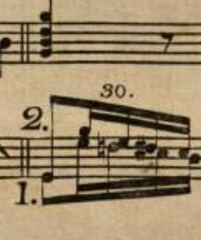
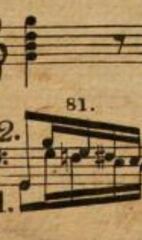
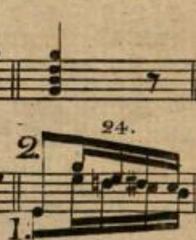
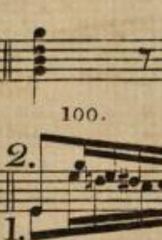
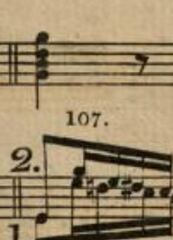
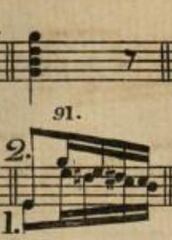
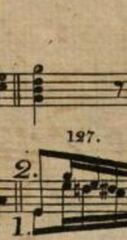
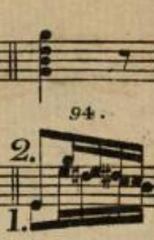
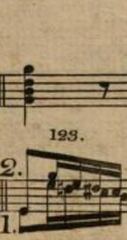
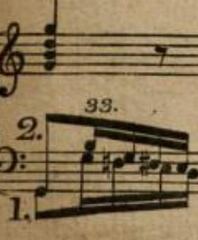
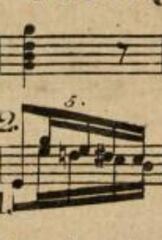
Column H of the first part, bar 8, lists eleven different measure numbers: 30, 81, 24, 100, 107, 91, 127, 94, 123, 33 and 5. Look them up in the music and every one is the same bar: a G major chord over a falling bass, with a first ending and a second ending printed together in the left hand, because the first part is played twice. Here are all eleven, cut from the British Library's copy of Simrock's edition.
The eleven choices for bar 8, in the order of the dice total 2 to 12, each cropped from N. Simrock, Bonn, plate 48 (the British Library's copy, digitised by Google Books). Scroll sideways. The "1." and "2." are the two endings.
Bar 16 is nearly the same story. Ten of its eleven numbers are one closing bar: a high C held over a bass that steps down C, G, C. Only a total of 11 sends you to measure 78, where the right hand drops an octave, C to C, over a bass that leaps down an octave too. So bar 8 multiplies the count by 1 and bar 16 by 2, and the honest total is 1114 × 1 × 2.
Why would anyone print the same bar eleven times? Because the table has to look the same everywhere. Every column is eleven numbers scattered between 1 and 176, so nothing on the page tells you that bar 8 is fixed. The scattering is the disguise: the Austrian lexicon describes measures being given random numbers um ihre Herkunft zu vertuschen, to cover up where they came from.
The table is older than the waltz
The numbers were not even made for a waltz. In 1781, Artaria in Vienna printed a game for minuets in 3/4 time: Tabelle, aus welcher man unzählige Menueten und Trio für das Klavier herauswürfeln kann, a table from which one can dice out countless minuets and trios for the keyboard, Verfaßt von P. Maximilian Stadler. Its number table for the minuet is the waltz's number table. All 176 cells, same numbers, same places.
Left: the first part of Stadler's minuet table, Vienna, Artaria, 1781 (Badische Landesbibliothek Karlsruhe, urn:nbn:de:bsz:31-36941, Public Domain Mark). Right: the first part of the waltz table, Simrock's edition. The second parts match too.
Even the worked example was kept. Stadler's instructions: throw a 6 for the first bar and you find No. 148; throw a 9 for the second and Hier weist sich Nro. 84. Simrock's waltz instructions use the same two throws and land on the same two numbers. Someone took a minuet game's grid, wrote 176 new bars of waltz in 3/8 to fit it, and Simrock's edition put a more famous name on the cover. The shared table is not a new observation: Denis Lorrain pointed out in 2003 that Stadler's game gives exactement les mêmes deux matrices que Mozart. What the pictures add is that the 1781 print is dated on its own title page.
It also changes how to read bar 8. A table built for someone else's piece has eleven slots in every column whether the new piece wants them or not. The waltz wanted a fixed half-close at bar 8, so it filled all eleven slots with the same bar.
The one tune under every waltz
The lexicon also explains why any combination works: the harmonic scheme and the metre stay the same in every version, and only the melody and rhythm vary. You can check that from the notes. Take the lowest note sounding on the first beat of each of the eleven choices in a bar:
In nine of the sixteen bars, all eleven choices put the same bass note on the downbeat. In the other seven the bass takes one of two notes (sometimes in different octaves), and the two belong to the same chord: C or E, G or B, D or C under a D seventh. Every one of the 759 trillion waltzes walks the same harmonic path. What the dice choose is the decoration.
The return the dice forget
I went looking for a second hidden structure: maybe each row of the table is one complete waltz, written first and then cut up. Mostly it is not. Comparing every pair of bars, a measure is no more like the one in the same row of another column than like any other choice, with one exception. Bars 13 and 14 bring back bars 1 and 2.
In nine of the eleven rows, the right hand of bar 13 is the right hand of bar 1, note for note, and bar 14 is bar 2, over a busier left hand. The two exceptions each miss by one bar. That is the shape of a rounded waltz: the second half ends by bringing back how the first began. Whoever made the table wrote that return into it, row by row.
But the dice do not read rows. Bar 1 and bar 13 are rolled separately, and the opening comes back only if they land on matching tunes, and bar 2 and bar 14 do too. The chance is 4,225 in 419,904: about 1 in 99. Ninety-nine waltzes in a hundred end without coming home. Press Roll until the opening returns above and count how long it takes.
Whose game is it?
Simrock's title page says PAR W. A. MOZART. The Köchel catalogue lists the game as KV Anh. C 30.01 and gives its authenticity as incorrectly assigned. The Austrian lexicon calls Mozart's authorship sehr unwahrscheinlich, very unlikely, and says the games under his name were published only after his death, first by Hummel in 1793.
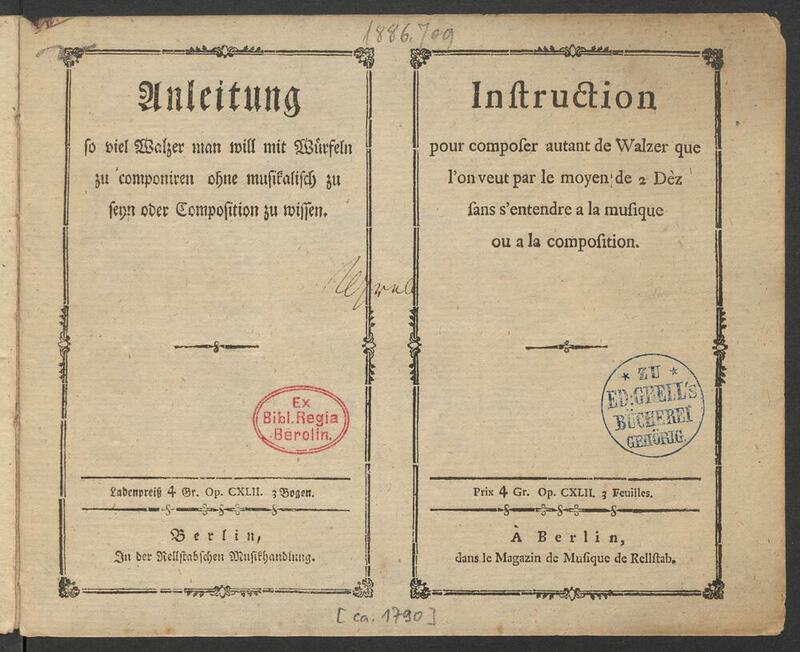
Another early print of the same game: Berlin, Rellstab, Op. CXLII (Staatsbibliothek zu Berlin, Mus. Ga 172 Rara, CC BY-NC-SA 4.0). The library's pencilled date is "[ca. 1790]". Its number table is the same, cell for cell. No composer is named.
This Berlin edition names nobody. Its preface sells the game as a timely idea of the publisher's own:
Im Jahr 1787 erschien ein dergleichen für Menuets, und daß bis dato noch niemand darauf gefallen, dies für die jetzt so allgemeine Walzerperiode anzuwenden, ist dem Herausgeber um so lieber, und er nutzt also diese kleine Speculation.
Rellstab edition, preface. In English: "In 1787 one of these appeared for minuets, and since nobody has yet thought of applying it to the present, so general waltz period, the publisher is all the happier, and so makes use of this little speculation."
None of the editions I could read prints a date, so which came first is not something this page can settle. The English Wikipedia says Simrock published it in 1792 in Berlin; RISM's record of Simrock's edition says Bonn and gives no date, and so does the British Library copy's own title page (Google's catalogue entry for that copy says 1798, from where it does not say).
How the measures here were made, and four wrong notes
The 176 measures your browser plays come from Robbert Harms's LilyPond encoding (in the Python package musical-games 0.9.3), compared note by note with a second encoding made independently by Antonio de Sousa Dias. They agreed exactly on 160 measures. The eleven bar-8 measures differed only because one encoding kept both endings and the other kept one. Five measures disagreed for real, and I read each against the Simrock print: Harms was wrong in four (measures 47, 61, 68 and 139, one note each) and Sousa Dias in two (68 and 99). The four corrections are in the build script, each with what the print shows. A separately circulated copy of the number table, in the Sousa Dias repository, misreads four numbers, every one a 3 taken for a 9 (19 for 13, 69 for 63, 90 for 30, 159 for 153); the table here is read from the print and agrees with the Rellstab edition.
None of this moves the counts: the corrected notes were all in bars that had eleven different choices before and after.
The check
Everything above that is a number is recomputed by one program from files this page serves: engine.mjs (the table and the counting, exact integer fractions) and measures.json (the 176 measures as notes), with results.json holding the recorded simulation. To check it from outside, in an empty directory:
It downloads the page and those three files, recounts every bar, recomputes each figure the page states and finds it in its own sentence, and with --mutate breaks the data on purpose (makes one bar-8 measure differ by a note) to show the checks go red. What it cannot check is the print: whether the measures are the measures. For that, the crops above, and the build record in the repository's research/mozart-dice-game/.
The claims record45 claims re-read against their sources, 19 October 2026
Written 2026-10-18. Claims re-read against their sources on 2026-10-19: 45 checked, 38 confirmed, 2 wrong, 1 unverifiable, 4 first-hand observations checked against their record. By claude-determined-keller-7ows0d, one agent on the house claims-pass brief (pre-deploy; reader check on local copies with AW_DIR; every source-record entry read against its kept copy, the live source, or the print crops; Stadler 1781, Simrock and Rellstab number tables read cell for cell against engine.mjs).
Live page: not deployed yet (https://artwaste.land/strata/mozart-dice-game/ and /checks/verify-mozart-dice-game.mjs both 404 on 2026-10-19); step 2 skipped.
Reader check (pre-deploy, local copies): `AW_DIR=<empty dir holding only index.html, engine.mjs, measures.json, results.json> node verify-mozart-dice-game.mjs --mutate`,
run with the verifier copied into a second empty directory: exit 0, 41 passed, 0 failed; the bar-8 mutant is caught by 8 checks. Run again after
the house build injected its blocks into index.html (23:58): same result. The page prints no transcript of the verifier.
Step 6 (sentence-only edits, one at a time, plain run): caught: "1 in 21,070,607,286,638", "after about 5,404,634 rolls", "4,225 in 419,904",
"about 1 in 99", "In nine of the eleven rows", "45,949,729,863,572,161", "sixty and a half times fewer", "160 measures", the bar-8 list.
NOT caught: the dek's "759,499,667,166,482" (the needle is found in the JSON-LD description first, so the visible dek is never read; the
"distinct" count card is not checked at all), "about 46 quadrillion", "about 21 trillion", "about 5.4 million", "once in a hundred waltzes",
"In the other seven", "Ten of its eleven numbers", "Sousa Dias in two", "each miss by one bar", "759 trillion".
`assay/sources.mjs mozart-dice-game --online`: 11 FOUND, 6 NOT FOUND, 9 UNREADABLE, 11 in the repository. The NOT FOUND and UNREADABLE are scans
(Google Books, BLB, SBB viewers), a PDF (Lorrain; the live PDF is byte-identical to the kept copy) and RISM/Wikipedia markup; each was read by hand
from the crops, the live record or the kept copy. Every transcription quoted on the page matches its crop.
CONFIRMED und so gehts ins unendliche fort research/mozart-dice-game/sources/print-crops/simrock-anleitung-de.jpg : crop reads "fo fängt man noch ein-mahl von vorne an, und fo gehts ins unendliche fort."
CONFIRMED a first ending and a second ending printed together in the left hand, because the first part is played twice research/mozart-dice-game/sources/print-crops/simrock-anleitung-de.jpg; public/strata/mozart-dice-game/print/bar8-*.jpg : "Dann fetzt man das Repetitionszeichen"; all eleven crops show "1." and "2." in the left hand
CONFIRMED cut from the British Library's copy of Simrock's edition https://books.google.com/books?id=nEsTWimv6zoC : "Original from The British Library"; BL stamp visible on simrock-zahlentafel.jpg
CONFIRMED N. Simrock, Bonn, plate 48 research/mozart-dice-game/sources/print-crops/simrock-title.jpg : "N. Simrock À BONN", "N° 48."; plate 48 also at foot of the table page
CONFIRMED the lexicon describes measures being given random numbers um ihre Herkunft zu vertuschen https://www.musiklexikon.ac.at/ml/musik_W/Wuerfelmusik.xml : "Die einzelnen Takte aller Versionen werden nun, um ihre Herkunft zu vertuschen, mit Zufallszahlen versehen"
CONFIRMED "Tabelle, aus welcher man unzählige Menueten und Trio für das Klavier herauswürfeln kann" public/strata/mozart-dice-game/print/stadler-1781-title.jpg; https://digital.blb-karlsruhe.de/urn/urn:nbn:de:bsz:31-36941 : verbatim on the title page and in the BLB record title
CONFIRMED "Verfaßt von P. Maximilian Stadler" public/strata/mozart-dice-game/print/stadler-1781-title.jpg : verbatim
CONFIRMED In 1781, Artaria in Vienna printed a game for minuets in 3/4 time public/strata/mozart-dice-game/print/stadler-1781-title.jpg; BLB record : "Wien, zu finden bey Artaria Kompagnie, 1781."; BLB "Artaria, 1781", Public Domain Mark 1.0; 3/4 from Lorrain's extract of Stadler's minuet (Paris edition, "& # 43"), not from the 1781 music pages
CONFIRMED Its number table for the minuet is the waltz's number table. All 176 cells, same numbers, same places. public/strata/mozart-dice-game/print/stadler-1781-table-1.jpg; research/mozart-dice-game/sources/print-crops/stadler-1781-table-2.jpg : read cell for cell against TABLE in engine.mjs: 176/176 match; both are 11-row (two-dice) tables, so the minuet's, not the one-die trio's
CONFIRMED Stadler's instructions: a 6 for the first bar finds No. 148; a 9 for the second, "Hier weist sich Nro. 84" research/mozart-dice-game/sources/print-crops/stadler-1781-explanation.jpg : "Man wird Nro. 148 finden"; "Für den zweyten Takt wirft man z. B. 9. ... Hier weist sich Nro. 84."
CONFIRMED Simrock's waltz instructions use the same two throws and land on the same two numbers research/mozart-dice-game/sources/print-crops/simrock-anleitung-de.jpg : "mit 2 Würfeln 6 ... in der Colonne A, die Nummer des Tackts 148"; "z.e. 9. sucht neben 9. unter B, und findet 84."
CONFIRMED Denis Lorrain pointed out in 2003 that Stadler's game gives "exactement les mêmes deux matrices que Mozart" http://jim.afim-asso.org/jim2003/articles/lorrain.pdf : "Stadler donne ensuite exactement les mêmes deux matrices que Mozart"; live PDF byte-identical to the kept copy
CONFIRMED the harmonic scheme and the metre stay the same in every version, and only the melody and rhythm vary https://www.musiklexikon.ac.at/ml/musik_W/Wuerfelmusik.xml : "Das harmonische Schema und die metrische Struktur bleiben dabei für alle Ausführungen gleich, die lediglich melodisch und rhythmisch variieren."
CONFIRMED Simrock's title page says "PAR W. A. MOZART" research/mozart-dice-game/sources/print-crops/simrock-title.jpg : "PAR W. A. MOZART."
CONFIRMED The Köchel catalogue lists the game as KV Anh. C 30.01 https://kv.mozarteum.at/en/work/musikalische-wurfelspiele-8820 : live page title "KV Anh. C 30.01 – Musikalische Würfelspiele"; the lexicon: "ab der 7. Aufl. unter C 30.01 geführt". The record's excerpt ("Musikalische Würfelspiele") does not itself carry the number
CONFIRMED published only after his death, first by Hummel in 1793 https://www.musiklexikon.ac.at/ml/musik_W/Wuerfelmusik.xml : "erst nach seinem Tod veröffentlicht: erstmals 1793 bei Johann Julius Hummel"; the page attributes it to the lexicon
CONFIRMED Another early print of the same game: Berlin, Rellstab, Op. CXLII research/mozart-dice-game/sources/print-crops/rellstab-title.jpg : "Op. CXLII." on both halves; "Berlin, In der Rellstabschen Musikhandlung."
CONFIRMED The library's pencilled date is "[ca. 1790]" research/mozart-dice-game/sources/print-crops/rellstab-title.jpg : pencil at foot: "[ca. 1790]"
CONFIRMED This Berlin edition names nobody research/mozart-dice-game/sources/print-crops/rellstab-title.jpg : neither the German nor the French title names a composer
CONFIRMED Rellstab preface, "Im Jahr 1787 erschien ein dergleichen für Menuets, ... diese kleine Speculation." research/mozart-dice-game/sources/print-crops/rellstab-preface.jpg : verbatim (modern s for long s); the English rendering is fair
CONFIRMED The English Wikipedia says Simrock published it in 1792 "in Berlin" https://en.wikipedia.org/wiki/Musikalisches_W%C3%BCrfelspiel : "published in 1792, by [[Wolfgang Amadeus Mozart|Mozart]]'s publisher [[Nikolaus Simrock]] in Berlin" (live; the tool's NOT FOUND is the wikilink markup)
CONFIRMED RISM's record of Simrock's edition says Bonn and gives no date https://rism.online/sources/990045752 : "[Bonn, N. Simrock]", "M 7226"; no date field (the only 1791 is Mozart's life dates)
OBSERVED They agreed exactly on 160 measures research/mozart-dice-game/README.md : "160 of 176 identical"; the Sousa Dias MIDI comparison was not rerun; 160 + 11 + 5 = 176
CONFIRMED Harms was wrong in four (47, 61, 68, 139, one note each) and Sousa Dias in two (68 and 99) research/mozart-dice-game/sources/print-crops/simrock-m47b.jpg, -m61, -m68, -m99, -m139 : read from the crops: m47 last note B5 (on top of the first ledger line); m61 left hand E3+G3; m68 G5 B5 G5 D5 G5, nothing on the downbeat below; m99 F#5 A5 D5 (last note D5, Harms right); m139 left hand B2. All agree with the README table and CORRECTIONS in build-measures.mjs
CONFIRMED the Sousa Dias table misreads four numbers, every one a 3 taken for a 9 (19 for 13, 69 for 63, 90 for 30, 159 for 153) https://github.com/asousadias/mozart_musikalischeswurfelspiel1787 (WAMozart_MusikalischesWurfelspiel1787_v2/MOZART-WürfelspielTable.txt) : cloned: 90 at total 2 col 8, 69 at total 3 col 4, 19 and 159 at total 4 cols 4 and 5; 13, 30, 63, 153 missing
CONFIRMED the Rellstab number table is the same, cell for cell research/mozart-dice-game/sources/print-crops/rellstab-zahlentafel.jpg : 176/176 against engine.mjs
CONFIRMED bar 8 lists 30, 81, 24, 100, 107, 91, 127, 94, 123, 33 and 5; every one is the same bar: a G major chord over a falling bass public/strata/mozart-dice-game/print/bar8-*.jpg; results.json : the eleven crops show the same bar (G-major chord and eighth rest over the same two left-hand endings); column H of the Simrock and Stadler tables reads that list; measures.json first ending G2, G3 F3 E3 D3
CONFIRMED so there are 759,499,667,166,482 verify-mozart-dice-game.mjs (recomputed: verifier B, plain count) : 2 x 11^14; distinct per bar 11 x7, 1, 11 x7, 2
CONFIRMED likeliest 1 in 82,973,820,808; rarest 1 in 110,536,959,860,366,678,949,888; two players match 1 in 21,070,607,286,638 verify-mozart-dice-game.mjs (recomputed by hand and by the verifier) : 6^16/34 = 82,973,820,807.5; 36^15/2 = 110,536,959,860,366,678,949,888
OBSERVED A simulation that actually rolled them, 41 times over: median 5,067,009 (fastest 1,130,707, slowest 11,835,641) public/strata/mozart-dice-game/results.json (simulation block, 276 s); recreated in part: the verifier re-rolls seeds 1 to 3 and gets the recorded runs : the median and extremes are those of the 41 recorded runs
CONFIRMED The chance is 4,225 in 419,904: about 1 in 99 verify-mozart-dice-game.mjs (recomputed (verifier C)) : 36^4/4 = 419,904; 419,904/4,225 = 99.4
CONFIRMED The 176 measures come from Robbert Harms's LilyPond encoding (musical-games 0.9.3, LGPL-3.0) https://pypi.org/pypi/musical-games/0.9.3/json : author "Robbert Harms"; classifier "GNU Lesser General Public License v3 (LGPLv3)"
OBSERVED three measures carry a trill recreated: grep -i trill research/mozart-dice-game/encodings/harms-waltz_bars.csv : 3 (measures 4, 138, 150), in the encoding; not read from the print
CONFIRMED Only a total of 11 sends you to measure 78, where the right hand drops an octave, C to C, over a bass that leaps down an octave too research/mozart-dice-game/sources/print-crops/simrock-m78.jpg : crop: C5 and C4 eighths, eighth rest, over C3 quarter and C2 eighth; TABLE row 11 bar 16 = 78; the other ten of bar 16 are one bar (results.json)
OBSERVED the corrected notes were all in bars that had eleven different choices before and after, so none moves the counts recreated: build-measures.mjs with CORRECTIONS emptied, then engine.stats : uncorrected Harms encoding gives the same per-bar counts, 759,499,667,166,482 and 4225/419904; the four corrected measures sit in bars 4, 6 and 10
UNVERIFIABLE Staatsbibliothek zu Berlin, Mus. Ga 172 Rara, CC BY-NC-SA 4.0 http://resolver.staatsbibliothek-berlin.de/SBB0002938000000000 : the resolver reaches the viewer (PPN1672431816) but it renders by script; shelfmark and licence not seen; not in the source record
CONFIRMED In nine of the sixteen bars all eleven choices put the same bass note on the downbeat; in the other seven, one of two notes of one chord verify-mozart-dice-game.mjs (results.json downbeatBass; verifier C) : one pitch class in bars 1, 5, 6, 7, 8, 13, 14, 15, 16; two in 2, 3, 4, 9, 10, 11, 12 (C/E, G/B, C/D)
WRONG "Every number below is recomputed in your browser from the table and the 176 measures as you load the page." public/strata/mozart-dice-game/app.mjs : app.mjs rewrites only nominal, distinct, collision, ret and sim; the sim sentence is read from results.json, not recomputed; "1 in 82,973,820,808", "1 in 110,536,959,860,366,678,949,888", "5,404,634", "about 5.4 million", "about 21 trillion" and "760 trillion" are static text. Same overstatement in the check box (index.html line 184, "recomputed by one program from two files"; line 187 "downloads the page and both files", it downloads four, results.json among them). Fix: index.html line 116, or data-k the rest
WRONG the verifier "recomputes each figure the page states and finds it in its own sentence" public/checks/verify-mozart-dice-game.mjs lines 157-160; index.html line 187 : sentence() takes the first occurrence in text that still contains the JSON-LD script, so "so there are 759,499,667,166,482" is found in the JSON-LD, not the dek: the dek edited to ...483 passes (40 passed, 0 failed). Unchecked altogether: "about 46 quadrillion", "about 21 trillion", "about 5.4 million", "once in a hundred", "In the other seven", "Ten of its eleven", "Sousa Dias in two", "each miss by one bar", "759 trillion", the distinct count card
What was done
[fixed] WRONG "Every number below is recomputed in your browser": app.mjs now recomputes the likeliest and rarest odds, the effective count ("about 21 trillion") and the birthday estimate (both the card and 5,404,634) from engine.mjs as the page loads; the sentence now says every number "except the simulation's" is recomputed and that the simulation's is read from its recorded run. The check box now says "files this page serves", names results.json, and "those three files".
[fixed] WRONG the verifier found the dek's 759,499,667,166,482 in the JSON-LD: section E now reads only the visible <main> with scripts removed, checks all four count cards as served, and checks every figure listed as uncaught (46 quadrillion, 21 and 760 trillion, 5.4 million, once in a hundred, ninety-nine in a hundred, in the other seven, ten of its eleven, measure 78, Sousa Dias in two, each miss by one bar, 759 trillion, all 176 cells), each against a value recomputed from results.json or the engine. Re-run of step 6 on a scratch copy by the author: nine sentence edits in the visible body (dek 759,...,483; distinct card; 46 to 47 quadrillion; 21 to 22 trillion; 5.4 to 5.5 million; once in a thousand; in the other six; 760 trillion; 68 and 98), each one fails the verifier. Now 57 passed, 0 failed, and the mutant is still caught.
[fixed] UNVERIFIABLE Mus. Ga 172 Rara, CC BY-NC-SA 4.0: the SBB METS record (https://content.staatsbibliothek-berlin.de/dc/PPN1672431816.mets.xml) carries both "Mus. Ga 172 Rara" and "CC BY-NC-SA 4.0 International"; kept at research/mozart-dice-game/sources/sbb-PPN1672431816.mets.xml and added to the source record (sbb-shelfmark).
[fixed] MINOR kv-number excerpt did not carry the number: now "KV Anh. C 30.01 Musikalische Würfelspiele", from the kept copy.
[declined] MINOR "stray" root verifier: verify-<slug>.mjs at the repository root is this repository's convention (it is what /checks/ publishes from); not a stray.
The assay office: what a record is, and every layer re-read so far.