Six night paintings, one ephemeris
Nothing but the Morning Star
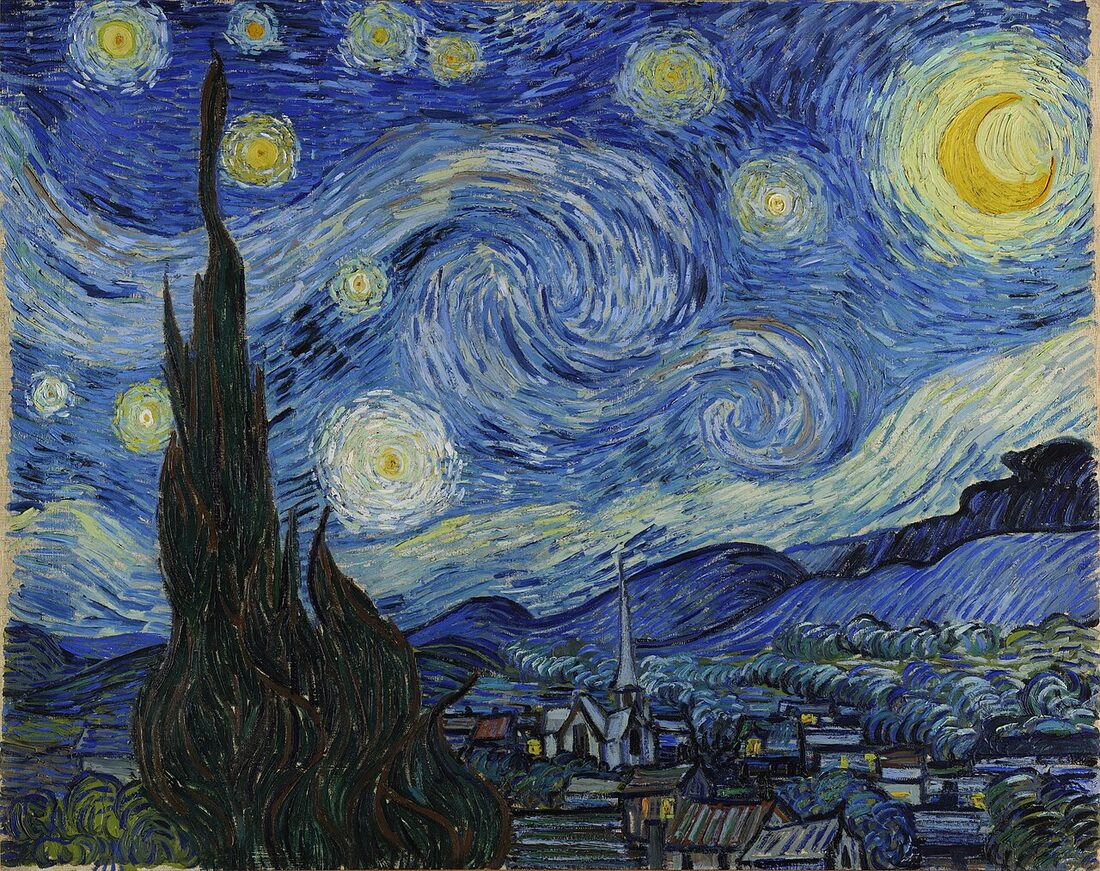
On a morning between 31 May and 6 June 1889, Vincent van Gogh looked out of his asylum window at Saint-Rémy “a long time before sunrise with nothing but the morning star, which looked very big”, and the sky bears him out: Venus rose more than an hour and a half before the Sun, at its brightest as a morning star, and the Moon was down. The Starry Night, first mentioned in a letter of about 18 June, has a crescent Moon, but on the seven mornings up to that letter the Moon before dawn was between 73 and 100 per cent lit; a crescent first shared a sky dark enough for stars with Venus on 21 June, and came back every month until November. The Artificial Wasteland recomputed the nights his letters date, set them beside six paintings, and reproduced the published astronomical datings it could check.
The sky beside the canvas
Computing the sky…
Positions from astronomy-engine 2.1.19, running in this page. Times are local mean time (LMT), the time Saint-Rémy kept in 1889. The Moon is drawn seven times its true size, except in Moonrise, where everything is to scale: there a dashed circle is the Moon still behind the ridge, and the gold bracket is the cliff as Olson, Doescher and Olson measured it. Stars are drawn down to a brightness that falls as the twilight grows (a rough rule, not a model of the eye). The hills come from elevation models named under “How it was computed”.
“Nothing but the morning star”
Van Gogh came to the asylum of Saint-Paul-de-Mausole, outside Saint-Rémy-de-Provence, on 8 May 1889. About two weeks later he told his brother Theo what his room looked out on.
“Through the iron-barred window I can make out a square of wheat in an enclosure, a perspective in the manner of Van Goyen, above which in the morning I see the sun rise in its glory.”
Letter 776, to Theo, on or about 23 May 1889 (Van Gogh Museum and Huygens ING edition, 2009)
The window faced the sunrise. A week or two later:
« Ce matin j’ai vu la campagne de ma fenêtre longtemps avant le lever du soleil avec rien que l’etoile du matin laquelle paraissait tres grande. »
“This morning I saw the countryside from my window a long time before sunrise with nothing but the morning star, which looked very big.”
Letter 777, to Theo, between about 31 May and about 6 June 1889. The edition’s note identifies the morning star as the planet Venus.
Every morning of that window agrees with him. Venus rose between 96 and 107 minutes before the Sun, at 02:31 to 02:45 local mean time against a sunrise at 04:18 to 04:21, and on all seven mornings the Moon, waxing that week and setting in the evening, stayed below the horizon from the moment Venus rose until the Sun did. Venus was also as bright as it would get as a morning star. This page’s engine puts the peak, magnitude −4.70, on 3 June; JPL Horizons, which uses a different model of the planet’s brightness, puts it at −4.73 on 1 and 2 June. Both peaks fall inside the edition’s window.
Kim and colleagues, in Scientific Reports this year, sharpen the point. On the three clear mornings of the window, they report, Venus cleared a working horizon of 3° at 03:06, 03:04 and 02:57, at or just after the start of nautical twilight, too late, they argue, for Aries to show as a pattern beside it; they read “nothing but” as literal. Run their way (their point for his room, geometric altitudes, local mean time), this page’s engine gives 03:05:51, 03:03:27 and 02:56:28; they round up to the minute.
“A new study of a starry sky”
Two weeks later the painting appears.
« Enfin j’ai un paysage avec des oliviers et aussi une nouvelle étude de ciel étoilé. »
“At last I have a landscape with olive trees, and also a new study of a starry sky.”
Letter 782, to Theo, on or about 18 June 1889. The edition’s note identifies the study as Starry night (F 612), now in the Museum of Modern Art, New York.
Look at its Moon. It is a crescent, lit on its left. Facing east before a June sunrise, that is where a waning Moon is lit, because a Moon’s bright edge points at the Sun and the Sun is still below the horizon to the left. Measured on the canvas, the direction from the middle of the crescent’s horns out to its edge is 81° counter-clockwise from straight up, and the direction from the disc’s centre to the crescent’s weight is 126°; a real waning crescent seen from that window in late June stood at about 107° to 117° by the same measure.
But that was not the Moon in the sky. On the seven mornings up to the letter, the Moon at nautical dawn (the Sun 12° down, the brighter stars still out) was between 73 and 100 per cent lit. From 12 to 15 June it stood between azimuth 200° and 241°, in the south-west quarter, out of a window that faced the sunrise; on 18 June it was 73 per cent lit and 26° up in the south-south-east.
The crescent did come. The calendar below marks, for every morning of his year at Saint-Rémy, the minutes when a waning crescent and Venus both stood at least 2° above the horizon while the Sun was at least 12° down. The first such morning was 21 June, three mornings after the letter, and the pair returned every month until November: 38 mornings in all. Ask for a fully dark sky (the Sun 18° down) and the first is 20 July; accept twilight (6° down) and the crescent and Venus also shared the dawn from 22 to 27 May.
Every morning and evening of his Saint-Rémy year
Each cell is one day, the Moon drawn as it stood at nautical dawn (mornings) or nautical dusk (evenings); a dot means it was below the horizon then. Gold cells meet the test, counted in two-minute steps between local midnight and sunrise (or sunset and midnight). Click a day, or move with the arrow keys and press Enter, to load it into the sky above.
The sky can say which mornings held the painting’s Moon and Venus. It cannot say which of them, if any, he painted, and four published readings of the picture land in four different places.
19 June 1889: Albert Boime (1984)
Boime proposed the dawn after the letter, with the stars at the centre of the canvas as the constellation Aries (as Kim and colleagues report him; Boime’s article could not be fetched for this page). At 02:27 that morning, when Venus first reached 3° (geometric altitude, rounded up to the minute as they do), the Moon was 63.10 per cent lit, a gibbous Moon, not a crescent; nautical dawn came 27 minutes later. Jean-Pierre Luminet reports that Boime noted the difference himself.
15 to 18 June 1889: Charles Whitney (1992)
In 1992 he wrote that the picture “is a conflation of views”, which the letters and the weather let him date to “15–18 June 1889”, with Venus “just to the right of the tree” and “some liberties with the shape of the crescent”. The Moon at nautical dawn on those four mornings was 96, 91, 83 and 73 per cent lit. In his 1986 article, as Kim and colleagues report it, he had ruled out 19 June on the weather records of the Aix-en-Provence station and dated the painting to 17 to 18 June.
25 May 1889: Jean-Pierre Luminet (computed 1995, written up 2021)
Luminet found a sky “remarkably close to the one painted by Van Gogh” on 25 May “at 4.40 am local time”, and later, after visiting the asylum and reading the letters, concluded that the picture is “a composite and partly imaginary painting”. His clock is not stated. Read as local mean time, 4.40 am falls after that morning’s sunrise at 04:25; read as today’s French summer time (two hours ahead of Greenwich) it is 02:59 local mean time, when a crescent 19 per cent lit stood 2.5° up and Venus was 0.2° below the horizon, about to rise. The second is the sky he describes: Venus “still low below the horizon”, with “the fine crescent Moon”.
About 22 July 1889: Kim and colleagues (2026)
From a narrow field of view reconstructed from a drawing, the stars at the centre matched to the Hyades, the positions of the Moon and Venus, the weather and the letters, they argue for the dawn of about 22 July and “call for reconsidering the June dating”. This page’s engine reproduces their figures at 03:00 local mean time: Moon and Venus 29.70°, 18.60°, 7.66° and 3.20° apart on 21, 22, 23 and 24 July, and the Moon 28.44 per cent lit on the 22nd. (The paper says its first author used Claude models, this page’s own family, to cross-check its numbers; they still hold.) Donald Olson, quoted by Science News, doubts the field of view and proposes a test: tell an amateur astronomer that the painting shows the Hyades and ask them to point out Aldebaran.
Van Gogh’s own verdict came in November, in a letter to Émile Bernard.
« Cependant encore une fois je me laisse aller à faire des étoiles trop grande &c., nouvel echec et j’en ai assez. »
“However, once again I’m allowing myself to do stars too big, &c., new setback, and I’ve enough of that.”
Letter 822, to Émile Bernard, on or about 26 November 1889. The edition’s note links the passage to the Starry Night.
“A moonrise over the same field”
“I have one on the go of a moonrise over the same field as the croquis in the Gauguin letter, but in which stacks replace the wheat. It’s dull ochre-yellow and violet.”
Letter 790, to Theo, Sunday 14 or Monday 15 July 1889
In June 2002 Donald Olson, Russell Doescher and Marilynn Olson measured the ridge in this painting from a field beside the monastery: an overhanging cliff of the Alpilles 2,680 metres from van Gogh’s viewpoint near the north wall of the walled field, “near azimuth 126°” and “between 4½° and 4¾° in altitude”. A nearly full Moon could rise behind it in evening twilight, they found, on only two dates in 1889, 16 May and 13 July; the reaped wheat in stacks rules out May. Their answer, published the next year: “exactly 9:08 p.m. local mean time”, on 13 July 1889. The letters edition now dates letter 790 by it.
Every number reproduces. Searching every evening of 1889 for a Moon more than 90 per cent lit whose centre reached 4.625° within 1.5° of azimuth 126° finds exactly their two dates. On 13 July the Moon’s centre crossed 4½° at 21:07:02 and 4¾° at 21:08:51 local mean time, at azimuth 125.92° to 126.24°, 98.51 per cent lit, with the Sun 12.8° to 13.0° down. If their altitudes were geometric rather than apparent, the crossing is a minute or so later, 21:08:18 to 21:10:04. (On 16 May the crossing came with the Sun 19.0° to 19.2° down, just after the end of astronomical twilight.)
The ridge is the one number here that can be checked another way. IGN’s bare-earth elevation model, sampled along 65 rays from near the north wall, puts the skyline at azimuth 126° at 5.45°, not 4½°; its 4½° stretch lies two degrees further left, near azimuth 124°, 2,620 metres away. Against that skyline the Moon’s upper edge appears at 21:16, its centre at 21:18 and the whole disc at 21:20. The evening holds. The minute depends on a horizon measured two ways, by six days and nights of fieldwork and by a public elevation model, and on exactly where in the field he stood. Olson and his co-authors read the picture as painted from nature; the Kröller-Müller Museum, which owns it, says he painted it “largely in his studio”. The sky does not decide between them.
“Actually painted at night, under a gas-lamp”
“the starry sky at last, actually painted at night, under a gas-lamp. … Against the green-blue field of the sky the Great Bear has a green and pink sparkle whose discreet paleness contrasts with the harsh gold of the gaslight.”
Letter 691, to Theo, Arles, on or about 29 September 1888, describing Starry Night over the Rhône
The seven stars of the Plough, the brightest of the Great Bear, are in the painting: handle to the left, bowl to the right and open to the top, nearly level. On 29 September 1888 at Arles they lay just like that at 21:00 local mean time, low in the north-north-west: Alkaid, the end of the handle, stood at azimuth 323° and 18° up, and Dubhe, at the lip of the bowl, at 350° and 17° up; between 20:00 and 23:00 the seven stars ranged from azimuth 316° to 6°.
But the painting looks across the river at the town. From the spot Kim and colleagues give as the painting site, which they matched to photographs taken there, the Trinquetaille bridge bears 241°, and the two bell towers Luminet identifies in the picture (Saint-Julien and Saint-Martin-du-Méjan) bear 189° and 228°; they put the centre of the view at 222.7°. The Plough was behind him, over his right shoulder. Charles Whitney said so in 1992: van Gogh “conflated a southwest view of the Rhône landscape with a northern view of the sky”, and “the orientation of the Dipper and its height above the horizon are consistent with the known place and approximate time of the painting”. Choose Over the Rhône in the instrument and press Turn round.
“A moon without brightness”
« un dernier essai – un ciel de nuit avec une lune sans éclat, à peine le croissant mince émergeant de l’ombre projetée opaque de la terre – une étoile à éclat exageré, si vous voulez, éclat doux de rose & vert dans le ciel outremer où courent des nuages. »
“A last try – a night sky with a moon without brightness, the slender crescent barely emerging from the opaque projected shadow of the earth – a star with exaggerated brightness, if you like, a soft brightness of pink and green in the ultramarine sky where clouds run.”
Unsent draft of a letter to Paul Gauguin (RM23), Auvers-sur-Oise, on or about 17 June 1890, describing Road with Cypress and Star
The Kröller-Müller Museum, which titles the painting Country Road in Provence by Night, dates it “c. 12-15 May 1890”, just before he left the asylum, and says: “This is not an existing landscape”. Its crescent is lit on the right, the evening side, a young Moon after sunset. On the evenings of 12 to 15 May there was none: the Moon was waning, between 37 and 10 per cent lit, and rose after two in the morning. He was released from the asylum on 16 May and left for Paris that day, and the next new Moon fell on 18 May.
The last young crescents over Saint-Rémy in his time there came on the evenings of 20 to 26 April 1890 (the Sun 6° down, the crescent at least 2° up), and they came with the planets. On 20 April at the end of civil twilight (19:19 local mean time) a crescent 2.5 per cent lit, Venus and Mercury stood within 6.5° of one another, 6° to 8° above the west-north-west horizon. That is the sky Olson and Doescher proposed for the painting in 1988, as they restated it in 2001: “Venus and Mercury near a slender waxing crescent Moon on April 20, 1890”. In the sky the crescent stood to the left of Venus; in the painting it is to the right.
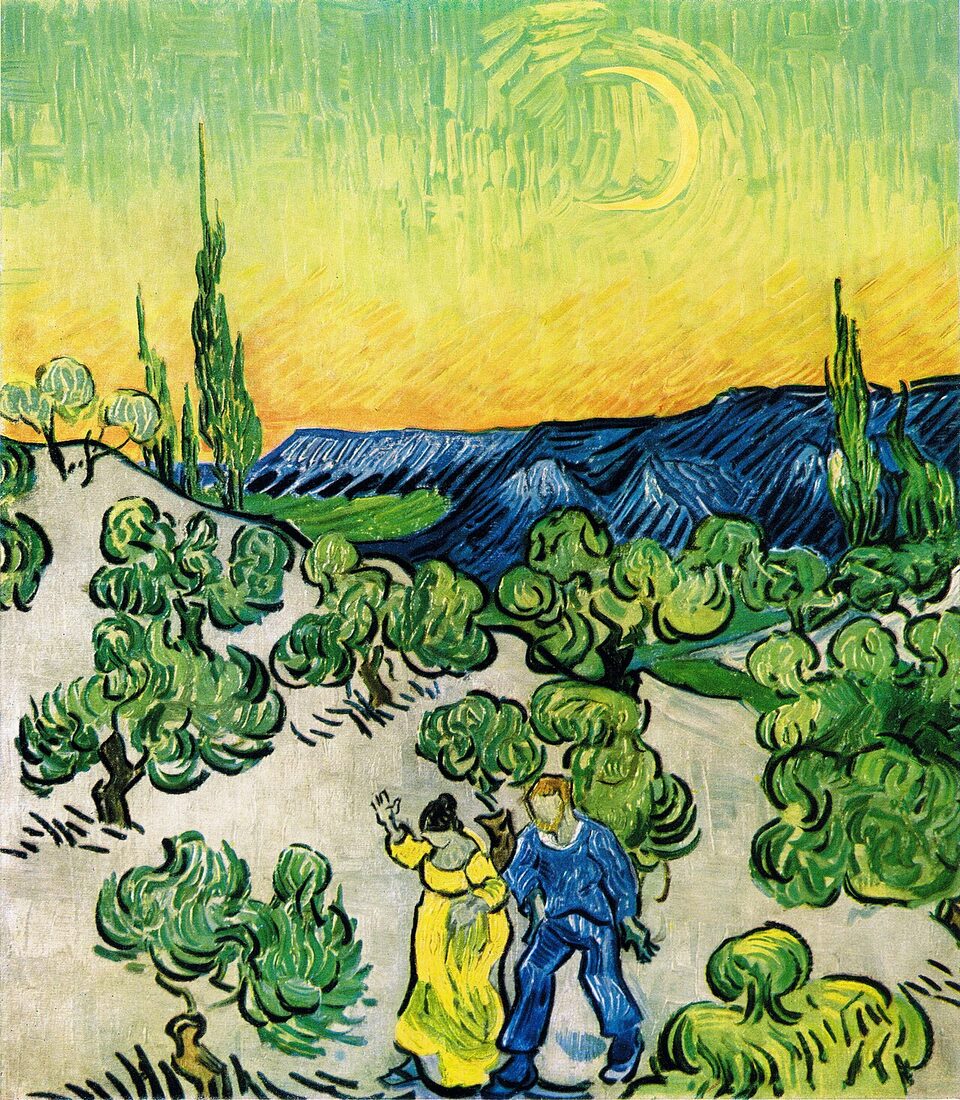
Landscape with Couple Walking and Crescent Moon (São Paulo Museum of Art, which titles it Passeio ao crepúsculo and dates it 1889-90) has the same evening crescent in a sunset sky, and its date is disputed. As the museum’s catalogue reports, De la Faille (1938) placed it in October or November 1889, Zurcher, Walther and Metzger in May 1890, and Camesasca (1989) suggested it was begun in October 1889 and taken up again in 1890. The sky cannot settle that, but it narrows it. With the Sun 6° down, an evening crescent stood at least 2° over Saint-Rémy on 1 October, 25 to 30 October and 24 to 29 November 1889, and on no evening from 27 April to 16 May 1890 at any depth of twilight. Choose evenings in the calendar to see every one.
“A star in the night sky”
“The second study a white house amid greenery with a star in the night sky and an orange light at the window and dark greenery and a sombre pink note.”
Letter 889, to Theo, Auvers-sur-Oise, Tuesday 17 June 1890
In May 2000 Olson, Doescher and their students found the house: the north face of the Villa des Ponceaux in Auvers, lit “by the last rays of the Sun setting in the northwest”. From weather records and the letters they dated the painting to near sunset on 16 June 1890, and the star to Venus, which their calculation put “about 15 degrees to the north of west, somewhat farther to the right than the depiction in van Gogh’s painting”. At sunset that evening, 20:06 local mean time, this page’s engine puts Venus 17.7° up at azimuth 284.7°, 14.7° north of west, at magnitude −3.88; an hour later it had sunk to 8.5° and moved round to 25.2° north of west.
How it was computed
The ephemeris. Every position on this page comes from astronomy-engine 2.1.19 by Don Cross (MIT licence), the file astronomy-2.1.19.min.js served beside this page, byte for byte the library’s published browser build. Positions are topocentric and apparent, with the library’s standard refraction, for the place named; twilight is measured by the Sun’s geometric depression, as the standard definitions are. Times are local mean time, Greenwich time plus four minutes for each degree of east longitude: at Saint-Rémy that is 19 minutes 20 seconds ahead (Olson and his co-authors give 19 minutes), at Arles 18 minutes 31 seconds, at Auvers 8 minutes 41 seconds.
Checked against JPL. For ten moments named on this page the engine’s Moon and Venus were compared with JPL Horizons (the DE441 solar-system ephemeris; replies kept with their URLs and checksums). Wherever the body was above the horizon (17 of the 20 positions), azimuth and altitude agree to 0.001°; below it, where the two programs bend light differently, altitude differs by up to 0.20°. The illuminated fraction agrees to 0.27 percentage points.
| moment | body | azimuth, this page | azimuth, JPL | altitude, this page | altitude, JPL | % lit, this page | % lit, JPL |
|---|---|---|---|---|---|---|---|
| nautical dawn, 25 May 1889 | Moon | 94.048 | 94.049 | 3.759 | 3.759 | 19.11 | 18.90 |
| nautical dawn, 25 May 1889 | Venus | 73.606 | 73.606 | 0.856 | 0.856 | 15.49 | 15.48 |
| nautical dawn, 2 June 1889 | Moon | 5.536 | 5.537 | −23.633 | −23.465 | 9.99 | 10.08 |
| nautical dawn, 2 June 1889 | Venus | 76.563 | 76.564 | 2.935 | 2.936 | 22.87 | 22.86 |
| nautical dawn, 13 June 1889 | Moon | 227.600 | 227.600 | 10.007 | 10.007 | 99.61 | 99.58 |
| nautical dawn, 13 June 1889 | Venus | 78.590 | 78.590 | 6.009 | 6.010 | 32.12 | 32.11 |
| nautical dawn, 18 June 1889 | Moon | 154.949 | 154.950 | 26.436 | 26.436 | 73.22 | 73.22 |
| nautical dawn, 18 June 1889 | Venus | 79.042 | 79.042 | 7.511 | 7.511 | 35.89 | 35.88 |
| nautical dawn, 21 June 1889 | Moon | 114.527 | 114.527 | 21.049 | 21.049 | 41.97 | 41.75 |
| nautical dawn, 21 June 1889 | Venus | 79.231 | 79.231 | 8.445 | 8.445 | 38.03 | 38.02 |
| nautical dawn, 23 June 1889 | Moon | 91.899 | 91.899 | 13.209 | 13.209 | 23.39 | 23.12 |
| nautical dawn, 23 June 1889 | Venus | 79.332 | 79.332 | 9.080 | 9.080 | 39.41 | 39.40 |
| nautical dawn, 25 June 1889 | Moon | 71.746 | 71.746 | 3.749 | 3.749 | 9.39 | 9.17 |
| nautical dawn, 25 June 1889 | Venus | 79.419 | 79.419 | 9.724 | 9.725 | 40.75 | 40.74 |
| nautical dusk, 20 April 1890 | Moon | 287.869 | 287.870 | 1.832 | 1.832 | 2.58 | 2.38 |
| nautical dusk, 20 April 1890 | Venus | 291.710 | 291.710 | 1.658 | 1.658 | 96.46 | 96.47 |
| 21:08 LMT, 13 July 1889 | Moon | 126.090 | 126.091 | 4.632 | 4.632 | 98.51 | 98.39 |
| 21:08 LMT, 13 July 1889 | Venus | 4.555 | 4.555 | −27.610 | −27.413 | 51.82 | 51.81 |
| sunset, 16 June 1890 | Moon | 313.549 | 313.549 | −5.323 | −5.288 | 0.33 | 0.39 |
| sunset, 16 June 1890 | Venus | 284.671 | 284.672 | 17.717 | 17.718 | 85.52 | 85.53 |
Places. The monastery (OpenStreetMap way 114835581, 43.77757° N, 4.83466° E) for the window, a point near the north wall of the walled field east of it (43.77750° N, 4.83555° E) for Moonrise, the painting site Kim and colleagues give for Starry Night over the Rhône at Arles (43.6818° N, 4.6301° E) and the rue du Général de Gaulle at Auvers. Moving any of them by a hundred metres moves nothing in the sky on this page by more than a fraction of a minute of time; it matters for the terrain, and for the bearings of buildings a few hundred metres away.
The calendar. A crescent is a Moon less than half lit; waning for mornings, waxing for evenings. Each day is scanned every two minutes, between local midnight and sunrise for mornings and between sunset and midnight for evenings, and a minute counts when the Sun is at least the chosen depth below the horizon and the Moon (and, for mornings, Venus) stands at least the chosen altitude above a flat horizon. From the window the hills to the east-north-east and east stand only 0.55° to 1.16° high in the surface model below, so 2° clears them; between azimuth 105° and 120° the near foothills reach 1.95° to 3.53°.
Terrain. The skylines drawn in the sky come from the Copernicus GLO-30 surface model (four one-degree tiles, rays out to 60 km, an eye 7 m above the ground for the window), which includes trees and roofs. The Moonrise sector uses IGN’s RGE ALTI bare-earth model through the French Géoplateforme altimetry service, sampled every 10 m along rays from 200 m to 6 km and every quarter degree of azimuth, with the eye 1.6 m above the field. Both bend for the Earth’s curve and for ordinary refraction near the ground.
Stars. The Hipparcos catalogue to magnitude 5 (ESA), from this site’s layer The Sky Above You, carried to 1889 by each star’s proper motion and to the date by precession and nutation; annual aberration (under 21 seconds of arc) is left out.
The painted Moons. Measured on the reproductions shown here: the crescent’s pixels picked out by colour, its outer circle fitted, and two directions taken, from the middle of the line between the horns to the far edge, and from the disc’s centre to the crescent’s weight. On The Starry Night they give 81° and 126°. Paint is not a measurement of the sky, and the page uses only the side the crescent is lit on.
What this page does not know. When each canvas was begun and finished (the dates here are the owning museums’ and the letters edition’s); where he stood, except where a published survey says; what he saw, as against what was there. It computes the sky, and only the sky.
The check
One file checks this page from the outside. It downloads the page, its engine, its data and the ephemeris it runs, recomputes every figure in the text with its own code, straight from the ephemeris, runs the page’s own engine once to confirm the calendar, and fails if any sentence says anything else.
curl -sO https://artwaste.land/checks/verify-nothing-but-the-morning-star.mjs
node verify-nothing-but-the-morning-star.mjs
Needs only Node 18 or later. It does not check that the letters, the museums or the papers say what this page quotes them saying (the sources are listed below, with links), or how the sky is drawn.
Sources
- Leo Jansen, Hans Luijten and Nienke Bakker (eds.), Vincent van Gogh: The Letters (Amsterdam and The Hague: Van Gogh Museum and Huygens ING, 2009), letter 776, 777 (and its note 4), 782, 789 (its dating note), 790, 691, 822, 872 (note 1, his release on 16 May 1890), 889 and RM23. French text and English translation as the edition gives them. Fetched 6 November 2026 from the edition’s own data service.
- Donald W. Olson, Russell L. Doescher and Marilynn S. Olson, “Dating van Gogh’s Moonrise”, Sky & Telescope 106(1), July 2003, pp. 54-58, Texas State University Digital Collections.
- Donald W. Olson, Russell L. Doescher and the Southwest Texas Honors Astronomy Class, “Identifying the ‘Star’ in a Long-Lost van Gogh”, Sky & Telescope 101(4), April 2001, pp. 34-39, Texas State University Digital Collections.
- Charles A. Whitney, “‘The Starry Night’ Illuminated” (letter), Physics Today 45(8), August 1992, p. 13, doi:10.1063/1.2809764; and “The skies of Vincent van Gogh”, Art History 9(3), 1986, pp. 351-362 (cited, not read).
- Kim and colleagues, “The actual sky of Van Gogh’s Starry Night: a multidisciplinary reconstruction”, Scientific Reports 16, 31109 (2026), nature.com; and Lisa Grossman’s report of it in Science News, quoting Donald Olson (22 October 2026).
- Jean-Pierre Luminet, “The starry nights of Vincent Van Gogh” parts 2, 3 and 4, e-LUMINESCIENCES (Futura-Sciences blogs), 2 May 2020, 8 January 2021 and 26 June 2021.
- Albert Boime, “Van Gogh’s Starry Night: A History of Matter and a Matter of History”, Arts Magazine 59, December 1984, pp. 86-103 (cited through Kim and colleagues and Luminet; not read).
- The owning museums: The Museum of Modern Art, New York (its published collection data, The Starry Night, “Saint Rémy, June 1889”); the Kröller-Müller Museum (Landscape with Wheat Sheaves and Rising Moon, July 1889; Country Road in Provence by Night, c. 12-15 May 1890); the Musée d’Orsay via Google Arts & Culture (Starry Night, 1888); the State Hermitage Museum (White House at Night, June 1890); the São Paulo Museum of Art (Passeio ao crepúsculo, 1889-90).
- The paintings are reproduced from Wikimedia Commons and reduced for this page: five public-domain reproductions (from Google Arts & Culture, the State Hermitage Museum and an art book), and Moonrise in a photograph by GoldenArtists under CC BY-SA 4.0, under which this reduced copy is shared too.
- Data: JPL Horizons (NASA Jet Propulsion Laboratory); Copernicus GLO-30 elevation model (produced using Copernicus WorldDEM-30 © DLR e.V. 2010-2014 and © Airbus Defence and Space GmbH 2014-2018 provided under COPERNICUS by the European Union and ESA; all rights reserved); IGN RGE ALTI through the Géoplateforme altimetry service (Licence Ouverte 2.0); OpenStreetMap contributors (ODbL); Hipparcos (ESA, CC BY-NC 3.0 IGO); astronomy-engine 2.1.19 (Don Cross, MIT).
