Convention
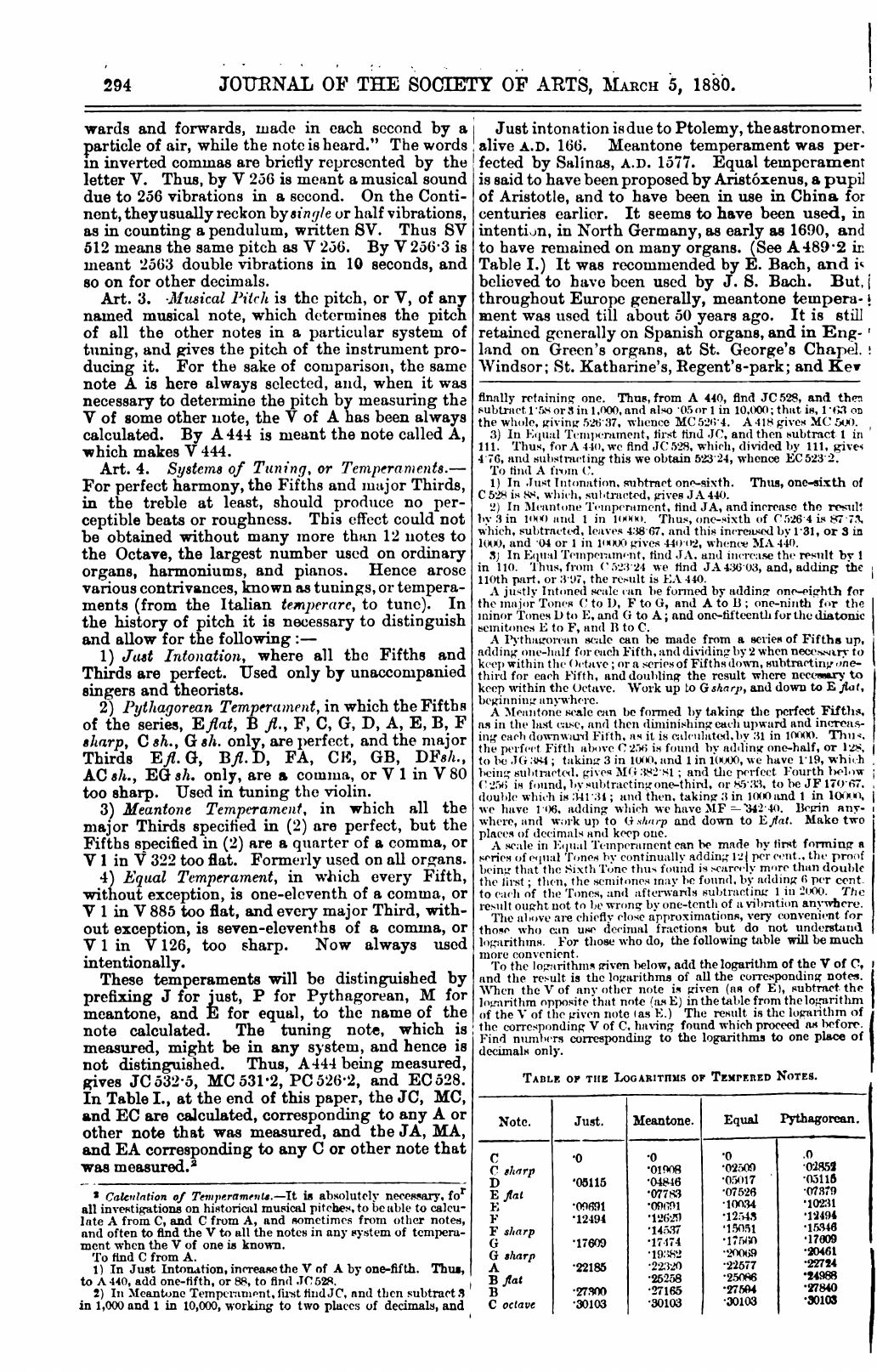
The Hipkins C 518·52 V is one input. Using Ellis’s printed logarithms on printed p. 294 gives different A values for meantone, equal temperament, and just intonation. Cents here are a modern gloss, not Ellis’s unit.
One object, three denominators
Ellis's England index repeats one A 474·1 pipe lineage on 6 Table II lines and enters the same Hipkins fork under 2 intonations, so these entries are not one measured pitch series.
Ellis's England index repeats one A 474·1 pipe lineage on 6 Table II lines and enters the same Hipkins fork under 2 intonations. The page keeps 142 pointer lines, 137 source-valued pitch pairs, 12 retained Table I records, and 11 fully linked evidence units separate. It cannot turn these mixed entries into one pitch for England.
Layer one · under ten seconds
Start with one source family. The first readout is Ellis’s own first-placed A value. Then change the intonation, the unit of evidence, or the date rule. Calculated C entries and unqualified ranges move where the source permits; direct entries and qualified dates stay identified.
Measured input · Table I, printed p. 323
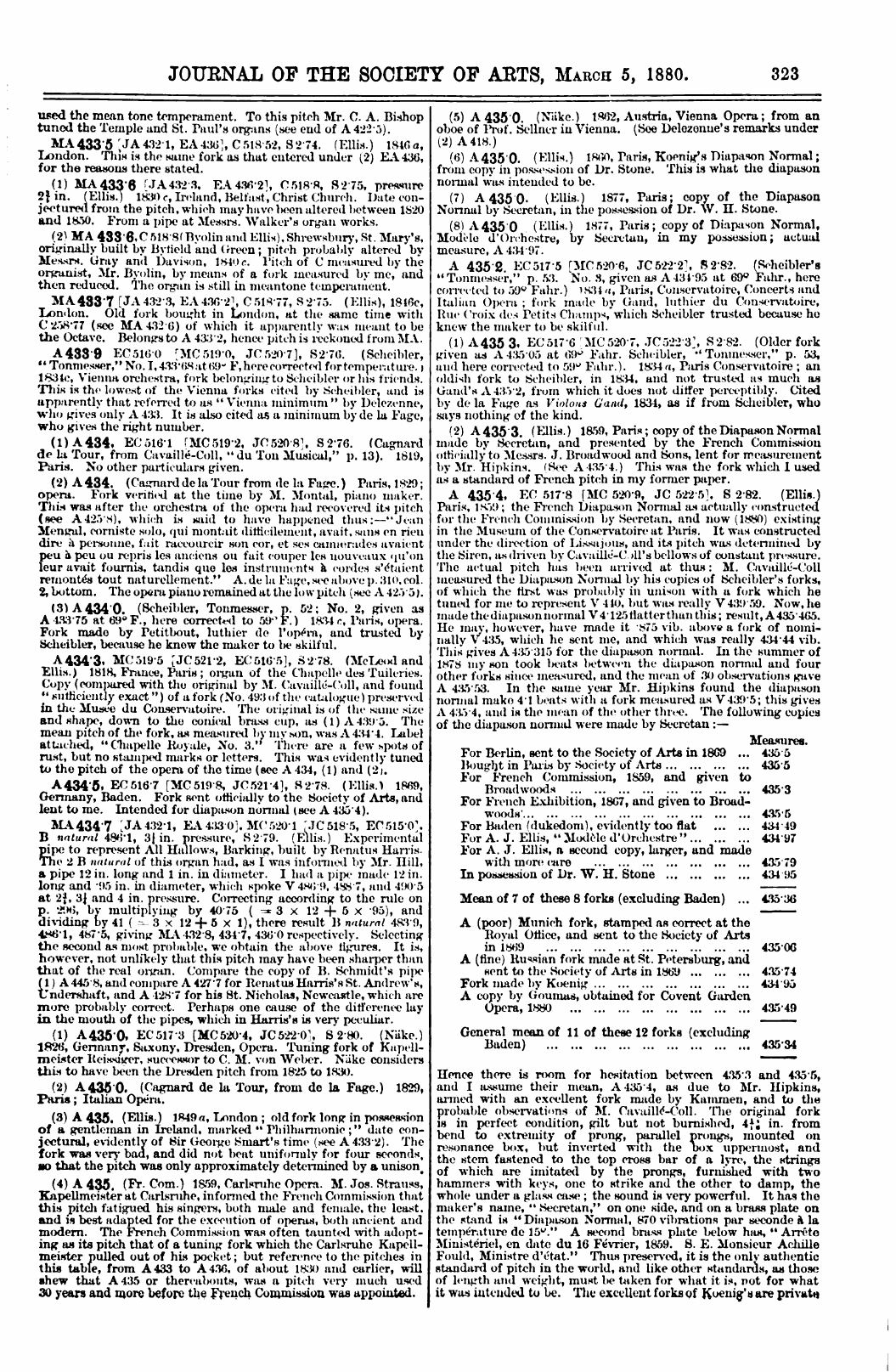
C 518·52 VHipkins’s fork is entered as EA 436·0 and also as MA 433·5. The input is the C cell, not a modern reference pitch. Ellis’s first-placed choice stays beside the alternative calculations.
No sound has been started. The tone is synthetic and reader-started.
The period split accepts every integer from 1600 through 1880. The boundary and representative values 1600, 1800, 1850, and 1880 are the declared verifier probes.
The local instrument is loading the frozen extract.
No selection statistics are available yet.
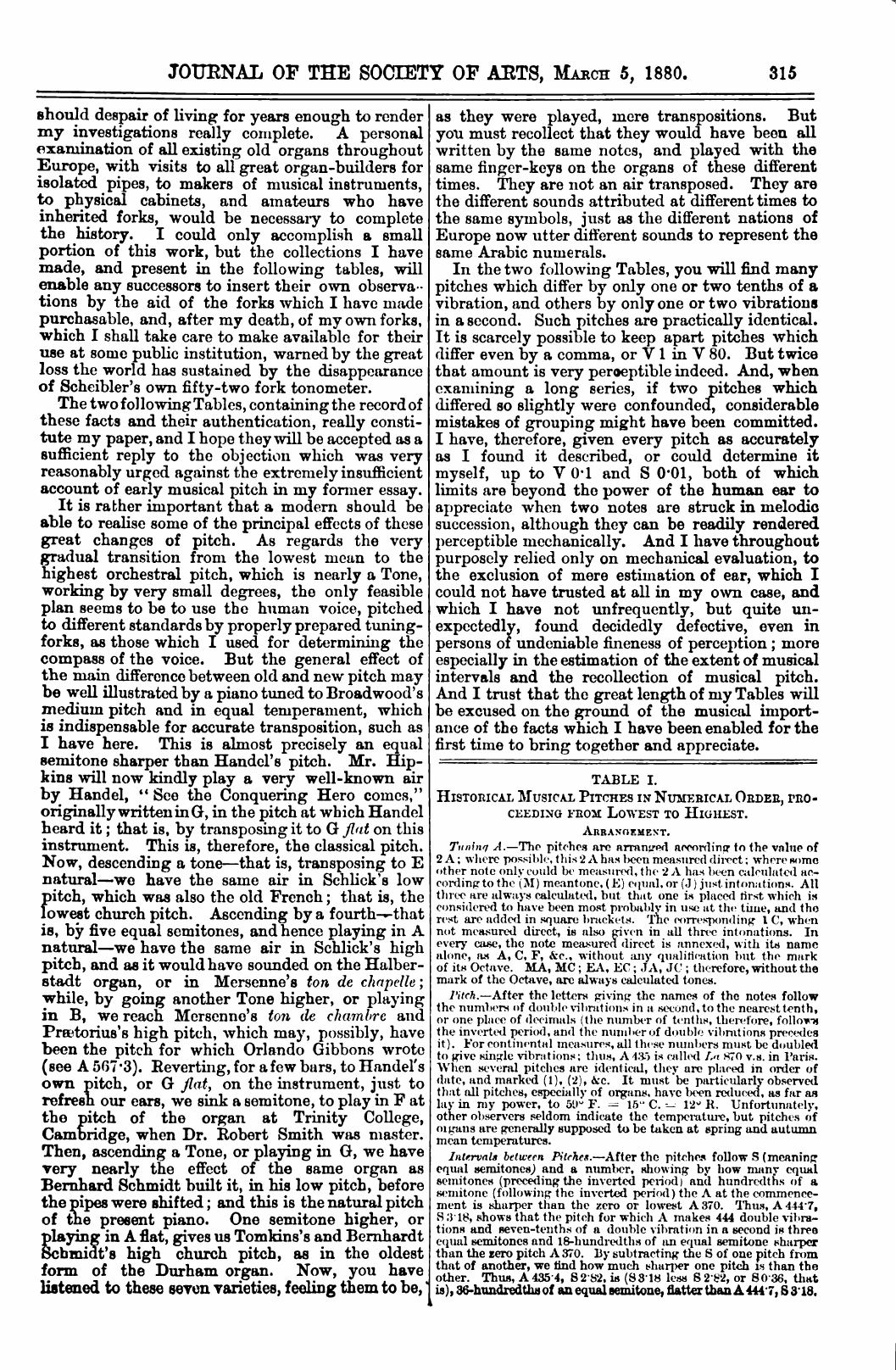
A is Ellis’s double vibrations per second, the unit he calls V. He says this is the modern hertz as a gloss, while continental sources may write single or half vibrations as SV on printed p. 294. S is his equal-semitone distance above A 370, with the conversion recomputed from the source constants on printed p. 315.
A suffix, a range, or a prose date is not an observation timestamp. Midpoint, earliest, and latest are editorial placements for unqualified ranges only; they do not place 1846a, 1846p, or another qualified date in a strict cutoff comparison. The entries below keep the source date and source page beside the value.
Layer two · the dismissal answered
There are at least four different ways for a neat-looking historical pitch to move: the measuring instrument, Ellis’s intonation convention, an inference about an original state, and the number of times one object is entered. The deeper result is not another pooled average. It is a live error budget that lets you turn each source choice on and off.
The Hipkins C 518·52 V is one input. Using Ellis’s printed logarithms on printed p. 294 gives different A values for meantone, equal temperament, and just intonation. Cents here are a modern gloss, not Ellis’s unit.
Durham’s A 474·1 is one old pipe whose original-state inference is indexed several times. Hipkins’s fork is one object entered under EA and MA. The Diapason Normal copies share a source lineage. Switch the unit above and the count changes because the record changes shape, not because the source grew new observations.
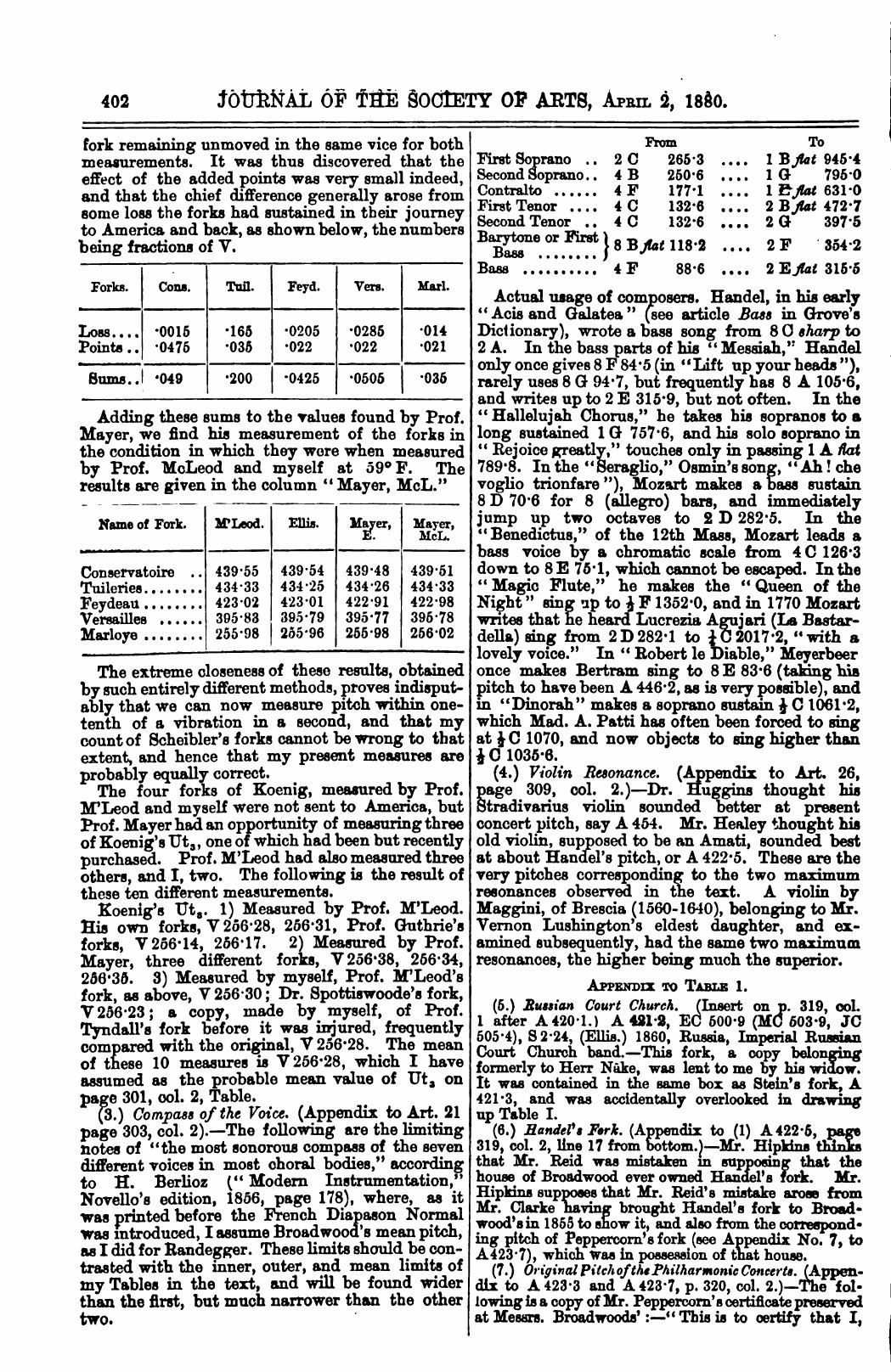
On printed p. 402 Ellis places five named forks in columns for McLeod, Ellis, Mayer E., and Mayer McL. The selected comparison uses McLeod, Ellis, and Mayer McL., which span at most loading, or loading as a modern gloss. Including the earlier Mayer E. column reaches loading, or loading. Ellis says Mayer E. was corrected into Mayer McL., so it is not a fourth independent observer.
Ellis’s correction paragraph places this comparison at 59° F; the exact source condition and correction column will appear with the frozen evidence.
Handel’s own fork is printed as A 422·5 in 1751. Bishop’s 1 C Philharmonic fork is printed as A 451·7 in 1878a. The table below recomputes their contrast under all four displayed choices, so the rise cannot hide behind one convention.
The rise is a within-class series of named forks. It is not a city average and it is not a tuning recommendation.
The apparatus
The anchor is Ellis’s own arithmetic, not a value copied from a heading. On printed p. 294 he gives logarithms for A 370 and the octave C. On printed p. 315 he prints worked results. The engine runs the same formula against each retained calculated cell and shows the source page for every disagreement.
Published arithmetic exercises, recomputed from Ellis’s printed logarithms
The clean transcription is active. Known source disagreements remain visible.
The clean run retains the Sarti EC misprint: Ellis prints EC 521·6 beside MC 521·6, while the printed logarithm recomputes EC as loading. Table II gives Botolph-lane S 4·24 while its Table I article gives S 4·29, so both printings stay visible. The page flags these instead of silently correcting the scan. The planted Hullah value is a verifier negative control, not part of the record.
Choose a tempting claim. The instrument will refuse it in the terms of the source.
Refused: these entries cannot supply one pitch for a city and year. Use the dated, attributed entries instead.
Frozen record · retrieved 2026-09-14
Ellis's England index repeats one A 474·1 pipe lineage on 6 Table II lines and enters the same Hipkins fork under 2 intonations, so these entries are not one measured pitch series.
The headline sentence is computed from the frozen extract when the instrument starts.
This page ships 143 Table II lines from Alexander J. Ellis's 1880 reprint. Of those, 142 have a source pitch pointer, including 137 source-valued A and S pairs and 5 reference-only lines whose printed A and S cells are blank. The frozen census retains 12 Table I article records and 11 fully linked evidence units; 123 pointer lines have no retained Table I prose, and one blank Whitehall line sits outside the pointer count. The rest of Table II remains outside this page.
Two independent image reads agree on all 266 numeric A and S cells. Four pairs are printed ditto marks, six rows have blank or reference pitch cells, and zero numeric cells were unreadable.
Ellis’s Table II is the classification used here. The page does not invent a modern grouping by place or instrument. Its free choices are named above: source family, unit, first-placed or recalculated intonation, inferred originals, class pooling, class name, arithmetic tolerance, date placement, cutoff year, fork columns, and the planted fault.
Temperature is metadata, not a slider. Ellis says he reduced values where possible to 59° F = 15° C = 12° R, while other observers often omit a temperature. The page keeps each source wording and counts stated, reduced, and unstated fields. It does not fabricate a correction coefficient.
These are the source phrases that connect an article to an index entry or to another object. Open the local scan crop beside each one. A source dash, spelling, or punctuation mark is retained in the extract.
The primary record is the public-domain scan of The History of Musical Pitch, Alexander J. Ellis, reprinted from the Journal of the Society of Arts in 1880, including Table I, Table II, and the appendix on printed pages 401 to 403. Open the IMSLP scan. The IMSLP work page marks Complete Book #665113 as Public Domain. The IMSLP page footer is separately CC BY-SA 4.0, and that page licence is not being applied to Ellis’s scan.
The related Nature item is an abstract and metadata record only, DOI 10.1038/021550a0. It is not used for source rows. The 1885 revision is a different record and is refused by this page.
Bounded search statement: We searched Ellis’s 1880 title and exact values, his own Table II classified index and 1885 revision, Cater’s 223-instance work, the McGee Flutes pitch table, the Haynes-based aPitch app and web queries for Ellis pitch datasets on 2026-09-14, and did not find a public, row-level, executable transcription of Ellis’s 1880 Tables I and II that separates index lines from independent evidence and recomputes Ellis’s own conversions.
The source PDF, frozen extract, file hashes, extraction method, exclusions, scan pages, and licence notes are named in the shipped research README. The verifier is shipped beside them and supports the visible ledger check.