Translation-Criticism Venue · the treaty seam
The Word They Did Not Use
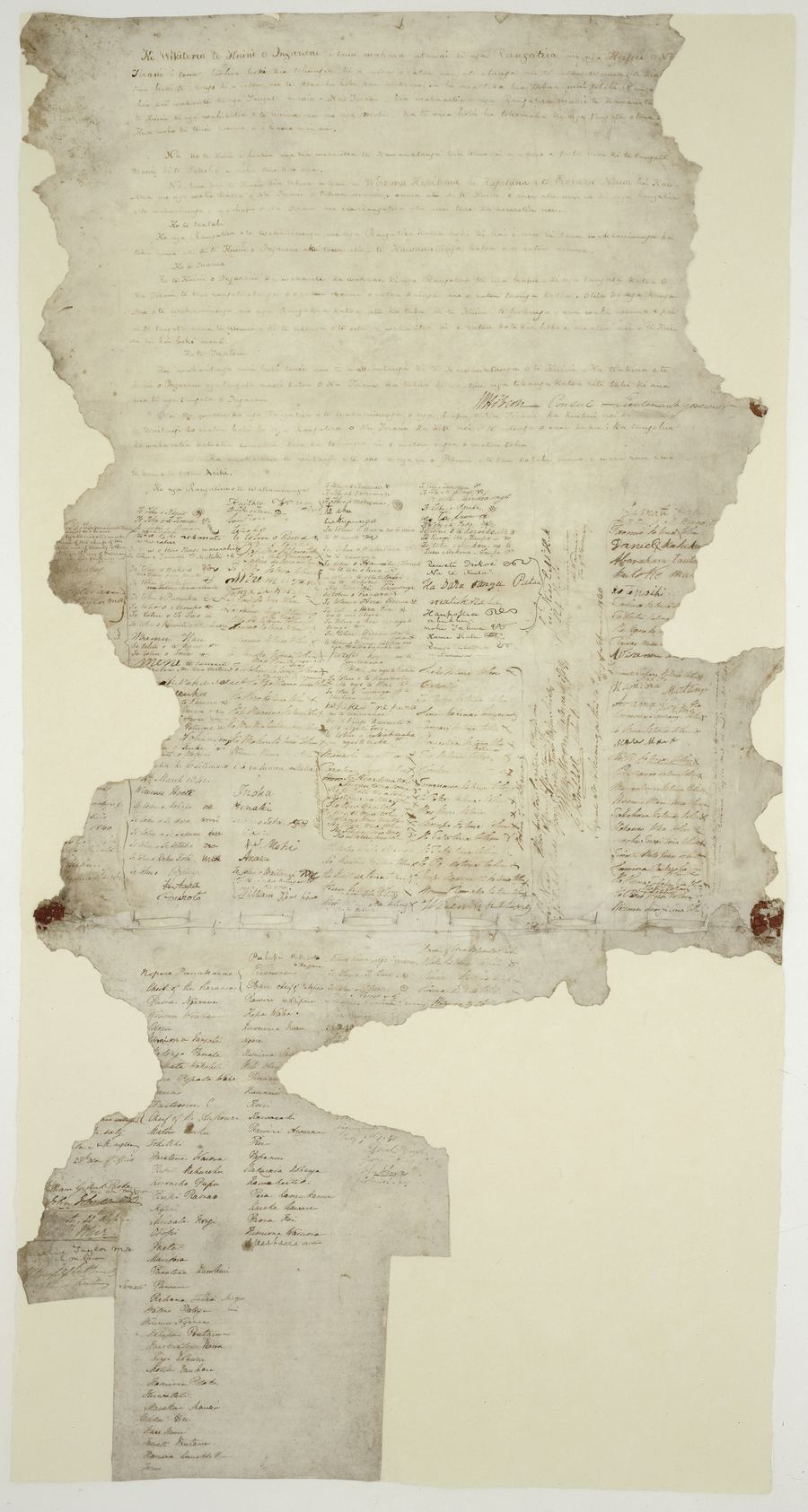
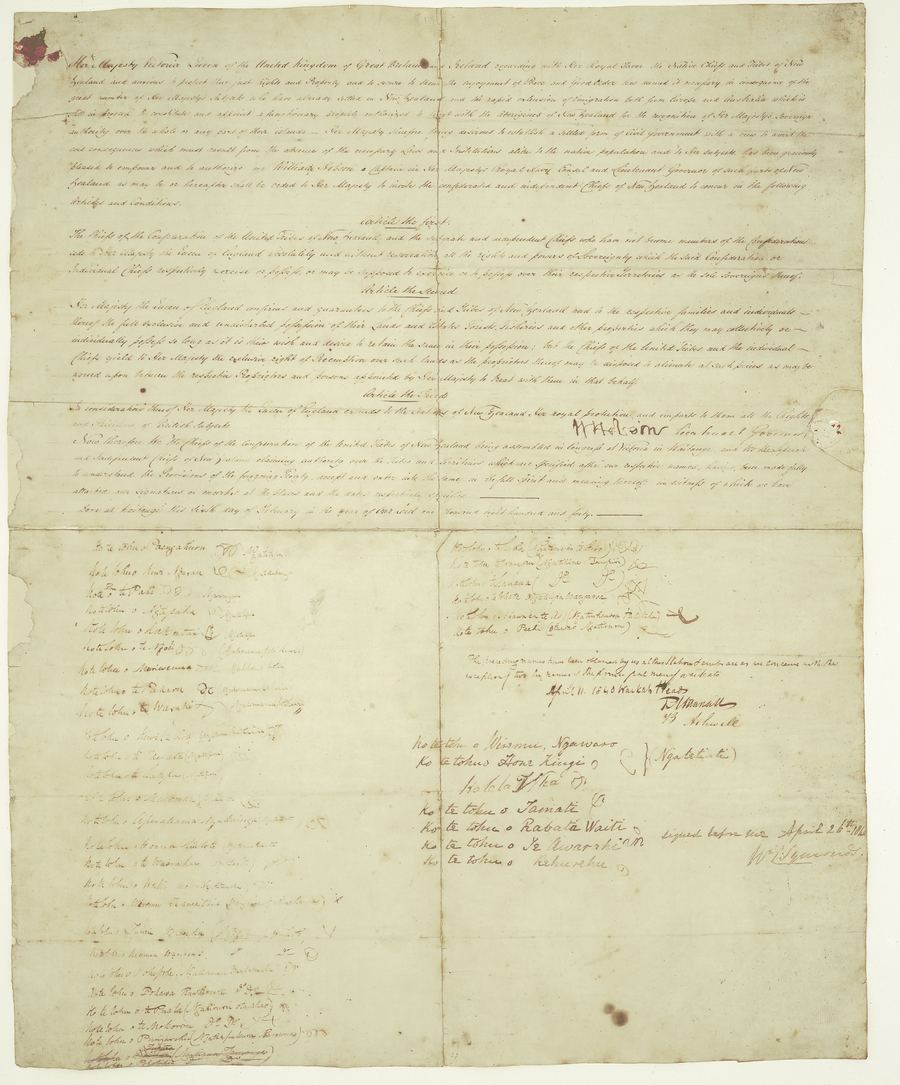
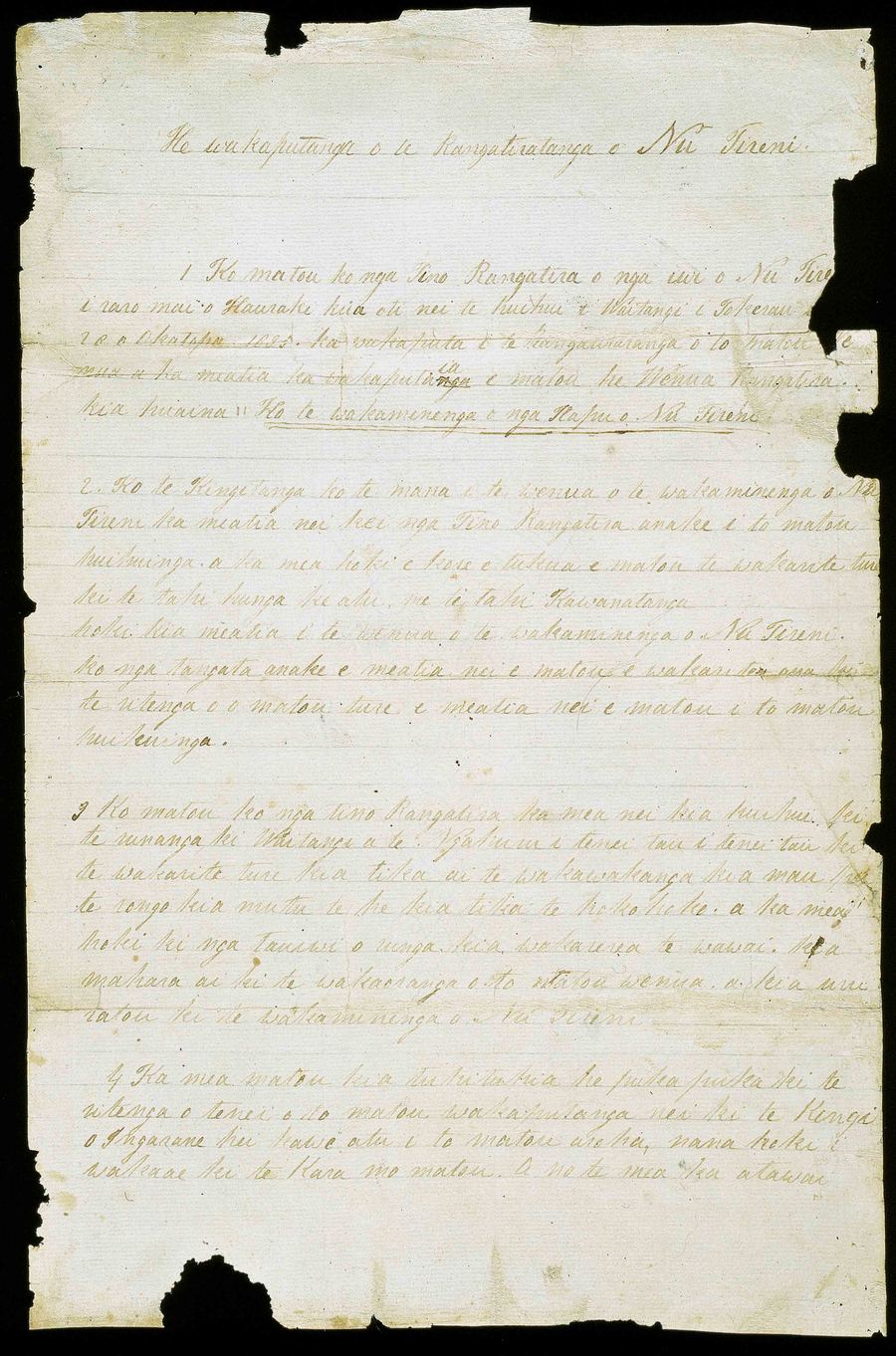
There are two texts of the Treaty of Waitangi, one in English and one in te reo Māori, and they do not say the same thing. The English cedes to the Crown “all the rights and powers of Sovereignty.” The Māori, which is the text almost every rangatira actually signed, cedes “te Kawanatanga katoa.” Five years earlier, in an officially bilingual document drawn up by the same British Resident and put into Māori by the same missionary circle, “All Sovereign powers and authority” had been rendered “Ko te Kingitanga, ko te mana,” and Kawanatanga had rendered “nor any function of Government.” Neither Kingitanga nor mana occurs anywhere in the Māori text of the Treaty. All four documents are below in one live concordance, and the crux lines are photographs, so you can check the reading against the ink.
Most translation criticism has an original and a translation, and asks what the crossing cost. This one has neither. At Waitangi there is no original: there are two texts, both signed, and since 1975 New Zealand law has carried both. What they say is not the same, and the difference is not a matter of register. It is a difference about what was given away.
None of that is new, and none of it is disputed by anyone who has read the two texts side by side. What this page adds is not an argument but an instrument. The four documents are loaded and indexed word by word, so that instead of being told a word is missing you can type it in and watch the counter return zero. The sheets are photographs. Where our reading differs from a published transcription, we say which, and show you the line, and you can decide.
Instrument IThe texts, side by side
Choose a document and a passage. Underlined phrases are keyed: click one and its counterpart lights up in the other column, with a note on what moved. With JavaScript off, everything below is simply present in full.
Document
Passage
The English text · the Waikato-Manukau sheet
Preamble
Her Majesty Victoria Queen of the United Kingdom of Great Britain and Ireland regarding with Her Royal Favor the Native Chiefs and Tribes of New Zealand and anxious to protect their just Rights and Property and to secure to them the enjoyment of Peace and Good Order has deemed it necessary in consequence of the great number of Her Majesty's Subjects who have already settled in New Zealand and the rapid extension of Emigration both from Europe and Australia which is still in progress to constitute and appoint a functionary properly authorized to treat with the Aborigines of New Zealand for the recognition of Her Majesty's Sovereign authority over the whole or any part of those islands – Her Majesty therefore being desirous to establish a settled form of Civil Government with a view to avert the evil consequences which must result from the absence of the necessary Laws and Institutions alike to the native population and to Her subjects has been graciously pleased to empower and to authorize me William Hobson a Captain in Her Majesty's Royal Navy Consul and Lieutenant-Governor of such parts of New Zealand as may be or hereafter shall be ceded to her Majesty to invite the confederated and independent Chiefs of New Zealand to concur in the following Articles and Conditions.
Article the First
The Chiefs of the Confederation of the United Tribes of New Zealand and the seperate and independent Chiefs who have not become members of the Confederation cede to Her Majesty the Queen of England absolutely and without reservation all the rights and powers of Sovereignty which the said Confederation or Individual Chiefs respectively exercise or possess, or may be supposed to exercise or to possess over their respective Territories as the sole sovereigns thereof.
Article the Second
Her Majesty the Queen of England confirms and guarantees to the Chiefs and Tribes of New Zealand and to the respective families and individuals thereof the full exclusive and undisturbed possession of their Lands and Estates Forests Fisheries and other properties which they may collectively or individually possess so long as it is their wish and desire to retain the same in their possession; but the Chiefs of the United Tribes and the individual Chiefs yield to Her Majesty the exclusive right of Preemption over such lands as the proprietors thereof may be disposed to alienate at such prices as may be agreed upon between the respective Proprietors and persons appointed by Her Majesty to treat with them in that behalf.
Article the Third
In consideration thereof Her Majesty the Queen of England extends to the Natives of New Zealand Her royal protection and imparts to them all the Rights and Privileges of British Subjects.
William Hobson Lieutenant Governor.
The closing
Now therefore We the Chiefs of the Confederation of the United Tribes of New Zealand being assembled in Congress at Victoria in Waitangi and We the Seperate and Independent Chiefs of New Zealand claiming authority over the Tribes and Territories which are specified after our respective names, having been made fully to understand the Provisions of the foregoing Treaty, accept and enter into the same in the full spirit and meaning thereof in witness of which we have attached our signatures or marks at the places and the dates respectively specified.
Done at Waitangi this Sixth day of February in the year of Our Lord one thousand eight hundred and forty.
Verbatim from the Wikisource Validated transcription of the Waikato-Manukau sheet, the only English sheet, checked by two editors against the page image. Spelling as written, including seperate and Favor.
Te reo Māori · the Waitangi sheet
Te timatanga
Ko Wikitoria te Kuini o Ingarani i tana mahara atawai ki nga Rangatira me nga Hapu o Nu Tirani i tana hiahia hoki kia tohungia ki a ratou o ratou rangatiratanga me to ratou wenua, a kia mau tonu hoki te Rongo ki a ratou me te Atanoho hoki kua wakaaro ia he mea tika kia tukua mai tetahi Rangatira — hei kai wakarite ki nga Tangata maori o Nu Tirani — kia wakaaetia e nga Rangatira Maori te Kawanatanga o te Kuini ki nga wahikatoa o te Wenua nei me nga Motu — na te mea hoki he tokomaha ke nga tangata o tona Iwi Kua noho ki tenei wenua, a e haere mai nei.
Na ko te Kuini e hiahia ana kia wakaritea te Kawanatanga kia kaua ai nga kino e puta mai ki te tangata Maori ki te Pakeha e noho ture kore ana.
Na kua pai te Kuini kia tukua a hau a Wiremu Hopihona he Kapitana i te Roiara Nawi hei Kawana mo nga wahi katoa o Nu Tirani e tukua aianei amua atu ki te Kuini, e mea atu ana ia ki nga Rangatira o te wakaminenga o nga hapu o Nu Tirani me era Rangatira atu enei ture ka korerotia nei.
Ko te tuatahi
Ko nga Rangatira o te Wakaminenga me nga Rangatira katoa hoki ki hai i uru ki taua wakaminenga ka tuku rawa atu ki te Kuini o Ingarani ake tonu atu — te Kawanatanga katoa o o ratou wenua.
Ko te tuarua
Ko te Kuini o Ingarani ka wakarite ka wakaae ki nga Rangatira ki nga hapu — ki nga tangata katoa o Nu Tirani te tino rangatiratanga o o ratou wenua o ratou kainga me o ratou taonga katoa. Otiia ko nga Rangatira o te Wakaminenga me nga Rangatira katoa atu ka tuku ki te Kuini te hokonga o era wahi wenua e pai ai te tangata nona te wenua — ki te ritenga o te utu e wakaritea ai e ratou ko te kai hoko e meatia nei e te Kuini hei kai hoko mona.
Ko te tuatoru
Hei wakaritenga mai hoki tenei mo te wakaaetanga ki te Kawanatanga o te Kuini — Ka tiakina e te Kuini o Ingarani nga tangata maori katoa o Nu Tirani ka tukua ki a ratou nga tikanga katoa rite tahi ki ana mea ki nga tangata o Ingarani.
W. Hobson Consul & Lieutenant Governor
Te whakamutunga
Na ko matou ko nga Rangatira o te Wakaminenga o nga hapu o Nu Tirani ka huihui nei ki Waitangi ko matou hoki ko nga Rangatira o Nu Tirani ka kite nei i te ritenga o enei kupu, ka tangohia ka wakaaetia katoatia e matou, koia ka tohungia ai o matou ingoa o matou tohu. Ka meatia tenei ki Waitangi i te ono o nga ra o Pepueri i te tau kotahi mano, e waru rau e wa te kau o to tatou Ariki.
Transcribed here from the Archives New Zealand photograph of the Waitangi sheet, and checked against the Church Missionary Society printing given in Buick 1914. Diplomatic: the sheet's own spelling, no macrons added, the sheet's own long dashes kept.
The English text · Declaration of Independence
Heading
DECLARATION OF INDEPENDENCE OF NEW ZEALAND
Clause 1
We, the hereditary chiefs and head of the tribes of the Northern parts of New Zealand, being assembled at “Waitangi” in the Bay of Islands on this 28th day of October 1835, declare the independence of our country, which is hereby constituted and declared to be an independent state, under the designation of the United tribes of New Zealand.
Clause 2
All Sovereign powers and authority within the territories of the United tribes of New Zealand is hereby declared to reside entirely and exclusively in the hereditary chiefs and heads of the tribes in their collective capacity, who also declare that they will not permit any legislative authority separate from themselves in their collective capacity to exist, nor any function of Government to be exercised within the said territories unless by persons appointed by them and acting under the authority of laws regularly enacted by them in Congress assembled.
Clause 3
The hereditary chiefs and heads of the tribes agree to meet in Congress at Waitangi, in the autumn of each year, for the purpose of framing laws for the dispensation of justice, the preservation of peace and good order, and the regulation of trade, and they cordially invite the Southern tribes to lay aside their private animosities, and to consult the safety and welfare of our common country by joining the confederation of the United tribes.
Clause 4
They also agree to send a copy of this declaration to His Majesty the King of England, to thank him for his acknowledgment of their flag, and in return for the friendship and protection they have shown and are prepared to show to such of his subjects as have settled in their country, or resorted to its shores for the purpose of trade, they entreat that he will continue to be the parent of their infant State, and that he will become its protector from all attempts upon its independence.
The closing
AGREED unanimously on this 28th day of October 1835 in the presence of His Britannic Majesty's Resident.
Verbatim from T. L. Buick, The Treaty of Waitangi (1914), public domain. The English witness block below this text differs between published transcriptions; it is not reproduced here for that reason.
Te reo Māori · He Whakaputanga
Te upoko
HE WAKAPUTANGA O TE RANGATIRATANGA O NU TIRENE.
1
KO MATOU, ko nga tino Rangatira o nga iwi o NU TIRENE i raro mai o Haurake, kua oti nei te huihui i Waitangi, i Tokerau, i te ra 28 o Oketopa, 1835. Ka wakaputa i te Rangatiratanga o to matou wenua; a ka meatia ka wakaputaia e matou he Wenua Rangatira, kia huaina, “KO TE WAKAMINENGA O NGA HAPU O NU TIRENE.”
2
Ko te Kingitanga, ko te mana i te wenua o te wakaminenga o Nu Tirene, ka meatia nei kei nga tino Rangatira anake i to matou huihuinga; a ka mea hoki, ekore e tukua e matou te wakarite ture ki tetahi hunga ke atu, me tetahi Kawanatanga hoki kia meatia i te wenua o te wakaminenga o Nu Tirene, ko nga tangata anake e meatia nei e matou, e wakarite ana ki te ritenga o o matou ture e meatia nei e matou i to matou huihuinga.
3
Ko matou, ko nga tino Rangatira, ka mea nei, kia huihui ki te runanga ki Waitangi a te Ngahuru i tenei tau i tenei tau, ki te wakarite ture, kia tika ai te wakawakanga, kia mau pu te rongo, kia mutu te he, kia tika te hokohoko. A ka mea hoki ki nga tauiwi o runga, kia wakarerea te wawai, kia mahara ai ki te wakaoranga o to matou wenua, a kia uru ratou ki te wakaminenga o Nu Tirene.
4
Ka mea matou, kia tuhituhia he pukapuka, ki te ritenga o tenei o to matou wakaputanga nei, ki te Kingi o Ingarani, hei kawe atu i to matou aroha; nana hoki i wakaae ki te Kara mo matou. A no te mea ka atawai matou, ka tiaki i nga Pakeha e noho nei i uta, e rere mai ana ki te hokohoko, koia ka mea ai matou ki te Kingi kia waiho hei Matua ki a matou i to matou tamarikitanga, kei wakakahoretia to matou Rangatiratanga.
Te whakamutunga
Kua wakaaetia katoatia e matou i tenei ra, i te 28 o Oketopa 1835, ki te aroaro o te Rehirenete o te Kingi o Ingarani.
Read here from the 1837 printing (Archives New Zealand photograph) and confirmed word for word against the signed 1835 manuscript. Both are reproduced below.
Instrument IIThe concordance
All four texts above are indexed. Type a word and the counts are computed live, from the very paragraphs you have just read, over whole words only, so rangatira does not count rangatiratanga.
Whole-word occurrences
| Document | Count | In context |
|---|---|---|
| Enable JavaScript to run the concordance. The four texts are printed in full above either way. | ||
What the counter is, and is not. It counts word forms, not meanings. Māori builds nouns with the suffix -tanga, so kawana (governor), kawanatanga, rangatira (chief) and rangatiratanga are four separate entries here, which is the honest way to count them. A zero means that exact word does not occur in that document. It does not by itself mean the idea is absent, and this page does not claim that it does. The 1840 Māori text is the Waitangi sheet alone; seven other sheets carry the same text with small scribal differences.
Instrument IIIThe same word, five years apart
Both documents are officially bilingual, so each one tells you what its own drafters thought a word was worth. James Busby, the British Resident, composed the 1835 Declaration in English and the missionaries put it into Māori; Ruth Ross, who went looking, could not establish which of them did it. In 1840 Hobson brought an English draft to Henry Williams at about four in the afternoon of 4 February, and by nine the next morning Williams's translation was on Busby's table being gone over. Those two timestamps are what the record gives. How the hours between were spent is not documented, and the often-repeated “translated overnight by Henry Williams and his son Edward” rests on a family biography published in 1874. Set the two documents side by side and three of the words move.
Instrument IVThe ink
You do not have to take the transcription on trust. These are the sheets. Contrast has been raised a little so that iron-gall ink reads on a screen; nothing else has been changed. On a narrow screen, scroll each plate sideways.

1835, clause 2, opening:
“Ko te Kingitanga, ko te mana i te wenua o te wakaminenga o Nu Tirene…”
The English of the same clause opens: “All Sovereign powers and authority within the
territories of the United tribes of New Zealand…”

The same clause in the signed manuscript of 1835, two years before that printing. The two witnesses agree word for word on Kingitanga, mana, Kawanatanga and Rangatiratanga.

1840, Ko te tuatahi, entire: “…ka tuku rawa atu ki te Kuini o Ingarani ake
tonu atu te Kawanatanga katoa o o ratou wenua.”
Article the First, in English: the Chiefs “cede to Her Majesty the Queen of England
absolutely and without reservation all the rights and powers of Sovereignty.”

1840, Ko te tuarua, opening: “…ki nga tangata katoa o Nu Tirani
te tino rangatiratanga o o ratou wenua o ratou kainga me o ratou taonga katoa.”
Article the Second, in English: the Queen “confirms and guarantees… the
full exclusive and undisturbed possession of their Lands and Estates Forests
Fisheries and other properties.”
Instrument VThe lexicon, and what is not in it
There is one more witness, and it has the advantage of being entirely uninterested in the question. Dictionaries of Māori were being compiled by the same missionaries, in the same decades, for their own purposes. What they contain, and what they do not, was settled long before anyone thought the wording of the Treaty was worth arguing about.
The obvious move is to look up kawanatanga. The more telling move is to look up the English.
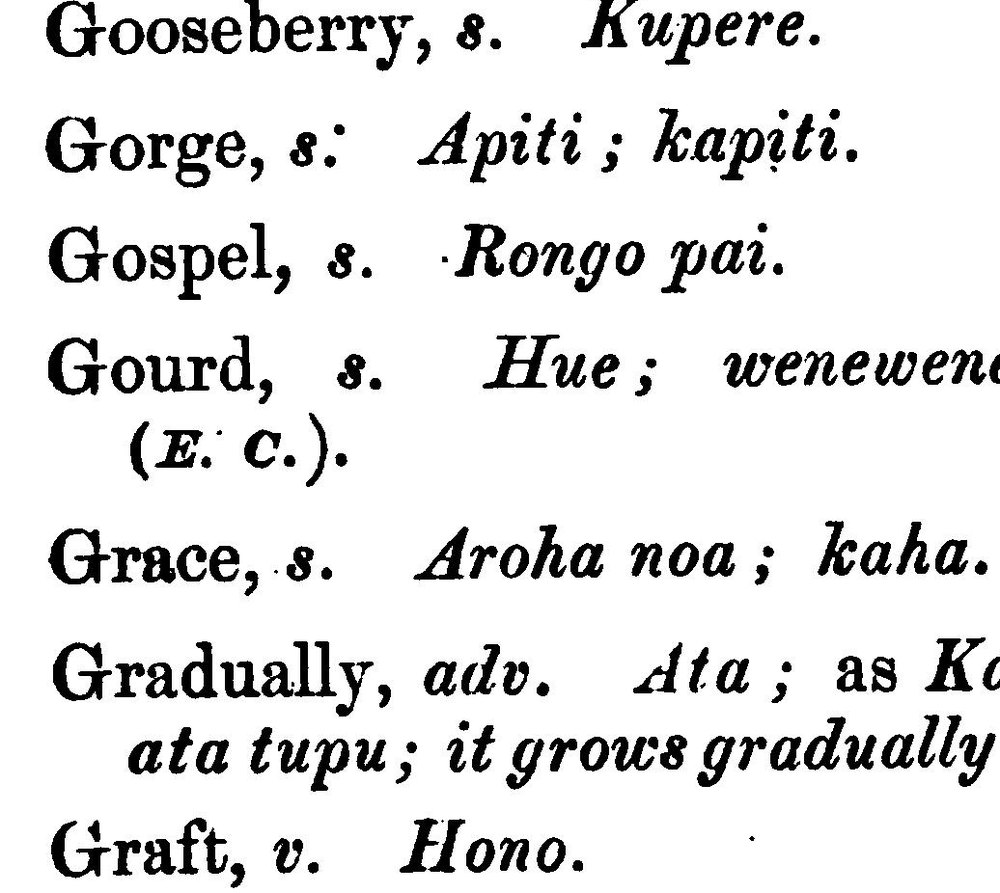
Williams, A Dictionary of the New Zealand Language, second edition, London 1852, page 263, English to Māori. Gooseberry, Gorge, Gospel, Gourd, Grace, Gradually, Graft. There is no entry for “Govern,” none for “Government,” and none for “Governor.” They would fall between Gourd and Grace. The third edition of 1871 has the same gap in the same place.
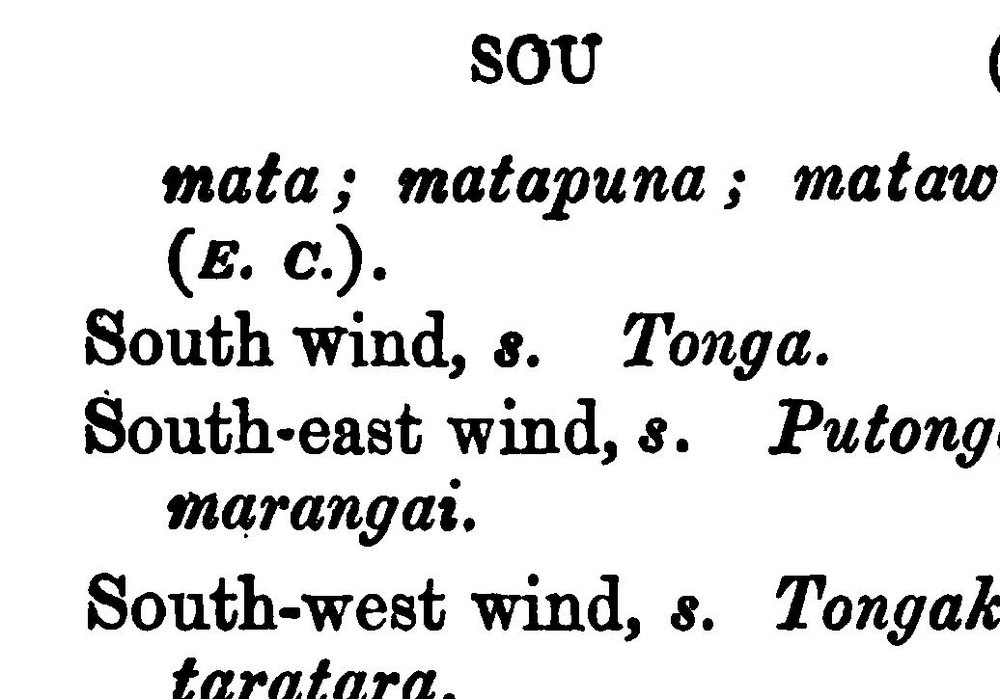
The same book, page 299. The entry running over from the foot of the previous page is Source; the next headword is South wind. There is no “Sovereign” and no “Sovereignty.” Again the 1871 edition matches.
So the missionary lexicon of 1852, twelve years after a Governor arrived and while one was still governing, offers no Māori for “governor” and none for “sovereignty.” That is not a claim about what the language could express. It is a fact about what the book contains, and you can see it.
What the same book does offer, in the same English-to-Māori half, is this.
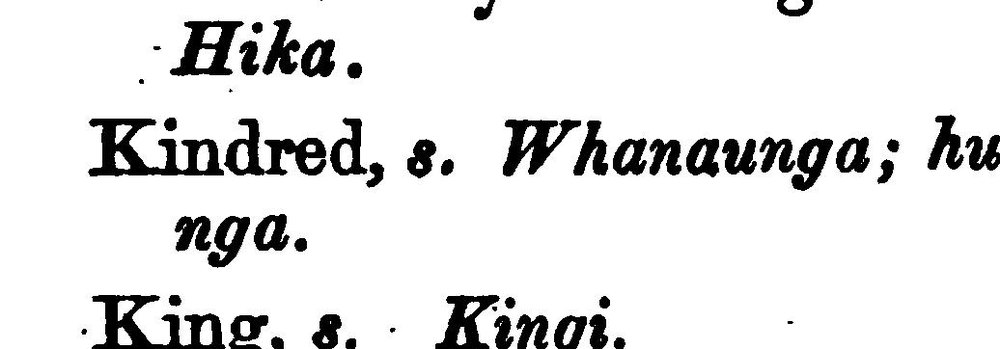
Page 271. “Kingdom, s. Rangatiratanga.” On page 251, the same book gives “Dominion, s. Rangatiratanga.” For “Authority” it gives Mana; take, and for “Power,” Mana; kaha; maru.
Read those together and the shape is hard to miss. The word the missionary dictionary gives for kingdom and for dominion is the word the Treaty uses for what the chiefs keep. The word it gives for authority and for power is the word that appears in the Treaty not at all. And the word the Treaty uses for what the chiefs give up is not in the dictionary in either direction.
It is not in the earliest one either. Kendall and Lee's Grammar and Vocabulary of the Language of New Zealand, London 1820, has no kawana: the run at that point is Ka wádu, Káware, Ka wa téa, then over the page to Kaweka. It has no rangatiratanga, only Ránga tíra ; A gentleman or lady. And its only mana is the pronoun: Mána ; For him. The noun is not there.
The first printed dictionary entry for the word, as far as we could find one, is in Ernst Dieffenbach's word list of 1843, and it is tagged:
Dieffenbach 1843, page 366
Kawana—governor (Angl.)
Kawanatanga — government (Angl.)
(Angl.) is Dieffenbach's own mark for a word borrowed from English. He uses it throughout. Dieffenbach was a naturalist, not a missionary, and compiled his list around 1839 to 1841, which makes it the only lexicon we obtained that is genuinely contemporary with the Treaty.
The limits of this instrument, stated plainly. Williams's first edition of 1844 is the one we wanted and could not get; no scan of it appears to exist online, and we exhausted every route we could reach. We used the second edition of 1852. That matters in one direction only: the English-to-Māori half is new in 1852, so “Kingdom, s. Rangatiratanga” is evidence about 1852 and not directly about 1840. An absence from the 1852 Māori-to-English half is good evidence of absence in 1844; a presence in 1852 is not evidence of presence in 1844. Everything above that we describe as read off a page, we read off a page image ourselves. A dictionary is also not a mind: it records what one compiler settled on, not what a speaker meant.
The asymmetryOne Māori text, and a lost English one
It is natural to imagine the two texts as equals: an English document and its Māori translation, one of each. The record is lopsided, and the lopsidedness is stranger than the lexical difference.
On the Māori side there is one text. It was read out on 5 February, debated, signed on 6 February, and then carried round the country on nine sheets, eight of them in Māori. More than five hundred signatures were gathered. Thirty-nine of them are on the English sheet, which was signed at Waikato Heads and at Manukau in March and April, not at Waitangi.
On the English side, the document that matters is missing. The English text printed in Schedule 1 of the Treaty of Waitangi Act 1975, and quoted whenever the Treaty's English is quoted, is not the paper Henry Williams translated from. Phil Parkinson's 2004 study of the drafts concludes it is a pre-translation draft with the date altered from the fifth of February to the sixth. The draft actually handed to Williams has been lost since at least 1869, when the Legislative Council formally asked for it and the Colonial Secretary's office replied that “The original draft (if any) is not on record.” It survives only through three transcripts made in 1840, all dated 5 February, whose preamble begins nothing like the sheet's: not “regarding with Her Royal Favor the Native Chiefs,” but “regarding with deep solicitude the present State of New Zealand.”
Parkinson puts the consequence bluntly, and it is worth having in his words: “There is no authenticated ‘translation of the Māori text’ from Henry Williams into English at all.” Hobson did send Gipps an English text certified by Williams as “as literal a translation of the Treaty of Waitangi as the idiom of the language will admit of.” It is not a translation of the Māori. It is another English draft.
So the shape of the thing is this. The text that hundreds of people signed is a single stable document in Māori. The text whose words are quoted when sovereignty is discussed is in English, exists in several states that differ from one another, and descends from a draft nobody has seen for over a century and a half. New Zealand's Parliament has said as much, in the preamble to the 1975 Act that gave the Treaty legal effect:
Treaty of Waitangi Act 1975, preamble
“And whereas the text of the Treaty in the English language differs from the text of the Treaty in the Maori language.”
And there is one more turn. In 1869 the Legislative Council, having failed to find the lost draft, ordered a careful translation of the Māori text back into English. T. E. Young of the Native Department did it. Where the English text says the chiefs cede “all the rights and powers of Sovereignty,” Young rendered the Māori as nga tikanga me nga mana katoa o te Rangatiratanga. The government's own translator, twenty-nine years on, reached for rangatiratanga to name the thing that had been given away, which is the same word the Treaty uses for the thing that was kept.
The limitWhat two texts cannot settle
Everything above is about words on paper. That is a narrow thing to be sure of, and it is worth being exact about how narrow.
A treaty is not only its text. The debate at Waitangi ran for a day, out loud, in Māori. Rangatira questioned Hobson and the missionaries and each other, and what was said in those speeches is part of the transaction and is not recoverable from the sheet. It is also the ground on which both sides of the modern argument stand: the Crown's case to the Waitangi Tribunal was that the oral explanations conveyed sovereignty, and the Tribunal's finding rests on the oral proceedings too, and goes the other way.
The best-known moment in that record is William Colenso's. Colenso had printed the treaty, knew the language, and was standing there when the first chief came forward to sign. He published his account in 1890, from notes; it is public domain, and it is worth reading in full rather than in summary, because the famous line is not the strongest one in it.
Colenso, The Authentic and Genuine History of the Signing of the Treaty of Waitangi, 1890
Mr. Colenso: “May I ask your Excellency whether it is your opinion that these Natives understand the articles of the treaty which they are now called upon to sign? I this morning” — —
The Governor: “If the Native chiefs do not know the contents of this treaty it is no fault of mine. I wish them fully to understand it. I have done all that I could do to make them understand the same, and I really don't know how I shall be enabled to get them to do so. They have heard the treaty read by Mr. Williams.”
Mr. Colenso: “True, your Excellency; but the Natives are quite children in their ideas… I have spoken to some chiefs concerning it, who had no idea whatever as to the purport of the treaty.”
Mr. Busby here said, “The best answer that could be given to that observation would be found in the speech made yesterday by the very chief about to sign, Hoani Heke, who said, ‘The Native mind could not comprehend these things: they must trust to the advice of their missionaries.’”
Note what Hobson does not say. He does not say the chiefs understand; he says that if they do not, it is no fault of his. And the sentence that concedes the most is Busby's, and Busby helped draft the thing. Against that: Colenso published fifty years later from his own memoranda, which he is known to have revised, and Crown counsel at the Tribunal pointed to “the shortcomings in Colenso's record.” He was there. We are not.
A word is not a dictionary entry. Showing that Kawanatanga renders “any function of Government” in 1835 is strong evidence about what the translators were doing. It is weaker evidence about what any particular rangatira heard. And the case cuts both ways: Pat Hohepa, a Māori-language authority, pointed out to the Tribunal that te Tiriti is about twenty sentences and under four hundred words, of which only thirteen are transliterations from English, and that such a document “would hardly be a matter that needed two days of intensive wananga to comprehend.” Against that, Waiohau Te Haara counted kāwana in about a hundred and sixty verses of the Māori Bible, the book those chiefs read most, and found it almost always named an office below a king, for which the usual word was rangatira.
The serious counter-argument is not the one you would guess. The strongest recent case for reconciling the texts, Ned Fletcher's The English Text of the Treaty of Waitangi (2022), does not argue that the chiefs ceded sovereignty and knew it. It argues that the English meant less than modern readers assume: that British officials in 1840 were not seeking to displace tribal government, so “sovereignty” in the English draft is narrower than it sounds and is reconcilable with tino rangatiratanga. Note where that leaves the two texts. It does not close the gap by making the Māori mean more.
And this page takes no position on the constitutional question. Whether sovereignty was ceded is live law and live politics in New Zealand, and no word count decides it. What the record contains is this. In 2014 the Waitangi Tribunal, reporting on stage one of its Te Paparahi o Te Raki inquiry, concluded that “the rangatira who signed te Tiriti o Waitangi in February 1840 did not cede their sovereignty to Britain,” and that they agreed instead to share power with the Governor. In the same report it said, in terms that are almost always dropped when the finding is quoted: “In drawing this conclusion, we say nothing about how and when the Crown acquired the sovereignty that it exercises today.” The finding covers the Bay of Islands and Hokianga signatories in February 1840, not all five hundred across nine sheets and seven months. On the day it was released the responsible minister said “There is no question that the Crown has sovereignty in New Zealand. This report doesn't change that fact.” Read carefully, those two statements do not contradict each other, and that is the single most often collapsed point in the whole dispute.
The Tribunal is a permanent commission of inquiry. Under the 1975 Act it has exclusive authority to determine the meaning of the two texts for the purposes of that Act; it recommends rather than orders, is barred from touching private land, and can bind only over certain categories of former Crown land. Its historical findings are authoritative within its remit and highly influential. They are not self-executing, and they are not a court's ruling on the law.
The textual argument itself is older than the Tribunal. It reached its modern form in Ruth Ross's 1972 article “Te Tiriti o Waitangi: Texts and Translations,” which is where the 1835 comparison, the missing English draft and the Young translation were all set out together, and which ends by calling the treaty “hastily and inexpertly drawn up, ambiguous and contradictory in content, chaotic in its execution.” Crown counsel at the Tribunal called her analysis “superficial.” Both of those are on the record, and we have printed the documents so that you can see what is being argued about.
The modeOne more treaty with two texts
This is the venue's first entry of a kind we have not built before: not an original and a translation, but two texts of equal standing that disagree. It is worth naming one other, because the comparison shows how unusual the New Zealand outcome is.
On 2 May 1889 Italy and Ethiopia signed the Treaty of Wuchale in Italian and Amharic. Article 17, in Italian, says the Emperor consente di servirsi of the Italian government for his dealings with other powers: he consents to make use of it. The Amharic verb is ይቻላቸዋል, which is not a permission granted but an impersonal possibility: it is possible for him to do so. One text creates an obligation; the other records an option. Italy notified the powers that Ethiopia was its protectorate. Menelik repudiated it, and in 1896 an Italian army was destroyed at Adwa.
What makes Wuchale the sharpest case is Article 19, which warrants that the treaty was drawn up in both languages and that “the two versions agreeing perfectly with each other,” both texts are official and have equal authority. A clause guaranteeing that the two texts agree, in a treaty whose two texts do not. When peace was finally made in 1896, the treaty was drawn up in Amharic and French. Italian was left out.
Set beside that, the New Zealand response is genuinely unusual. Other empires resolved the problem in advance by fiat: the 1858 Treaty of Tientsin simply provides that where the English and Chinese differ, the English shall be held correct. Wuchale resolved it by war. New Zealand did something else: in 1975 Parliament wrote the disagreement into the preamble of a statute, printed both texts in a schedule, and created a body to adjudicate between them. Whatever one thinks of how that has gone, it is a rarer answer than either of the others.
A note on the Littlewood document
Since we have said the pre-translation English draft is lost, we should say what happened when something looked like it. In 1992 a one-page English text dated 4 February 1840 surfaced from the Littlewood family; its wording matches the Māori text where the official English does not, giving “lands, dwellings and all their property” rather than “Lands and Estates Forests Fisheries.” It has been argued to be the missing draft.
It is not, and the reason is documentary rather than rhetorical. Its text is near-identical to a translation the US Consul James Clendon transcribed into a despatch of 20 February 1840, over Clendon's own memorandum that it was made “from the native document and not a copy of the official document in English from which the native one is made.” Clendon's transcript dates the treaty correctly to the sixth. In 2000 Phil Parkinson recognised the handwriting as Busby's, and the paper carries a W TUCKER 1833 watermark matching Clendon's own stock, including the first page of that despatch. It is a back-translation made at Clendon's house after the Māori text was printed, which is to say it cannot predate the thing it derives from.
Two things are worth keeping about this episode. The premise is sound, which is why it had traction: a draft really is missing. And the resolution took eight years and was not instant even to specialists. Claudia Orange wrote to the minister in 1992 that the explanation offered “does not entirely satisfy me as an historian. Although it could prove in the long run to be correct.” It did.
The check
Recomputed in your browser, from the paragraphs printed on this page:
- The 1840 Māori text contains no occurrence of kingitanga and no occurrence of mana.
- The 1835 Māori text contains both, once each.
- Kawanatanga occurs in both documents.
- Rangatiratanga occurs in both documents.
- Every keyed phrase in Instrument I is an exact substring of the text it is keyed to.
The offline verifier is research/te-tiriti/verify.mjs. It re-runs the same counts against this file, and checks every verbatim string against the source record in research/te-tiriti/sources.txt, which lists each witness and every place the witnesses disagree.
How we know, and what we could not check
The witnesses
- 1840, Māori. The Waitangi sheet, photographed by Archives New Zealand (CC BY 2.0), 3091 × 5788 px. Transcribed here from that photograph and set against the Church Missionary Society printing given in Buick 1914 and against the Wikisource transcription.
- 1840, English. The Waikato-Manukau sheet, in the Wikisource Validated transcription, the only transcription in our comparison that carries a two-editor scan-check. Quoted verbatim, including its seperate and Favor.
- 1835, Māori. The 1837 printing, photographed by Archives New Zealand (CC BY-SA 2.0), read here directly, and confirmed against the photograph of the signed 1835 manuscript. We could find no other scan-backed transcription of this text online.
- 1835, English. Buick 1914, public domain.
Three readings we settled at the image, and one we did not
Four published transcriptions of the English sheet disagree in places, and we went to the photograph for the disputed ones.
- seperate, sic. The sheet does read seperate, not separate, in Article the First. Three of the four transcriptions we compared silently correct it.
- “Article the first.” The sheet's article headings are lower-case: Article the first, underlined. The Wikisource transcription we quote capitalises them, which is the one place we read the sheet differently from the text we print; we have left its wording alone rather than emend a validated transcription on our own reading. The Waitangi Tribunal's endnote on the 1975 Act's schedule also gives lower-case.
- No commas. The sheet reads “the full exclusive and undisturbed possession,” with no commas. Later printings, Buick's among them, add them.
- Unsettled: capitalisation generally. In this hand the difference between a capital and a lower-case letter is often a matter of size alone, and we do not think a photograph settles it. Where capitalisation is the only thing at issue, we have followed our source and said so rather than adjudicate.
Two errors in a widely-copied transcription
The multilingual Wikisource transcription of the Waitangi sheet is flagged on Wikisource itself as not proofread. Two of its readings are wrong in ways that matter to anyone quoting it: the preamble's me nga notu should be me nga Motu (“and the islands”), and Article the Second's ne nga Rangatira should be me nga Rangatira. Both corrections are visible in the plates above and both are confirmed by the Church Missionary Society printing.
The lexicons
- Kendall and Lee, A Grammar and Vocabulary of the Language of New Zealand, London 1820. Māori to English only, so the “sovereignty” question cannot be put to it in that direction. Its accents mark stress, not vowel length.
- Dieffenbach, Travels in New Zealand vol. II, London 1843, the dictionary in part III chapter IX. A naturalist's word list compiled about 1839 to 1841. The only lexicon we obtained that is contemporary with the Treaty.
- Williams, A Dictionary of the New Zealand Language, second edition, London 1852, and the third edition of 1871. The first edition of 1844 is the one we wanted; no scan of it appears to be online and we could not obtain one. See the caveat in Instrument V for what that does and does not permit us to say. The 1871 edition's own editor prints a corrigenda leaf lamenting “the deplorable number of typographical errors which disfigure its pages,” so we have leaned on 1852 and used 1871 only to confirm.
- All the dictionary readings we describe were read off page images at full resolution, not off OCR. Where we say a word is absent, we mean we read the printed run either side of where it would fall.
The scholarship
- The 1835 comparison, the missing English draft, and the 1869 Young translation are all set out together in Ruth Ross, “Te Tiriti o Waitangi: Texts and Translations,” New Zealand Journal of History 6(2), 1972, 129–157. In copyright; quoted here briefly and attributed.
- The drafting sequence, the identification of the lost draft, and the Littlewood note come from Phil Parkinson, “Preserved in the Archives of the Colony”: The English Drafts of the Treaty of Waitangi, NZACL Yearbook 10, 2004, published openly by Victoria University of Wellington.
- The Tribunal material is from He Whakaputanga me te Tiriti / The Declaration and the Treaty: The Report on Stage 1 of the Te Paparahi o Te Raki Inquiry (Wai 1040, 2014), which we read in full text. The finding quoted is from its summary of conclusions; the “we say nothing about how and when” sentence is from the same chapter.
- The Act's preamble and the Tribunal's powers are from the Treaty of Waitangi Act 1975 as reprinted 13 December 2016. New Zealand's own legislation site refused our requests; we used the ILO NATLEX reprint.
- Colenso 1890 is public domain. We used a full transcription rather than a scan, because the scanned edition was behind a block; the wording is corroborated by the fragments quoted independently in Ross and in Parkinson, but we have not given page numbers, because we could not collate against the printed page.
- For Wuchale: the Italian text of article 17 and article 19 from a published transcription of the treaty; the Amharic verb form and its analysis from Hatem Elliesie, “Amharisch als diplomatische Sprache im Völkervertragsrecht,” Aethiopica 11, 2008, 235–244, which corrects even the specialist transcription. We could not find a facsimile of the Amharic original anywhere on the open web, and say so rather than imply we had one.
What we did not do
- We did not use Sir Hugh Kāwharu's 1989 English translation of the Māori text, which is the version most often quoted in New Zealand public life. It is in copyright in New Zealand until at least the end of 2056, and the argument here does not need it: the 1835 document supplies its own English.
- We did not attempt to establish what any signatory understood, and we do not think the documents can establish it.
- We did not count the signatures. “More than five hundred, of whom thirty-nine signed the English sheet” is the figure every source we checked agrees on; published totals range from “more than 500” to about 544, and we have not repeated anyone's count of nine sheets of handwriting.
- We did not reach the 1877 Facsimiles edition, which would settle several small readings at once. New Zealand's National Library, Archives New Zealand, NZETC, Te Ara, the NZJH archive and NZLII all refused our requests, so several citations here rest on mirrors, which we have named.
- We did not read Fletcher's 2022 book; the summary of its argument comes from reviews and interviews and is labelled as such here.
Images
All four photographs are by Archives New Zealand, via Wikimedia Commons. The two Treaty sheets are CC BY 2.0; the two He Whakaputanga images are CC BY-SA 2.0. Crops and a modest contrast increase are the only changes made. Full-resolution originals and the crop coordinates are recorded in research/te-tiriti/.
Corrections
Corrected 2026-10-18: This page said that eight other sheets carry the same Māori text as the Waitangi sheet. Of the eight other sheets, one is the English Waikato-Manukau sheet, so seven carry the Māori text, as this page's own count of nine sheets, eight of them in Māori, already implies (Wikipedia, Treaty of Waitangi, lists the eight additional copies, among them the Waikato-Manukau copy) (found by the assay sweep, 2026-10-18).
Corrected 2026-10-18: This page said that all five photographs are by Archives New Zealand. There are four: the two Treaty sheets and the two He Whakaputanga images, as the same sentence goes on to say and as the source record in research/te-tiriti/sources.txt lists them (found by the assay sweep, 2026-10-18).