The Verification Venue · the Artificial Wasteland
I Have Not Counted Them
Henry Dudeney's The Canterbury Puzzles (1907) answers with certainty: the fewest possible moves, the only way, just so many ways. The Artificial Wasteland pulled 187 claims from it and tested 183 against programs and kept sources. 148 hold; among the rest are two misprints, a stamp missing from his own list, and the plum-pudding routes he admitted he had not counted. There are fourteen, and he had found them all.
Fourteen
A guest brought sixty-four plum puddings drawn on a sheet of paper, eight rows of eight. Put your pencil on the pudding in the top corner, the one with a sprig of holly, and strike out all sixty-four in twenty-one straight strokes, up, down or across but never diagonally, and never through a pudding twice; the steaming pudding must come at the end of the tenth stroke, and the other sprig of holly, in the bottom row, last of all. Henry Ernest Dudeney printed it in 1907, and his answer was sure of itself: “It is the only way within the conditions laid down.” In the second edition, in 1919, the same answer goes on: “There are a good many different routes for passing from one sprig of holly to the other in the smallest possible number of moves—twenty-one—but I have not counted them.” “I have recorded fourteen of these, and possibly there are more.” And of the steaming pudding: “I am not aware of more than one solution to this puzzle; but as I may not have recorded all the tours, I cannot make a positive statement on the point at the time of writing.”
There are no more. A search of every route that strikes out all sixty-four once, from one holly to the other, all 2,184,565 of them, finds that fourteen take twenty-one strokes and none takes fewer. The fourteen he recorded by hand were all of them. Exactly one of the fourteen ends its tenth stroke on the steaming pudding, and it is his: the sentence of 1907 was right.
The hollies are ringed in green and the steaming pudding in red; the dot marks where each route's tenth stroke ends. Of the 2,184,565 routes, 76 take twenty-two strokes and 220 take twenty-three; the commonest length is 38 strokes, with 208,394 routes. From one corner to the opposite corner, which he says cannot be done, there are no routes at all.
The fewest possible moves
The Canterbury Puzzles first appeared in 1907 and again, with fuller solutions and new notes, in 1919. The conceit is that Chaucer's pilgrims, riding to Canterbury, each set the company a puzzle, and Dudeney supplies the answers. The answers are confident. Again and again they say how many: the fewest possible moves, the only way it can be done, just so many different ways. A claim of that kind is a promise a program can hold him to.
The Artificial Wasteland read the whole book, puzzles and solutions, and pulled out the statements a program or a source could settle: 187 claims from 92 of its 114 puzzles and its introduction (a few it did not take up are named at the end), each quoted below in his own words with the line it stands on in Project Gutenberg's transcription of the 1919 edition. Arithmetic, and any search small enough, runs again on this page, in your browser, when you ask it to. The drawings a check needs, all but one, were transcribed twice, by two readers who never saw each other's work; their readings agreed on nineteen of twenty puzzles, and the twentieth was settled by reading the picture again. Five searches too large for a browser were run once in compiled code, each by two separately written programs, and kept; sums of cubes went to PARI/GP and mwrank. His claims about the world, quotations and dates and postage stamps, were held to sources fetched and kept beside the page.
148 of the 187 hold. That deserves saying first, because the man was working with a pencil: 894,348 ways to put 500 pennies in four bags; 575 squares with a rose at every corner on a shield of eighty-seven roses, 396 of them standing on a corner; twenty-six moves to reverse a toy train, and his four printed stages of it reached in exactly the moves he gives; 118 moves for the Frogs' Ring, and a formula for any number of frogs that holds for every number tried, from two a side to eight.
The first puzzle is the Reve's: move a pile of cheeses from one stool to another, one at a time, never a larger on a smaller, with four stools instead of the three of the Tower of Hanoi. Dudeney: “The 8 cheeses can be removed in 33 moves”. Click a stool to lift its top cheese and another to set it down. His “and 21 cheeses in 321 moves” was confirmed by Richard Korf's computer search in 2004 and proved, for any number of cheeses, by Thierry Bousch in 2014. With five stools his table is proved by computer up to twenty cheeses (Hinz and Petr, 2016) and is still unproved beyond.
Where the book and the program part
The ribbon that does not turn misprint
Puzzle 83 asks for a number written on a ribbon which, multiplied, gives back the same figures round the ring. His answer is the repeating decimal of one forty-seventh, which, he says, “may be multiplied by any number up to 46 inclusive to give the same order of figures in the ring”. The number printed in the solution is not quite it. Its forty-first figure is printed 3 where the period of one forty-seventh has 8, and as printed it keeps its ring under no multiplier from 2 to 46 but 10, which only carries the leading nought round: doubled, it is a different string of figures. The slip is in the type, not in the transcription: the 1908 American printing and the 1919 London one both have it.
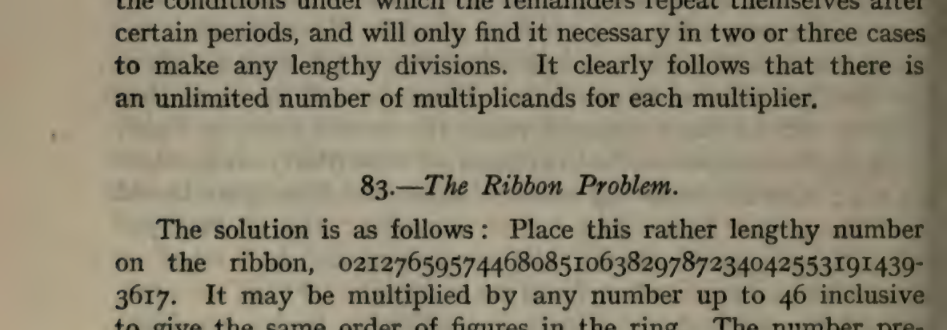
He also left a question open: whether, if the multipliers need only run from 2 to 9, “a short period circulator might give a solution in fewer figures”. They cannot. Searching every number whose figures repeat in a cycle shorter than 46 finds only his first ribbon of 16 figures and that ribbon written twice (32 figures).
Eleven for one misprint
The Frogs' Ring is right in every number. Twelve frogs, six of each colour, cross a ring of thirteen places to change sides, and the fewest moves are 118; his own 118 moves, played on the ring as drawn, are legal at every step and never leave a choice. His formula for n frogs of each colour, 3n² + 2n − 2, gives the fewest for every n searched, two to eight, and so does n² + 4n + 2 for the variant he adds. But the sentence that introduces the variant reads: “If, instead of 11 and 12 changing places, the 6 and 7 must interchange”. The puzzle's condition was that 1 and 12 change places. Eleven and twelve are both black frogs moving the same way round, and can never pass each other. The paragraph is new in 1919; the 1908 printing ends before it.

A stamp not on his own list fails
Puzzle 68 asks for ten current postage stamps in a magic square of ninepence. His answer uses a 4½d. stamp. His own list, a page later, of “the stamps at present in circulation”, has no 4½d. With only the stamps on that list the puzzle has no answer at all: a magic square of ninepence has threepence in the middle and four pairs of cells making sixpence through it, and the list can make only two such pairs from single stamps, so a second two-stamp cell or a second repeated value would be needed, and the puzzle allows one of each.
The list itself is the Post Office's. Its seventeen values are exactly those the Post Office Guide of 1 January 1902 says are issued, the £5 included. By July 1904 the Guide had dropped the £5, and in July 1919, the year of the second edition, it listed fifteen values, without the £1 or the £5 out of date. The 4½d. of his answer was a Victorian stamp of 1892, still good for postage in 1907; every Victorian stamp was invalidated on 30 June 1915. His coins fare better: the fifteen in his coinage square include three double florins, struck only from 1887 to 1890, but legal tender then and never called in holds.
Fifty-nine figures, fifty-eight figures fails
Puzzle 45's cellarer drew a pint from a hundred-pint cask thirty times, each time topping it up with water. Dudeney gives what he stole to fifty-eight decimals, and all fifty-eight are right. In the same paragraph he says the sum is “a number composed of 59 figures to be divided by a number composed of 58 figures”. The thirtieth power of 99 has 60 figures and the twenty-ninth power of 100 has 59.
Where it turns on how the puzzle is read
Five islands, ten courses turns on a reading
The Shipman sails each of the ten courses between his five islands once a year, “always setting out from the same island”, and asks in how many ways. Dudeney: “There are just two hundred and sixty-four different ways in which the ship Magdalen might have made her ten annual voyages without ever going over the same course twice in a year.” From one island there are 528. His number is the count when a year's voyages and the same voyages sailed in the opposite order are taken as one way; the puzzle fixes the island and says nothing either way about the direction. His other claim, that every such year ends where it began, holds for all 528.
Three in a line turns on a reading
Ovid's game is played on nine points with three counters a side, placed in turn and then moved along the lines, to get three in a line. Both readers of the drawing find no diagonal lines on it, so a counter moves only along rows and columns. Whether three on a diagonal wins is not drawn and not said. Solved both ways: if it does, every word of his answer is exact, for the first player wins by opening in the centre and by no other opening, and with the centre barred the game is drawn, with only the two corners next to the first one keeping it so, as he says. If only rows and columns count, the centre opening wins nothing; every opening is drawn.
The Cook's 145 turns on a reading
Eleven diners, four portions each of pie and pasty: in how many ways may the Franklin “choose whom he will serve”? Dudeney says 145 and warns that a great many people answer 185. Both numbers are right, for different questions: 145 is the number of ways to choose which eight are served, 185 the number of ways to decide who eats which dish. His wording asks the first.
A word with no vowel turns on a reading
The Secret Lock opens at a three-letter word, a letter from each of three dials. The only vowel on any dial is Y, and Dudeney reasons that “there is no English word composed of consonants alone”, so the word is PYX. The dials also spell CWM, a glacial hollow; Scott's Last Expedition (1913) has “many cwms on the lower ranges”. PYX is the answer if a word borrowed from Welsh does not count.
Twelve ways, if No. 1 keeps one end turns on a reading
The tea merchant “always keeps No. 1 at one end of the row”. Dudeney's 12 orders, and from them his 93,312 and 91,584, hold if that means the same end every time; if either end will do there are 24.
A square window turns on a reading
Sir Hugh wants a window one foot every way, barred into eight lights “whose sides shall be all equal”, and the answer is that it must be diamond-shaped, “as it is most certain it never could be” square. If each light only needs its own sides equal, a square works: one light nine inches square and seven three inches square fill it exactly.
Out of date in its own pages
Only eleven out of date
The introduction says “The only number composed only of ones that we know with certainty to have no divisor is 11.” True in 1907. The 1919 printing kept the sentence and added a footnote reporting that Oscar Hoppe had since proved the nineteen-ones number prime. This page's own check proves it too, by a Miller-Rabin test with the first thirteen primes as bases, which is a proof for every number below 3,317,044,064,679,887,385,961,981.
What he could not know
The spider at two to six feet answered here
The spider is a foot below the ceiling at one end of a room 30 by 12 by 12, the fly a foot above the floor at the other; the obvious crawl is 42 feet and the shortest, over five of the room's six faces, is 40. He closes: “I will leave the reader to discover which are the shortest routes when the spider and the fly are 2, 3, 4, 5, and 6 feet from the ceiling and the floor respectively.” Here they are, every unfolding of the room tried and kept only where the straight line really crosses each fold.
1 ft: 40 ft; 2 ft: 41.231 ft; 3 ft: 41.785 ft; 4 ft: 42 ft; 5 ft: 42 ft; 6 ft: 42 ft. From four feet on, the obvious route over the ceiling, always 42 feet, cannot be beaten.
Two cubes that make nine holds
The Doctor of Physic wants two phials together holding as much as phials one and two feet round: two fractions whose cubes add to nine. Dudeney's pair has twelve-figure numbers, and he says no one had published so small a one. No one could: every rational answer is a multiple, under the curve's own addition, of the obvious 2 and 1, and his is the smallest positive one after it (PARI/GP and mwrank, kept). Fermat's route to an answer takes three tangents from 1 and 2 and ends on a denominator of 21 figures, as Dudeney says. He says he found “by trial a negative fundamental solution in smaller figures”; there is one, 919 cubed less 271 cubed is nine times 438 cubed (Lucas had printed it in 1876), and the tangent there gives his pair exactly. And “We can say of any number up to 100 whether it is possible or not to express it as the sum of two cubes, except 66.” J. W. S. Cassels (1950) and Ernst Selmer (1951) proved that 66 is not the sum of two rational cubes, and the curve's rank of nought is proved again here. The rest of the sentence was not so fails: the list he relied on, Sylvester's, had 31 and 67 as impossible and 73 as possible, and all three are the other way round, as Selmer found and the curves computed here agree.
Nineteen ones, twenty-three ones settled since
“The factors when n= 19, 23, and 37 are unknown, if there are any.” Today: nineteen ones is prime, twenty-three ones is prime, and thirty-seven ones is 2028119 x 247629013 x 2212394296770203368013, all settled by this page's own arithmetic in a moment.
Questions the century answered settled since
“But how many magic squares may be formed with the 25 numbers, 1 to 25, nobody knows”: 275,305,224, turnings and reflections aside: counted by Richard Schroeppel’s program in 1973. A knight's tour of the chessboard whose ranks and files all add alike, and its diagonals too, “it is not certain that it cannot be done”: It cannot be done: a search of every possibility, finished on 5 August 2003, found 140 semimagic knight’s tours and no magic one. Sixteen trees in fifteen rows of four, his “pious opinion” that fifteen cannot be beaten: right, by computer searches of 2008 to 2010, though no refereed paper proves it. The Haberdasher's triangle cut into four pieces that make a square: four is the fewest if pieces may not be turned over: no dissection into three or fewer polygonal pieces exists (Demaine, Kamata and Uehara, 2024; ITCS 2026).
What he said about the world
The book quotes, dates and names, too. A program cannot read old print, but every source below was fetched, kept beside the page, and checked again by the verifier for the words quoted from its text copies; page images were read by eye.
- quoted loosely Mr. Tulliver. “he was accustomed to make the trite remark, "It's a puzzling world."” George Eliot: "This was a puzzling world, as he often said"; Mr. Tulliver himself: "This is a puzzlin’ world." The habit is in the novel (The Mill on the Floss, Book First, chapter III); the words in his quotation marks are not.
- quoted loosely Fitzosborne on puzzles. “Here is an extract: "The ingenious study of making and solving puzzles is a science undoubtedly of most necessary acquirement, and deserves to make a part in the meditation of both sexes.” Melmoth’s letter has "making and solving riddles" and "the education of both sexes"; the book has puzzles and meditation. Letter V, "To Timoclea", in the Letters of Sir Thomas Fitzosborne (1748 printing). The closing maxim, "he who knows not how to riddle knows not how to live", is his word for word; three sentences and the end of a fourth are cut without a mark.
- turns on a reading Solomon. “Solomon himself, who may be supposed to have been as sharp as most men at solving a puzzle, had to admit "there be three things which are too wonderful for me” The words are the King James Bible’s, Proverbs 30:18-19, word for word. The chapter opens "The words of Agur the son of Jakeh". They are Solomon’s only on the rabbinic reading of Agur as one of his names (Jewish Encyclopedia, vol. I, 1901).
- fails Chaucer's moon. “the moon's altitude (she being in mid-Libra) was steadily increasing” Chaucer: "Ther-with the mones exaltacioun, I mene Libra, alwey gan ascende": it is the sign Libra that rises, and the moon is not put in it. The moon "in mid-Libra" comes from a manuscript slip ("In mena Libra") that Skeat called a "rotten basis" for any calculation. The correspondent’s 3.58 p.m. was not checked.
- turns on a reading The day the pilgrims left. “the pilgrimage set out from Southwark on 17th April 1387” The day and the year are Skeat’s reckoning (1868), from the eighteenth day of April named in the Man of Law’s Prologue; Chaucer names no year. Skeat: "The year may be supposed to be 1387". The book gives it as a fact here and as a supposition at No. 29.
- fails Abracadabra. “To-day we know that Abracadabra was the supreme deity of the Assyrians” The earliest use, in Serenus’s Liber Medicinalis, prescribes the word against a fever and names no god. The 1911 Britannica ties it to the Gnostic Abraxas; Wiktionary calls its origin unknown. The one match found is Brewer’s Dictionary of Phrase and Fable: "It is said that Abracadabra was the supreme deity of the Assyrians." Brewer says it is said; the book says "To-day we know".
- fails Nine men's morris. “referred to by Shakespeare in _A Midsummer Night's Dream_ (Act ii., Scene 2)” Act II, Scene 1, in Titania’s speech: "The nine men’s morris is fill’d up with mud" (2.1.101 in the Folger edition).
- fails Kayles. “Kayles—derived from the French word _quilles_” Skeat’s Etymological Dictionary (1910): "Of O. Low Ger. origin; Du. kegel", with French quille itself from the German word. The book follows Strutt’s Sports and Pastimes (1801) almost word for word ("derived from the French word quilles"). Wiktionary also gives Middle English keyle, akin to Dutch kegel. The Oxford English Dictionary was not consulted.
- quoted loosely Prince Henry's chessboard. “The following version of the incident is taken from Hayward's _Life of William the Conqueror_, published in 1613” Hayward’s Lives of the III. Normans (1613) has the French King "lying at Conflance" (the book prints Constance), and Louis "called him the sonne of a bastard", a clause the quotation drops without a mark. The book is The Lives of the III. Normans, Kings of England, not a Life of William the Conqueror; the passage is in its life of William the First.
- holds Lewis Carroll's diary. “Sat up last night till 4 a.m., over a tempting problem, sent me from New York, 'to find three equal rational-sided right-angled triangles.' I found two ... but could not find three!” Collingwood’s Life and Letters of Lewis Carroll (1898) prints the diary for 19 December 1897: "Sat up last night till 4 a.m., over a tempting problem, sent me from New York, "to find 3 equal rational-sided rt.-angled triangles." I found two, whose sides are 20, 21, 29; 12, 35, 37; but could not find three." The book writes out "3" and "rt.-angled" and ends on an exclamation mark; its omission is marked.
- holds Montucla. “No more than three right-angled triangles, equal to each other, can be found in whole numbers, but we may find as many as we choose in fractions” Hutton’s English edition of Montucla’s Ozanam, Recreations in Mathematics (1803), vol. I, p. 54: "No more than three rightangled tringles, equal to each other, can be found in whole numbers; but we may find as many as we choose in fractions or mixt numbers". The statement itself is wrong, as this puzzle’s answer shows: four triangles share the area 341,880.
- holds Jaenisch. “Jaenisch, in his Analyse Mathematique au jeu des Echecs (1862), quotes the statement that there are just twenty-one solutions” W. Ahrens (1910) says the same: "Die Angabe bei Jaenisch, l. c., p. 260, es gebe 21 Stammlösungen für diesen Fall, ist jedenfalls unrichtig." At second hand: Jaenisch’s own page (Traité, vol. 3, 1863, p. 260) was not reached. Ahrens counts 17, as the book does, and so does OEIS A002567.
- holds The Royal Society. “I exhibited this problem before the Royal Society, at Burlington House, on 17th May 1905” Year-book of the Royal Society (1906), p. 144: "36. Exhibited by Mr. H. E. Dudeney. A new Problem on Superposition." At the conversazione at Burlington House on 17 May 1905 (p. 140). The showing at the Royal Institution was not checked.
Newton's oxen holds
Dudeney credits Newton's Universal Arithmetic with splitting the grazing oxen in two, those that eat the grass already grown and those that eat the growth, and Newton does. His own worked example asks how many oxen will eat 36 acres in 18 weeks and answers 36, which is right for 24 acres; for 36 acres it is 54. The English edition of 1720 prints it so, and in the Wellcome Library's copy someone has written 54 above the printed answer by hand; the second edition, of 1728, asks about 24 acres.

The card-sharper's game
Puzzle 79 is a swindle from the racecourse: twenty-four cards, four each of one to six, turned in turn and added; whoever makes thirty-one wins, and whoever cannot play without passing it loses. Dudeney: “By leading with a 5 the first player can always win.” “The first player may also win by leading a 1 or a 2, but the play is complicated.” The program played every possible game. Leading a 1, a 2, a 5 wins; every other lead loses against best play. The sharper below plays perfectly.
Every claim
All 187, in the book's order. Green means the check found exactly what Dudeney says; red, that it did not; amber, that the claim holds on one reading of the puzzle and not another; violet, a misprint, a loose quotation or a sentence the years overtook; blue, a question he left open, answered here or settled by others since; grey, a question still open, or a claim this page did not test, with the reason. The checks marked to run will run in your browser, now.
-
Introduction quoted loosely
“he was accustomed to make the trite remark, "It's a puzzling world."”
Mr. Tulliver's habitual remark was "It's a puzzling world." Found: George Eliot: "This was a puzzling world, as he often said"; Mr. Tulliver himself: "This is a puzzlin’ world."
The habit is in the novel (The Mill on the Floss, Book First, chapter III); the words in his quotation marks are not.
-
Introduction turns on a reading
“Solomon himself, who may be supposed to have been as sharp as most men at solving a puzzle, had to admit "there be three things which are too wonderful for me”
The three things too wonderful are Solomon's words. Found: The words are the King James Bible’s, Proverbs 30:18-19, word for word.
The chapter opens "The words of Agur the son of Jakeh". They are Solomon’s only on the rabbinic reading of Agur as one of his names (Jewish Encyclopedia, vol. I, 1901).
-
Introduction quoted loosely
“Here is an extract: "The ingenious study of making and solving puzzles is a science undoubtedly of most necessary acquirement, and deserves to make a part in the meditation of both sexes.”
This is an extract from the letters of Fitzosborne. Found: Melmoth’s letter has "making and solving riddles" and "the education of both sexes"; the book has puzzles and meditation.
Letter V, "To Timoclea", in the Letters of Sir Thomas Fitzosborne (1748 printing). The closing maxim, "he who knows not how to riddle knows not how to live", is his word for word; three sentences and the end of a fourth are cut without a mark.
-
Introduction holds
“the prize being thirty sheets and thirty changes of garments for a correct solution”
Samson's prize for the answer was thirty sheets and thirty changes of garments. Found: Judges 14:12: "then I will give you thirty sheets and thirty change of garments".
It was a wager both ways: had they failed, they owed him the same (14:13).
-
Introduction settled since
“Nobody in the world knows yet whether that number has a divisor or not.”
Whether the number written with nineteen ones has a divisor was unknown. Found: nineteen ones is prime
The book's own footnote reports Oscar Hoppe's proof, given to the London Mathematical Society in 1917 and 1918 (Dickson, History, vol. I, p. 179).
-
Introduction holds
“The number composed of seventeen ones, 11,111,111,111,111,111, has only these two divisors, 2,071,723 and 5,363,222,357”
Seventeen ones is 2,071,723 times 5,363,222,357, and both are prime. Found: product checked, both prime
-
Introduction out of date
“The only number composed only of ones that we know with certainty to have no divisor is 11.”
Eleven was the only repunit known to be prime. Found: nineteen ones is prime
true when first written (1907); the same 1919 printing reports in a footnote that the nineteen-ones number had been proved prime
-
Introduction holds
“there is only one way of doing it, for we do not count as different the arrangements obtained by merely turning round the square and reflecting it in a mirror”
The numbers 1 to 9 make exactly one magic square, turnings and reflections aside. Found: 1
-
Introduction holds
“there are just 880 different ways of doing it, again not counting reversals and reflections”
The numbers 1 to 16 make exactly 880 magic squares, turnings and reflections aside. Found: 880
-
Introduction settled since
“But how many magic squares may be formed with the 25 numbers, 1 to 25, nobody knows”
The number of 5 by 5 magic squares was unknown. Found: 275,305,224, turnings and reflections aside: counted by Richard Schroeppel’s program in 1973.
OEIS A006052; Schroeppel’s own 1991 letter gives it as "4 * 68826306". Martin Gardner published it in 1976 (per Walter Trump).
-
Introduction holds
“exactly 174,240 such squares may be formed of one particular restricted kind only—the bordered square, in which the inner square of nine cells is itself magic”
There are 174,240 bordered magic squares of the numbers 1 to 25. Found: 174240
1393920 counting each turning and reflection
-
Introduction settled since
“with the exception of the two diagonals, which so far have baffled all efforts. But it is not certain that it cannot be done.”
Whether a knight's tour of the chessboard can be fully magic was unknown. Found: It cannot be done: a search of every possibility, finished on 5 August 2003, found 140 semimagic knight’s tours and no magic one.
The search ran J. C. Meyrignac’s program; MathWorld reported it on 6 August 2003.
-
Introduction holds
“as Leland tells us, was an "ingenious mathematician"”
Leland called Chaucer an ingenious mathematician. Found: Leland: "hinc ingenioſus mathematicus" (Commentarii de Scriptoribus Britannicis, ed. Hall, 1709, p. 420).
-
1. The Reve's Puzzle holds
“The 8 cheeses can be removed in 33 moves”
Eight cheeses on four stools need 33 moves, and no fewer. Found: 33
every one of the 65536 placings of eight cheeses on four stools searched, breadth first
-
1. The Reve's Puzzle holds
“10 cheeses in 49 moves”
Ten cheeses on four stools need 49 moves, and no fewer. Found: 49 moves, and no fewer
Every position of ten cheeses on four stools searched (a breadth-first search in C, checked against a second program); there are 2,178 shortest solutions.
-
1. The Reve's Puzzle settled since
“and 21 cheeses in 321 moves”
Twenty-one cheeses on four stools need 321 moves, and no fewer. Found: 321 moves, and no fewer
Too many positions to search here; the count is the Frame-Stewart number. Richard Korf's search of 2004 verified the shortest solutions up to 24 cheeses, and Thierry Bousch proved in 2014 that the Frame-Stewart numbers are the fewest for four stools and any number of cheeses (sources/world/math/FINDINGS.md, 1 and corrections). Searched here up to ten.
-
1. The Reve's Puzzle still open
“This table will at once give solutions for any number of cheeses with three stools, for triangular numbers with four stools, and for pyramidal numbers with five stools.”
With five stools, 1, 4, 10, 20, 35, 56 and 84 cheeses need 1, 7, 31, 111, 351, 1023 and 2815 moves. Found: 1, 7, 31 and 111 moves for 1, 4, 10 and 20 cheeses are the fewest (searched here up to ten; confirmed by computer up to twenty by Hinz and Petr); 351, 1023 and 2815 are the Frame-Stewart numbers for 35, 56 and 84
That the Frame-Stewart numbers are the fewest for five stools is still unproved beyond twenty cheeses (Hinz and Petr, Electronic Notes in Discrete Mathematics 53, 2016; sources/world/math/FINDINGS.md, corrections).
-
1. The Reve's Puzzle holds
“In these cases there is always only one method of solution—that is, of piling the cheeses.”
For a triangular number of cheeses on four stools, only one way of piling them gives the fewest moves. Found: for 3, 6 and 10 cheeses on four stools, every shortest solution builds the same piles of the same cheeses (for ten: 1 to 6, then 7 to 9)
The method of piling is unique, as he says; the moves themselves can be played in 1, 4 and 144 different orders.
-
2. The Pardoner's Puzzle holds
“visit all the other towns once, and once only, in fifteen straight pilgrimages”
All 64 towns can be visited once each in fifteen straight lines, as his route shows. Found: 64 towns, 15 straight lines
every leg runs along roads, the missing road is not used, and no town is entered twice
-
3. The Miller's Puzzle holds
“As the Miller has stipulated in effect that as few bags as possible shall be moved, there is only one answer to this puzzle”
Only one arrangement works with the fewest sacks moved. Found: ["2, 78, 156, 39, 4"]
-
3. The Miller's Puzzle holds
“only five of the sacks need be moved”
Five sacks moved is the fewest. Found: 5
-
3. The Miller's Puzzle holds
“There are just three other ways in which they might have been arranged (4, 39, 156, 78, 2; or 3, 58, 174, 29, 6; or 6, 29, 174, 58, 3), but they all require the moving of seven sacks.”
Exactly three other arrangements work, each moving seven sacks. Found: {"arrangements":4,"othersMoved":[7,7,7]}
-
4. The Knight's Puzzle holds
“The Knight declared that as many as 575 squares could be marked off on his shield, with a rose at every corner.”
The 87 roses on the shield are the corners of 575 squares. Found: 575 squares (396 of them tilted) on 87 roses
-
6. The Host's Puzzle holds
“It is a knotty little problem and a fascinating one. A good many persons to-day will find it by no means an easy task. Yet it can be done.”
A true pint can be put into each measure with no other vessel, as his steps do. Found: his 13 steps work; the fewest are 13
without letting the cask run dry (so that it can serve as a measure), no sequence ends with a pint in each measure
-
7. The Clerk of Oxenford's Puzzle holds
“It will be found that the four columns, four rows, and two long diagonals now add up to 34 in every case.”
His four pieces reassemble into a magic square adding to 34. Found: four pieces cut along the lines; two stay put and two change places, and all ten lines add to 34
Read from the drawing by one reader only (transcribe/RECONCILED.md).
-
8. The Tapiser's Puzzle not checked
“while one of the pieces contains only twelve of the little squares”
Twelve squares is the smallest a third piece can be.
That no three-piece cutting has a smaller third piece would need a search of every cutting along the lines; it was not made.
-
10. The Puzzle of the Squire's Yeoman holds
“The illustration will show how three of the arrows were removed each to a neighbouring square on the signboard of the "Chequers" Inn, so that still no arrow was in line with another.”
His three moves leave no two arrows in line. Found: no two of the nine in line before or after; 1 way of doing it in all
-
11. The Nun's Puzzle holds
“CYASNPTREIRMBLUIRG, which is the required arrangement for the cards”
Dealt table, bottom, table, bottom, this pack spells CANTERBURY PILGRIMS. Found: CYASNPTREIRMBLUIRG
-
12. The Merchant's Puzzle holds
“The least number is 7,560.”
7,560 is the smallest number with exactly 64 divisors. Found: 7560
-
12. The Merchant's Puzzle holds
“The stipulation as to "no more" was not necessary in the case of my puzzle, for no smaller number has more than sixty-four divisors.”
No number below 7,560 has more than 64 divisors. Found: 60
the most divisors any number below 7560 has is 60
-
12. The Merchant's Puzzle holds
“the smallest number that has seven divisors and no more is 64, while 24 has eight divisors”
64 is the smallest number with exactly seven divisors; 24 has eight. Found: {"seven":64,"d24":8}
-
13. The Man of Law's Puzzle holds
“The fewest possible moves for getting the prisoners into their dungeons in the required numerical order are twenty-six.”
The prisoners need 26 moves, and no fewer. Found: 26
every position within reach searched (172,652); his 26 moves are legal and end in order
-
14. The Weaver's Puzzle holds
“derived from the lions and castles borne in the arms of Ferdinand III., the King of Castile and Leon, whose daughter was the first wife of our Edward I.”
Ferdinand III bore lions and castles, and his daughter was the first wife of Edward I. Found: Eleanor of Castile, daughter of Ferdinand III, married Edward I in 1254 and was his first wife; Ferdinand quartered the castles of Castile with the lions of León.
-
15. The Cook's Puzzle turns on a reading
“making in all 145 ways of selecting the eight participants. A great many people will give the answer as 185”
The Franklin can choose whom to serve in 145 ways, not 185. Found: 145 ways to choose who is served; 185 to choose who eats which dish
145 counts which eight are served; 185 counts who eats which dish. The question ("in how many different ways the good Franklin may choose whom he will serve") fits 145.
-
16. The Sompnour's Puzzle holds
“The number that the Sompnour confided to the Wife of Bath was twenty-nine”
Twenty-nine, begun at the Doctor, is the smallest count that puts out only the men. Found: 29, from the pilgrim second anticlockwise of the Wife
Every count from 1 to 29 and every starting place tried. The Wife's own 11 from herself puts out the five women; the five men go out in the order the solution names, the Sompnour fourth and the Miller fifth.
-
16. The Sompnour's Puzzle holds
“Any multiple of 2,520 added to 29 would also have served the same purpose, beginning the count at the Doctor.”
29 plus any multiple of 2,520 works from the Doctor too. Found: 29 + 2,520, 29 + 5,040 and 29 + 7,560 put out the same five in the same order
With 10, 9, 8, 7 and 6 people left, only the count's remainder by each matters, and 2,520 is the least number all five divide.
-
17. The Monk's Puzzle holds
“The Monk might have placed dogs in the kennels in two thousand nine hundred and twenty-six different ways”
Ten dogs a side can be kennelled in 2,926 ways. Found: 2926
-
17. The Monk's Puzzle holds
“if we count all reversals and reflections as different, as the Monk himself did, then n dogs (odd or even) may be placed in ((n^4 + 6n^3 + 14n^2 + 15n) / 6) + 1 ways”
With every turning counted, n dogs a side go in (n^4 + 6n^3 + 14n^2 + 15n)/6 + 1 ways. Found: checked against a count for n = 1 to 24
-
17. The Monk's Puzzle holds
“the number of different ways is (n^4 + 10n^3 + 38n^2 + 62n + 33) / 48, where n is odd, and ((n^4 + 10n^3 + 38n^2 + 68n) / 48) + 1, where n is even, if we count only those arrangements that are fundamentally different”
Turnings and reflections aside, the count is (n^4+10n^3+38n^2+62n+33)/48 for odd n and (n^4+10n^3+38n^2+68n)/48 + 1 for even n. Found: checked against a count of patterns up to turning and reflection, n = 1 to 24
-
17. The Monk's Puzzle holds
“In order that there may be n dogs on every side, the number must not be less than 2n nor greater than 4n, but it may be any number within these limits.”
Any total from 2n to 4n dogs works, and no other. Found: every total from 2n to 4n occurs, n = 1 to 24
-
18. The Shipman's Puzzle turns on a reading
“There are just two hundred and sixty-four different ways in which the ship Magdalen might have made her ten annual voyages without ever going over the same course twice in a year.”
The ten courses can be sailed in 264 orders from one island. Found: 528 orders from one island; 264 if each order and its reverse count as one
Every order of the ten courses from the same island, each sailed once. The puzzle fixes the island but not the direction round; his 264 counts a year's voyages and the same voyages sailed backwards as one way.
-
18. The Shipman's Puzzle holds
“Every year she must necessarily end her tenth voyage at the island from which she first set out.”
Every such year ends where it began. Found: 528 of 528 end where they began
four courses meet at every island, an even number
-
20. The Puzzle of the Doctor of Physic holds
“The cubes of (415280564497 / 348671682660) and (676702467503 / 348671682660) added together make exactly nine”
These two fractions cubed add to exactly 9.
-
20. The Puzzle of the Doctor of Physic holds
“To find exact dimensions in the smallest possible numbers is one of the toughest nuts I have attempted.”
His pair is the smallest exact answer. Found: every rational answer is a multiple of (2, 1); the positive ones are multiples 1, 6, 8, 13, 15 and on; his is the 6th multiple, the smallest after 1 and 2 themselves
x^3 + y^3 = 9 is the curve 243a1 in Cremona's tables, of rank 1 (mwrank's 2-descent; also L'(E,1) = 1.290190, not 0). The list of positive answers is complete below a denominator of 10^554.
-
20. The Puzzle of the Doctor of Physic holds
“Peter de Fermat showed in the seventeenth century how an answer may be found in two fractions with a denominator of no fewer than twenty-one figures”
Fermat's method gives a denominator of 21 figures. Found: 3 tangents from 1 and 2; the denominator is 609623835676137297449, 21 figures
Two negative answers come first, over 7 and 90391.
-
20. The Puzzle of the Doctor of Physic holds
“I found by trial a negative fundamental solution in smaller figures than his derived negative solution, from which I obtained the result shown above.”
A negative answer in smaller figures than Fermat's leads to his pair. Found: 919 cubed less 271 cubed is 9 times 438 cubed; the tangent there gives (676702467503/348671682660, 415280564497/348671682660), his pair
Fermat's last negative answer has the denominator 90391; this one has 438.
-
20. The Puzzle of the Doctor of Physic holds
“of which Legendre gave at some length a "proof" of impossibility”
Legendre held that 6 is not the sum of two rational cubes. Found: Dickson’s History (vol. II, 1920, p. 573): Legendre "stated that the equation is impossible for A = 3, 5, 6".
Legendre’s own Théorie des nombres (1798) was not read, so how long his "proof" ran is not checked.
-
20. The Puzzle of the Doctor of Physic holds
“but I have since found that Lucas anticipated me in a communication to Sylvester”
Lucas had the answer for 6 before him. Found: Lucas published 17³ + 37³ = 6 × 21³, "contrary to Legendre", in the Nouvelles Annales of 1878 (Dickson, vol. II, p. 575).
Dickson credits the same answer to Lamé, in the Comptes Rendus of 1865, before Lucas. Whether Lucas sent it to Sylvester is not checked.
-
20. The Puzzle of the Doctor of Physic holds
“the cubes of (63284705 / 21446828) and (28340511 / 21446828) added together make exactly 28”
These two fractions cubed add to exactly 28.
-
20. The Puzzle of the Doctor of Physic holds
“6 = (17/21)^3 + (37/21)^3”
(17/21) cubed and (37/21) cubed add to 6.
-
20. The Puzzle of the Doctor of Physic settled since
“We can say of any number up to 100 whether it is possible or not to express it as the sum of two cubes, except 66.”
Whether 66 is a sum of two rational cubes was unknown. Found: no: 66 is not the sum of two rational cubes (Cassels, 1950; Selmer, 1951)
J. W. S. Cassels proved it in 1950 and Ernst Selmer in 1951 (Selmer, Acta Math. 85, p. 342: "also proved by Cassels"); OEIS A185345 lists it. Proved again here: the curve Y^2 = X^3 - 432 x 66^2 (conductor 117612) has rank 0, proved twice: mwrank's 2-descent finds a 2-Selmer rank of 0, and L(E,1) = 3.934373 is not 0 (Coates and Wiles). Of the 85 cube-free numbers up to 100, 49 are sums of two rational cubes and 36 are not (counting 1, which is 1 cubed plus 0 cubed, as not a sum of two nonzero cubes; the OEIS counts it, giving 50 and 35).
-
20. The Puzzle of the Doctor of Physic fails
“We can say of any number up to 100 whether it is possible or not to express it as the sum of two cubes, except 66.”
Every other number up to 100 had been decided, and rightly. Found: The list he relied on, Sylvester's, had 31 and 67 as impossible and 73 as possible, and all three are the other way round.
Ernst Selmer (Acta Math. 85, 1951, pp. 306 and 342): Sylvester's statement was "partly based on the inaccurate communication from Pépin", whose insoluble 31 and 67 "are both soluble", and 73 "has never been noticed in earlier papers". The curves computed here agree: 31 and 67 are sums of two rational cubes, 73 is not.
-
21. The Ploughman's Puzzle holds
“The illustration shows how the sixteen trees might have been planted so as to form as many as fifteen straight rows with four trees in every row.”
His sixteen trees stand in fifteen rows of four. Found: 16 trees, 15 rows of four
Every row is exactly straight in the regular figure the drawing shows (star points, the star's inner corners, a small pentagon and the centre); the drawing is within 2.8% of the figure's radius of it.
-
21. The Ploughman's Puzzle settled since
“though with our present knowledge I cannot rigorously demonstrate that fifteen rows cannot be beaten, I have a strong "pious opinion" that it is the highest number of rows obtainable”
Fifteen rows of four is the most sixteen trees can make: an opinion, not a proof. Found: Fifteen is the most: OEIS A006065 gives 15 rows of four for sixteen trees.
The value rests on computer searches by Zhao Hui Du and the eMath forum (2008 to 2010); no refereed paper proving it was found.
-
22. The Franklin's Puzzle holds
“The trick consists in the fact that, although the six bottles (3, 5, 6, 9, 10, and 15) in which the flowers have been placed are not removed, yet the sixteen need not occupy exactly the same position on the table as before.”
Without the trick, no magic square of 30 moves ten bottles or fewer; with it, his square does. Found: in place, at most 5 of the 16 can stay; shifted one column, his six stay and ten move
All 7,040 magic squares of 0 to 15 (every line 30) compared with the first placing.
-
23. The Squire's Puzzle turns on a reading
“the pilgrimage set out from Southwark on 17th April 1387”
The pilgrimage set out on 17 April 1387. Found: The day and the year are Skeat’s reckoning (1868), from the eighteenth day of April named in the Man of Law’s Prologue; Chaucer names no year.
Skeat: "The year may be supposed to be 1387". The book gives it as a fact here and as a supposition at No. 29.
-
23. The Squire's Puzzle holds
“and Edward the Third died in 1377”
Edward III died in 1377. Found: Edward III died on 21 June 1377.
-
24. The Friar's Puzzle holds
“The five hundred silver pennies might have been placed in the four bags, in accordance with the stated conditions, in exactly 894,348 different ways.”
500 pennies go into four bags in 894,348 ways. Found: 894348
-
24. The Friar's Puzzle holds
“If there had been a thousand coins there would be 7,049,112 ways.”
1,000 coins would go in 7,049,112 ways. Found: 7049112
-
25. The Parson's Puzzle holds
“as he will have at first read the conditions, the puzzle is quite impossible of solution”
Read plainly, no path from house to church crosses each bridge once. Found: odd numbers of bridges at I and W, not at the house and the church
Walking round the river's source joins the west and east banks; then the odd ones are I and WE, the house's and the church's, and his route crosses all eight bridges once.
-
26. The Haberdasher's Puzzle holds
“I have found that the feat may really be performed in so few as four pieces, and without turning over any piece when placing them together.”
His construction cuts the triangle into four pieces that make an exact square. Found: four pieces; swung on their hinges they make a square of side 1.316074013
EH = 1.316074012952, the side of a square of the triangle's area; 25600 points of the assembled square each lie in exactly one piece
-
26. The Haberdasher's Puzzle settled since
“Now some of the more learned of the company found a way of doing it in five pieces, but not in four.”
Whether fewer than four pieces could do it was an open question. Found: Four is the fewest if pieces may not be turned over: no dissection into three or fewer polygonal pieces exists (Demaine, Kamata and Uehara, 2024; ITCS 2026).
With flipping allowed, or curved pieces, three is still open. The same paper says it "remains unclear" whether the four-piece solution was first Dudeney’s or C. W. McElroy’s.
-
26. The Haberdasher's Puzzle holds
“I exhibited this problem before the Royal Society, at Burlington House, on 17th May 1905”
He showed it at the Royal Society on 17 May 1905. Found: Year-book of the Royal Society (1906), p. 144: "36. Exhibited by Mr. H. E. Dudeney. A new Problem on Superposition."
At the conversazione at Burlington House on 17 May 1905 (p. 140). The showing at the Royal Institution was not checked.
-
27. The Dyer's Puzzle holds
“The correct answer is 18,816 different ways.”
Six flowers can be removed in 18,816 ways leaving every row and column even. Found: 18816
-
27. The Dyer's Puzzle holds
“The general formula for six fleurs-de-lys for all squares greater than 2^{2} is simply this: Six times the square of the number of combinations of n things, taken three at a time”
On an n by n square the count is 6 times C(n,3) squared. Found: n = 3 to 10
-
29. Chaucer's Puzzle fails
“the moon's altitude (she being in mid-Libra) was steadily increasing”
Chaucer has the moon in mid-Libra, rising. Found: Chaucer: "Ther-with the mones exaltacioun, I mene Libra, alwey gan ascende": it is the sign Libra that rises, and the moon is not put in it.
The moon "in mid-Libra" comes from a manuscript slip ("In mena Libra") that Skeat called a "rotten basis" for any calculation. The correspondent’s 3.58 p.m. was not checked.
-
29. Chaucer's Puzzle holds
“consequently it will hold less at the top of a mountain than at the bottom”
A mug filled to the brim holds less on a mountain top. Found: 1.98e-7 cubic millimetres less, for a mug 8 cm across carried up 4,000 m
true in principle and far below anything a mug could show: a single drop of water (about 0.05 ml, or 50 cubic millimetres) is some 253 million times the difference
-
30. The Puzzle of the Canon's Yeoman holds
“The number of different ways is 63,504.”
"Was it a rat I saw?" reads 63,504 ways in the diamond. Found: 63504
-
30. The Puzzle of the Canon's Yeoman holds
“the general solution for such cases, where the line contains 2n + 1 letters, is 4(2^n - 1)”
A non-palindrome line of 2n+1 letters (BOY) reads 4(2^n - 1) ways. Found: 12
his formula agrees with a count for lines of 3 to 11 letters
-
30. The Puzzle of the Canon's Yeoman holds
“Where the line is a single palindrome, with its middle letter in the centre, as in B, the general formula is [4(2^n - 1)]^{2}.”
A single palindrome (LEVEL) reads [4(2^n - 1)] squared ways. Found: 144
his formula agrees with a count for lines of 3 to 11 letters
-
30. The Puzzle of the Canon's Yeoman holds
“In C, where the line contains 4^n-1 letters, the general expression is 4^(2^{2n}-2).”
The NOON diamond reads 4(2^{2n} - 2) ways (as the formula is most likely meant). Found: 56
as Gutenberg transcribes it, 4^(2^{2n}-2) gives 268435456 for this diamond; read as 4(2^{2n} - 2), the printed superscripts being a transcription slip, it gives 56, which the count confirms for words of 4 to 10 letters
-
30. The Puzzle of the Canon's Yeoman holds
“In the example given there are therefore 400 readings for n = 2.”
The LEVELEVEL diamond reads 400 ways. Found: 400
his long formula, read as printed with n! (the factorial bracket in the illustration of it), agrees with a count for lines of 5 to 21 letters; with the plain n of the Gutenberg text it would fail from n = 3
-
31. The Manciple's Puzzle holds
“the Miller should receive seven pieces of money, and the Weaver only one”
The fair split is seven pieces to one. Found: [7,1]
-
32. The Game of Bandy-Ball holds
“Two very good distances are 125 and 75, which carry you round in 28 strokes”
Strokes of 125 and 75 yards go round in 28. Found: 28
-
32. The Game of Bandy-Ball holds
“There are thus 26 strokes in all, and the feat cannot be performed in fewer.”
No two distances go round in fewer than 26 strokes. Found: {"total":26,"a":125,"b":100}
-
33. Tilting at the Ring holds
“the number of rings Stephen Malet did win was three, and those that fell to Henry de Gournay would be nine”
Malet won three rings and De Gournay nine. Found: [3,9]
-
34. The Noble Demoiselle holds
“only one of these odd cells lieth on the outside of the dungeon, so we must perforce start therefrom”
Exactly two cells have an odd number of doors, and only one of them is on the outside. Found: 2 cells with an odd number of doors (A4, E1); 1 of them against the outer wall
35 cells and 57 doorways as read from the drawing; every other cell has two or four doors.
-
35. The Archery Butt holds
“The nineteen numbers may be so arranged that the lines will add up to any number we may choose to select from 22 to 38 inclusive, excepting 30.”
Every line total from 22 to 38 is possible except 30. Found: [22,23,24,25,26,27,28,29,31,32,33,34,35,36,37,38]
-
35. The Archery Butt holds
“In some cases there are several different solutions, but in the case of 23 there are only two.”
For 23 there are exactly two arrangements. Found: 2
-
35. The Archery Butt holds
“In every instance there must be an even number in the central place, and any such number from 2 to 18 may occur.”
The centre is always even, and every even number from 2 to 18 can be the centre. Found: [2,4,6,8,10,12,14,16,18]
-
36. The Donjon Keep Window turns on a reading
“I did not tell thee that the window must be square, as it is most certain it never could be.”
A square window cannot be barred into eight lights with all their sides equal. Found: 8 square lights fill the square exactly
if "whose sides shall be all equal" means each light has its own sides equal, a square window works: one light of 9 inches and seven of 3 inches; if every side of every light must be the same length, his diamond-shaped window is the answer
-
38. The Amulet holds
“the result, 1024, is the answer thou dost seek”
Abracadabra reads down the amulet 1,024 ways. Found: 1024
-
38. The Amulet fails
“To-day we know that Abracadabra was the supreme deity of the Assyrians”
Abracadabra was the supreme deity of the Assyrians. Found: The earliest use, in Serenus’s Liber Medicinalis, prescribes the word against a fever and names no god.
The 1911 Britannica ties it to the Gnostic Abraxas; Wiktionary calls its origin unknown. The one match found is Brewer’s Dictionary of Phrase and Fable: "It is said that Abracadabra was the supreme deity of the Assyrians." Brewer says it is said; the book says "To-day we know".
-
40. Lady Isabel's Casket holds
“The number in a square indicates the length in inches of the side of that square, so the accuracy of the answer can be checked almost at a glance.”
His twelve squares and the strip fill a 20-inch square exactly, no two squares alike. Found: 12 squares and the strip cover the 20-inch top once over, every quarter-inch of it; no two squares the same size
-
40. Lady Isabel's Casket not checked
“This is the only possible solution”
No other arrangement of unequal squares around that strip fills a square.
That no other set of unequal squares fills the casket around the strip would need a search of every such filling; it was not made.
-
41. The Riddle of the Fish-pond holds
“It is easy to solve in four revolutions, but the solutions in three are more difficult to discover.”
Three times round the pond is the fewest. Found: 3
-
42. The Riddle of the Pilgrims holds
“must have been 27, and that, since three more than this number were actually provided with beds, the total number of pilgrims was 30”
Under the Abbot's rules only 27 and 30 pilgrims can be housed. Found: [27,30]
-
42. The Riddle of the Pilgrims holds
“it would have been possible to accommodate either 24, 27, 30, 33, 36, 39, or 42 pilgrims”
Without the room rules, 24 to 42 pilgrims in steps of three could be housed. Found: [24,27,30,33,36,39,42]
-
43. The Riddle of the Tiled Hearth holds
“No tile is in line (either horizontally, vertically, or diagonally) with another tile of the same design, and only three plain tiles are used.”
Three plain tiles is the fewest. Found: 3
-
43. The Riddle of the Tiled Hearth holds
“The secret consists in placing four of one kind and only three of each of the others.”
Every best hearth has four of one design and three of each other. Found: ["4333"]
-
44. The Riddle of the Sack Wine holds
“The same quantity of wine was transferred from the bottle as water was taken from the jug.”
However large the glass, as much wine leaves the bottle as water leaves the jug. Found: {"g":"1/4","wineInJug":"1/5","waterInBottle":"1/5","equal":true}
-
45. The Riddle of the Cellarer holds
“26.0299626611719577269984907683285057747323737647323555652999”
The cellarer stole exactly this many pints. Found: 26.0299626611719577269984907683285057747323737647323555652999
all 58 decimals agree
-
45. The Riddle of the Cellarer fails
“gives us a number composed of 59 figures to be divided by a number composed of 58 figures”
The thirtieth power of 99 has 59 figures and the twenty-ninth power of 100 has 58. Found: [60,59]
99 to the 30th has 60 figures and 100 to the 29th has 59
-
46. The Riddle of the Crusaders holds
“The correct answer is that there would have been 602,176 Crusaders”
602,176 is the answer (the smallest). Found: 602176
776 squared, plus one, is 113 times 73 squared; no smaller square works
-
47. The Riddle of St. Edmondsbury holds
“As a matter of fact, 1,111,111 equals 239 x 4649 (both primes)”
1,111,111 is 239 times 4,649, both prime. Found: [239]
-
47. The Riddle of St. Edmondsbury holds
“The factors when n = 3, 5, 11, and 13 are respectively (3 . 37), (41 . 271), (21,649 . 513,239), and (53 . 79 . 265371653).”
These are the factors of the repunits of 3, 5, 11 and 13 ones. Found: each product checked, each factor prime
-
47. The Riddle of St. Edmondsbury holds
“When n = 29, the factors are (3,191 . 16,763 . 43,037. 62,003 . 77,843,839,397)”
These are the factors of the repunit of 29 ones. Found: product checked, all five prime
-
47. The Riddle of St. Edmondsbury holds
“when n = 31, one factor is 2,791; and when n = 41, two factors are (83 . 1,231)”
2,791 divides 31 ones; 83 and 1,231 divide 41 ones. Found: 31 ones = 2791 x 6943319 x 57336415063790604359; 41 ones = 83 x 1231 x 538987 x 201763709900322803748657942361 (probable prime)
-
47. The Riddle of St. Edmondsbury settled since
“The factors when n= 19, 23, and 37 are unknown, if there are any.”
Whether 19, 23 and 37 ones have factors was unknown. Found: nineteen ones: prime; twenty-three ones: prime; thirty-seven ones = 2028119 x 247629013 x 2212394296770203368013
Nineteen ones: Oscar Hoppe, 1917-18. Twenty-three ones: Kraitchik found no factor in 1928, and D. H. Lehmer proved it prime in 1929 (Bull. Amer. Math. Soc. 35). Who first split thirty-seven ones was not found.
-
47. The Riddle of St. Edmondsbury holds
“n = 14 = (11) x 1,111,111 x (909,091)”
The even-n factor tables are right, and the bracketed numbers are prime. Found: twelve products checked; 11, 101, 9,091 and 909,091 prime
-
47. The Riddle of St. Edmondsbury holds
“while the remaining factor is composite and can be split into 19 . 52579”
The last factor of 18 ones splits into 19 and 52,579. Found: the eighteen-ones number is 11 x 3 x 3 x 7 x 13 x 19 x 37 x 52,579 x 333,667
-
48. The Riddle of the Frogs' Ring holds
“The fewest possible moves in which this puzzle can be solved are 118.”
The frogs need 118 moves, and no fewer. Found: 118
every position searched; his 118 moves are legal, never leave a choice, and end as the puzzle asks
-
48. The Riddle of the Frogs' Ring holds
“The general solution in the case of this puzzle is 3n^{2} + 2n - 2 moves, where the number of frogs of each colour is n.”
With n frogs of each colour, the fewest moves are 3n^2 + 2n - 2. Found: n = 2: 14; n = 3: 31; n = 4: 54; n = 5: 83; n = 6: 118; n = 7: 159; n = 8: 206
3n² + 2n − 2 gives 14, 31, 54, 83, 118, 159, 206 for n = 2 to 8
-
48. The Riddle of the Frogs' Ring misprint
“If, instead of 11 and 12 changing places, the 6 and 7 must interchange”
In the puzzle as set, 11 and 12 change places. Found: the puzzle has 1 and 12 change places; 11 and 12 are both black, move the same way, and can never pass each other
Printed so in the 1919 edition (page 200); the paragraph is not in the 1908 printing.
-
48. The Riddle of the Frogs' Ring holds
“If, instead of 11 and 12 changing places, the 6 and 7 must interchange, the expression is n^{2} + 4n + 2 moves. If we give n the value 6, as in the example of the Frogs' Ring, the number of moves would be 62.”
If 6 and 7 must change places instead, n^2 + 4n + 2 moves: 62. Found: n = 2: 14; n = 3: 23; n = 4: 34; n = 5: 47; n = 6: 62; n = 7: 79; n = 8: 98
n² + 4n + 2 gives 14, 23, 34, 47, 62, 79, 98
-
50. The Underground Maze not checked
“He had simply to grope his way to a wall and then keep on walking without once removing his left hand (or right hand) from the wall.”
Keeping a hand on the wall leads from the centre to the door.
The maze is drawn in perspective and its walls were not transcribed; whether the wall the jester first touches joins the outer wall is what decides it.
-
51. The Secret Lock turns on a reading
“Therefore Y must occur in the middle, and the only word that I can find is "PYX,"”
PYX is the only English word the dials can spell. Found: the only vowel on the dials is Y; PYX can be set, and so can CWM
CWM has no vowel at all, and the book says no English word is "composed of consonants alone"; but cwm, a glacial hollow, is in English use (Wiktionary gives cwm as an English noun, with Scott’s Last Expedition (1913): “there are many cwms on the lower ranges”). PYX is the answer if a borrowed Welsh word does not count.
-
53. The Royal Gardens holds
“This is the only answer possible, and it was doubtless that which the jester intended.”
Without the foot-in-the-door trick, no route enters every garden exactly once. Found: no route from A to B enters all sixteen once; 4 enter the other fifteen, his among them
A and B lie in gardens of the same colour on a chessboard pattern, and a route through all sixteen would have to end on the other colour. His route ends in the garden beside the starred one, which is touched through its doorway.
-
55. The Three Teacups holds
“There are in all fifteen different solutions to this puzzle.”
There are fifteen ways. Found: 15
-
57. The Christmas Geese holds
“Farmer Rouse sent exactly 101 geese to market.”
101 geese, the only number that works. Found: [101]
-
58. The Chalked Numbers holds
“There are just three other ways in which the boys may be grouped”
With the 9 read as 6, there are exactly four groupings: his and three others. Found: 3
as chalked the eight numbers add to 39, which no two equal groups can share; with the 9 turned to 6 there are exactly four groupings
-
59. Tasting the Plum Puddings holds
“It is the only way within the conditions laid down.”
Only his route meets all the conditions, the tenth stroke on the steaming pudding included. Found: exactly one route of twenty-one strokes ends its tenth stroke on the steaming pudding, and it is his
The sentence is in his first answer (the 1908 printing of the first edition has it) and is kept in 1919, beside the later doubt.
-
59. Tasting the Plum Puddings holds
“There are a good many different routes for passing from one sprig of holly to the other in the smallest possible number of moves—twenty-one—but I have not counted them.”
Twenty-one strokes is the fewest between the hollies. Found: 21 strokes is the fewest from holly to holly
Every route through all 64 squares listed (2,184,565 of them) and counted by strokes; a second, stroke-by-stroke search agrees.
-
59. Tasting the Plum Puddings answered here
“I have recorded fourteen of these, and possibly there are more.”
How many 21-stroke routes there are was not counted. Found: exactly 14 routes take 21 strokes, so the fourteen he recorded were all of them
Counted twice, by two separately written searches.
-
59. Tasting the Plum Puddings answered here
“I am not aware of more than one solution to this puzzle; but as I may not have recorded all the tours, I cannot make a positive statement on the point at the time of writing.”
Whether his route is the only one with the tenth stroke at the steaming pudding was unsettled. Found: exactly one of the 14 ends its tenth stroke on the steaming pudding, and it is his
-
59. Tasting the Plum Puddings holds
“For if it were desired to move, under the condition of visiting every square once and once only, from one corner square to the other corner square on the same diagonal, the feat is impossible.”
No such route joins opposite corners. Found: no route visits every square once from one corner to the opposite corner
Opposite corners are the same colour, and a route through all 64 squares must end on the other colour; the search finds none.
-
60. Under the Mistletoe Bough holds
“the result, 645, represents exactly the number of kisses that were actually given under the mistletoe bough”
645 kisses. Found: 645
-
61. The Silver Cubes holds
“One of the silver cubes must measure 2-23278/40831 inches along each edge, and the other must measure 11663/40831 inch.”
These two edges cubed add to exactly 17.
-
61. The Silver Cubes holds
“Here is the answer in the smallest possible numbers.”
No smaller pair of fractions does it. Found: his pair is twice the generator (18/7, -1/7) and the smallest positive answer; the next has a 31-figure denominator
x^3 + y^3 = 17 has rank 1 (mwrank's 2-descent). Positive answers are the multiples 2, 5, 8, 11, 14 and on.
-
64. The Runaway Motor-Car holds
“Russell found that there are just twelve five-figure numbers that have the peculiarity”
Exactly twelve five-figure numbers do it. Found: 12
-
64. The Runaway Motor-Car holds
“But only one of these twelve begins with a 1—namely, 14926.”
Only 14926 begins with 1. Found: [14926]
-
66. The Buried Treasure holds
“The field must have contained between 179 and 180 acres—to be more exact, 179.37254 acres.”
The field is 179.37254 acres (209.70537 for 3, 2, 4 furlongs). Found: [[179.37254],[209.70537]]
-
67. The Coinage Puzzle holds
“I give the arrangement requiring the fewest possible current English coins—fifteen.”
Fifteen current coins is the fewest. Found: 15 coins with double florins; 16 without
His fifteen uses three double florins, the four-shilling piece. It was legal tender in 1907 and in 1919, and was never called in, though struck only from 1887 to 1890, and by 1914 some seventy per cent had been withdrawn.
-
68. The Postage Stamps Puzzles fails
“The stamps at present in circulation are these:—1/2d., 1d., 1-1/2d., 2d., 2-1/2d., 3d., 4d., 5d., 6d., 9d., 10d., 1s., 2s. 6d., 5s., 10s., L1, and L5.”
His first answer uses only stamps on his own list. Found: his answer uses a 4.5d. stamp; with only the stamps on his list there are 0 answers
his answer is magic, but its 4.5d. stamp is not on his own list of stamps in circulation, and with only the stamps on that list the puzzle has no answer
-
68. The Postage Stamps Puzzles out of date
“The stamps at present in circulation are these”
These seventeen values were the stamps in circulation. Found: His seventeen values are the Post Office Guide’s list of 1 January 1902, value for value.
The £5 was off the Post Office’s list by July 1904. In July 1919 the Guide listed fifteen values, his seventeen less the £1 and the £5, and every Victorian stamp, the 4½d. of his own first answer among them, had been invalid for postage since 30 June 1915.
-
68. The Postage Stamps Puzzles holds
“All the columns, rows, and diagonals add up 1s. 6d. There is no stamp on one square, and the conditions did not forbid this omission.”
His second answer adds to 1s. 6d. every way with stamps all different. Found: 18d. every line, eleven different stamps, all on his list
-
69. The Frogs and Tumblers holds
“It is perfectly true, as the Professor said, that there is only one solution (not counting a reversal) to this puzzle.”
Only one set of three jumps works (two, counting its reflection). Found: 2
every choice of three frogs and three empty tumblers tried
-
70. Romeo and Juliet holds
“These are the fewest turnings possible, and the problem can only be solved by the route shown or its reversal.”
Fourteen turnings is the fewest, and only his route (or its reversal) does it. Found: 14 turnings is the fewest, and exactly two routes do it: his and its mirror image
Every route with 13 or fewer turnings ruled out by two separately written searches; 24 routes take 15.
-
71. Romeo's Second Journey holds
“by means of which only sixteen turnings are required to perform the feat”
Sixteen turnings is the fewest for the white squares. Found: 16 turnings is the fewest; 8 routes do it (2, allowing for the board's symmetries), his among them
-
73. The Game of Kayles fails
“Kayles—derived from the French word _quilles_”
The word kayles comes from the French quilles. Found: Skeat’s Etymological Dictionary (1910): "Of O. Low Ger. origin; Du. kegel", with French quille itself from the German word.
The book follows Strutt’s Sports and Pastimes (1801) almost word for word ("derived from the French word quilles"). Wiktionary also gives Middle English keyle, akin to Dutch kegel. The Oxford English Dictionary was not consulted.
-
73. The Game of Kayles holds
“the first player can always win, but only by knocking down the sixth or tenth kayle”
The first player wins, and only by knocking down the sixth or tenth pin. Found: ["pin 6","pin 10"]
-
74. The Broken Chessboard quoted loosely
“The following version of the incident is taken from Hayward's _Life of William the Conqueror_, published in 1613”
The passage is Hayward's, as he gives it. Found: Hayward’s Lives of the III. Normans (1613) has the French King "lying at Conflance" (the book prints Constance), and Louis "called him the sonne of a bastard", a clause the quotation drops without a mark.
The book is The Lives of the III. Normans, Kings of England, not a Life of William the Conqueror; the passage is in its life of William the First.
-
75. The Spider and the Fly not checked
“it was actually first propounded by me in the _Weekly Dispatch_ of 14th June 1903”
He first set it in the Weekly Dispatch of 14 June 1903.
No open copy of the Weekly Dispatch for 1903 was found (archive.org has none for 1902 to 1905); the subscription archives were not tried.
-
75. The Spider and the Fly holds
“it will be found that the shortest route is in No. 4, for it is only 40 feet in length”
The shortest crawl is 40 feet. Found: 40
-
75. The Spider and the Fly holds
“he would have gone 42 feet! Route No. 2 is 43.174 feet in length, and Route No. 3 is 40.718 feet.”
The other routes are 42, 43.174 and 40.718 feet. Found: [40,40,40.71855,40.71855,40.71855,40.71855,42,42,43.17407,43.17407]
the third route is 40.71855 ft, which he gives cut short to three places
-
75. The Spider and the Fly holds
“It will be seen that the spider actually passes along five of the six sides of the room!”
The shortest route crosses five of the six faces. Found: x0 z1 y0 z0 x1
-
75. The Spider and the Fly answered here
“I will leave the reader to discover which are the shortest routes when the spider and the fly are 2, 3, 4, 5, and 6 feet from the ceiling and the floor respectively.”
The shortest routes at 2 to 6 feet were left to the reader. Found: 1 ft: 40; 2 ft: 41.231; 3 ft: 41.785; 4 ft: 42; 5 ft: 42; 6 ft: 42
1 ft from ceiling and floor: 40 ft across 5 faces; 2 ft from ceiling and floor: 41.231 ft across 4 faces; 3 ft from ceiling and floor: 41.785 ft across 4 faces; 4 ft from ceiling and floor: 42 ft across 3 faces; 5 ft from ceiling and floor: 42 ft across 3 faces; 6 ft from ceiling and floor: 42 ft across 3 faces
-
76. The Perplexed Cellarman holds
“Each of the three then receives the same quantity of wine, and the same number of each size of bottle.”
His division is fair (and is the only one). Found: ["2/3 2/3 3/1"]
one man takes 3 full large and 1 full small, the other two 2 full large and 3 full small each: the only way
-
78. Catching the Hogs holds
“Hendrick can never catch the black hog, and that the white hog can never be caught by Katruen”
Each pursuer can catch only the hog of the other colour. Found: Hendrick catches the white hog in 6 of his moves at most, Katruen the black in 6; the other two chases never end
Each chase is solved exactly on its own. Hendrick and the black hog stand on squares of the same colour, and so do Katruen and the white hog; each move changes a piece's colour, so at the pursuer's turn the two are always on the same colour and he can never step onto it, however anyone plays.
-
79. The Thirty-one Game holds
“By leading with a 5 the first player can always win.”
Leading with a 5 wins. Found: [1,2,5]
-
79. The Thirty-one Game holds
“The first player may also win by leading a 1 or a 2, but the play is complicated.”
Leading with a 1 or a 2 also wins. Found: [1,2,5]
-
81. The Eight Clowns holds
“but with 1 missing (that is, using 2, 3, 4, 5, 6, 7, 8, and 9) it is not possible”
The numbers 2 to 9 and a gap make no magic square. Found: 0
-
81. The Eight Clowns holds
“In the case of our puzzle there would be no difficulty in making the magic square with 9 missing”
The numbers 1 to 8 and a gap do make one. Found: 1
arrangements, turnings and reflections aside
-
82. The Wizard's Arithmetic holds
“The other multipliers fail to produce a solution, so 83, 86, and 71 are the only three possible multipliers.”
Only 83, 86 and 71 do the trick. Found: [71,83,86]
every two-figure multiplier tried with numbers of up to 120 figures, which covers every repeating period
-
83. The Ribbon Problem misprint
“Place this rather lengthy number on the ribbon, 0212765957446808510638297872340425531914393617. It may be multiplied by any number up to 46 inclusive to give the same order of figures in the ring.”
The printed number times anything up to 46 is the same ring of figures. Found: as printed, of the multipliers 2 to 46 only 10 gives the figures back round the ring (it only carries the leading nought round)
the printed number differs from the true period of 1/47, which he says it is, in 1 figure(s): figure 41 is 3 where it should be 8; the 1908 and 1919 printings both have it (sources/scans/)
-
83. The Ribbon Problem answered here
“in limiting our multipliers to the first nine numbers it seems just possible that a short period circulator might give a solution in fewer figures, but there are reasons for thinking it improbable”
Whether a shorter ribbon works for multipliers 2 to 9 was left open. Found: ["0588235294117647","05882352941176470588235294117647"]
below 46 figures the only ribbons are 0588235294117647 (16 figures) and 05882352941176470588235294117647 (32 figures)
-
85. Captain Longbow and the Bears holds
“Eleven bears cannot possibly be arranged to form of themselves seven rows of bears with four bears in every row.”
Eleven points cannot make seven rows of four. Found: Six rows of four is the most for eleven points (OEIS A006065), so seven cannot be had.
No source found says who first proved it.
-
87. The Chifu-Chemulpo Puzzle holds
“The fewest possible moves are twenty-six.”
The train needs 26 moves, and no fewer. Found: 26 moves; 20 cannot be done
Every arrangement within reach searched. His four printed positions come in exactly the moves he gives (10, 12, 17, 26), so his play is a shortest one; read with the siding's left end at the very end of the line instead, it would take 28 and his third position could not be reached in 17.
-
88. The Eccentric Market-woman holds
“The smallest possible number of eggs that Mrs. Covey could have taken to market is 719.”
719 eggs is the smallest. Found: 719
-
90. The Round Table holds
“Of course, at a circular table, A will be next to the man at the end of the line.”
His fifteen sittings never give a man the same two neighbours twice. Found: 15 sittings, no man twice between the same two
-
91. The Five Tea Tins turns on a reading
“There are twelve ways of arranging the boxes without considering the pictures.”
Twelve orders of the boxes. Found: 12
12 with No. 1 always at the same end; 24 if it may stand at either end
-
91. The Five Tea Tins holds
“the boxes may therefore be arranged, in accordance with the conditions, in 91,584 different ways”
91,584 different rows of pictures (93,312 if all thirty differed). Found: 91584
93312 if every picture differed; 1728 rows repeat
-
92. The Four Porkers holds
“The number of ways in which the four pigs may be placed in the thirty-six sties in accordance with the conditions is seventeen”
Seventeen placings, turnings and reflections aside. Found: 17
-
92. The Four Porkers holds
“Therefore the pigs may be placed in (2 x 2) + (4 x 1) + (8 x 14) = 120 different ways by reversing and reflecting all the seventeen forms.”
120 placings counting every turning and reflection. Found: 120
-
92. The Four Porkers holds
“Three pigs alone may be placed so that every sty is in line with a pig, provided that the pigs are not forbidden to be in line with one another; but there is only one way of doing it”
Three pigs can command every sty in only one way. Found: 1
-
92. The Four Porkers holds
“Jaenisch, in his Analyse Mathematique au jeu des Echecs (1862), quotes the statement that there are just twenty-one solutions”
Jaenisch gives 21 solutions. Found: W. Ahrens (1910) says the same: "Die Angabe bei Jaenisch, l. c., p. 260, es gebe 21 Stammlösungen für diesen Fall, ist jedenfalls unrichtig."
At second hand: Jaenisch’s own page (Traité, vol. 3, 1863, p. 260) was not reached. Ahrens counts 17, as the book does, and so does OEIS A002567.
-
93. The Number Blocks holds
“Thus, 3,485 multiplied by 2 is 6,970, and 6,970 multiplied by 1 is the same. You will find it quite impossible to get any smaller result.”
6,970 is the smallest common product. Found: 6970
6970 x 1 = 3485 x 2
-
93. The Number Blocks holds
“Arrange the blocks so as to form the two multiplication sums 915 x 64 and 732 x 80, and the product in both cases will be the same: 58,560.”
58,560 is the largest common product. Found: 58560
732 x 80 = 915 x 64
-
94. Foxes and Geese holds
“The smallest possible number of moves is twenty-two—that is, eleven for the foxes and eleven for the geese.”
Twenty-two moves is the fewest. Found: 22 moves
Fox first: 22; goose first: 22. Every position searched, never a fox within reach of a goose.
-
96. The Fifteen Orchards holds
“Such a number is 120. The next number is 360,480”
120 apples, and next 360,480. Found: [120,360480]
-
97. The Perplexed Plumber holds
“The exact dimensions cannot be given, but 12.6 ft. x 12.6 ft. x 6.3 ft. is a close approximation. The cistern will hold a little too much water”
The open cistern is half a cube; 12.6 by 12.6 by 6.3 holds a little over 1,000 cubic feet. Found: {"side":12.5992,"approx":1000.188}
-
98. The Nelson Column holds
“The length of the garland is therefore five times as long—216 ft. 8 in.”
The garland is 216 ft 8 in, height plus circumference. Found: 216 ft 8 in
-
99. The Two Errand Boys holds
“Thus 720 + 400 + 640 = 1760 yards, or one mile, which is the distance required.”
The shops are a mile apart. Found: 1760
-
99. The Two Errand Boys holds
“three times the first distance less the second distance will always give the answer, only the first distance should be more than two-thirds of the second”
Three times the first distance less the second always gives it. Found: D = 3a - b, checked for meeting points up to 200
-
100. On the Ramsgate Sands holds
“Just six different rings may be formed without breaking the conditions.”
Six rings, and his six are right. Found: 6 rings; all 78 pairs of children hold hands exactly once
-
101. The Three Motor-Cars holds
“Pope has told us that all chance is but "direction which thou canst not see,"”
Pope wrote it. Found: An Essay on Man, Epistle I: "All chance, direction, which thou canst not see;"
-
101. The Three Motor-Cars holds
“The only set of three numbers, of two, three, and five figures respectively, that will fulfil the required conditions is 27 x 594 = 16,038.”
Only 27, 594 and 16,038 work. Found: ["27x594=16038"]
9 sets of two, three and five figures in all; 13 of one, four and five figures
-
102. A Reversible Magic Square holds
“add up 179, whether you turn the page upside down or not”
His square is magic both ways up. Found: 179
-
103. The Tube Railway holds
“We thus see that there are just 640 different routes in all, which is the correct answer to the puzzle.”
640 routes from A to F. Found: 640
every way from A to F that never runs along the same section twice, each of the parallel sections counted as its own
-
105. The Dorcas Society holds
“six ladies would do it in twice the time—four and a half months longer—which is the correct answer”
Twelve ladies, six of them sisters: four and a half months longer. Found: [[12,6]]
12 ladies take 4 1/2 months; the 6 who are not sisters take 9
-
106. The Adventurous Snail holds
“the whole journey, up and down, will take it exactly twenty days”
Twenty days, by his rule for the descent. Found: 20
by his own rule for the descent, which the puzzle does not state
-
107. The Four Princes holds
“The area in every case is 341,880 square furlongs.”
341,880 is the smallest area four whole-number right triangles share. Found: 341880
-
107. The Four Princes holds
“No more than three right-angled triangles, equal to each other, can be found in whole numbers, but we may find as many as we choose in fractions”
Montucla wrote this. Found: Hutton’s English edition of Montucla’s Ozanam, Recreations in Mathematics (1803), vol. I, p. 54: "No more than three rightangled tringles, equal to each other, can be found in whole numbers; but we may find as many as we choose in fractions or mixt numbers".
The statement itself is wrong, as this puzzle’s answer shows: four triangles share the area 341,880.
-
107. The Four Princes holds
“Sat up last night till 4 a.m., over a tempting problem, sent me from New York, 'to find three equal rational-sided right-angled triangles.' I found two ... but could not find three!”
Lewis Carroll wrote this in his diary. Found: Collingwood’s Life and Letters of Lewis Carroll (1898) prints the diary for 19 December 1897: "Sat up last night till 4 a.m., over a tempting problem, sent me from New York, "to find 3 equal rational-sided rt.-angled triangles." I found two, whose sides are 20, 21, 29; 12, 35, 37; but could not find three."
The book writes out "3" and "rt.-angled" and ends on an exclamation mark; its omission is marked.
-
109. Noughts and Crosses holds
“Between two players who thoroughly understand the play every game should be drawn.”
Noughts and crosses is a draw. Found: 0
-
109. Noughts and Crosses holds
“If Nought (the first player) takes the centre, Cross must take a corner, or Nought may beat him with certainty.”
After the centre, only a corner saves Cross. Found: {"0":0,"1":1,"2":0,"3":1,"5":1,"6":0,"7":1,"8":0}
-
109. Noughts and Crosses holds
“If Nought takes a corner on his first play, Cross must take the centre at once, or again be beaten with certainty.”
After a corner, only the centre saves Cross. Found: {"1":1,"2":1,"3":1,"4":0,"5":1,"6":1,"7":1,"8":1}
-
110. Ovid's Game holds
“an extension of the game that is distinctly mentioned in the works of Ovid”
Ovid mentions a three-a-side game won by three in a line. Found: Ars Amatoria III.365-366: "Parva tabella capit ternos utrimque lapillos, in qua vicisse est continuasse suos": a little board holds three stones a side, and to win is to get one’s own in a line. Also Tristia II.481-482.
Ovid says nothing of moving the stones, or of nine men’s morris; that descent is the book’s.
-
110. Ovid's Game fails
“referred to by Shakespeare in _A Midsummer Night's Dream_ (Act ii., Scene 2)”
Nine men's morris is in Act II, Scene 2. Found: Act II, Scene 1, in Titania’s speech: "The nine men’s morris is fill’d up with mud" (2.1.101 in the Folger edition).
-
110. Ovid's Game turns on a reading
“The first player can always win, provided he plays to the centre on his first move.”
First player wins by opening in the centre. Found: if a diagonal three counts: the centre opening wins, and no other opening does; if only rows and columns count: every opening draws
Counters move only along the drawn lines, and no diagonals are drawn (both readers); whether a diagonal three wins is not shown, so the game was solved both ways. A player who cannot move loses.
-
110. Ovid's Game holds
“This should always end in a draw, but to ensure it the first player must play to two adjoining corners (such as 1 and 3) on his first and second moves.”
With the centre barred, best play draws. Found: a draw either way; with diagonal threes, after White 1 and Black's centre only 3 or 7 keeps White's draw
He says the first player must take two adjoining corners, such as 1 and 3.
-
111. The Farmer's Oxen holds
“Sir Isaac Newton has shown us, in his _Universal Arithmetic_, that we may divide the bullocks in each case in two parts”
Newton divides the oxen into two parts in this way. Found: Universal Arithmetick (1720), Problem XI: Newton adds "theſe 7 Oxen, which the Growth of the Graſs alone would ſuffice to feed, to the 8, which the Graſs without Growth after 4 Weeks would feed".
The two laws of variation that follow are the book’s own way of putting it, and they are right. Newton’s example in the English edition of 1720 asks about 36 acres and answers for 24; the second edition, of 1728, asks about 24.
-
111. The Farmer's Oxen holds
“we find that 88 oxen may be fed on a 40-acre meadow for 6 weeks”
88 bullocks. Found: 88
-
112. The Great Grangemoor Mystery holds
“Therefore the shot must have been fired at 2 h. 54 min. 32-8/11 sec. exactly”
Only 2 h 54 min 32 8/11 sec fits the welded hands. Found: 2 h 54 min 32.727 s
of the eleven times, only this one has the seconds hand about 22 divisions behind the minute hand (21.818)
-
113. Cutting a Wood Block holds
“Though the cubic contents are sufficient for twenty-five pieces, only twenty-four can actually be cut from the block.”
Twenty-four pieces is the most. Found: 24 pieces is the most; 25 cannot be cut
Proved for pieces cut with their faces parallel to the block's, as all of his are, by integer programming and an exact weighting argument; pieces set at a slant were not searched. His own 24-piece cutting checks.
-
114. The Tramps and the Biscuits holds
“The smallest number of biscuits must have been 1021”
1,021 biscuits is the smallest. Found: 1021
-
114. The Tramps and the Biscuits holds
“The general solution is that for n men the number must be m (n^{n+1}) - (n - 1), where m is any integer.”
For n men, m n^(n+1) - (n - 1) biscuits. Found: n = 2 to 6, with m = 1, and the final shares
What it cannot see
A program can only test the claim it is given, read the way it is read. Where a puzzle admits two readings, both were run and the page says which way each falls. Some verdicts rest on a stated scope: the wood block's twenty-four pieces are proved the most for pieces cut square to the block, not for pieces set at a slant; the Chifu-Chemulpo train is solved on the reading of its track that his own printed stages confirm; the orchard numbers rest on computer searches that were never refereed. The Clerk's square was read by one reader only. Some statements a program could have tested were not taken up: that the English Tour cannot be done as first understood (No. 86) and the Primrose Puzzle's two words (No. 89), though both drawings were transcribed, and smaller claims in Nos. 19, 65, 72 and 84. Four claims were not tested at all: whether any three-piece cutting of the Tapiser's cloth has a smaller third piece, whether Lady Isabel's casket has no other filling, whether a hand on the wall leads out of the underground maze (drawn in perspective, and not transcribed), and his date in the Weekly Dispatch, for which no open copy was found. Riddles, tricks and physical claims are not computations; the Chaucer mug, at least, can be measured: for a mug eight centimetres across carried up four thousand metres the difference is about 2.0 x 10⁻⁷ cubic millimetres.