Three famous lines, and the oldest printings this page can show
Once as Grand Tragedy
Three famous lines about history repeating, each set beside the oldest printing that can be shown. Marx's tragedy and farce opens a paragraph he cut down for the 1869 edition; in 1852 its list repeated, nearly word for word, a list in a letter Engels wrote to him on 3 December 1851. Santayana's line is exact, in a paragraph about minds that do not retain experience. The rhyme was first credited to Mark Twain in 1970, and the closest wording with his name on it opens an editorial in a Gilded Age chapter that Paine gives to Warner.
Three famous lines say that history repeats itself: Marx's tragedy and farce, Santayana's warning about the past, and a rhyme that, in Quote Investigator's words, is usually attributed to Mark Twain
. Each line has come loose from its source, and each in a different way. One stands in a paragraph its own author cut down. One is exact, but it travels without its paragraph. One was handed to a famous name. Choose a line: the instrument sets the form you know beside the oldest printing this page can show you, and compares them word by word, in your browser, from transcriptions of the pages pictured beside them.
The line you know, and its oldest printing
The form you know
The oldest printing this page can show
marked like this only in the printing below the line you know · struck like this only in the line you know · grey the paragraph around an exact match
Once as tragedy: the paragraph Marx cut
The famous sentence opens chapter I of The Eighteenth Brumaire of Louis Bonaparte in the second edition, which Marx revised for Otto Meißner in Hamburg in 1869. In Saul K. Padover's English translation of that 1869 text, the one the Marxists Internet Archive gives, it reads: He forgot to add: the first time as tragedy, the second time as farce.
Daniel De Leon's English of 1898 has the nephew for the uncle too, and puts the clause Once as tragedy, and again as farce.
The German Werke edition prints the revised text as well: zeno.org's transcription of its volume 8 (Berlin, 1960) gives the source note Der Text folgt der zweiten, von Marx überarbeiteten Ausgabe, Hamburg 1869.
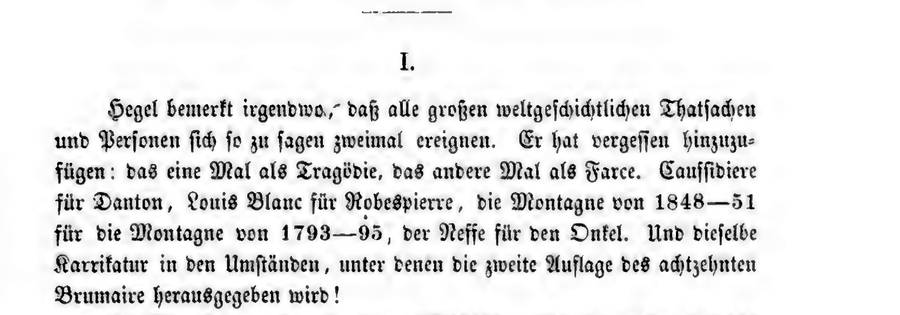
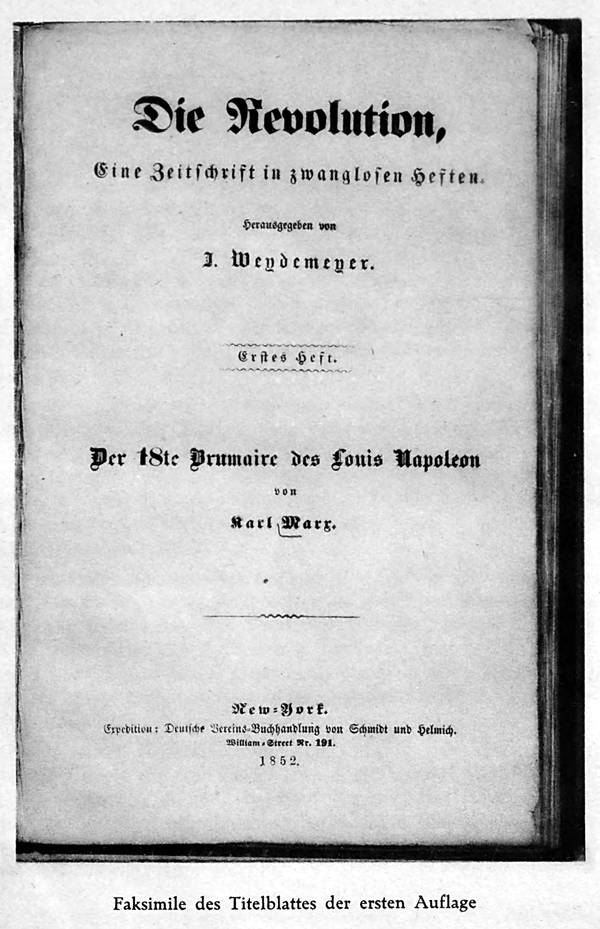
The first printing is older and rarer. It came out in New York in 1852 as the first number of Joseph Weydemeyer's Die Revolution, under the title Der 18te Brumaire des Louis Napoleon. The title page above reads Erstes Heft, though Marx's own preface of 1869 calls it the second number: deren zweites Heft aus meinem „Achtzehnten Brumaire“ besteht
. D. Rjazanov, who edited the book in 1927, wrote of that printing: Sie wurde in Newyork in nur 1000 Exemplaren gedruckt, von denen nur wenige Europa erreichten.
(It was printed in New York in only 1000 copies, of which only a few reached Europe; this page's translation.) Marx, in that preface, put it differently: Einige hundert Exemplare davon fanden damals den Weg nach Deutschland, ohne jedoch in den eigentlichen Buchhandel zu kommen.
(Some hundreds of copies found their way to Germany then, without reaching the book trade proper; this page's translation.) A copy was within Rjazanov's reach: the title page above is his facsimile, which he says was reproduced from an exemplar once owned by F. Leßner. On page 9 of his preface, under the words Diese erste Fassung lautete:
, he printed the 1852 opening paragraph in full. Choose the first line in the instrument above to read it against the 1869 text.
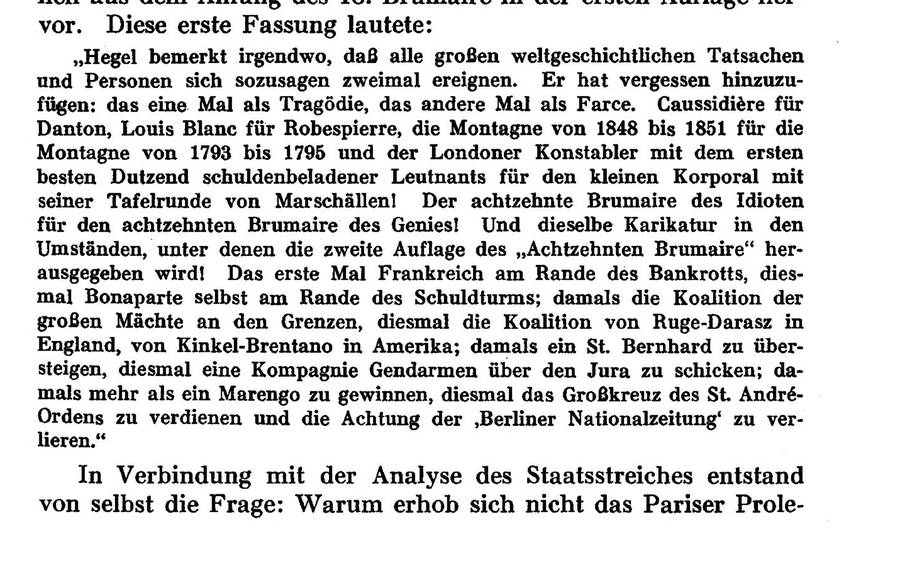
Counted the way the instrument counts, Rjazanov's 1852 paragraph runs to 168 words and the 1869 paragraph to 69 (67 as Meißner printed it: the spelling table writes Marx's 1848—51 and 1793—95 out as 1848 bis 1851 and 1793 bis 1795, as Rjazanov does). Every word of 1869 but two stands in the 1852 paragraph, in the same order; the two new words are Neffe and Onkel, the nephew for the uncle. Everything else the revision did to the paragraph was cutting: 101 words in four places. Out went the London constable with the first dozen debt-laden lieutenants, standing in for the little corporal and his round table of marshals; out went the eighteenth Brumaire of the idiot for the eighteenth Brumaire of the genius; out went a string of then-and-now contrasts that closed the paragraph. (These English words are this page's gloss of the cut German, not a published translation.) The famous line is what the cut left.
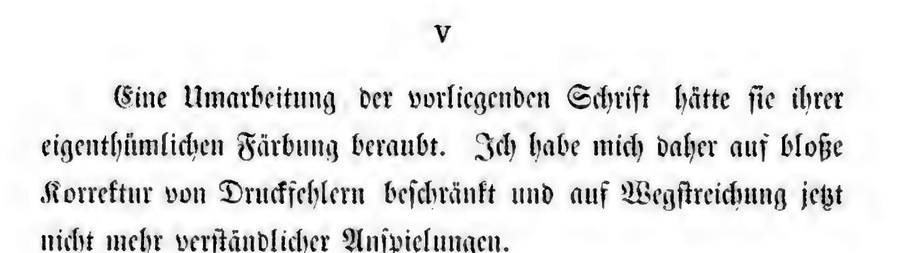
Marx's own account of the revision is one sentence of that preface: Ich habe mich daher auf bloße Korrektur von Druckfehlern beschränkt und auf Wegstreichung jetzt nicht mehr verständlicher Anspielungen.
(I have therefore limited myself to correcting misprints and to striking out allusions no longer understood; this page's translation.) Rjazanov quoted that sentence in 1927 and answered it: Das stimmt nicht ganz.
(That is not quite right.) He meant that Marx had also struck passages of substance, most of them in the last chapter. Whether the opening list counts as an allusion no longer understood is a judgement this page leaves to you; what the texts show is the cut itself.
It is in Engels's letter of 3 December 1851
The pairing of tragedy and farce, Hegel and all, is in a letter Engels wrote to Marx on 3 December 1851, about what wir gestern gesehen haben
(what we saw yesterday). In the edition of their correspondence by A. Bebel and Ed. Bernstein, the sentence reads:
Nach dem aber, was wir gestern gesehen haben, ist auf den peuple gar nichts zu geben, und es scheint wirklich, als ob der alte Hegel in seinem Grabe die Geschichte als Weltgeist leitete und mit der größten Gewissenhaftigkeit alles sich zweimal abspinnen ließe, einmal als große Tragödie und das zweite Mal als lausige Farce, Caussidière für Danton, Louis Blanc für Robespierre, Barthélemy für Saint-Just, Flocon für Carnot, und das Mondkalb mit dem ersten besten Dutzend schuldenbeladener Leutnants für den kleinen Korporal und seine Tafelrunde von Marschällen.
Der Briefwechsel zwischen Friedrich Engels und Karl Marx, ed. A. Bebel and Ed. Bernstein, vol. 1 (Stuttgart: Dietz, 1919 printing), pp. 271–272.The English of the Marx/Engels Collected Works renders the pairing once as grand tragedy and the second time as rotten farce
, which is where this page takes its title.
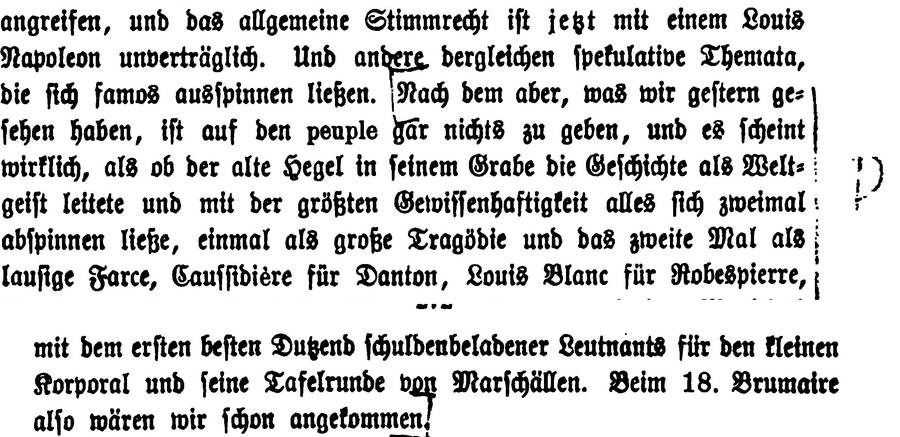
Set beside the 1852 paragraph, the letter's list survives in long runs. Aligned in order, Engels's sentence and Rjazanov's 1852 paragraph share three runs of three or more words, 22 words in all: Farce, Caussidière für Danton, Louis Blanc für Robespierre; mit dem ersten besten Dutzend schuldenbeladener Leutnants für den kleinen Korporal; and Tafelrunde von Marschällen. Between them, the 1852 list swaps Engels's Barthélemy and Flocon for the two Montagnes and his moon-calf for the London constable. Against the 1869 paragraph only one of those runs is left, 8 words long. That is all the texts show: Engels's letter of 3 December 1851 has the phrasing, and the first printing of Marx's book, the next year, repeats his list nearly word for word. It is not a new observation. Rjazanov printed the letter's list and the 1852 paragraph one above the other on that same page in 1927, and in 1972 Bruce Mazlish published a note in History and Theory titled The Tragic Farce of Marx, Hegel, and Engels, which this page cites by title only because it has not read it.
Compare any two printings
Two readings of one 1852 page
There is one thing this page cannot settle, and it sits in the famous clause itself. Rjazanov's transcription of 1852 reads das eine Mal als Tragödie, das andere Mal als Farce
, the same words as 1869. The 1852 text in the complete Marx/Engels edition, MEGA² volume I/11 (Berlin: Dietz, 1985), page 96, reads das eine Mal als große Tragödie, das andre Mal als lumpige Farce
, with Engels's große and a cousin of his lausige. (Great tragedy, shabby farce: this page's gloss.) The two readings of the clause differ in three places. Both present their text as the 1852 one: Rjazanov in so many words, MEGA² by printing the 1852 version, London constable and all, with the title page of Die Revolution among its plates.
This page could not look at the 1852 page itself. It tried the HathiTrust and ZDB catalogues and Google Books, each of which refused an automated reader, and searched the Internet Archive, the Munich digital collections, Europeana and the Library of Congress without finding a scan of the 1852 issue. The only piece of the 1852 printing it can show you is the title page above. Its copy of MEGA² is not a scan either: it is a third-party file whose pages are redrawn from machine-read text, with errors such as Konstabier
for Konstabler, so even its reading of the clause is a reading of a reading.
What can be checked is Rjazanov's habit. In the same book he copies two texts this page can see in print: Engels's sentence, from es scheint wirklich to its end, and the 1869 paragraph. Against the printed originals, his copy of the 1869 paragraph differs from Meißner's print in 18 words and his copy of Engels's sentence from the 1919 printing in 3, and every one of those differences is a respelling: Tatsachen for the print's Thatsachen, zweitemal for zweite Mal, and the like. The spelling table below is made of exactly these seven respellings, so with it applied the two copies differ in 0 and 0 words; the zeros restate that finding and add nothing to it. He modernised spelling and changed no words in the two passages that can be checked, which is a reason to take his 1852 seriously and not a proof of it. On the other side, the adjectives were in print before 1985: a full-text search of the Internet Archive on 2026-11-01 finds the clause with both adjectives quoted in German books that its catalogue dates 1970 and 1974, and their snippets do not say which printing they read. Until someone looks at the 1852 page, the adjectives stay open. Both readings have the list and the contrasts that 1869 cut, so the cut itself does not rest on them; the counts do, because they are counts of Rjazanov's text. Put MEGA²'s clause in place of his and the same count finds 170 words in 1852, 104 of them cut in seven places, andere new in 1869 beside Neffe and Onkel, and a fourth run shared with Engels, als große Tragödie, for 25 words in four runs. MEGA²'s older spellings elsewhere in the paragraph, such as Schulden beladener Lieutenants
where Rjazanov has schuldenbeladener Leutnants, would move them again.
Hegel's somewhere
Marx gives no work and no page: Hegel bemerkt irgendwo
, Hegel remarks somewhere. Which passage he meant is not known from his text. Engels's letter has Hegel directing history from the grave, and the Marxists Internet Archive's copy of the English Collected Works translation carries a note at his sentence pointing to Hegel's lectures on the philosophy of history, in the part on Rome from the Second Punic War to the Empire; the page does not say who wrote the note. It is a candidate, not the only one (the same site's glossary names others), and what it says is that repetition confirms, not that it degrades. In the 1837 edition, page 323:
Ueberhaupt wird eine Staatsumwälzung gleichsam im Dafürhalten der Menschen sanktionirt, wenn sie sich wiederholt. So ist Napoleon zweimal gefangen genommen worden, und zweimal vertrieb man die Bourbonen. Durch die Wiederholung wird das, was im Anfang nur als zufällig und möglich erschien, zu einem Wirklichen und Bestätigten.
Hegel, Vorlesungen über die Philosophie der Geschichte, ed. Eduard Gans (Berlin: Duncker und Humblot, 1837), p. 323.J. Sibree's English of 1857 has a political revolution is sanctioned in men's opinions, when it repeats itself
, and the repetition turns what looked like chance into a real and ratified existence
. In this passage the second time confirms the first. Marx's addition makes the second time a farce.
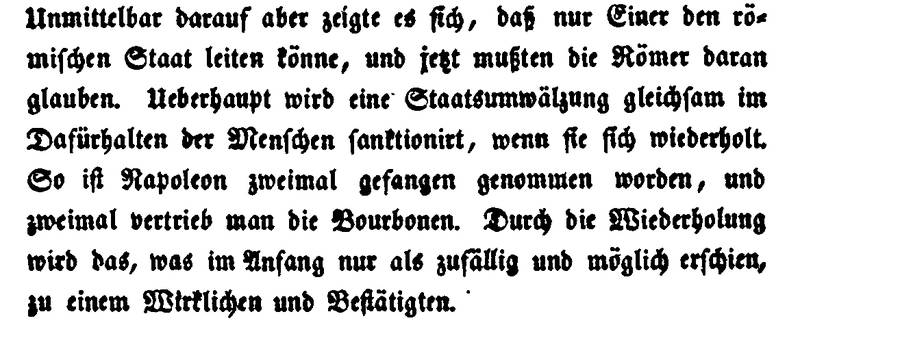
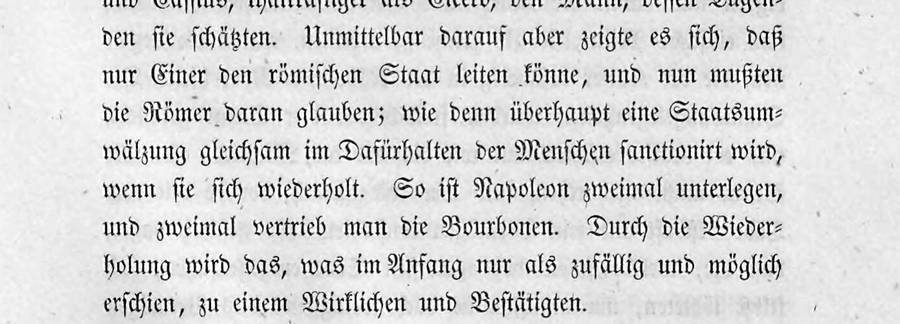
And the passage has no single wording to be faithful to. Hegel's lectures reached print through editors, from his manuscripts and from his listeners' notebooks. In 1840 his son Karl Hegel brought out a second edition, and his preface says of the first, edited by Eduard Gans in 1837: Denn hatte die erste Redaction dieser Vorlesungen, mit Ausnahme eines Theils der Einleitung, sich nur an die nachgeschriebenen Hefte der Zuhörer gehalten
(for the first edition of these lectures, apart from part of the introduction, had kept only to the notebooks of the listeners; this page's translation), while his own started from Hegel's manuscripts. The two editions give this passage differently, in four places: jetzt becomes nun; a new sentence becomes a clause, which takes two places, with sanktionirt respelled sanctionirt; and Napoleon, zweimal gefangen genommen worden
(twice taken prisoner) in 1837, is zweimal unterlegen
(twice defeated) in 1840. Run them through the instrument below.
Hegel, 1837 against 1840
struck only in Gans, 1837 · marked only in Karl Hegel, 1840
Exact, and about something else
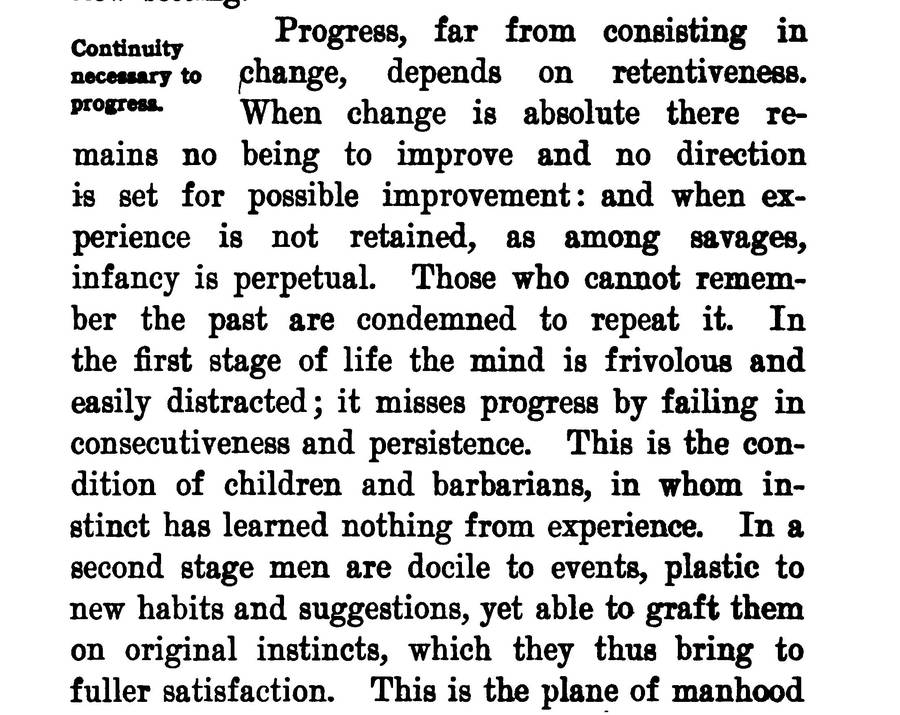
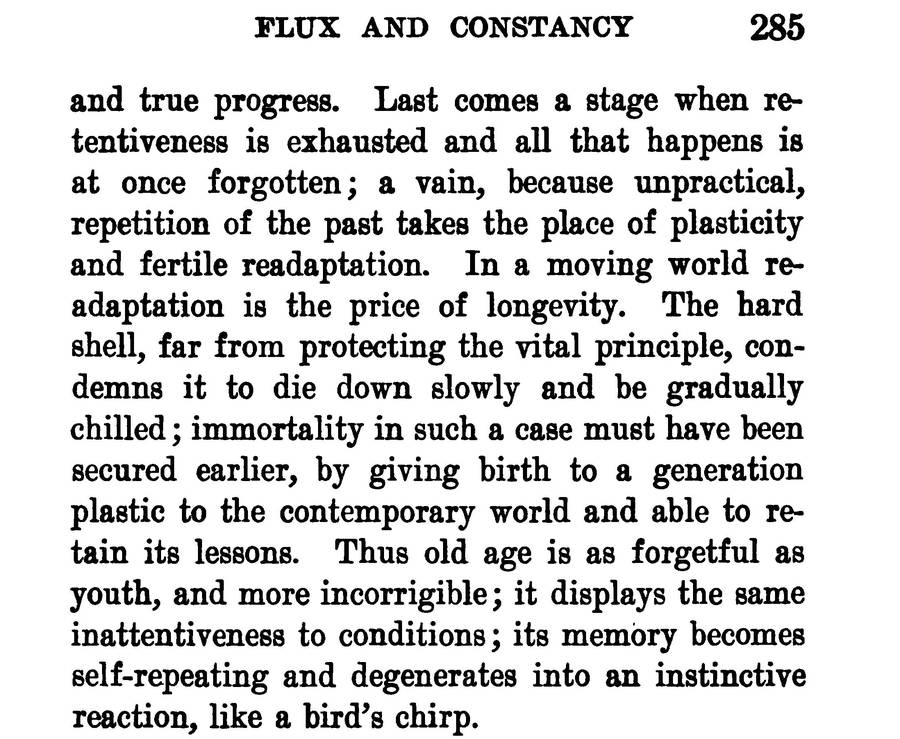
Santayana's line needs no correcting. It is in The Life of Reason, in the part titled Reason in Common Sense, published by Scribner's in February 1905, in chapter XII, Flux and Constancy in Human Nature, on page 284, word for word as this page quotes it: Those who cannot remember the past are condemned to repeat it.
The second line of the instrument above finds the 11 words unchanged, and shows the other 236 words of their paragraph in grey. What travels without it is its paragraph. The margin of the page calls it Continuity necessary to progress.
, and it reads:
Progress, far from consisting in change, depends on retentiveness. When change is absolute there remains no being to improve and no direction is set for possible improvement: and when experience is not retained, as among savages, infancy is perpetual. Those who cannot remember the past are condemned to repeat it. In the first stage of life the mind is frivolous and easily distracted; it misses progress by failing in consecutiveness and persistence. This is the condition of children and barbarians, in whom instinct has learned nothing from experience. In a second stage men are docile to events, plastic to new habits and suggestions, yet able to graft them on original instincts, which they thus bring to fuller satisfaction. This is the plane of manhood and true progress. Last comes a stage when retentiveness is exhausted and all that happens is at once forgotten; a vain, because unpractical, repetition of the past takes the place of plasticity and fertile readaptation. In a moving world readaptation is the price of longevity. The hard shell, far from protecting the vital principle, condemns it to die down slowly and be gradually chilled; immortality in such a case must have been secured earlier, by giving birth to a generation plastic to the contemporary world and able to retain its lessons. Thus old age is as forgetful as youth, and more incorrigible; it displays the same inattentiveness to conditions; its memory becomes self-repeating and degenerates into an instinctive reaction, like a bird’s chirp.
George Santayana, The Life of Reason, part Reason in Common Sense (New York: Charles Scribner's Sons; published February 1905), chapter XII, pp. 284–285.
On the page, the sentence is about retentiveness: progress needs a mind that keeps what it has lived through. The examples around it are the stages of a life. The first is the condition of children and barbarians, in whom instinct has learned nothing from experience
; the second is the plane of manhood and true progress
; in the last, old age, retentiveness is exhausted and all that happens is at once forgotten
. The paragraph speaks of savages and barbarians in the language of its day, and it is quoted here as printed, whole and not trimmed.
The rhyme without Twain
The tracing of History never repeats itself but it rhymes
belongs to Garson O'Toole's Quote Investigator, whose article on the saying (posted 12 January 2014, updated 9 June 2024) is the place to read the whole chain; this page cites its findings and does not repeat its work. Its verdict: There is no substantive evidence that Twain who died in 1910 made this remark. Twain first received credit many years later in 1970
, in John Robert Colombo's Neo Poems and in a reader's query printed by the New York Times in January 1970. Its earliest source for the saying is not Twain at all: The earliest strong match known to QI appeared in 1965 within an essay by psychoanalyst Theodor Reik titled “The Unreachables”.
Reik's sentence ends it merely rhymes.
Quote Investigator also gives the closest wording with Twain's name on it, a remark that opens with the line's first five words: Mark Twain did use the phrase “History never repeats itself” as a preface to a longer remark within a novel he co-wrote with his neighbor Charles Dudley Warner.
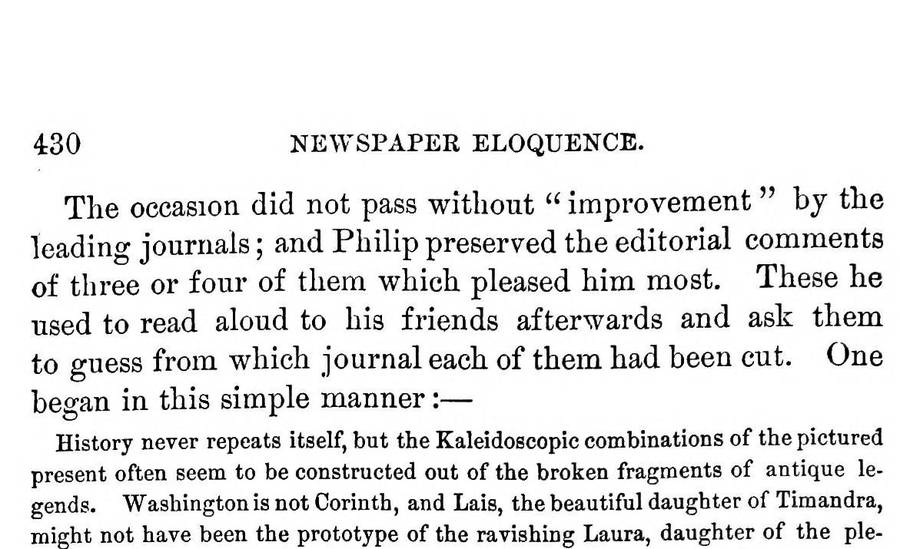
The novel is The Gilded Age (Hartford, 1874), and the remark, on page 430, is this:
History never repeats itself, but the Kaleidoscopic combinations of the pictured present often seem to be constructed out of the broken fragments of antique legends.
Mark Twain and Charles Dudley Warner, The Gilded Age: A Tale of To-Day (Hartford: American Publishing Company, 1874), p. 430, chapter XLVII.
Two things travel without it. First, the novel does not say it in its own voice. The page's running head is Newspaper Eloquence, and the sentence is set in small type as the opening of an editorial: Philip, one of the characters, preserved the editorial comments of three or four of them which pleased him most
, and One began in this simple manner
. Second, the book has two authors, and the chapter is not clearly Twain's. Albert Bigelow Paine's biography of Twain (1912) divides The Gilded Age chapter by chapter, and chapter XLVII is on Warner's list. That is Paine's division, not a manuscript; it does not prove that Warner wrote this sentence, but it is the record this page has.
Paine's division of The Gilded Age
Read from Paine's own sentence each time the page loads. Blue: Clemens (Mark Twain). Brown: Warner. Striped: portions by both. Choose a chapter.
Paine's footnote ends The work was therefore very evenly divided.
Read as lists, it gives Clemens 32 whole chapters and Warner 28, with 3 in portions by both, and the three lists cover the novel's 63 chapters once each, no chapter missing and none counted twice. The instrument above reads them from his sentence each time the page loads; the chapter with the kaleidoscope sentence, XLVII, runs from page 426 to the start of XLVIII on page 434 in the 1874 contents.
Three ways a line comes loose
The three lines fail in three different ways, and each needs a different check. Marx's line is genuine, but the paragraph it opens is the author's own second draft, cut down from a first form whose list repeated one in Engels's letter; the check is the first edition, which here exists only at one remove. Santayana's line is genuine and exact; the check is the paragraph, which shows what it is about. The rhyme has no settled author. Quote Investigator tentatively credits Theodor Reik with formulating this saying
, from the earliest match it knows; the rhyme's famous name came decades after the death of the man it names; and the closest wording with his name on it is a newspaper editorial in a novel, in a chapter that Twain's own biographer gives to his co-author. The correction in each case is the same act, done three times: go to the page.
The check
One script re-does this page. Run it in an empty directory with Node 18 or later; it downloads the page and its files from this site, needs nothing installed, and writes only into a folder named after the page:
curl -sO https://artwaste.land/checks/verify-once-as-grand-tragedy.mjs
node verify-once-as-grand-tragedy.mjs
It recomputes every comparison on the page with its own plain word alignment, written separately from the page's engine, and asserts each figure in the sentence that states it: the 168 and 69 words (67 as printed), the 101 cut in four places and the 2 added, the three shared runs of 22 words and the 8 left in 1869, Rjazanov's 18 and 3 differing words, every difference one of the table's seven respellings, and so 0 and 0 with the table, the three places where MEGA² and Rjazanov differ, the 170 words, 104 cut in seven places and four runs of 25 words with MEGA²'s clause, the four places where the two Hegel editions differ, Santayana's 11 words unchanged and the 236 around them, and Paine's 32, 28 and 3 covering 63. It also runs the page's own instrument code against a small stand-in for the browser and checks every figure the instruments write when the page loads. It checks that every quotation on the page is word for word in its source passage, and then sweeps the page: any number it has not checked fails the run. With --mutate it plants wrong figures in a copy of the page and must fail.
Free choices, named. Words are compared in lower case with punctuation and quotation marks dropped and the long s read as s. The alignment is a longest common subsequence, so where a cut and an insertion sit side by side it reports them as one place. The shortest shared run is three words; the second instrument lets you change it. The spelling table has 7 pairs (such as Thatsachen and Tatsachen, 1848—51 written as 1848 bis 1851) and is used only for German texts printed in different spellings: words are compared in the table's forms but shown as each printing spells them. The 1852 text is Rjazanov's 1927 transcription, the only one this page could see on a page image; the MEGA² reading is shown beside it, and the disagreement between them is the page's one open question.
What the script cannot check. The transcriptions themselves: they were typed for this page from the page images shown here (long s set as s, line-end hyphens joined) and read against them by eye, and a typing slip in one would be inherited by every count. The 1852 printing, which no one working on this page has seen. Whether the Bebel and Bernstein edition prints Engels's whole letter; it is quoted for this one sentence, which Rjazanov's 1927 copy matches from es scheint wirklich to the end. Quote Investigator's sources for 1965 and 1970 (Reik, Colombo and the New York Times), which this page has not seen and cites, not re-checks. And Paine's division, which is his testimony.
Sources
- Karl Marx, Der Achtzehnte Brumaire des Louis Bonaparte, Zweite Ausgabe (Hamburg: Otto Meißner, 1869): preface p. V and chapter I, p. 1. Bayerische Staatsbibliothek copy digitized by Google; Internet Archive item bub_gb_OdlBAAAAcAAJ, Public Domain Mark. archive.org
- Karl Marx, Der achtzehnte Brumaire des Louis Bonaparte, neue ergänzte Ausgabe, ed. D. Rjazanov (Wien, Berlin: Verlag für Literatur und Politik, 1927): title-page facsimile, preface pp. 9, 12–14, and text p. 21. Public domain in the United States as a work first published abroad before 1931, by Cornell University Library's chart, except where the chart's first special case applies: in Alaska, Arizona, California, Hawaii, Idaho, Montana, Nevada, Oregon, Washington, Guam and the Northern Mariana Islands it treats a work published abroad from 1 July 1909 through 1978 in a language other than English, and not later republished with a copyright notice, as unpublished until its first US-compliant publication. archive.org; the chart
- Karl Marx Friedrich Engels Gesamtausgabe (MEGA²), Erste Abteilung, Band 11, Text (Berlin: Dietz, 1985), p. 96. Copyrighted; one clause quoted, read in a third-party copy whose pages are redrawn from machine-read text, which this page does not link.
- Marx/Engels, Werke, vol. 8 (Berlin, 1960), source note, as transcribed at zeno.org (marked there as public domain). zeno.org
- Saul K. Padover's English translation of chapter I (from the German edition of 1869), Marxists Internet Archive; one sentence quoted. marxists.org
- Karl Marx, The Eighteenth Brumaire of Louis Bonaparte, translated by Daniel De Leon (New York: International Publishing Co., 1898). Columbia University Libraries copy; public domain. archive.org
- Der Briefwechsel zwischen Friedrich Engels und Karl Marx 1844 bis 1883, ed. A. Bebel and Ed. Bernstein, vol. 1 (Stuttgart: J. H. W. Dietz Nachf., 1919 printing), letter of 3 December 1851, pp. 271–272. University of Michigan copy digitized by Google; public domain. archive.org
- Engels to Marx, 3 December 1851, English translation from Marx/Engels Collected Works vol. 38, as given at the Marxists Internet Archive, with a note on Hegel whose author the page does not name; one phrase quoted. marxists.org
- Bruce Mazlish, The Tragic Farce of Marx, Hegel, and Engels: A Note, History and Theory 11:3 (1972), p. 335; doi:10.2307/2504684. Cited from its catalogue record; not read.
- G. W. F. Hegel, Vorlesungen über die Philosophie der Geschichte, ed. Eduard Gans (Berlin: Duncker und Humblot, 1837), p. 323. National Central Library of Florence copy digitized by Google; Public Domain Mark. archive.org
- The same, second edition by Karl Hegel (Berlin: Duncker und Humblot, 1840), preface p. XXII and text p. 381. Staatsbibliothek Bamberg copy. archive.org
- G. W. F. Hegel, Lectures on the Philosophy of History, translated from the third German edition by J. Sibree (London: Henry G. Bohn, 1857), p. 325. Public domain. archive.org
- George Santayana, The Life of Reason, part Reason in Common Sense (New York: Charles Scribner's Sons; published February 1905), chapter XII, pp. 284–285. Harvard copy digitized by Google; public domain. archive.org
- Mark Twain and Charles Dudley Warner, The Gilded Age: A Tale of To-Day (Hartford: American Publishing Company, 1874), contents and p. 430. Cornell University Library copy; no known copyright restrictions in the United States. archive.org. Chapter headings counted in Project Gutenberg eBook 3178. gutenberg.org
- Albert Bigelow Paine, Mark Twain: A Biography, vol. 1 (New York and London: Harper & Brothers, 1912), chapter LXXXVIII, footnote on p. 477. University of Toronto copy; public domain. archive.org
- Garson O'Toole, Quote Origin: History Does Not Repeat Itself, But It Rhymes, Quote Investigator, posted 12 January 2014, updated 9 June 2024; cited with short quotations. quoteinvestigator.com
- Internet Archive full-text search for the phrase lumpige Farce, run 2026-11-01. archive.org