Balaklava, 25 October 1854
Six Hundred and Seven
The first printing of Tennyson's poem, in The Examiner of 9 December 1854, carries a footnote: the Times correspondent's first report gave “only 607 sabres”. The other famous counts of the charge were taken at different hours and measure different things: 198 back from action by 2 p.m., 195 still mounted at the first muster, 157 “killed” in the return the Gazette printed on 12 November, 113 killed in Kinglake's history. Count the men later named as prisoners of the Russians among the dead, as that return appears to have done, and three of its five regiments agree with the later lists to the man.

The number under the poem
The poem was first printed in The Examiner on Saturday 9 December 1854, on page 780, signed A. T.
Its title, THE CHARGE OF THE LIGHT BRIGADE.*
, carries an asterisk, and the asterisk leads to a footnote at the foot of the column:
* Written after reading the first report of the Times' correspondent, where only 607 sabres are mentioned as having taken part in the charge.
The Examiner, 9 December 1854, p. 780
The footnote is not signed, and none of our sources says whether Tennyson wrote it or the paper added it; his son's memoir, which dates the poem, never mentions the 607. The poem itself rounds the figure off in its first stanza:
Half a league, half a league, Half a league onward, All in the valley of Death Rode the six hundred.
The Examiner, 9 December 1854, p. 780
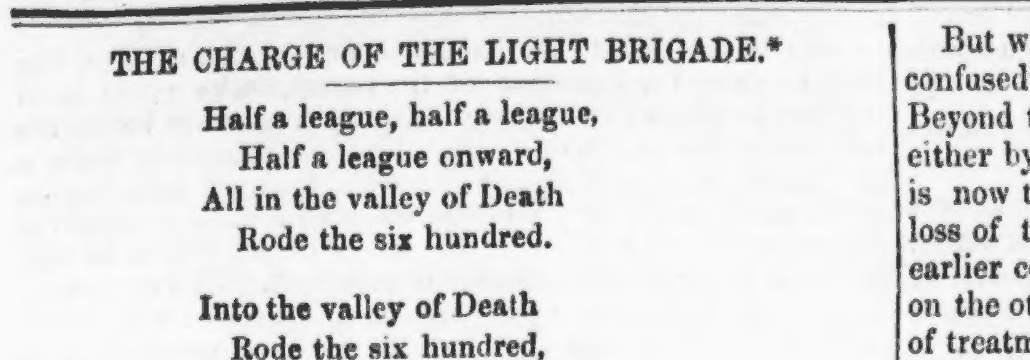
His son's memoir, published in 1897, says Tennyson wrote it on 2 December in a few minutes
, and notes that it was Published in the Examiner, Dec. 9th.
The memoir also says what he had been reading:
On Dec. 2nd he wrote “The Charge of the Light Brigade” in a few minutes, after reading the description in the Times in which occurred the phrase “some one had blundered,” and this was the origin of the metre of his poem.
Hallam Tennyson, Alfred Lord Tennyson: A Memoir, vol. I (1897), p. 381
We have not seen that issue of the Times, so we cannot confirm that the phrase was printed there. The memoir is the family's account, published more than forty years later.
Where the 607 comes from
The correspondent was William Howard Russell. We read his letter in a reprint: the Daily National Intelligencer of Washington printed it on 29 November 1854 as an extract from the correspondence of the London Times
. In the entry headed WEDNESDAY, OCT. 25.
he wrote:
At 11.10 our light cavalry brigade rushed to the front. They numbered 607 sabres.
Russell's letter, Daily National Intelligencer, 29 November 1854, p. 2
Two documents of 1854 thus give the correspondent's figure as 607: the footnote under the poem, and the Washington reprint. The same sentences, revised, are in Russell's own book The War (1855), whose title page calls him CORRESPONDENT OF “THE TIMES.”
(in capitals, as printed); its editor's notice says the letters appear as they did in the Times Except a few omissions and some slight alterations
. In this passage the alteration drops the number: At ten minutes past eleven, our Light Cavalry brigade advanced.
Anyone who looks for the 607 in the book will not find it.
One charge, eleven counts
Every figure below is printed in the document named, or, for the two Gazettes, added up from its printed rows and names. Pick one. Watch the words as well as the numbers: one document's killed or missing
is another's killed
, and Ret'd from action.
is not mounted strength
.
Choose a document above.
Bars share one scale, 0 to 800. The dashed line is the poem's six hundred.
| Document | When | Rode | Back or mounted | Killed, as worded | Wounded | Prisoners | Horses |
|---|---|---|---|---|---|---|---|
| Russell's letter | 25 Oct., 11.10 a.m. | 607 | |||||
| Russell's table | 25 Oct., 2 p.m. | 607 | 198 | 409, “Loss” (killed, wounded and missing together) | in the loss | ||
| Russell's note, both brigades | 25 Oct., 4 p.m. | 169, “killed or missing” | 218 | 394 | |||
| London Gazette, the return | printed 12 Nov. | 157, “killed” | 121 | 335 | |||
| London Gazette, the names | printed 17 Nov. | 97, “KILLED OR MISSING” (men only) | 109, and 11 unseen | 57 | |||
| The Examiner, leader | printed 18 Nov. | 700 | 150 | ||||
| The poem | printed 9 Dec. | six hundred | |||||
| Letters from Head-quarters | 1856 | 156, “Killed and missing” | 122 | 335 | |||
| Lord Cardigan's statements | printed 1868 | 670 | 195 | 300, “killed, wounded, or missing” | in the 300 | 396 | |
| Kinglake, vol. IV | 1868 | 673 | 195 | 113, “killed” | 134 | 475 | |
| National Army Museum | read 1 Nov. 2026 | 673 | around 260, “killed or wounded” | in the 260 | 475 |
These need not be mistakes for one another. The 607 and 198 are Russell's count of men out and men back at two in the afternoon, and the 409 in his column headed Loss.
is everyone not yet back; he warned that many will still come in, and about eighty wounded have already returned.
The 195 is a count of men on horseback, not of men alive. The 157 comes from a return covering 22 to 26 October: the whole of 25 October and four other days, not the charge alone. It is what this page's next section is about. Kinglake's 113 and 134 come from what he calls a later examination
, and he adds: These figures may not agree exactly with other returns, but I have good reason for believing them to be accurate
.
The dead who were prisoners
The return printed in the London Gazette Extraordinary of Sunday 12 November 1854, signed by the Adjutant-General, J. B. Bucknall Estcourt, is headed Return of Casualties from 22nd to 26th October, 1854, both days inclusive.
Its five Light Brigade rows add up to 157 killed of all ranks (10 officers and 147 men), 121 wounded and 335 horses killed. Here and below, “men” means the return's serjeants, drummers, and rank and file together.
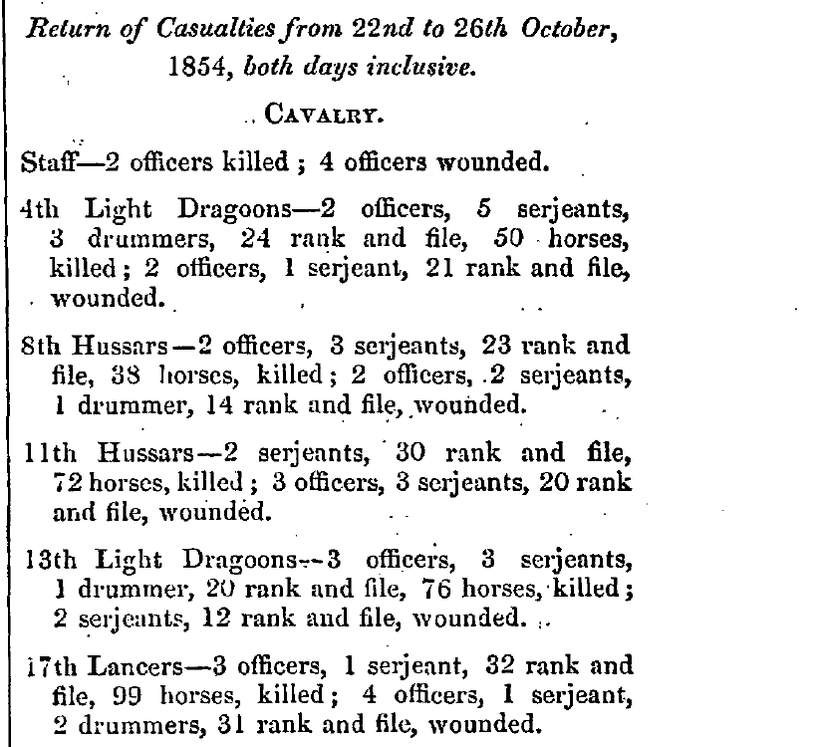
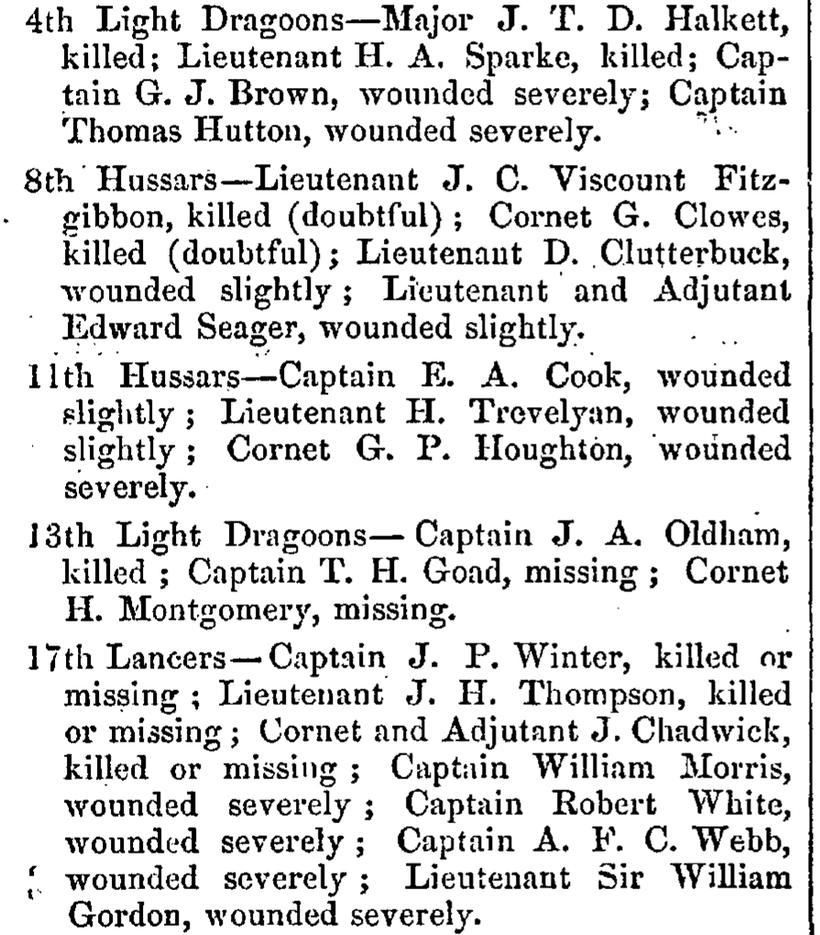
On Friday 17 November a supplement to the Gazette printed the men by name, under October 25.
Each Light Brigade regiment's first list is headed KILLED OR MISSING.
, and the five lists hold 97 names. Two pages later comes a Return of Prisoners taken by the Russians, the 25th October, 1854.
It names 57 men of the five regiments (2 officers and 55 men; 41 of the 57 wounded, 16 not), and two officers of the Commissariat who are not counted here.
Put the prisoners back among the dead
| Regiment | 12 Nov. killed | 17 Nov. heading | named | prisoners | compared | difference |
|---|---|---|---|---|---|---|
| 4th Light Dragoons | 32 | KILLED OR MISSING. | 16 | 16 | 16 | −16 |
| 8th Hussars | 26 | KILLED OR MISSING. | 18 | 9 | 18 | −8 |
| 11th Hussars | 32 | KILLED OR MISSING. | 25 | 7 | 25 | −7 |
| 13th Light Dragoons | 24 | KILLED OR MISSING. | 12 | 12 | 12 | −12 |
| 17th Lancers | 33 | KILLED OR MISSING. | 26 | 11 | 26 | −7 |
| 4th Dragoon Guards | 1 | KILLED. | 1 | 0 | 1 | 0 |
| 5th Dragoon Guards | 2 | KILLED. | 2 | 0 | 2 | 0 |
| 1st Royal Dragoons | 2 | KILLED. | 2 | 0 | 2 | 0 |
| 2nd Dragoons | 2 | KILLED. | 2 | 0 | 2 | 0 |
| 6th Dragoons | 2 | KILLED. | 2 | 0 | 2 | 0 |
Prisoners not counted: 0 of the 5 Light Brigade regiments match; all 5 Heavy Brigade regiments match.
Tick the box. The 4th Light Dragoons come to 16 + 16 = 32, the 11th Hussars to 25 + 7 = 32, and the 13th Light Dragoons to 12 + 12 = 24: exactly the killed in the 12 November return. The 8th Hussars come to one more than the return (27 against 26) and the 17th Lancers to four more (37 against 33). We do not know why, and the page shows them as they are.
The other five cavalry regiments in the return, the Heavy Brigade under Brigadier-General Scarlett, are the control. None of their men is on the prisoner return, their lists are headed plain KILLED.
, and every one of the five agrees with the 12 November return with nothing added: 9 killed and 87 wounded between them, regiment by regiment.
No man appears on both his regiment's killed-or-missing list and its prisoner return. Within a regiment, the one surname shared between the two kinds of list belongs to two different men in the 13th Light Dragoons: Corporal E. W. A. Smith, killed or missing, and Troop-Serjeant-Major George Smith, a wounded prisoner.
The lists appear here when the page's script runs.
The same reading, four more ways
The officers. The 12 November officer list says it in words. The ten Light Brigade officers in the return's killed column are printed as 3 “killed”, 2 “killed (doubtful)”, 2 “missing” and 3 killed or missing
, and the return's officer counts (2, 2, 0, 3 and 3, regiment by regiment) are exactly these entries. Two of the ten are on the prisoner return: Cornet G. Clowes, killed (doubtful)
of the 8th Hussars appears there as Cornet George Clowes
, and the 17th Lancers' Cornet and Adjutant J. Chadwick, killed or missing
as Lieutenant John Chadwick
(the rank differs as printed).
Russell at four o'clock. Two hours after his table, Russell wrote a note about our cavalry fight to-day
, all the cavalry and not only the Light Brigade: 156 men killed or missing
and 197 men wounded
. Add up the men in the ten cavalry regiments of the 12 November return and you get 156 killed and 197 wounded. The same numbers: Russell's word for the first is “killed or missing”, the Gazette's is “killed”. His officers and horses do not match.
| Russell, 4 p.m. | Gazette, 12 Nov. | |
|---|---|---|
| men killed (Russell: “killed or missing”) | 156 | 156 |
| men wounded | 197 | 197 |
| officers killed (Russell: “killed or missing”) | 13 | 12 |
| officers wounded | 21 | 25 |
| horses killed (Russell: “killed or missing”) | 394 | 381 |
A staff officer in 1856. Letters from Head-quarters, published anonymously, BY AN OFFICER ON THE STAFF.
(library catalogues name Somerset Calthorpe), prints the Light Brigade's losses as 156 Killed and missing.
and 122 wounded, 278 casualties
. That is the Gazette's 157 and 121 with one officer moved from the first column to the second. He adds: It has since been ascertained that the Russians made a good many prisoners; the exact number is not yet known.
His 156 is all ranks of the Light Brigade; Russell's 156 is the men of both brigades. Same number, different things.
The wounded. In the 4th Light Dragoons and the 8th Hussars, the wounded agree exactly (22 and 17) without the wounded prisoners, so in those two regiments the return's wounded column appears not to include the wounded prisoners. Elsewhere they do not agree: the 11th Hussars list 26 against the return's 23, the 17th Lancers 33 against 34, and the 13th Light Dragoons 11 wounded plus 11 Sent on board ship without being seen by the Regimental Surgeon.
against 14.
All of this is an observation about the numbers. We found no document saying how the 12 November return was made, so we cannot say it counted the prisoners as killed; we can say that, with them counted so, three of its five Light Brigade regiments agree with the names to the man, and the Heavy Brigade, with no prisoners, agrees without them.
What the 195 counts
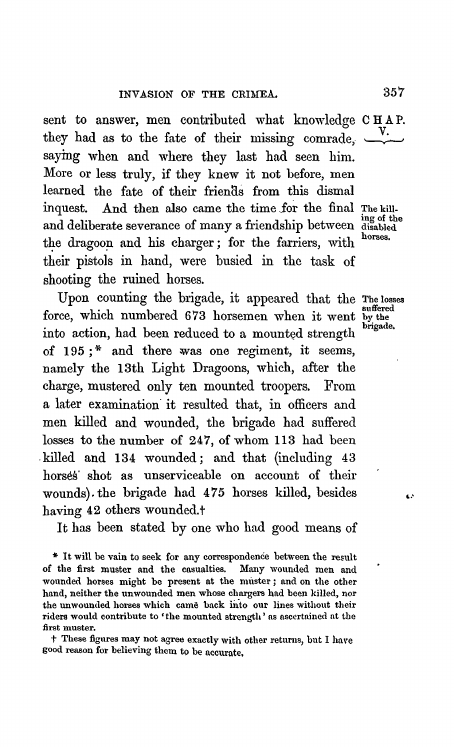
Lord Cardigan, who commanded the Light Brigade, gave Kinglake a statement that Kinglake printed in 1868: there then were 195 mounted men out of 670.
Kinglake's own text has the brigade, which numbered 673 horsemen when it went into action
, reduced to a mounted strength of 195
. It is easy to read 195 as the survivors.
Unticked: 195 is a count of men on horseback at the first muster.
Read that way, 673 − 195 = 478 men would be dead. A later examination, which Kinglake reports on the same page, found 113 killed and 134 wounded, 247 in all; and he warned against the subtraction in a footnote:
It will be vain to seek for any correspondence between the result of the first muster and the casualties. Many wounded men and wounded horses might be present at the muster; and on the other hand, neither the unwounded men whose chargers had been killed, nor the unwounded horses which came back into our lines without their riders would contribute to 'the mounted strength' as ascertained at the first muster.
Kinglake, The Invasion of the Crimea, vol. IV (1868), p. 357
The difference shows regiment by regiment too. Russell's 2 p.m. table has 61 men of the 13th Light Dragoons Ret'd from action.
; Kinglake says the same regiment, after the charge, mustered only ten mounted troopers.
Back is not the same as mounted.
Do the sums yourself
Russell's table can check itself: each row's men in less men back must give the loss, and each column must add up to the totals. As printed in Washington, every row and every column works. Change a figure and see what breaks.
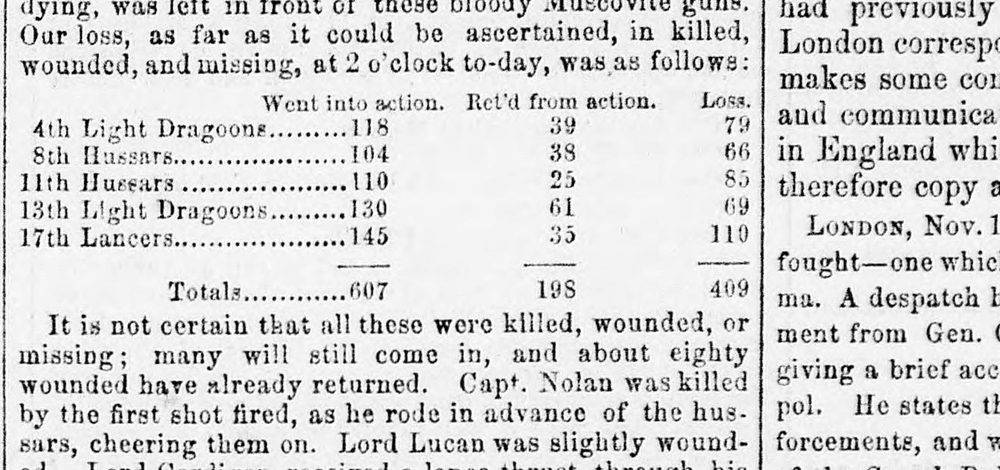
| Regiment | Went into action | Ret'd from action | Loss, printed | in less back |
|---|---|---|---|---|
| 4th Light Dragoons | 79 | 79 | ||
| 8th Hussars | 66 | 66 | ||
| 11th Hussars | 85 | 85 | ||
| 13th Light Dragoons | 69 | 69 | ||
| 17th Lancers | 110 | 110 | ||
| Totals, as printed | 607 | 198 | 409 | |
| Totals, added up | 607 | 198 | 409 |
As printed: every row and both added columns agree.
The button types the 143 that Wikipedia's version of this table gives for the 17th Lancers (revision 1380693685, read on 1 November 2026). With 143, the row gives 108, not the printed 110, and the column adds to 605, not 607. The scan reads 145.
The Gazette's return checks itself the same way. Its thirteen rows (cavalry staff, ten cavalry regiments, the Royal Artillery, and the Engineers and Sappers) add up to its printed total in every column: 13 officers, 16 serjeants, 4 drummers, 142 rank and file and 381 horses killed; 27 officers, 21 serjeants, 4 drummers and 199 rank and file wounded.
The whole 12 November return, row by row
| Row as printed | K off. | K sjt. | K dr. | K r&f | horses | W off. | W sjt. | W dr. | W r&f |
|---|
What this page does not settle
The Times itself. We read Russell's letter only in the Washington reprint of 29 November 1854; we have not seen the London original. The footnote under the poem is the second witness to the 607.
Who counted as riding. Russell counted sabres
, Cardigan men who had gone into action
and Kinglake horsemen
. None of these passages says how the count was made or who was in it. The E. J. Boys archive, which aims to give an account of every member of the Light Brigade who served in the Crimean War (more than 2600 Hussars, Lancers and Light Dragoons
), is one modern effort to account for the men one by one; we have not inspected any modern roll of who rode, and this page stops at what was printed between 1854 and 1868, with one museum's figure from today.
Kinglake's later examination. His 113 is not the 12 November return less the prisoners: 157 less the 57 named prisoners is 100. On the page where he gives them, he does not say how they were reached.
The two regiments that do not fit. The 8th Hussars' one and the 17th Lancers' four extra names are unexplained here.
The Examiner's 700. Three weeks before it printed the poem, The Examiner's leader of 18 November said the brigade were 700 sabres
, and that a hundred and fifty out of seven hundred return in order to their position.
The same leader has about half a league
and to do and die
. It gives no source for its figures, and we have no evidence that Tennyson read it.
Today's figure. The National Army Museum gives Around 260 men of the Light Brigade’s 673 were killed or wounded, and 475 horses were lost.
The 673 and the 475 are also Kinglake's figures; the 260 is not his 247, and the museum's page does not say where it comes from.
The check
A verifier recomputes this page from its own copy of the printed figures and fails if any number a reader can see disagrees. It checks:
- Russell's table, row by row and column by column, and that 143 for the 17th Lancers breaks it; and his 4 p.m. arithmetic.
- the 12 November return: its thirteen rows against its printed total, the Light Brigade sums (157, 121, 335) and the cavalry men (156 and 197);
- the 17 November lists, recounted from the 370 names in data.json, against counts typed separately into the verifier; the reconciliation, regiment by regiment, both ways; and that no prisoner shares a surname and first initial with a man on his regiment's killed-or-missing list;
- Kinglake's 113 + 134 = 247 and 673 − 195 = 478, Calthorpe's 156 + 122 = 278, and every figure in the tables and sentences above, each in its own sentence or cell; then a sweep that fails on any number on the page it has not checked;
- the text each instrument shows after a click, in every state (each document's card, both boxes ticked and unticked, the 143 button and the reset, a cell that is not a whole number, each regiment's lists, the whole return), as engine.mjs writes it; app.mjs only places that text on the page, and the verifier does not run a browser;
- every quotation, word for word, against the transcriptions published with the page (and, inside our repository, against the kept source copies).
Free choices and uncertainties, named: “men” means serjeants, drummers, and rank and file together, which is how the return's categories fall and how the named lists (which leave out officers) can be compared; the two officer prisoners are left out of that comparison and discussed in words; the two Commissariat prisoners are not counted; the names were read by eye from the Gazette's page images; the Light Brigade lists and the prisoner return were read twice, independently (once by this layer's scout and once by its builder), and the two counts agree for every one of them; the Heavy Brigade lists were read once, by the builder, and agree with the 12 November return regiment by regiment; the spelling of a few names is uncertain; the verifier cannot check that a scan was read correctly, which is why the scans are on this page.
Run it yourself (Node 18 or later, nothing to install):
curl -sO https://artwaste.land/checks/verify-six-hundred-and-seven.mjs
node verify-six-hundred-and-seven.mjs
Sources
- The Examiner (London), No 2,445, 9 December 1854, p. 780: the poem, signed A. T., and its footnote. Public domain; scan at archive.org, sim_examiner-a-weekly-paper-on-politics-literature-music_1854-12-09_2445.
- The Examiner (London), No 2,442, 18 November 1854, front page, leader The Affair of the Twenty-Fifth. Public domain; scan at archive.org, sim_examiner-a-weekly-paper-on-politics-literature-music_1854-11-18_2442.
- Daily National Intelligencer (Washington), 29 November 1854, p. 2, reprinting the London Times correspondent's letter (W. H. Russell). Public domain; Library of Congress, Chronicling America, loc.gov/resource/sn83026172/1854-11-29/ed-1/?sp=2, read through its IIIF image server.
- The London Gazette Extraordinary, Numb. 21624, 12 November 1854, pp. 3455 to 3459: Raglan's despatch, the Return of Casualties from 22nd to 26th October, and the officer list. thegazette.co.uk; Open Government Licence v3.0.
- Supplement to The London Gazette Extraordinary, Numb. 21628, 17 November 1854, pp. 3505 to 3511: the nominal return and the Return of Prisoners taken by the Russians. thegazette.co.uk; Open Government Licence v3.0.
- Hallam Tennyson, Alfred Lord Tennyson: A Memoir by his Son, vol. I (London: Macmillan, 1897), p. 381. Public domain; archive.org, alfredlordtennys01tennuoft.
- W. H. Russell, The War: from the Landing at Gallipoli to the Death of Lord Raglan (London: Routledge, 1855), pp. 231 and 232. Public domain; archive.org, warrussell01russ.
- [S. J. G. Calthorpe], Letters from Head-quarters; or, The Realities of the War in the Crimea, by an Officer on the Staff, vol. I (London: John Murray, 1856), p. 320. Public domain; archive.org, lettersfromhead00caltgoog.
- A. W. Kinglake, The Invasion of the Crimea, vol. IV (Edinburgh and London: Blackwood, 1868), p. 357, and Appendix III and IV, Lord Cardigan's statements, pp. 401 to 404. Public domain; archive.org, india.history.resource.74364.
- National Army Museum, Battle of Balaklava, nam.ac.uk/explore/battle-balaklava, read 1 November 2026. Quoted briefly.
- Lives of the Light Brigade: the E. J. Boys Archive, Edward James Boys - a biography, chargeofthelightbrigade.com/index3.html, read 1 November 2026. Quoted briefly.
- Wikipedia, Charge of the Light Brigade, revision 1380693685, read 1 November 2026: its table of Russell's figures. CC BY-SA 4.0; cited, not reproduced.
Each quotation on this page is in quotes.json beside it, with its source and the kept copy it was checked against. The full transcriptions, the page-image crops used to read them, and the script that builds data.json are kept with the layer.