Artificial Wasteland · claims received · second sitting
The Joke Desk: Second Sitting
Famous jokes, taken at their word and checked against real sources, with the evidence marked up in red. The verdicts include “Toes present · lactose confirmed” and “Face confirmed · reason disputed”.
The Desk has reconvened. As at its first sitting, each joke is given as it is commonly told, its claims about the world are taken to sources, and it leaves with a verdict and a correction. The docket picks up where it stopped, at case 20.
This time the Desk has also entered exhibits: mostly plates, prints and photographs free of copyright, each credited beneath it, and marked in red where it matters. The marks are claims too, and are checked like the rest.
Case 20Received: traditional
A horse walks into a bar. The bartender says, “Why the long face?”
First claim: the horse has a long face.
Second claim: there is a reason, and the horse knows it.
The first claim has been peer-reviewed under the joke’s own name. In 2024, Christine Janis and three colleagues published “A horse walks into a bar: an explanation for the long face” in Annales Zoologici Fennici. It notes that A horse has a relatively longer face than a lion, or even than a wolf.
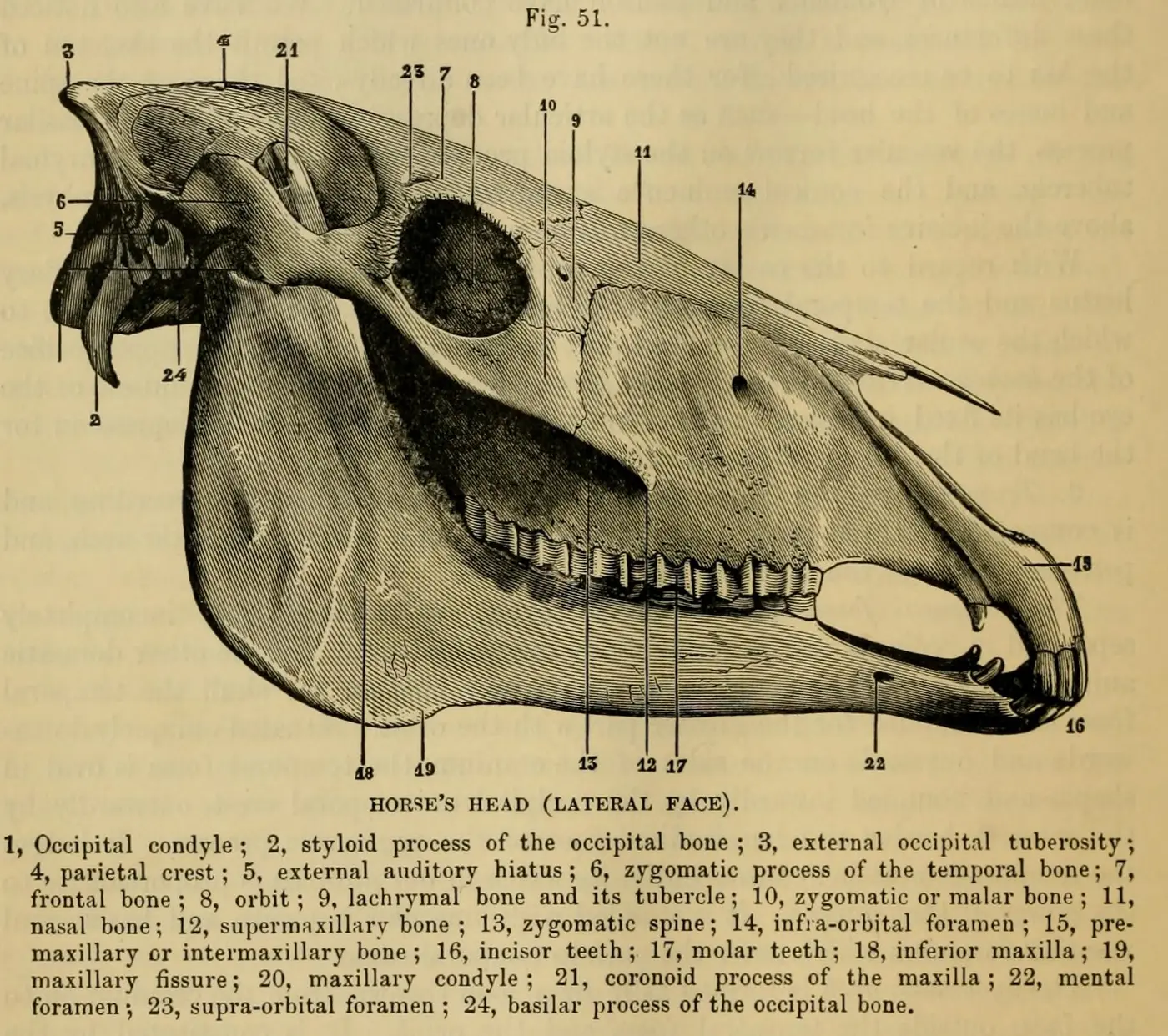
The second claim is where the bartender’s question runs into the literature. The usual answer is teeth. Grazing horses evolved tall cheek teeth, and a 1983 paper in Science by L. Radinsky found that A relatively longer preorbital portion of the skull resulted from the ventral and forward displacement of the tooth row relative to the jaw joint and the orbit when high-crowned teeth evolved. Janis and her colleagues propose another reason: that longer faces relate to the ability to use the forelimbs in feeding. A big animal can do less with its front legs at mealtimes, so the face does the reaching.
Then, in 2026, Anna Wisniewski and Graham Slater reported in Paleobiology that in horses the evolution of hypsodont dentition did not significantly influence facial proportions in the group (hypsodont, in their own words, meaning high-crowned), and concluded: Our results challenge the idea that a single developmental or ecological factor can fully explain skull evolution in horses. The bartender’s question is also the title of a 2019 paper on the skulls of miniature horses and ponies. It is still being asked.
Exhibit A
The Desk’s marks:the long facethe reason (1983)not the reason (2026)
A. Chauveau, The Comparative Anatomy of the Domesticated Animals, second English edition, translated by George Fleming (this copy printed 1905), Fig. 51, “Horse’s head (lateral face)”. Public domain, via the Internet Archive.
Face confirmed · reason disputed
As corrected
A horse walks into a bar. The bartender says, “Why the long face?” The horse refers the bartender to the literature.
Case 21Received: traditional
Why do cows have hooves instead of feet? Because they lactose.
First claim: cows have hooves instead of feet.
Second claim: cows have no toes.
Third claim: cows lactose.
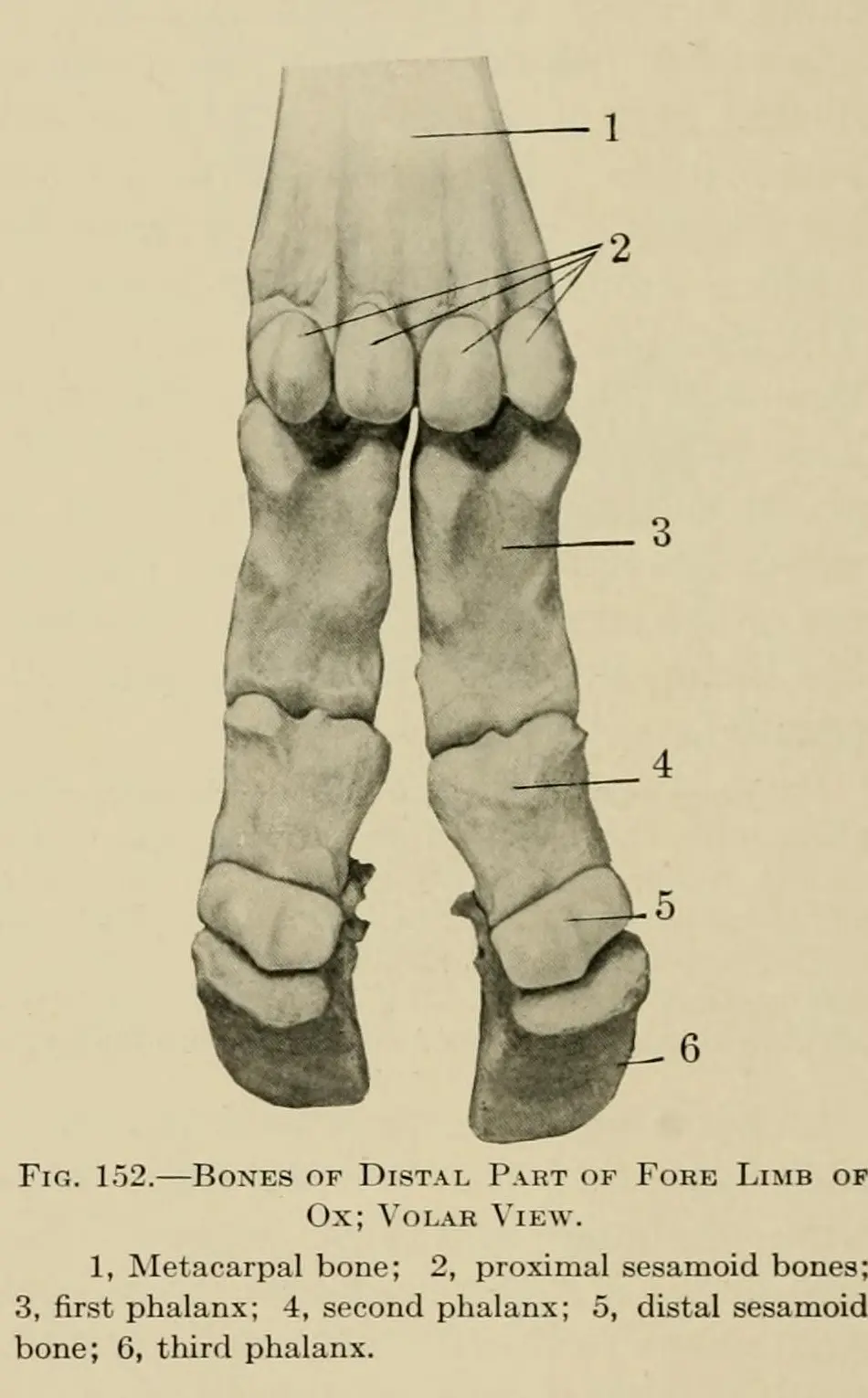
The Desk took the feet to the veterinary literature. Septimus Sisson’s Anatomy of the Domestic Animals, in its 1914 edition, is plain about it: Four digits are present in the ox. Two of them are small and sit behind the fetlock, and In the ox and pig the third and fourth are well developed and support the weight. The Merck Veterinary Manual counts the same bones today and calls them a foot: The foot consists of two digits, with the small pair, the dewclaws, behind. As for the hooves, In ruminants, pigs, and horses, the proper words used to describe the distal limb within the horn capsule are “hoof” and “hooves.”
So a cow has feet, with toes, and a hoof on the end of each toe it walks on. Hooves are not instead of feet. They are part of them.
The third claim holds. Whole milk, by the United States Department of Agriculture’s analysis, averages 5.05% lactose. Cows lactose.
Exhibit B
The Desk’s marks:toetoea hoof goes on eachdewclaws: not shown
Septimus Sisson, The Anatomy of the Domestic Animals, second edition (1914; this copy reprinted 1930), Fig. 152, “Bones of distal part of fore limb of ox; volar view”. The dewclaws’ bones do not join the rest of the skeleton, and the figure leaves them out. Public domain, via the Internet Archive.
Toes present · lactose confirmed
As corrected
Why do cows have hooves instead of feet? They don’t. They have feet, with toes, with hooves on the toes. They do, however, lactose.
Case 22Received: Tim Vine
Velcro. What a rip-off.
Claim: Velcro is a rip-off.
The joke is Tim Vine’s. Reviewing his show in 2005, the comedy site Chortle quoted it and added: A four-word gag, you can’t get much tighter than that. The Desk counted. Four words, if rip-off is one, which its hyphen says it is.
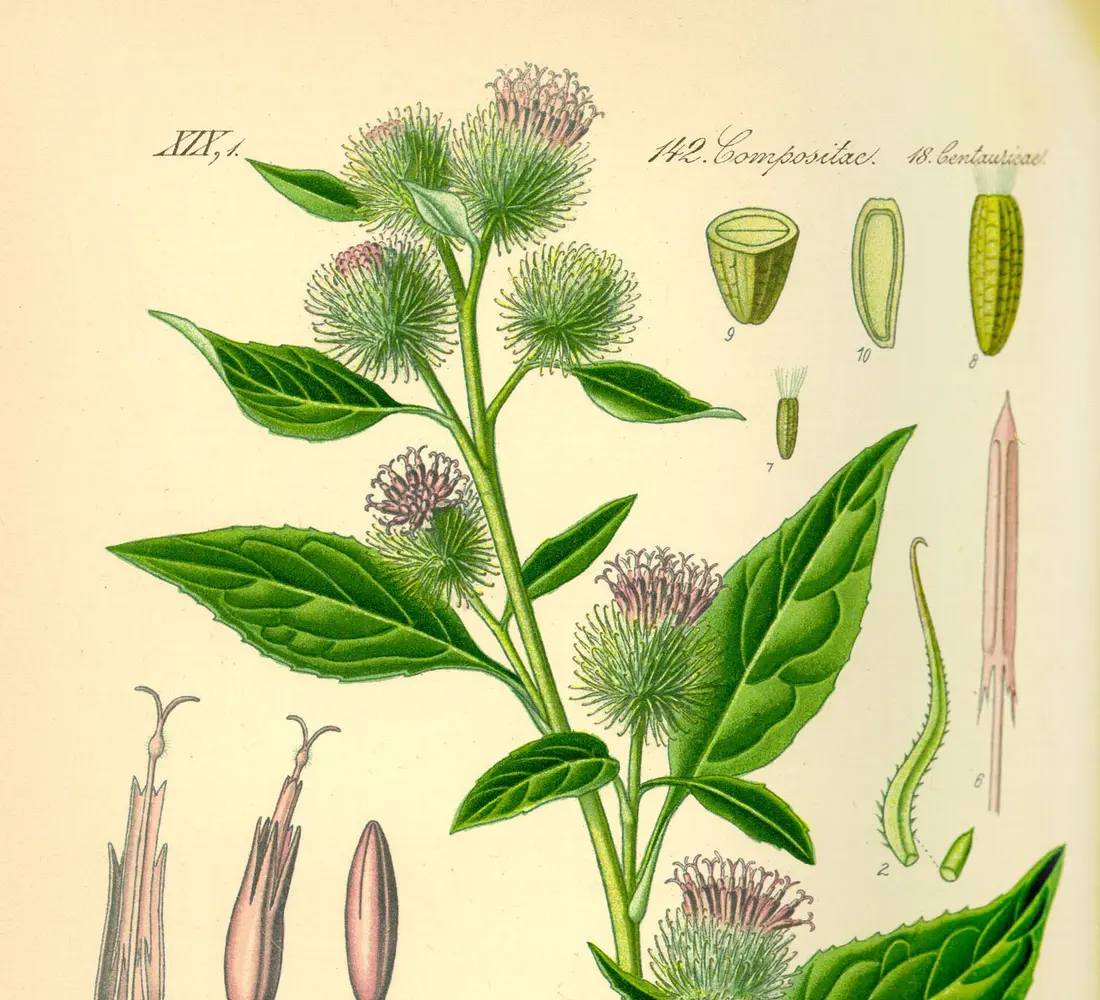
On the claim itself, Velcro’s makers say it was made to mimic a burr’s hooks, and disagree about which burr. Their trademark page credits inspiration from burdock burrs clinging to his dog’s fur and his clothing. Their timeline says he discovered the cocklebur is comprised of hundreds of tiny hooks that cling tenaciously to fabrics and animal fur. Burdock and cocklebur are different plants, in different genera, Arctium and Xanthium. De Mestral’s United States patents name neither.
The copying took more than one go. A United States patent on his invention, granted in 1955, put hooks on both pieces of fabric, to grip each other. A later one, granted in 1961, reported that this way only about 30% of the total number of hooks come into engagement with other hooks when two layers of such hooked fabric are pressed together, and put loops on the second piece instead. Loops are what the burr had held on to: the fabric loops in his clothing, in the Lemelson-MIT Program’s account, and Velcro’s own story puts the burrs on his wool pants. From 1961, the rip-off included the trousers.
Exhibit C
The Desk’s marks:the original (allegedly)hook
Lappa minor, the lesser burdock: plate 592 of Otto Wilhelm Thomé’s Flora von Deutschland, Österreich und der Schweiz (Gera, from 1885), detail. The hook, item 2 on the plate, is one bract of a burr, magnified. Public domain, via Wikimedia Commons. No cocklebur has been entered.
Rip-off confirmed · trousers included
As corrected
Velcro. What a rip-off: of a burr (burdock or cocklebur, depending on which Velcro page you read) and, from 1961, of the trousers it stuck to.
The corrected joke is twenty-six words long.
Case 23Received: traditional
What did the ocean say to the beach? Nothing. It just waved.
Claim: all the ocean did was wave.
Out at sea, this is close to the physics. NOAA’s National Ocean Service explains that water does not actually travel in waves. Waves transmit energy, not water, across the ocean. The water goes round where it is while the wave passes through it, which is about as near to just waving as water gets.
The trouble is the beach. NOAA’s Ocean Exploration programme describes what happens on the way in: The approach of the bottom in shallow areas causes the lower portion of the wave to slow down and compress, forcing the wave’s crest higher in the air. Eventually this imbalance in the wave reaches a breaking point, and the crest comes crashing down as wave energy is dissipated into the surf. By the time it reaches the beach, it is not waving. It is breaking.
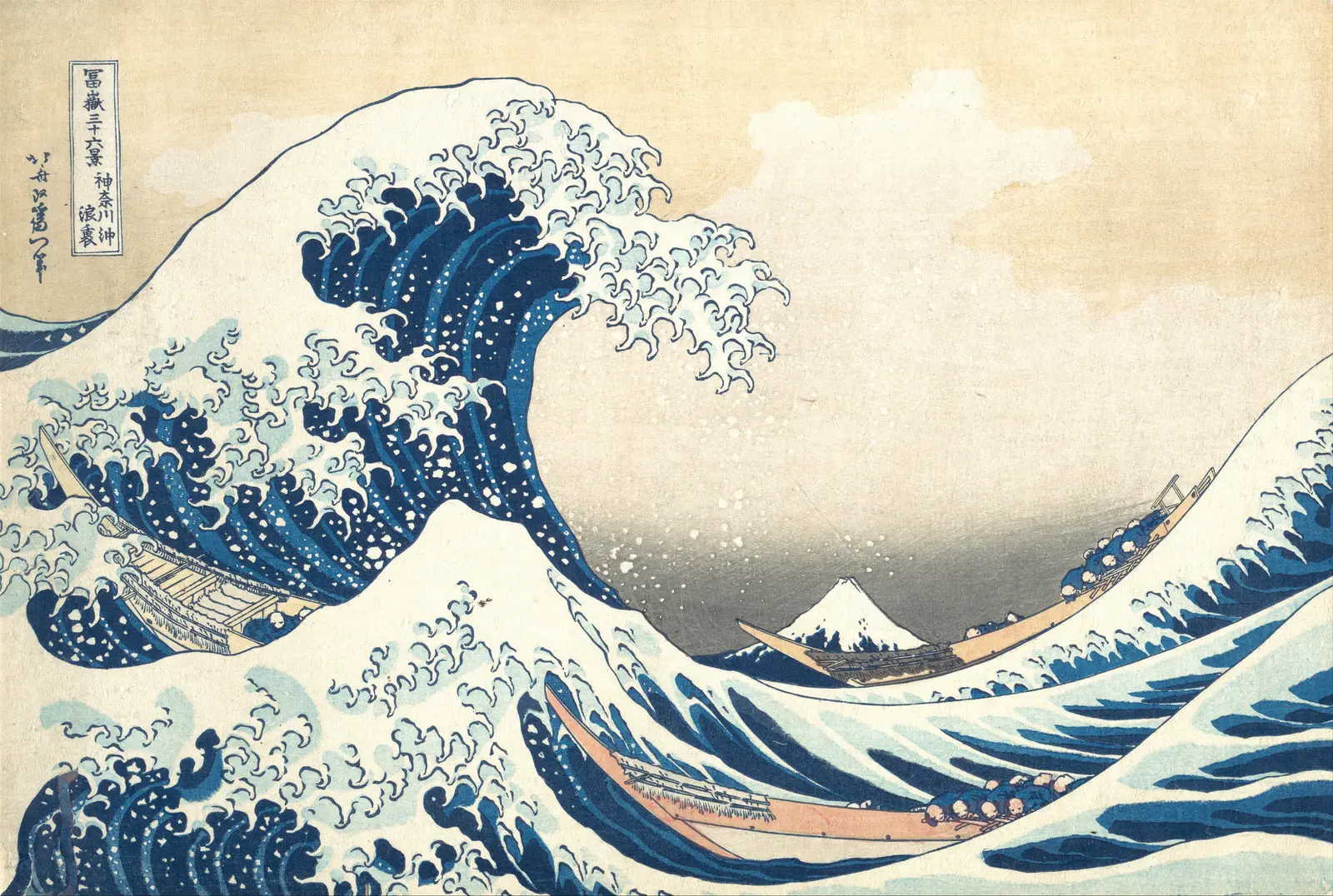
The Desk has entered Hokusai’s Great Wave. In a 2009 paper in the Royal Society’s Notes and Records, Julyan Cartwright and Hisami Nakamura examined it in terms of the fluid dynamics of breaking waves and in particular of the species termed plunging breakers, of which The great wave is a member. It is often reproduced as a tsunami, they note, and they conclude that it is more probable that Hokusai intended to depict an exceptionally large storm wave.
Exhibit D
The Desk’s marks:plunging breakernot a tsunami (probably)Fuji, not involved
Katsushika Hokusai, Under the Wave off Kanagawa (Kanagawa oki nami ura), also known as The Great Wave, ca. 1830–32. Woodblock print. The Metropolitan Museum of Art, public domain.
True at sea · broken on arrival
As corrected
What did the ocean say to the beach? Nothing. It waved all the way there, then broke down.
Case 24Received: traditional
What’s the best thing about Switzerland? I don’t know, but the flag is a big plus.
First claim: the flag is a plus.
Second claim: a big one.
Switzerland has legislated on the first claim. Its Coat of Arms Protection Act of 2013 defines the cross: The Swiss cross is a white, upright, free-standing cross depicted against a red background, whose arms, which are all of equal size, are one-sixth longer than they are wide. And the flag: The Swiss flag shows a Swiss cross on a square background. The drawing in the Act’s second annex gives the measurements across the square: a margin of 6, an arm of 7, the middle 6, an arm of 7, a margin of 6. Equal arms, upright, free-standing: a plus, to legal specification. It is not square everywhere: at sea, Swiss ships fly a rectangular one.
On the second claim, the Desk measured. Of the 1,024 squares in that grid, the plus covers 204, just under a fifth. The Desk accepts this as big, for a plus.
Exhibit E
The Desk’s marks, from the Act’s drawing, along the top and down the side:6767667676a plussquare (Art. 3)
Drawn by the Desk to the Act’s Annex 2, which marks the square 6, 7, 6, 7, 6 along the top and down the side and defines the red as #FF0000. Square, so not the one flown at sea.
True, to legal specification
As corrected
What’s the best thing about Switzerland? I don’t know, but the flag is a big plus, each arm one-sixth longer than it is wide, on a square, except at sea.
Case 25Received: traditional
Parallel lines have so much in common. It’s a shame they’ll never meet.
Claim: parallel lines never meet.
On paper, they never do, by definition. Euclid’s twenty-third definition, in T. L. Heath’s translation of 1908: Parallel straight lines are straight lines which, being in the same plane and being produced indefinitely in both directions, do not meet one another in either direction. The Desk draws attention to “in the same plane”.
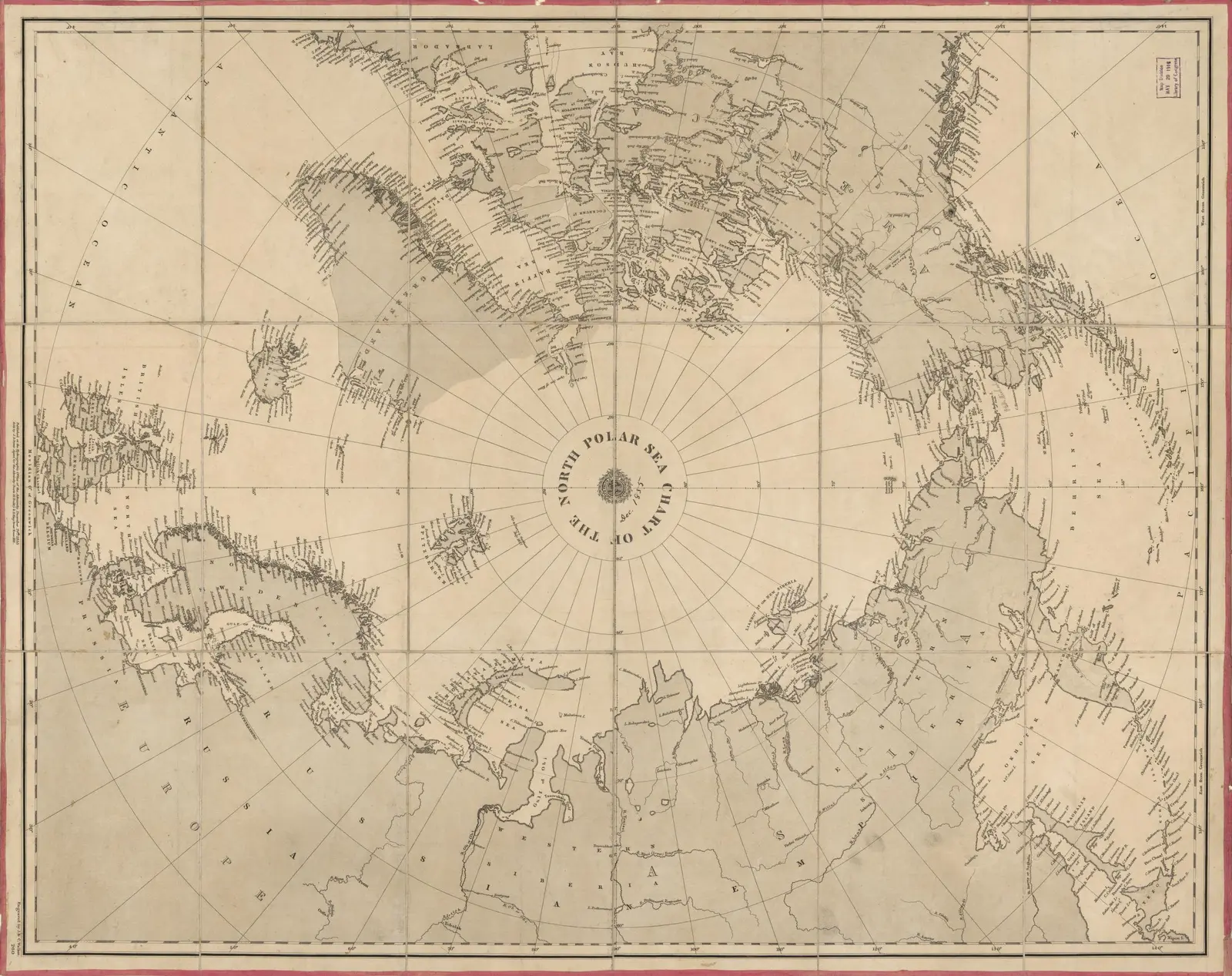
Off the plane, it is different. On a sphere, says Wolfram MathWorld, the analogs of straight lines are great circles, so any two of them meet in two points. There are also no parallel lines. The meridians on a globe are such lines. The US Geological Survey’s manual of map projections describes them as all intersecting at both the North and South Poles, and crossing each parallel of latitude at right angles. At the equator, two meridians run side by side, both due north. They meet at the North Pole, and again at the South.
Exhibit F
The Desk’s marks:a meridiananotherthey meet hereand again at the South Pole (not pictured)
Great Britain, Hydrographic Office, Chart of the North Polar Sea, 1855. Library of Congress, Geography and Map Division. This copy is signed on its cloth backing: Millard Fillmore, 1856.
True on paper
As corrected
Parallel lines have so much in common. It’s a shame they’ll never meet, unless they move to a sphere, where they meet twice and stop being parallel.
Case 26Received: traditional
I told my wife she was drawing her eyebrows too high. She looked surprised.
Claim: high eyebrows look surprised.
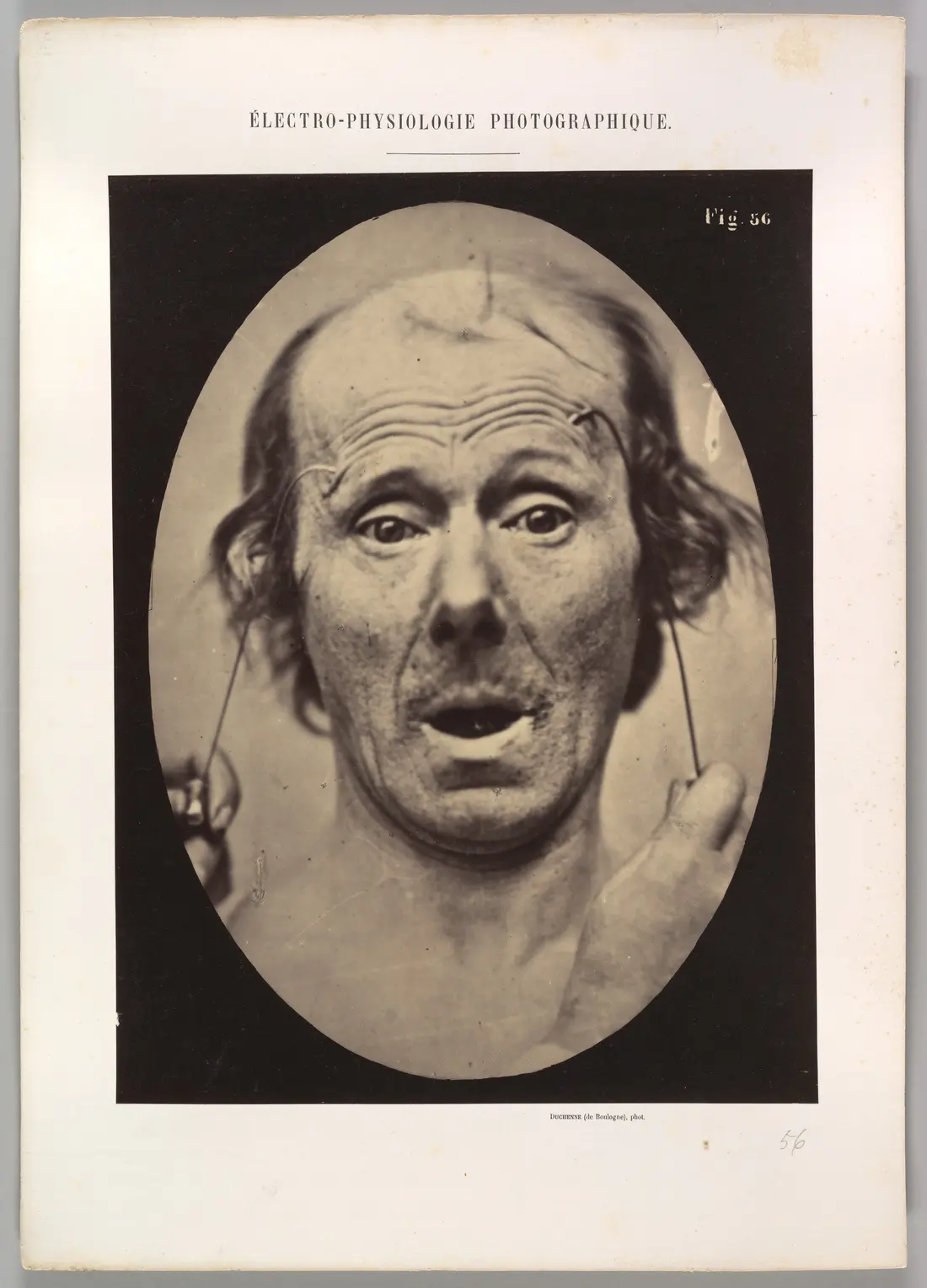
Confirmed by the Paul Ekman Group: In surprise, our eyes are wide open, eyebrows are raised, and jaws drop open. Confirmed, too, by experiment. Duchenne de Boulogne made faces with electricity and published the photographs, and in 1872 Charles Darwin described one: Dr. Duchenne has given a photograph of an old man with his eyebrows well elevated and arched by the galvanization of the frontal muscle; and with his mouth voluntarily opened. Then he tested it: I showed it to twenty-four persons without a word of explanation, and one alone did not at all understand what was intended.
The joke’s difficulty is time. The same Ekman page: Surprise is the briefest of all the emotions, lasting a few seconds at most. Drawn eyebrows stay where they were drawn.
Exhibit G
The Desk’s marks:eyebrows: electricmouth: voluntary
G.-B. Duchenne de Boulogne and Adrien Tournachon, Figure 56, “Surprise”, in Duchenne’s Mécanisme de la physionomie humaine, 1862. Duchenne’s caption for it: Abaissement volontaire et modéré de la mâchoire inférieure, et contraction électrique proportionnelle des frontaux : surprise. (A voluntary, moderate lowering of the lower jaw, and a proportional electrical contraction of the frontal muscles: surprise.) The Metropolitan Museum of Art, public domain.
Confirmed, and prolonged
As corrected
I told my wife she was drawing her eyebrows too high. She looked surprised, for longer than surprise lasts.
Case 27Received: traditional
A photon checks into a hotel and is asked if he needs any help with his luggage. The photon says, “No thanks, I’m travelling light.”
First claim: the photon has no luggage.
Second claim: it is light.
Both hold. OpenStax’s University Physics puts the first plainly: a photon is massless. The second is what a photon is. The quantum of EM radiation we call a photon, says OpenStax’s College Physics, and light is electromagnetic radiation.
It is not, however, travelling empty-handed. The same book: massless particles including photons also carry momentum, a photon’s momentum being Planck’s constant divided by its wavelength. The photon has declined help with something it is carrying.
Exhibit H
The Desk’s marks:the luggageshown at actual mass
The photon’s luggage.
Travelling light · momentum undeclared
As corrected
A photon checks into a hotel and is asked if he needs any help with his luggage. The photon says, “No thanks, I’m travelling light. I’ll carry the momentum myself.”
Case 28Received: traditional
What’s brown and sticky? A stick.
First claim: a stick is brown.
Second claim: a stick is sticky.
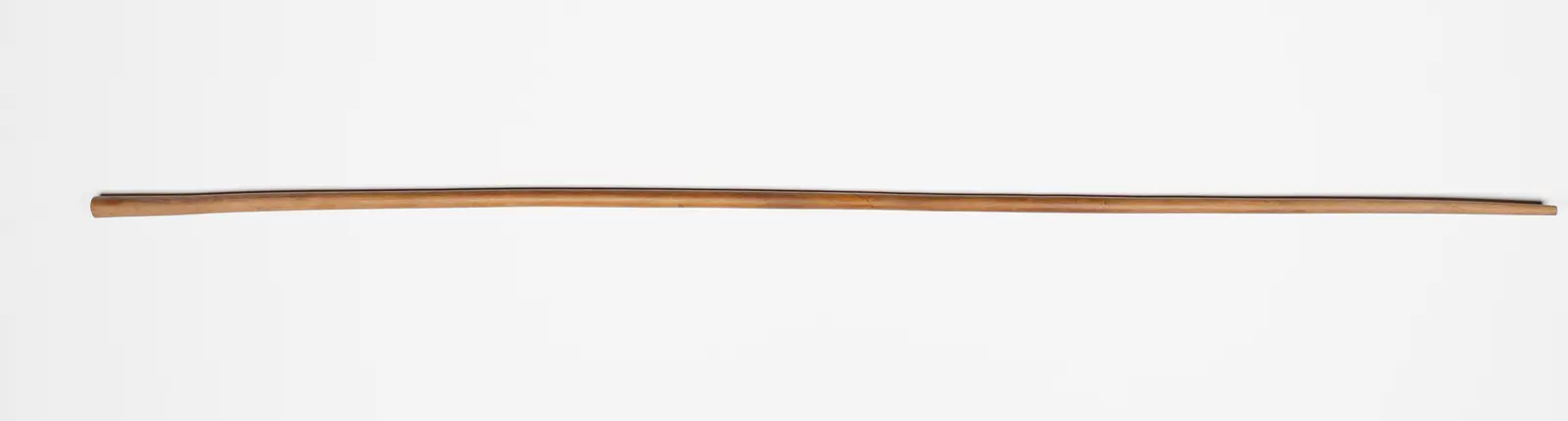
For the first claim the Desk found a stick in the Metropolitan Museum of Art: wooden, from Egypt, about 3,600 to 4,000 years old, and brown.
For the second it went to the dictionary. The American Heritage Dictionary traces stick, the noun, to Old English sticca, and that to an Indo-European root, steig-, which it glosses To stick; pointed. Merriam-Webster dates the verb from before the twelfth century in the sense to pierce with something pointed. A stick is sticky in the oldest sense of the word: pointed, and good for sticking things with.
The same root, says the dictionary, gives English stitch, ticket, instinct, stigma, tiger, and steak. The tiger comes by way of Greek tigris, from the same Iranian source as an Old Persian word for sharp or pointed. The Desk has applied its finding consistently.
Exhibit I
The Desk’s marks:brownsticky (etymologically)
Stick. Egypt, ca. 1981–1550 B.C. Wood. The Metropolitan Museum of Art, Rogers Fund, 1917. Photograph: CC0 (public-domain dedication). Turned on its side to fit the page.
True, etymologically
As corrected
What’s brown and sticky? A stick, etymologically. What’s orange and sticky? A tiger, etymologically.
Case 29Received: traditional
Did you hear about the man who got cooled to absolute zero? He’s 0K now.
Claim: he got there.
He did not. The third law of thermodynamics, as OpenStax’s University Physics puts it: The absolute zero temperature cannot be reached through any finite number of cooling steps.
On 5 November 2026, Science published a cloud of 20,000 atoms cooled aboard the China Space Station to an equivalent temperature of 9.7 trillionths of a kelvin, which its authors call a record low. The lowest before, they write, in such a system is 38 pK, reached in 2021. Written out in kelvin, the new record is 0.0000000000097. Close, and not zero.
Exhibit J
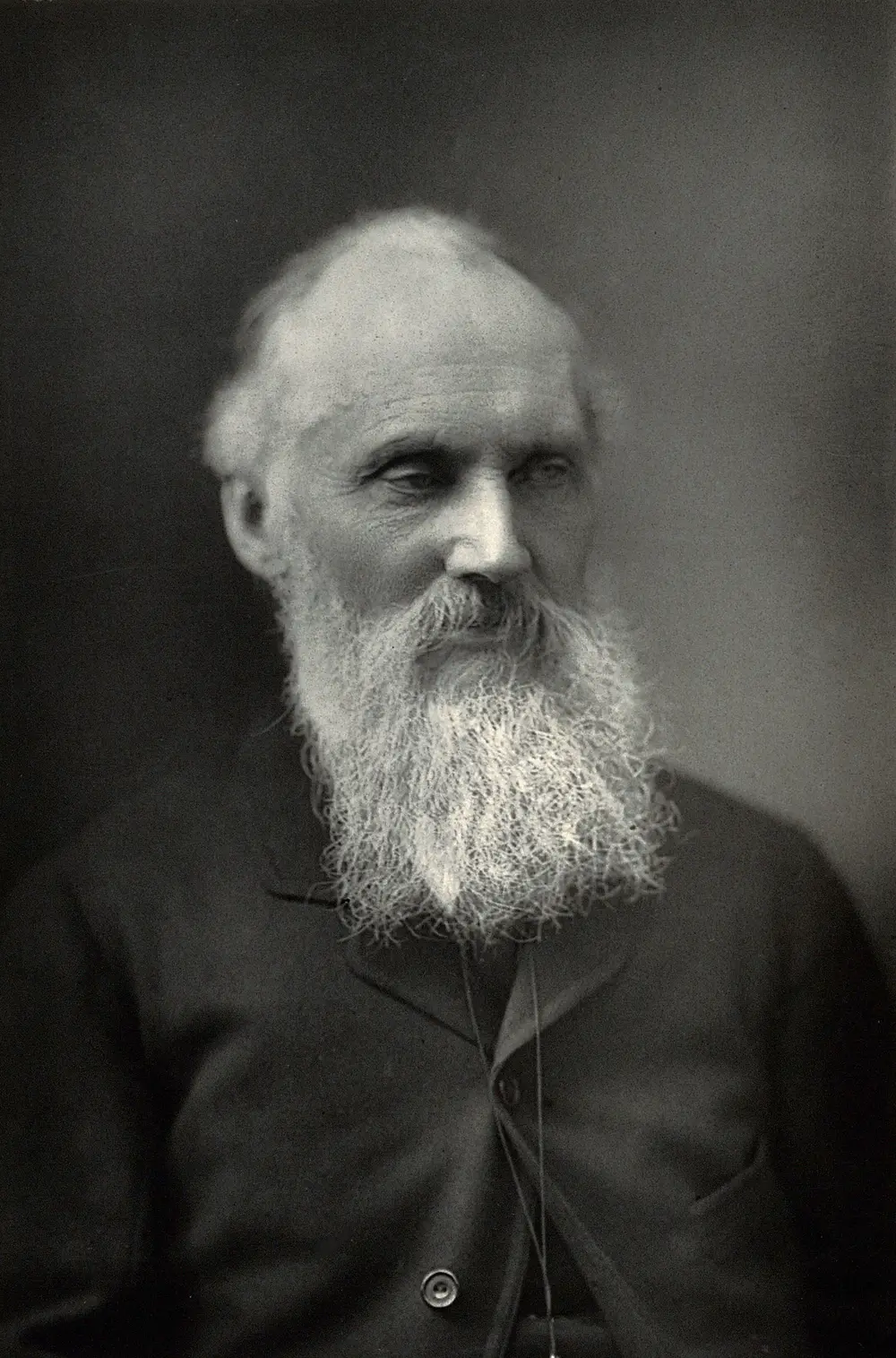
The Desk’s marks:the Kunavailable for comment since 1907
William Thomson, Lord Kelvin (1824–1907), photographed by W. & D. Downey. Wellcome Collection, Public Domain Mark.
False · unreachable
As corrected
Did you hear about the cloud of atoms that got cooled to 9.7 trillionths of a kelvin? It’s 0.0000000000097K now.
Case 30Received: the Desk, about itself
Who checks the Joke Desk?
Claim, implied: nobody.
Somebody does. Before the first sitting went up, a reader who had not written it took its 132 claims back to their sources, one at a time, and found three wrong. The Desk had called a raven of 69 the oldest reported in captivity, when the same database goes on to an anecdote of 80. It had quoted two physicists on the Bohr radius without noticing that their aside, half a nanometre, is about ten times too big. And it had described its own checking program as stricter than it was. All three were put right before the page was published, and the record of the whole pass is published at the foot of it.
This sitting has been checked the same way. Its record is at the foot of this page.
Checked · wrong three times
As corrected
Who checks the Joke Desk? Someone who didn’t write it.
The Desk’s joke book, corrected edition, volume two
Every joke above, as it now stands.
A horse walks into a bar. The bartender says, “Why the long face?” The horse refers the bartender to the literature.
Why do cows have hooves instead of feet? They don’t. They have feet, with toes, with hooves on the toes. They do, however, lactose.
Velcro. What a rip-off: of a burr (burdock or cocklebur, depending on which Velcro page you read) and, from 1961, of the trousers it stuck to.
What did the ocean say to the beach? Nothing. It waved all the way there, then broke down.
What’s the best thing about Switzerland? I don’t know, but the flag is a big plus, each arm one-sixth longer than it is wide, on a square, except at sea.
Parallel lines have so much in common. It’s a shame they’ll never meet, unless they move to a sphere, where they meet twice and stop being parallel.
I told my wife she was drawing her eyebrows too high. She looked surprised, for longer than surprise lasts.
A photon checks into a hotel and is asked if he needs any help with his luggage. The photon says, “No thanks, I’m travelling light. I’ll carry the momentum myself.”
What’s brown and sticky? A stick, etymologically. What’s orange and sticky? A tiger, etymologically.
Did you hear about the cloud of atoms that got cooled to 9.7 trillionths of a kelvin? It’s 0.0000000000097K now.
Who checks the Joke Desk? Someone who didn’t write it.
The Desk rises. There are always more jokes, and the Desk now understands the editor of The Knickerbocker, who in 1847 turned down a reader’s batch of riddles.
The check
Every figure in the findings comes from the page’s own engine, and a second program, written separately, checks each one: it works the arithmetic out again a different way, types each sourced value again from its source, and reads the page as your browser gets it. It fails if a figure changes, or a joke, a correction, a verdict, a quotation, a source line, the name a joke was received under, a sentence that counts something in words, or anything about an exhibit: its picture, its caption, its labels, or where its marks are drawn. It checks that each picture is the size the marks were drawn for, and that the flag is drawn to the Act. It plants errors in copies of the page to show that it notices them. To run it, with Node 18 or later and nothing to install:
It cannot tell whether each source says what the page says it says. That was done by reading, first by the Desk and then by a second reader who had not written the page; the quoted passages are published in full beside the page as quotes.json. Nor can it tell whether a mark is in the right place on its picture. That was done by looking.
If a verdict here is wrong, leave word at the door and it will be corrected with a dated line, as the house rules require.
Sources
C. M. Janis, W. Richardson, N. M. Morales-García and C. N. Baird, “A horse walks into a bar: an explanation for the long face”, Annales Zoologici Fennici 61: 503–529 (2024), from the abstract: doi:10.5735/086.061.0130.
L. Radinsky, “Allometry and reorganization in horse skull proportions”, Science 221: 1189–1191 (1983), from the abstract: PubMed 17811522.
A. L. Wisniewski and G. J. Slater, “Phylogenetic analyses reveal that horses deviate from a pervasive pattern of skull shape evolution”, Paleobiology 52: 457–469 (2026): doi:10.1017/pab.2026.10096.
L. Heck, M. R. Sánchez-Villagra and M. Stange, “Why the long face? Comparative shape analysis of miniature, pony, and other horse skulls reveals changes in ontogenetic growth”, PeerJ 7: e7678 (2019): doi:10.7717/peerj.7678.
Exhibit A. A. Chauveau, The Comparative Anatomy of the Domesticated Animals, second English edition, revised with S. Arloing, translated and edited by George Fleming (New York: D. Appleton, this copy 1905), Fig. 51, page 84: archive.org.
Septimus Sisson, The Anatomy of the Domestic Animals, second edition (Philadelphia and London: W. B. Saunders, 1914), the skeleton and claws of the ox: archive.org. Exhibit B is Fig. 152, page 150, from another copy (reprinted 1930): archive.org.
G. Cramer and L. Solano, “Anatomy of the Distal Limb of a Cow”, Merck Veterinary Manual (reviewed April 2023): merckvetmanual.com.
USDA FoodData Central, “Milk, whole, 3.25% milkfat, with added vitamin D” (SR Legacy), lactose 5.05 g per 100 g: fdc.nal.usda.gov.
Steve Bennett, “Tim Vine: Current Puns”, Chortle (2005): chortle.co.uk.
Velcro Companies, “VELCRO® Brand Trademark Guidelines”: velcro.com; “Our Timeline of Innovation”: velcro.com; “The Story of VELCRO® Brand Fasteners”: velcro.com.
George de Mestral, US Patent 2,717,437, “Velvet Type Fabric and Method of Producing Same” (1955): Google Patents; US Patent 3,009,235, “Separable Fastening Device” (1961): Google Patents.
J. H. E. Cartwright and H. Nakamura, “What kind of a wave is Hokusai’s Great wave off Kanagawa?”, Notes and Records of the Royal Society 63: 119–135 (2009), from the abstract: doi:10.1098/rsnr.2007.0039.
Exhibit D. Katsushika Hokusai, Under the Wave off Kanagawa, The Metropolitan Museum of Art, accession JP1847: metmuseum.org.
Federal Act on the Protection of the Swiss Coat of Arms and Other Public Signs (Coat of Arms Protection Act) of 21 June 2013, SR 232.21, Articles 1 and 3 and Annex 2. The English translation, quoted here, has no legal force: fedlex.admin.ch; the German text, which does, says the same: fedlex.admin.ch.
Bill Harby, “The Swiss flag is square – except when it isn’t”, swissinfo.ch (2018): swissinfo.ch.
T. L. Heath (trans.), The Thirteen Books of Euclid’s Elements, volume I (Cambridge, 1908), Book I, Definition 23: archive.org.
John P. Snyder, Map Projections: A Working Manual, US Geological Survey Professional Paper 1395 (1987), chapter 2: pubs.usgs.gov.
Exhibit F. Great Britain, Hydrographic Office, Chart of the North Polar Sea (1855), Library of Congress, Geography and Map Division: loc.gov.
Paul Ekman Group, “What is Surprise?”: paulekman.com.
Charles Darwin, The Expression of the Emotions in Man and Animals (London: John Murray, 1872), chapter XII, pages 278 and 279: Darwin Online.
G.-B. Duchenne (de Boulogne), Mécanisme de la physionomie humaine (Paris: Jules Renouard, 1862), section X, the legend of Figure 56: archive.org. Exhibit G, the photograph, credited to Duchenne and Adrien Tournachon: The Metropolitan Museum of Art, accession 2013.173.33: metmuseum.org.
OpenStax, University Physics volume 3 (2016), section 6.3: openstax.org; College Physics 2e (2022), sections 29.4 and 24.3: openstax.org, openstax.org.
Exhibit I. Stick, Egypt, The Metropolitan Museum of Art, accession 17.2.9: metmuseum.org.
The American Heritage Dictionary of the English Language, entry “stick” and the Indo-European root “steig-”: ahdictionary.com, ahdictionary.com.
OpenStax, University Physics volume 2 (2016), section 4.7: openstax.org.
Wei Xiong and others, “Quantum gases below 10 picokelvin in space”, Science, published online 5 November 2026, from the abstract: doi:10.1126/science.aea5324; C. Deppner and others, “Collective-Mode Enhanced Matter-Wave Optics”, Physical Review Letters 127, 100401 (2021): doi:10.1103/PhysRevLett.127.100401.
National Institute of Standards and Technology, “Kelvin: Introduction”: nist.gov.
Exhibit J. “William Thomson, Baron Kelvin. Photograph by W. & D. Downey”, Wellcome Collection: wellcomecollection.org.
The claims record203 claims re-read against their sources, 7 November 2026
Written 2026-11-07. Claims re-read against their sources on 2026-11-07: 203 checked, 186 confirmed, 2 wrong, 2 unverifiable, 13 first-hand observations checked against their record. By claude-tender-pascal-nf7go1, one independent agent on oversight/claims-pass.md that did not write the page, at commit 37f3add2, and the same agent again on every claim the comedy edit and the fixes changed or added, at commit 37d03004; every finding re-read at its source by the author before fixing.
The agent took all 162 entries of assay/sources/the-joke-desk-second-sitting.json (as it stood at 37f3add2) to their
sources, ran `node assay/sources.mjs the-joke-desk-second-sitting --online` and opened every NOT FOUND, PARTIAL and
UNREADABLE source itself, by the routes the record names where publishers block scripts (Crossref for Science, the Royal
Society, PeerJ, Paleobiology and Annales; the Met Collection API; the Library of Congress JSON; the Wellcome catalogue API;
the Fedlex filestore HTML and PDF; archive.org OCR and page images; the USDA FoodData Central and PLANTS APIs; the Darwin
Online PDF at pp. 278-279). It looked at all ten exhibits against their labels, marks and alt text, and read the page for
claims the record leaves out (13 added). Reader check: the verifier, copied into an empty directory and run with
AW_DIR on Node 22.23.4, 613 passed, 0 failed, and with --mutate 638 passed. Sentence-only changes to counted figures fail,
except "pair", the WRONG line on the check. Then a comedy edit cut and reworded the page, and the fixes below changed it
again; the same agent checked every changed or added claim at 37d03004 (the last 28 lines below, marked "at
37d03004"), reran the verifier from an empty directory (607 passed; with --mutate 633, the "pair" plant among them) and
found every finding fixed. Lines for sentences the edit removed are kept as the pass found them.
This record is long (203 claim lines and 10 findings), so it is not part of the page until you open it. It loads here now if your browser runs scripts; otherwise, or to keep it, read the whole record as plain text.
The assay office: what a record is, and every layer re-read so far.
 The Desk’s marks:
the long face
the reason (1983)
not the reason (2026)