Flowers · Courtship · Bibliography
Understood in the Same Way
A Victorian bouquet could be read only if the sender’s flower dictionary agreed with the receiver’s. The Artificial Wasteland transcribed twenty-eight printings of those dictionaries, from 1811 to 1890, and measured it: two books listing the same flower printed the same meaning only about half the time. Read any flower in all of them at once, and follow who copied whom, misprints and all.
The 28 books, oldest on the left, each spine coloured from a patch of its own cover in the scan (the London book of 1834 has no cover there, so its spine is a plain board colour). Tap one for its title page.
Choose a flower
Each book’s meaning appears under it, grouped with the books that printed the same words. Every reading links to the page of the scan it was taken from.
The posy, read in every book
All that is necessary
The language of flowers promised a bouquet that could be read: a yellow rose for one thing, lavender for another, a posy that said what could not be said aloud. Elizabeth Wirt, whose Flora’s Dictionary was first printed in 1829 in Baltimore (it is read here in a printing of 1832), admitted that most of its meanings were her own, supplied because so few had come from the East, and defended the few she had simply made up the way one would defend words. A spoken word, she argued, is arbitrary too, and works anyway,
all that is necessary being, that the purpose of the sign be understood in the same way by all who use it.
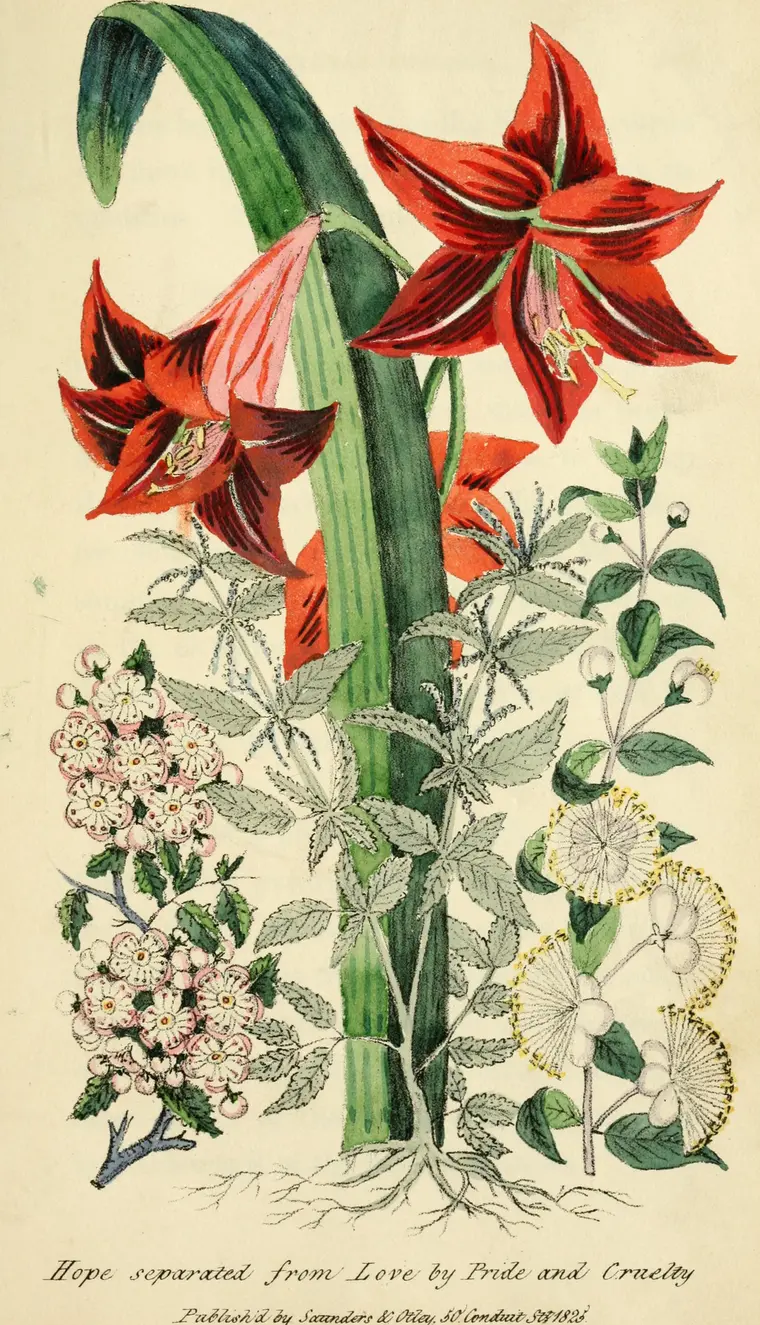
Hope separated from Love by Pride and Cruelty: a sentence in flowers, a coloured plate in Henry Phillips’s Floral Emblems (London: Saunders and Otley, 1825), bound into his entry for Pride. In the book’s own dictionary, hawthorn is Hope, myrtle Love, the amaryllis Pride and the stinging nettle Cruelty: Hope stands on the left, Love on the right, and Pride and Cruelty between them. Scan: Internet Archive, floralemblems00phil, leaf 296, from the LuEsther T. Mertz Library of the New York Botanical Garden; the Internet Archive’s record marks it as not in copyright.
That is a condition that can be checked. The language had no speakers to ask: it lived in its dictionaries, so this page reads 24 of them, and later printings of four: 28 volumes printed in France, Britain and the United States between 1811 and 1890. They have been transcribed exactly as printed, misprints and all: 11,137 entries, each tied to its page.
The doubt is as old as the books. The first of them, Delachénaye’s Abécédaire de Flore (Paris, 1811), had found lists of meanings going round, copied by hand and then printed, and did not trust them:
mais la différence qu’on observe dans la signification de quelques-unes des fleurs dont elles sont composées, porte à croire que ces productions, sans prétention comme sans autorité, ne proviennent pas d’une véritable source
but the differences to be seen in the meaning of some of their flowers lead one to believe that these productions, without pretension as without authority, do not come from a true source
He then did, by hand, a small version of what this page does: he took three lists, and where two agreed against the third, he printed the two.
How often two books agreed
Take any two of the 22 English-language books, one edition of each, and a flower they both list. They print the same meaning, word for word, 50% of the time. Count a shared sentiment as agreement (“Coldness. Indifference.” against “Indifference.”) and it rises to 59%.
Those are pooled over all 35,678 comparisons between 231 pairs of books. Pair by pair the spread is wide, from 4% to 99%; of the 231 pairs that share at least thirty flowers, the middle one agrees word for word on 42%.
Not all of the rest is real
disagreement. Two readers, AI helpers working blind (shown two meanings and nothing else, no flower and no book,
mixed in with as many pairs that do share a sentiment), judged 150 comparisons drawn at random from the
14,544 in which two books share no sentiment at all. Both called 42 of them the same thing
in other words, such as Distrust.
and Suspicion.
for lavender, or Cure for Heart-ache.
and
Cure for heartache.
, which the rules count as different. Both called 41 related,
59 different (Excess is dangerous.
and Marriage.
, for saffron) and
2 opposed: for nightshade, Burke’s list says Truth.
, and Ingram’s, which prints the same
words as Burke’s for 92.5% of the flowers they share, says Falsehood
. So
roughly a quarter of the outright disagreement is only wording, and about two in five of those comparisons give
the flower a different meaning. The two readers are runs of the same kind of model, so their agreeing with each
other 144 times in 150 says less than two people’s agreement would.
A flower counts as shared only when two books name it the same way, once case, punctuation and the order of words are set aside: “Rose, Yellow” is “Yellow Rose”, but Pansy and Heart’s Ease, one plant, stay two names here, and so do the longer forms the books give them. The French books are matched through the English name their plants are most often printed under. Merging synonyms by hand would add comparisons of both kinds, agreeing and not, and was not done.
The disagreement has been noticed before. Beverly Seaton’s history of the language of flowers, in her publisher’s
summary, shows that it was not a single and universally understood correlation of flowers to meanings
, and
that The language differs from book to book, country to country.
Susan Loy, who gathered the meanings of
seventeen books printed across the century, found that it is rare when a majority agreed on one meaning
, and that
Overlap existed among the dictionaries because the writers copied each other.
What this page adds is the count:
every entry of every book here, a rate of agreement anyone can recompute, and the copying traced book by book. The
count does not quite agree with her on majorities. Counted word for word, in these books a majority is not rare: of
the 679 flowers listed in at least five of the English-language books,
524 have one meaning printed by more than half of the books that list them. That
is the copying again: a family of books that copy each other can make a majority by itself, while the middle pair of
books agrees word for word on only 42% of the flowers it shares.
Switch books off and on to see the pooled figure recomputed in your browser from the counts for each pair of books, which the verifier below recomputes from the entries themselves.
Every pair
Each square is a pair of books, darker where they print the same words more often; the books are ordered by family, so copying shows as dark blocks. Squares left blank share fewer than thirty flowers.
Who copied whom
Agreement is not spread evenly, and the reason is copying. For each book, the line below joins it to the earlier book it agrees with most: its nearest relative among these 28 volumes, which is evidence of copying, not proof of it. The rules for drawing these lines were fixed before any two books had been compared, and they had to pass a test first: given a later edition of a book already in the set, they must find its own earlier edition. A line is drawn heavier the more the two books agree; a faint one means only that no earlier book here is closer.
Follow the strong lines back, those along which two books print the same
words at least half the time, and 20 of the 26 later books reach La Tour’s Paris
book. (The two French books are compared through an English gloss of each meaning, written by the transcribers, so
the lines from them are the least certain here.) One road runs through the London book of 1834,
which says it is founded on the French
, to the Sentiment of Flowers of 1837,
which adopted the system of Madame de la Tour
, and on to books that copied it closely: Waterman’s
Philadelphia book of 1840 prints the same words as the Sentiment of Flowers for
82 of the 98 flowers they share.
Thirty years on, the road was still open: the book Robert Tyas wrote for Routledge in 1869
(library catalogues name him as the author of the Sentiment of Flowers too, whose preface is signed
R. T.
) is closest to that earlier book, the same words as its 1841 printing for
103 of 143 shared flowers, and not to the
Burke list Routledge was already printing, with which it agrees word for word on
41.2% of the flowers they share. The
other road runs through Phillips’s London emblems of 1825, then the Philadelphia book of
1836, which calls itself a reprint of the last London edition
(its title page adds the Emblems of
American Flowers
, and the 13 readings it shares with
Hale’s Boston book and no other book here, bar Hale’s own later edition, suggest where those came from), Nelson’s alphabet
(1846) and Reid’s Glasgow lexicon (1847), to Mrs Burke’s Routledge book
(1858). From there one list runs on nearly unchanged: in Valentine’s book for Warne
(1867), the same words as Burke’s for 609 of
642 shared flowers; in Ingram’s Flora Symbolica, also for Warne
(1869); and in Greenaway’s for Routledge (1884), the same words as Burke’s
for 660 of 666. The exceptions are all
American: the books of Wirt and Hale, both read in printings of 1832, which agree with each other
(44.1%) far more than with anything earlier, and Hale named Wirt’s book as a source;
the books that drew on those two; and Osgood’s Floral Offering (1847).
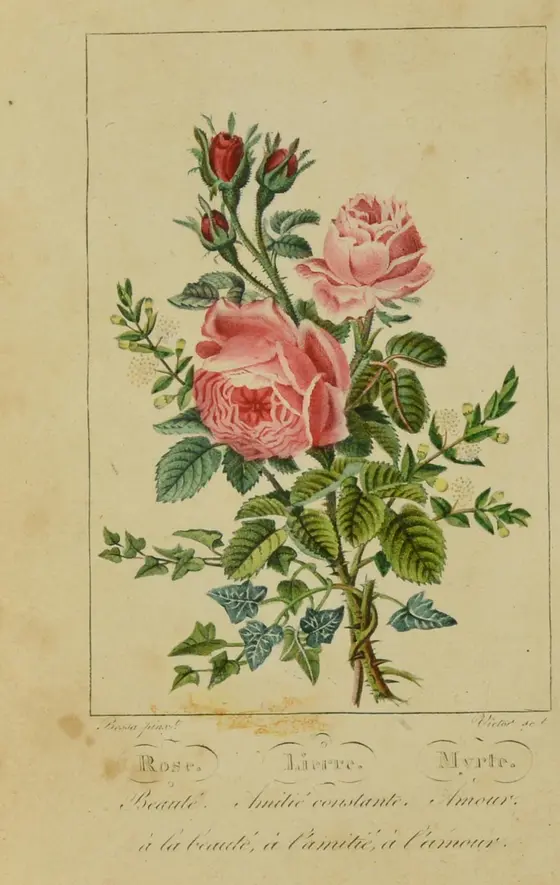
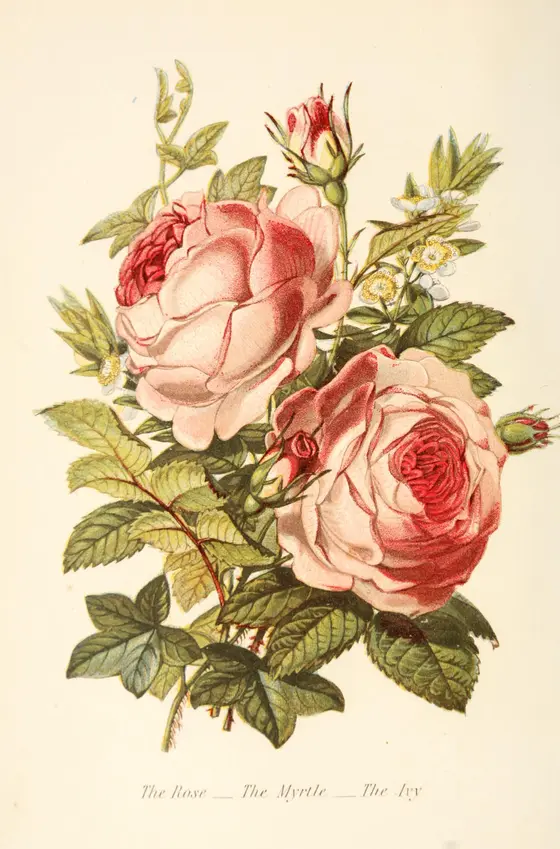
Rose. Lierre. Myrte. over Beauté. Amitié constante. Amour., signed by Bessa,
who painted it, and Victor, who engraved it; scan langagedesfleur00lato,
leaf 11, from Cornell University Library by way of the Biodiversity Heritage Library, which states: “Public domain.
The BHL considers that this work is no longer under copyright protection.” Right: the frontispiece of Robert Tyas’s
book (London: George Routledge and Sons, 1869), which names the rose, the myrtle and the ivy, and which its list of
plates calls emblematic of Beauty, Friendship, and Love; scan languageofflower00tyas, leaf 7, from the LuEsther T. Mertz Library of the New York Botanical Garden; the Internet Archive’s record marks it as not in copyright.
That family is one reason the pooled figure above is as high as it is. Burke’s list and its three reprints agree with each other 95% of the time over 3,912 comparisons. Switch off Valentine, Ingram and Greenaway in the panel above, so that the list is counted once, and the books print the same words 42% of the time. That check was not in the pre-registration; it is here because the tree made it obvious.
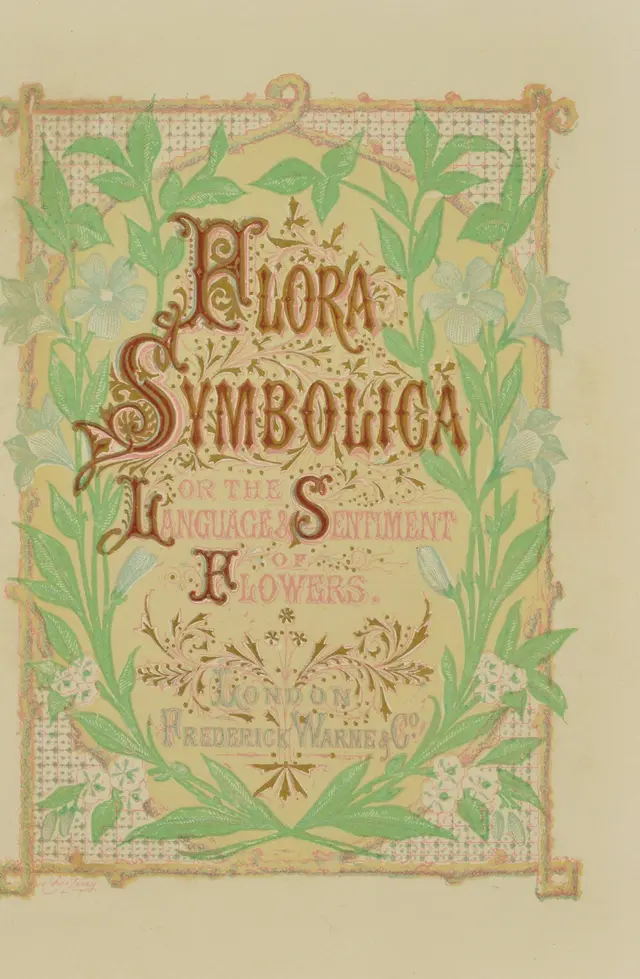
printed in colours by Terry. Scan: Internet Archive, florasymbolica00ingr, leaf 6, from Cornell University Library by way of the Biodiversity Heritage Library, which states: “Public domain. The BHL considers that this work is no longer under copyright protection.”
The editors said so
The compilers knew where their meanings came from, and several of them said so in their
prefaces. Sarah Josepha Hale, in Boston in 1832:
There is nothing new attempted, except in the arrangement, and the introduction of American sentiments
. She
named Wirt’s book as a source, and described the method: Making a book (not writing it) is somewhat like preparing
a dinner, the ingredients must be collected from many places, and these are usually so disguised by the preparation
that little of the original flavor remains.
The London book of 1834
is founded on the French
; the Sentiment of Flowers of 1837
had its origin in that celebrated publication, “Le Langage des Fleurs;”
. In
1869 John Ingram wrote that many recent English and American
vocabularies have been simply word-for-word translations from the works of our Gallic neighbours
. And John
Reid, who signed his preface at Pera of Constantinople in March 1839 and published it in Glasgow in
1847, was certain that we are more indebted to the Occidentals than the
Orientals for the contents of the present volume
, and printed two meanings, the second in italics, wherever
the European and American sentiments attached to a flower disagree
.
Not every such claim survives the count. The New York book of
1834, compiled by a society of ladies and gentlemen for their own
amusement
, says that most of the emblems have been copied from “Flora’s Dictionary.”
Of all the earlier books
here, Wirt’s Flora’s Dictionary is indeed its nearest relative, but the two print the same words for only
21 of the 86
flowers they share. The copying was loose, or it was from a printing not read here: Wirt’s own preface mentions an
earlier sketch that found its way to the press in Boston
.
The misprint that travelled
Copying leaves fingerprints, and the best of them is a plant that does not exist. Under A,
the Philadelphia book of 1836 lists Austurtium (Scarlet)
, meaning Splendour: almost certainly the
scarlet nasturtium, which Nelson’s book lists correctly, with the same meaning, under N. The same misprint, with the
same meaning, is filed under A in eight of these books, from Philadelphia in
1836 to Greenaway’s in 1884: Nelson, Reid, both editions of Burke, Valentine, Ingram and
Greenaway, every one of them on one branch of the tree drawn above. It is not in Phillips. It came in later, probably in the London
edition the Philadelphia printer says it followed, which is not among these books, though it could have been made in
Philadelphia. Smaller trails run the same way:
Rudbeakia
from Philadelphia through Nelson and Reid; Frog Optorys
, a mangled frog ophrys, only in
Nelson and Reid; and Hydranger
, a boaster, in Wirt (1832) and again in Waterman
(1840). Two copyists rarely invent the same mistake.
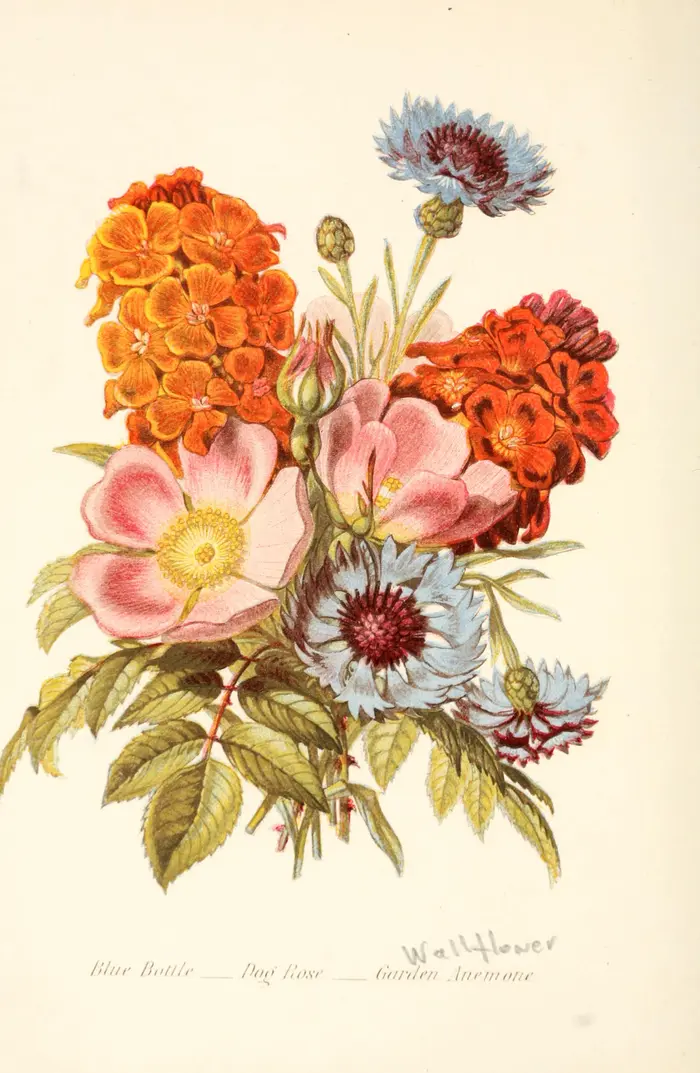
Garden Anemone, but the orange flowers are the wallflowers of the book’s list of plates (
Blue Bottle—Dog Rose—Garden Wallflower, combined to express, “Delicacy and simplicity add charms to lasting beauty”); an erratum below that list says
the word Anemone should be Wallflower, and a reader of this copy pencilled
Wallflowerover the caption. Scan: Internet Archive, languageofflower00tyas, leaf 115, from the LuEsther T. Mertz Library of the New York Botanical Garden; the Internet Archive’s record marks it as not in copyright.
| Prediction | Result |
|---|---|
| Each control, a later edition of a book already in the set, finds that book as its nearest earlier relative, printing the same words for at least 90% of the flowers they share. If one failed, the lines above would not be trusted. | Held for all four. Burke’s book in its edition of 1867 finds its first edition (99.9%); Hale’s of 1856, hers of 1832 (95.8%); the Sentiment of Flowers of 1841, that of 1837 (100.0%); and the Mazawattee tea booklet of 1890, Beecham’s calendar of 1886 (99.5%). The last was made a control after the pre-registration, when the booklet turned out to print the calendar’s text. |
| At least one pair of different books, not editions of one book, prints the same words for at least 80% of the flowers they share: wholesale copying. | Held: 11 pairs, among books sharing at least thirty flowers. All but two are Burke’s list, its second edition and the books that reprint it; the other two are Waterman’s lexicon of 1840 with each edition of the Sentiment of Flowers (83.7% with the first). |
| At least one pair of books sharing at least 100 flowers prints the same words for fewer than 25% of them: independent traditions. | Held: 38 pairs. The lowest between two English-language books is the New York book of 1834 against Osgood’s Floral Offering of 1847: the same words for 8 of the 117 flowers they share. |
The Philadelphia book of 1836, which calls itself a reprint of the last London edition, has a London book as its nearest earlier relative. |
Held: Phillips’s Floral Emblems (London, 1825), the same words for 137 of 197 shared flowers. Phillips lacks the misprint above, so the London edition it followed was probably a later book, not read here. |
| Greenaway’s book (Routledge, 1884) has a Routledge book as its nearest earlier relative. | Held: Burke’s, in Routledge’s edition of 1867, the same words for 661 of 666 shared flowers. |
The hope the books left out
The idea owed its fame in Europe to one letter. C’est à lady Montague que ce langage doit sa célébrité en Europe
(it is to Lady Montagu that this language owes its fame in Europe), wrote the orientalist Joseph von Hammer
in Vienna in 1809, in the journal he edited, though other travellers had mentioned it before her. Her letter, headed Pera, March 16, O. S.
and printed in
1763, described a Turkish love letter made of things, most of them not flowers at all (soap, coal, a straw, a
match, gold wire, pepper), and explained how such a letter is read:
You see this letter is all in verse, and I can assure you, there is as much fancy shewn in the choice of them, as in the most studied expressions of our letters; there being, I believe, a million of verses designed for this use. There is no colour, no flower, no weed, no fruit, herb, pebble, or feather, that has not a verse belonging to it; and you may quarrel, reproach, or send letters of passion, friendship, or civility, or even of news, without ever inking your fingers.
A verse, not a symbol. Her pear says Give me some hope.
Hammer, who had lived several years
in Constantinople, explained the mechanism: the women who used these
signs, he wrote, chose a word that rhymes with a thing’s name, and built a sentence ending on the rhyme. A pear is
armoude, and it says Ver bana bir omoude, give me some hope, because
omoude rhymes with it. He put the whole stock at not much more than a hundred signs and phrases,
and doubted that anyone had made a dictionary of it: Nous n’en connoissons point de fait, et nous doutons fort qu’il en existe
(we know of no dictionary of it, and strongly doubt that one exists). So he printed one himself: the signs he had
collected from Greek and Armenian women with connections inside the harems, translated so as to keep the rhyme
wherever French allowed it. His pear still rhymes: Poire. Donnez-moi de l’espoir.
So the hope crossed into French, rhyme and all, in Hammer’s journal. It did not cross into the flower books: ten of the books here list the pear tree or its blossom, and they give it “Affection”, “Comfort” or “Health”; not one gives it hope. Whatever the dictionaries took from the East, they did not take this, and the prefaces above say where most of their meanings came from: from the poets, from the plants’ names and habits, and from the other books.
What the yellow rose meant
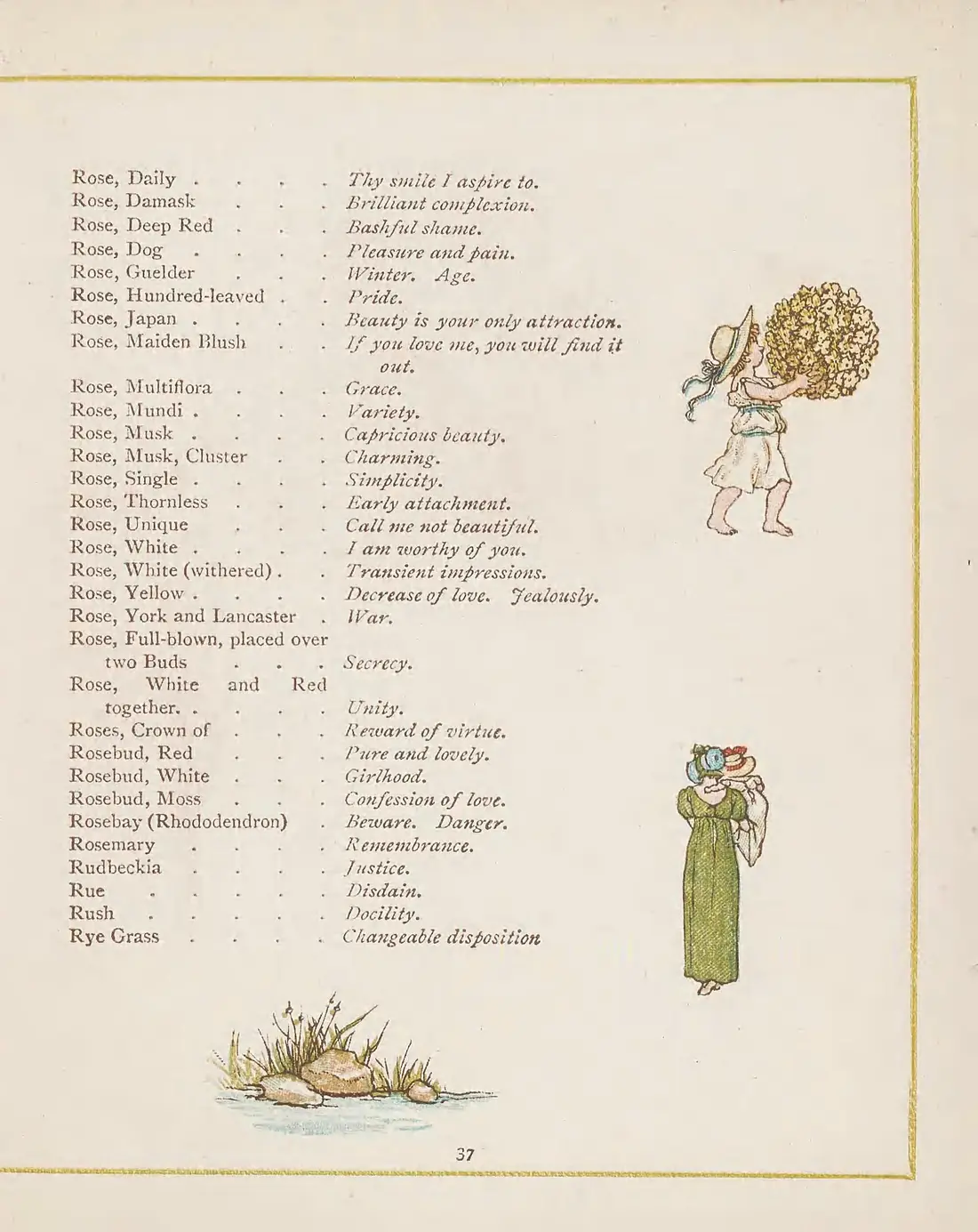
Modern guides to the Victorian meanings give the yellow rose jealousy. The Old Farmer’s
Almanac, whose chart, it says, reflects mainly Victorian flower language
, lists Jealousy, Decrease of love,
Infidelity
; a florist’s blog this year says yellow roses evolved from jealousy and dying love in older flower
dictionaries
. In these books jealousy is one family’s reading. Counting each book once, leaving out its later editions, the
commonest meaning word for word is Infidelity, in nine of them, and the decrease of love, alone or with something
added, is in seven: Wirt (1832) has
The decrease of love, on better acquaintance
, which later books shorten; Reid’s Glasgow lexicon, which files its yellow rose as Rose, Yellow. (Yellow Sweet
Briar.)
, a name the rule keeps apart, says Decrease of love.
too. Hale has Let us Forget
. Jealousy first appears with
Mrs Burke (1858), as Decrease of love. Jealousy.
, and every later book that prints it descends
from hers along the lines drawn above: Valentine and Ingram word for word, Seelye (1875) with jealousy alone, and Greenaway
(1884), on the page above, as Decrease of love. Jealously.
The check
What was read. Every book here is a scan in the Internet Archive, and every reading in the reading room links to the page of the scan it was taken from, so any of them can be checked against the paper. The vocabularies were transcribed from the scans’ OCR, rebuilt into printed lines from the position of every word, and then corrected letter by letter against the page images by AI helpers, keeping each book’s own spelling and its misprints. Then other AI helpers, who never saw the transcriptions, re-read a random sample off the scans, given only each entry’s leaf and printed name: 840 entries, thirty from each book, drawn by a seeded program anyone can rerun. 624 came out identical, 214 differed only in punctuation, spacing or capitals, and two differed in a letter. Re-read against the scan by the page’s author, two of those were the transcription’s reading, which leaves no misreadings found. The auditors also counted every entry on 56 whole pages, two from each book, and 56 of those counts matched the transcription. Every reading is in the audit file, which the verifier below scores again.
The rules were fixed first. How names are matched, what counts as the same meaning, how the headline is pooled, how a nearest relative is chosen, and five predictions, were committed to the repository before any two books had been compared; the record is in the pre-registration. The departures from it, each with its reason, are listed in the notes.
The figures are recomputed. Every figure on this page about agreement was computed from the same entries the reading room shows, and is computed a second time, from those entries, by a separate program that writes the rules again in different code. With Node 18 or later and nothing else installed:
curl -O https://artwaste.land/checks/verify-the-language-of-flowers.mjs
node verify-the-language-of-flowers.mjs
It downloads this page and its data, recomputes every pair, the pooled figures, the nearest relatives and every
number in the prose, and fails if any differs. Run it with --mutate and it also plants wrong figures,
a changed meaning, a dropped entry and a moved date in copies, and fails unless it catches each one.
What this cannot tell you. Whether anyone ever read a real bouquet by one of these books: the dictionaries are the only place the language is recorded, so they are what is measured. Whether these books are typical: they include the famous ones and some humbler ones, two of them advertising booklets, chosen from the Internet Archive’s holdings to span the century and the three countries, not drawn at random from every edition printed. And whether two books meant the same thing: the rules compare words, and the two readers above are the only check on sense.
Sources
The books, in the order of the shelf. Each was read in the Internet Archive scan named; the leaves are the scan’s own numbering of the vocabulary pages. A name or a year in square brackets is not printed on the title page: it comes from elsewhere in the book, a copyright notice or a library catalogue.
- B. Delachénaye, Abécédaire de Flore, ou Langage des fleurs (Paris: P. Didot l'aîné, 1811). Internet Archive abeyceydairedef00dela; the vocabulary is on leaves 181 to 190.
- Madame Charlotte de Latour (the pen name of Louise Cortambert), Le Langage des Fleurs (Paris: Audot, undated; see the note). Internet Archive langagedesfleur00lato; the vocabulary is on leaves 328 to 347. The title page is undated (Audot, Rue des Maçons Sorbonne N° 11; printer Fain). An owner’s inscription in this copy is dated 27 November 1824, so it was printed by then; the year 1824 is used only to order it among the books, as the latest it can be.
- Henry Phillips, Floral Emblems (London: Saunders and Otley, 1825). Internet Archive floralemblems00phil; the vocabulary is on leaves 92 to 395.
- “A Lady” (Elizabeth Washington Gamble Wirt, named in later editions), Flora's Dictionary (Baltimore: Fielding Lucas Jr., 1832). Internet Archive florasdictionary00wirtrich; the vocabulary is on leaves 36 to 239.
- Sarah Josepha Hale, Flora's Interpreter (Boston: Marsh, Capen and Lyon, 1832). Internet Archive florasinterprete1832hale; the vocabulary is on leaves 222 to 226.
- anonymous; its preface says it is “founded on the French”, The Language of Flowers (London: Saunders and Otley, 1834). Internet Archive languageflowers01cortgoog; the vocabulary is on leaves 316 to 329.
- anonymous, The Language of Flowers (New York: Osborn & Buckingham, 1834). Internet Archive mobot31753000460664; the vocabulary is on leaves 4 to 35.
- anonymous, The Language of Flowers: or, Alphabet of Floral Emblems (Philadelphia: Thomas T. Ash, 1836). Internet Archive languageflowers00q; the vocabulary is on leaves 42 to 63.
- [Robert Tyas], The Sentiment of Flowers; or Language of Flora (second edition) (London: Charles Tilt, 1837). Internet Archive sentimentflower00; the vocabulary is on leaves 346 to 355.
- Catharine H. Waterman, Flora's Lexicon (Philadelphia: H. Hooker, 1840). Internet Archive floraslexiconint00wate; the vocabulary is on leaves 262 to 265.
- [Robert Tyas], The Sentiment of Flowers; or, Language of Flora (London: R. Tyas, 1841), kept as a control. Internet Archive sentimentflower00tyas; the vocabulary is on leaves 350 to 359.
- “A Lady”, The Bouquet: containing the Poetry and Language of Flowers (Boston: Benjamin B. Mussey, 1845). Internet Archive bouquet00muss; the vocabulary is on leaves 142 to 145.
- edited by James G. Bertram, The Language of Flowers: an Alphabet of Floral Emblems (London: T. Nelson, 1846). Internet Archive languageflowers00a; the vocabulary is on leaves 14 to 33.
- John Reid, The Language of Flowers (Glasgow: John Morrison, 1847). Internet Archive languageflowers00reid; the vocabulary is on leaves 18 to 39.
- [John S. Adams], The Language of Flowers: Poetically Expressed (New York: Leavitt & Allen, [1847]). Internet Archive languageofflower00adam; the vocabulary is on leaves 136 to 139.
- Frances Sargent Osgood (ed.), The Floral Offering, a Token of Friendship (Philadelphia: Carey and Hart, 1847). Internet Archive floraloffering00osgo; the vocabulary is on leaves 162 to 170.
- Henrietta Dumont, The Language of Flowers: the Floral Offering (Philadelphia: H. C. Peck & T. Bliss, 1851). Internet Archive languageflowers00dumo; the vocabulary is on leaves 274 to 282.
- Sarah Josepha Hale, Flora's Interpreter, and Fortuna Flora (Boston: Sanborn, Carter and Bazin, 1856), kept as a control. Internet Archive florasinterprete00haleiala; the vocabulary is on leaves 286 to 290.
- Mrs. L. Burke, The Illustrated Language of Flowers (London: G. Routledge, 1858). Internet Archive illustratedlang00burk; the vocabulary is on leaves 14 to 73.
- Miss Ildrewe, The Language of Flowers (Boston: De Vries, Ibarra, [1865]). Internet Archive languageflowers00ildr; the vocabulary is on leaves 178 to 196.
- “L. V.” [L. Valentine], The Language and Sentiment of Flowers (London: Frederick Warne, 1867). Internet Archive languagesentime00vale; the vocabulary is on leaves 77 to 122.
- Mrs. L. Burke, The Illustrated Language of Flowers (London: G. Routledge and Sons, 1867), kept as a control. Internet Archive illustratedlang00burka; the vocabulary is on leaves 12 to 71.
- John Ingram, Flora Symbolica (London: Frederick Warne, [1869]). Internet Archive florasymbolica00ingr; the vocabulary is on leaves 400 to 407.
- Robert Tyas, The Language of Flowers, or Floral Emblems (London: G. Routledge, 1869). Internet Archive languageofflower00tyas; the vocabulary is on leaves 24 to 284.
- “Uncle Charlie” [Charles W. Seelye], The Language of Flowers and Floral Conversation (Rochester: [not named], 1875). Internet Archive languageflowers00seelb; the vocabulary is on leaves 102 to 143.
- illustrated by Kate Greenaway, Language of Flowers (London: George Routledge and Sons, [1884]). Internet Archive languageflowers00gree; the vocabulary is on leaves 10 to 50.
- anonymous, an advertising booklet for Beecham’s Pills, The Language of Flowers & Boudoir Calendar 1887 ([St Helens]: [Thomas Beecham]; printed by Davies & Davies, London, [1886]). Internet Archive b30477815; the vocabulary is on leaves 2 to 14.
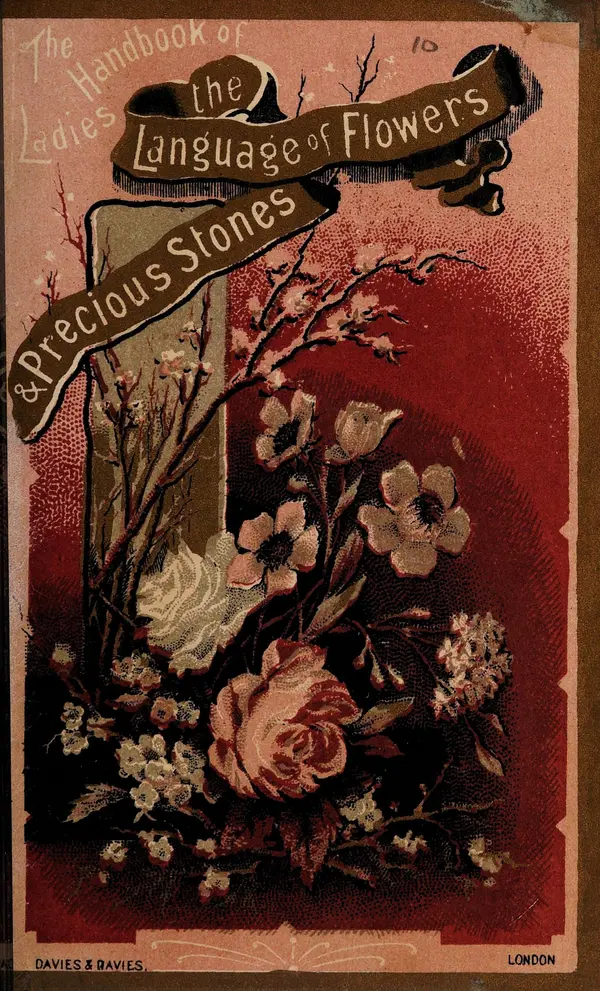
- anonymous, an advertising booklet for Mazawattee tea, The Ladies Handbook of the Language of Flowers & Precious Stones (London: printed by Davies & Davies for [the Mazawattee Ceylon Tea Co.], [1890]), kept as a control. Internet Archive b30477669; the vocabulary is on leaves 2 to 14. Not one of the three controls fixed in the pre-registration: found after transcription. The booklet prints the same text as Beecham’s 1887 calendar in the same layout (the same Keble poem, the same columns, the same Shakespeare quotation), for a different advertiser three years later; so it is treated as a second printing of that text and kept out of the headline, as the pre-registration keeps later editions out.
And the others quoted:
- Lady Mary Wortley Montagu, letter XL (
Pera, March 16, O. S.
), in Letters of the Right Honourable Lady M——y W——y M——e (London: T. Becket and P. A. de Hondt, 1763), vol. III, pp. [1] to [5]; Internet Archive bim_eighteenth-century_letters-of-the-right-hon_montagu-mary-wortley-l_1763_3_0. The pear's line is quoted from the edition of 1790 as transcribed by Project Gutenberg, eBook 17520. - [Joseph von] Hammer, Sur le langage des fleurs, in Fundgruben des Orients, vol. I (Vienna: Anton Schmid, 1809), pp. 32 to 42; Internet Archive bub_gb_oigwAAAAYAAJ.
- Bibliothèque nationale de France, authority record La Tour, Charlotte de (1782-1875):
Pseudonyme de Louise Delaistre, épouse Cortambert.