On the morning of 6 February 1840, in a tent at Waitangi, a Catholic bishop
leaned over and said something to the Governor that nobody else could hear. A few minutes
later a missionary wrote a sentence on a slip of paper, the slip went round three pairs of
hands, and the sentence was read aloud once. The slip is gone. New Zealand's Parliament
considered in February 2026 whether that sentence is a fourth article of te Tiriti o
Waitangi. Here are the five surviving records of the minute in which it was made, verbatim,
searchable, at the distance in time each one actually stands. This page takes no position on
the constitutional question. It shows you what the record can and cannot carry.
0 · the objectThe sentence, as the only man who wrote it down in Māori gives it
Fifty years after the event, in an account printed by the Government Printer for the
Treaty's jubilee, William Colenso set the words of the slip in type. They are the only
Māori text of the sentence that survives anywhere.
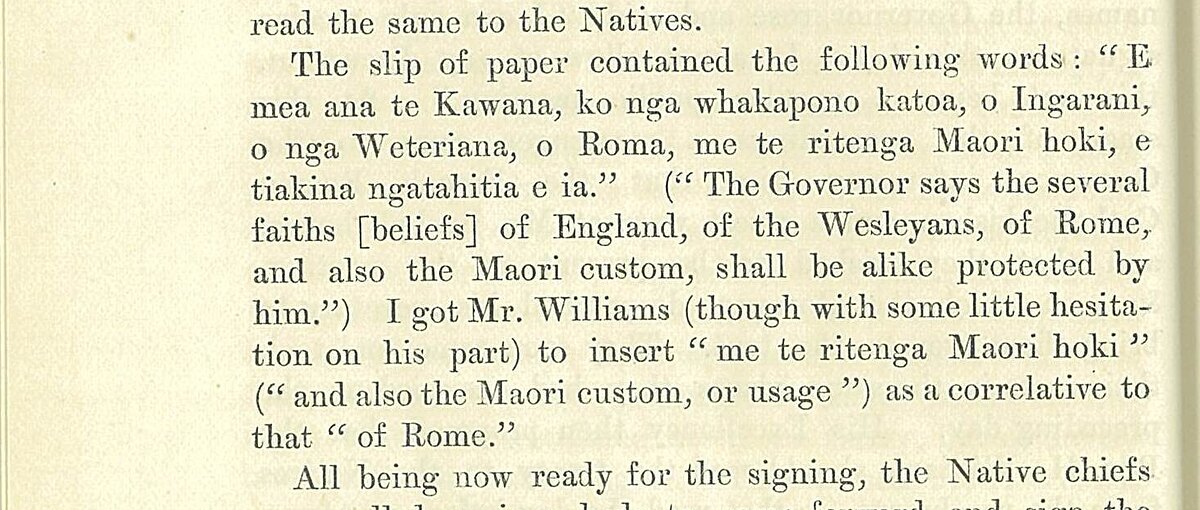
“E mea ana te Kawana, ko nga whakapono katoa, o Ingarani, o nga Weteriana,
o Roma, me te ritenga Maori hoki, e tiakina ngatahitia e ia.”
“The Governor says the several faiths [beliefs] of England, of the Wesleyans,
of Rome, and also the Maori custom, shall be alike protected by him.”
Three of those clauses are churches. The fourth, me te ritenga Maori hoki,
is not. It is the one that carries the weight of the modern argument, because a promise to
protect Māori custom is a promise about far more than freedom of worship. It is also the
clause with the strangest history in the record, and the point of this page is to lay that
record out rather than to summarise it.
Note what the object is. There is no original: the slip was passed from Henry Williams to
Governor Hobson to Bishop Pompallier and back, read out, and never seen again. There is no
translation either, in the ordinary sense, because the English words the Governor spoke and
the Māori words the assembly heard were not produced by one person working from the other's
text in a settled way. What there is, is testimony. Five people or documents record some
part of that minute, and they were written down between fifteen days and fifty years after
it.
1 · the witnessesFive records, at the distance each really stands
Every interval below is computed from the date the record was made or published, against
6 February 1840. None of them is typed into this page. The badge on each card says whether
we read the printed page itself, a digitisation of it, or somebody else's transcription of
a manuscript we could not reach.
The Sydney Herald
15 days later
printed 21 February 1840 · printed report · Englishread at the page
A report of the two days, in diary form, carried to Sydney by the first ship out. Its last sentence names Captain Robertson, who left Waitangi while the signing was still going on, so the account is his or is built on his.
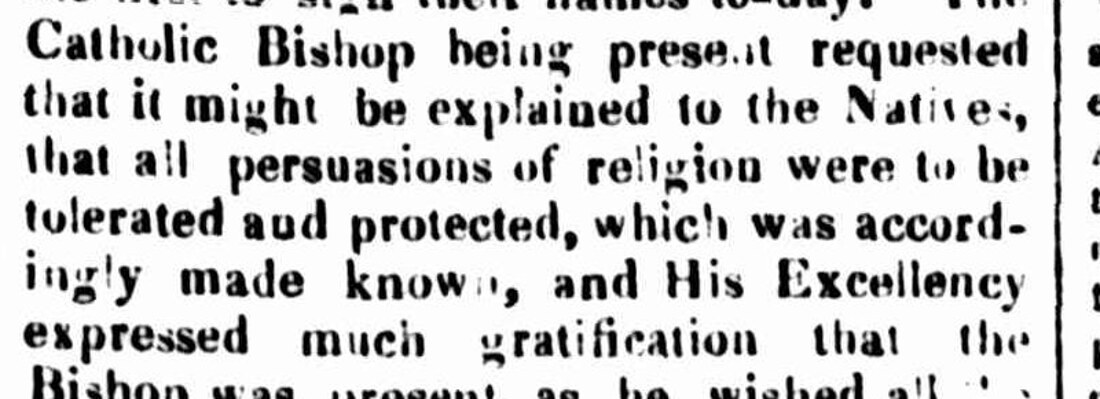
The Catholic Bishop being present requested that it might be explained to the Natives, that all persuasions of religion were to be tolerated aud protected, which was accordingly made known, and His Excellency expressed much gratification that the Bishop was present, as he wished all proceedings to be as open and candid as possible.
The Sydney Herald, 21 February 1840, p. 2. The printer set aud for and; we keep it.
complete by 25 March 1840 · manuscript · English, quoting Māorianother's transcription
Printer to the Church Mission at Paihia; stood beside Henry Williams. He wrote the narrative in 1840 from notes taken at the time, and the account of the Bishop's arrival is an insertion running over three manuscript pages, across the top of the next and down its right margin, finishing on a separate sheet.
Mr. W. taking pencil & paper proceeded to do so. Mr C was seen suggtg. somewhat to Mr. W. – the paper when written was passed to the Govr. who passed it to the Bp. who sd. “This will do very well.” Mr. W. then read the clause to the meeting – it was as follows, “E mea ana te K. ko nga wakapono Katoa o Ingarani o nga Weteriana, o Roma, me te ritenga maori hoki, e tiakina ngatahitia e ia.”
Alexander Turnbull Library, MS-Papers-1611, as transcribed by Judith Ward, Fact or Fiction? (MA thesis, Massey University, 2011), pp. 91–92 · Massey Research Online
Henry Williams, Early Recollections
37 years later
published 1877 · memoir · Englishread in digitisation
The interpreter. He read the treaty from the parchment, he wrote the slip, and he read the slip aloud. His account was written for his son-in-law Hugh Carleton at an unrecorded date before his death in July 1867, and printed in Carleton's second volume ten years later.
In the course of a few minutes, the French Bishop, attended by one of his priests, passed forward to the side of Captain Hobson, and requested “that the natives might be informed that all who should join the Catholic (Roman) religion should have the protection of the British Government.” Captain Hobson, with much blandness of gesture and expression observed,—“Most certainly;” and expressed his regret that he had not made known his wish earlier, as “your desire should have been embodied in the treaty.” … I observed to Captain Hobson, I presumed the same protection would be afforded to all. He said, certainly. I asked, what need then such an announcement, if all would have protection alike? Captain Hobson observed that, as the Bishop wished the communication to be made, he should feel obliged by my delivering the same to the meeting. I accordingly commenced, but could not proceed, finding that it was somewhat of a tough morsel, requiring care. I therefore took paper, and as this very grave announcement was for the benefit of all, I wrote as follows, taking the various Missions in their order of establishment in the country. “The Governor wishes you to understand that all the Maories who shall join the Church of England, who shall join the Wesleyans, who shall join the Pikopo or Church of Rome, and those who retain their Maori practices, shall have the protection of the British Government.” This paper I handed to the Governor, who passed it to the Romish Bishop. Having perused it, he said, “Oh yes, that will do.” I then read out this document, which was received in silence. No observation was made upon it; the Maories, and others, being at perfect loss to understand what it could mean. M. Pompallier then rose, bowed to the Governor, and retired from the meeting.
Henry Williams, “Early Recollections”, in Hugh Carleton, The Life of Henry Williams, Archdeacon of Waimate, vol. II (Auckland: Wilson & Horton, 1877), pp. 14–15 · Early New Zealand Books, via the Internet Archive
Jean Baptiste Pompallier
48 years later
published 1888 · memoir · English, from his Frenchread at the page
The Vicar Apostolic of Western Oceania, and the man who asked. He came to Waitangi in his episcopal cassock, was seated in a place of distinction, spoke once, and left the meeting as soon as the answer had been given.
While the speeches were being made on behalf of Captain Hobson and of the chiefs of the Maori tribes, I remained silent; I had nothing to say; they were simply about political matters. One question however interested me deeply, it was that of religious freedom, about which no one in anyway seemed to trouble themselves. Before the last meeting broke up and it became a question of signing the treaty, I broke my silence. I addressed Captain Hobson, begging him to make known to all the people the principles of European civilisation which obtain in Great Britain, and which would guarantee free and equal protection to the Catholic as to every other religion in New Zealand. My demand was immediately acceded to by Captain Hobson, who made a formal notification of it to all the assembled people, to the great satisfaction of all the Catholic chiefs and tribes, who triumphed in the fact of my presence in the face of the Protestant missionaries and at the speedy compliance with the few words I had spoken.
Pompallier, Early History of the Catholic Church in Oceania (1888), p. 63.
J. B. F. Pompallier, Early History of the Catholic Church in Oceania (Auckland: H. Brett, 1888), pp. 62–63 · Internet Archive
William Colenso, the 1890 print
50 years later
published 1890 · printed book · English, quoting Māoriread at the page
The same narrative, set in type by the Government Printer for the fiftieth jubilee. Colenso's introduction says he decided not to alter it in any instance, so that it should stand as James Busby had read it in March 1840.
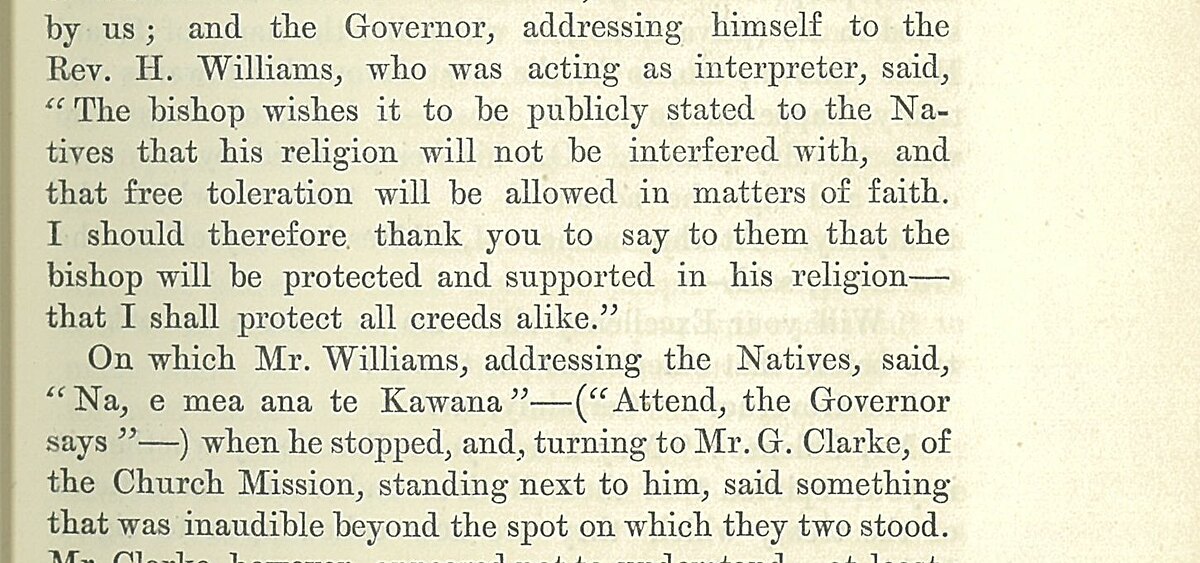
Here the Roman Catholic bishop made some remarks to the Governor in an undertone, which were not heard by us; and the Governor, addressing himself to the Rev. H. Williams, who was acting as interpreter, said, “The bishop wishes it to be publicly stated to the Natives that his religion will not be interfered with, and that free toleration will be allowed in matters of faith. I should therefore thank you to say to them that the bishop will be protected and supported in his religion—that I shall protect all creeds alike.” On which Mr. Williams, addressing the Natives, said, “Na, e mea ana te Kawana”—(“Attend, the Governor says”—) when he stopped, and, turning to Mr. G. Clarke, of the Church Mission, standing next to him, said something that was inaudible beyond the spot on which they two stood. Mr. Clarke, however, appeared not to understand—at least, not to hear plainly what Mr. Williams had said. Seeing this, I, who stood next, said to Mr. Williams, “Pray, sir, write it down first, as it is an important sentence.” Then Mr. Williams, taking paper and pencil, proceeded to do so. The paper, when written on, was passed to the Governor for the Roman Catholic bishop's inspection, who, having read it, said in English, “This will do very well;” on which the paper was returned to Mr. Williams, who read the same to the Natives. The slip of paper contained the following words: “E mea ana te Kawana, ko nga whakapono katoa, o Ingarani, o nga Weteriana, o Roma, me te ritenga Maori hoki, e tiakina ngatahitia e ia.” (“The Governor says the several faiths [beliefs] of England, of the Wesleyans, of Rome, and also the Maori custom, shall be alike protected by him.”) I got Mr. Williams (though with some little hesitation on his part) to insert “me te ritenga Maori hoki” (“and also the Maori custom, or usage”) as a correlative to that “of Rome.”
Colenso, Authentic and Genuine History (1890), p. 32. The last word of the claim is correlative.
William Colenso, The Authentic and Genuine History of the Signing of the Treaty of Waitangi (Wellington: Government Printer, 1890), pp. 31–32 · Wikimedia Commons, from the scanned edition
2 · the instrumentSearch the testimony
The counter below reads the five passages out of the paragraphs this page has just
rendered, folds macrons and case, and matches whole words. It is counting what you are
looking at. Type a word, or take one of the offered ones.
Concordance over the five witnesses
Counts whole-word occurrences across the five witness passages.
Witness
Written
Hits
3 · the asymmetryWhat was asked, and what was said
The sentence on the slip was supposed to be a rendering of something. There are two links
here, not one: the ask, meaning what the interpreter was handed to put into Māori,
and the sentence, meaning what the assembly is recorded as having heard. Four of the
five records give the ask. Three give the sentence. Two give both.
Below, each span is quoted exactly from the passage above it, and the page checks that it
is before it counts. The right-hand column is computed by looking in that span for any of
ritenga, custom,
practices, which are the three ways the clause about Māori custom
is worded anywhere in this record.
The clause about Māori custom, link by link
Record
Link
Custom clause
That is a statement about where in the chain the clause enters, and the strong form of it
is not the pattern across witnesses but the pattern inside two of them. Colenso
prints the Governor's instruction in full and then the slip: the instruction ends “that I
shall protect all creeds alike,” and the slip has the custom clause. Williams quotes the
Bishop's request and then his own sentence: the request is about people who join the Roman
church, and the sentence has the custom clause. Neither man is being contradicted by
somebody else's memory. Each is recording, in one continuous account, an ask without the
clause and an answer with it.
Colenso, Authentic and Genuine History (1890), p. 31. The Governor's
instruction as Colenso reports it, in full. Creeds, faith, religion. No custom.
4 · the conflictTwo men, one minute, two accounts of who wrote it
Both of the men who report the sentence as delivered also report how it came to be
written, and each account leaves no room in it for the other. Click a marked phrase in
either column.
Colenso, printed 1890
Seeing this, Then
Mr. Williams, taking paper and pencil, proceeded to do so.
Williams, published 1877
I accordingly commenced, but could not proceed, finding that it was somewhat of a tough
morsel, requiring care. , and as this very grave announcement was for the benefit of all, I wrote as
follows,
… I then read out this document,
Pick a phrase
Two first-person accounts of the same two minutes. Colenso is not mentioned anywhere in
Williams's account; Williams gives his own reason for the writing and his own reason for the
shape of the list.
The disagreement is not about the words. Williams's English list and Colenso's Māori
sentence contain the same four items in the same order, and the fourth item is the Māori
one in both. What they disagree about is agency: who caused the sentence to be written, and
why the fourth item is there. Colenso says he prompted the writing and then got the fourth
item inserted as a counterweight to Rome. Williams says he took the paper himself because
the announcement was hard to render on the spot, and that he listed the four in the order
the missions had been established in the country, which puts Māori practice at the
beginning of the sequence rather than at the end of a list of churches.
Neither man corroborates the other, and neither contradicts the other on any fact except
this one. It is worth being exact about what that leaves: the clause is attested by two
independent witnesses as having been in the sentence, and its authorship is claimed by one
of them alone.
Colenso, Authentic and Genuine History (1890), p. 32. Read the last four
lines. The word is correlative; the standard modern transcription of Colenso's
manuscript prints correlation.
5 · the collationThe manuscript against the print
Colenso's 1890 introduction makes an unusual promise. The narrative, he says, was written
in 1840 from notes taken at the time; James Busby read the manuscript on the passage to
Sydney in March 1840 and added notes in six places; and “on consideration he has decided
not to alter it in any instance, so that the narration should stand as Mr. Busby read it,
and with his full acquiescence in its correctness.”
The manuscript survives, at the Alexander Turnbull Library, and Judith Ward collated it
against the print in a 2011 Massey MA thesis. Her transcription of this passage is the one
we have used, because we could not reach the manuscript ourselves. It does not support the
promise for this paragraph.
The slip passage, 1840 manuscript against 1890 print
In the 1840 manuscript
In the 1890 print
“Mr C was seen suggtg. somewhat to Mr. W.”
dropped. The printed narrative has no such sentence
at this point.
nothing
added: an English gloss of the Māori sentence, in
parentheses.
nothing
added: “I got Mr. Williams (though with some little
hesitation on his part) to insert me te ritenga Maori hoki … as a
correlative to that of Rome.”
“ko nga wakapono Katoa … me te ritenga maori hoki”
“ko nga whakapono katoa … me te ritenga Maori hoki”
So the fact that a suggestion was made to Williams while he wrote is in the 1840 text. The
identification of the suggester as Colenso in the first person, the identification of what
was suggested, and the reason for it, are all 1890. Fifty years separate the two, and the
author of both had spent the intervening decades in public argument with the Church
Missionary Society and its people, including Henry Williams.
We are not able to say that Colenso invented the claim in 1890, and we do not think the
documents can establish it. A man writing hurriedly in 1840 in an insertion squeezed down a
margin may well have left out what he later put in. The honest statement of the position is
narrower and firmer: the earliest surviving text records that somebody made a suggestion
to Williams as he wrote, and does not say who or what; the claim that it was Colenso, and
that it was this clause, is first attested fifty years later, in a book by Colenso.
The orthography in the last row is a smaller matter and cuts the other way. Colenso's
postscript says the old way of writing Māori, without the wh, has been retained, and
it plainly has been in the appendices, where the Māori text of the Treaty is printed
throughout as wenua, wakaminenga, wakaaro.
Inside the narrative the same sentence is modernised. That is a compositor's decision more
likely than an author's, and we mention it only because a promise of an unaltered text
should be tested where it can be.
A check we ran that came out against us
Our first thought was that Busby's silence mattered. Busby stood at the Governor's
immediate left with the Bishop beside him, he read the manuscript within seven weeks, and
he annotated it. If he passed over this paragraph, that might be a second witness declining
to object. So we located every one of the sixteen footnotes in the 1890 narrative by
character offset. Five are signed “J. B.” and a sixth reports a query Busby wrote in the
margin, and all six fall on the first day, 5 February. But the last footnote of any kind in
the book falls before the tent scene as well, and the closing 11,438 characters of
the narrative, close to a quarter of it, carry none at all. Busby's silence here is part of
a general silence, and is evidence of nothing in particular. We are leaving the check in
because a negative a page runs and reports is worth more than one it quietly drops.
6 · the word nobody usedWhat none of the five calls it
Put article into the search above and every one of the five
witnesses returns zero. None of them describes the sentence as an article of the treaty, a
clause of the treaty, or a part of the treaty. The one person recorded as saying anything
at all about its relation to the treaty is the Governor, and what Williams reports him
saying is that it was not in it:
Captain Hobson, with much blandness of gesture and expression
observed,—“Most certainly;” and expressed his regret that he had not made known his wish
earlier, as “your desire should have been embodied in the treaty.”
That is one sentence in one memoir published thirty-seven years afterwards, and it should
be weighed as such. It is also the only remark in the entire surviving record that bears
directly on the question Parliament was asked in 2026.
7 · the argument nowWhat this page does not do
In February 2026 a New Zealand parliamentary petitions committee, having received a
petition initiated by the historian and theologian Alistair Reese with two Tauranga
kaumātua, recommended that the government begin a formal policy process on whether to
recognise the oral undertaking. The committee did not recommend legislating it. The
question is live and unsettled.
The two positions, in their strongest form and in their own words:
For recognition. Reese: “The Treaty is firstly an oral covenant before it is a
written one.” Every signatory affirmed with a tohu or a signature on the strength of what
they had heard, not what they had read; the negotiations happened in te reo, aloud; and
tiaki is active protection rather than mere tolerance.
Against. Paul Moon: “The Treaty is written. That's it.” Most signatories were
not present to hear the statement, there is no evidence it was repeated at any other
signing, the term “fourth article” does not appear in the record before the 1990s, and
Lord Normanby's 1839 instructions had explicitly refused to protect Māori custom in
general terms.
Nothing on this page settles that. Reese's argument does not depend on who held the
pencil. If the operative instrument was what the assembly heard, then the assembly heard
the clause, and both witnesses to the utterance say so. Moon's argument does not depend on
it either. The documentary record can tell you where a clause enters a chain of custody; it
cannot tell you what a promise made aloud to people who were listening is worth.
There is a deeper limit, and it should be said plainly rather than buried at the bottom.
Every witness on this page is a European man writing in English, and four of the five were
partisans of one mission or another. The assembly at Waitangi was mostly Māori and the
exchange that mattered happened in te reo Māori. Māori accounts of that day exist in forms
this instrument cannot read: whaikōrero, whakapapa, the memory carried in hapū and iwi and
given in evidence to the Waitangi Tribunal. A page built out of colonial paper will
systematically find colonial paper, and a reader should discount it accordingly. What we
can honestly claim is narrow: this is what the written witnesses say, and this is how
far apart they stand.
Sources, method, and what we could not check
The five witnesses
The Sydney Herald, Friday 21 February 1840, p. 2, “PROCLAMATION.” Read off the
National Library of Australia's page image at full resolution
(nla.news-page1526154), not off the OCR text. The OCR drops a
comma after “Natives” and reads the printer's aud as and; the printed sheet
has both as we give them.
Colenso's 1840 manuscript, Alexander Turnbull Library, MS-Papers-1611. We did
not see it. Our reading is Judith Ward's transcription in Fact or Fiction? William
Colenso's Authentic & Genuine History of the Signing of the Treaty of Waitangi
(MA thesis, Massey University, 2011), pp. 91–92, quoted briefly and attributed. Ward
establishes that the manuscript is a genuine 1840 eye-witness account, and that the
Pompallier material in it is an insertion running over three pages and onto a separate
sheet.
Henry Williams, “Early Recollections”, in Hugh Carleton, The Life of Henry
Williams, Archdeacon of Waimate, vol. II (Auckland: Wilson & Horton, 1877),
pp. 14–15. We did not see the printed page. Early New Zealand Books at the University of
Auckland refused our requests, so we read their digitisation through the Internet
Archive's copy of it, which carries the page breaks and so gives the page numbers. This
is the weakest link in our chain and we would replace it with a scan if we could.
J. B. F. Pompallier, Early History of the Catholic Church in Oceania
(Auckland: H. Brett, 1888), pp. 62–63. Read off the University of Toronto scan at the
Internet Archive, at full resolution. The odd “in anyway” is the printer's.
William Colenso, The Authentic and Genuine History of the Signing of the
Treaty of Waitangi (Wellington: Government Printer, 1890), pp. 31–32. Read off the
scanned edition on Wikimedia Commons at 300 dpi. We also collated two independent
transcriptions of it, Wikisource's proofread text and the one at waitangi.com, and they
agree with the page and with each other on this passage.
What we settled at the page
The last word of Colenso's authorship claim is correlative. Ward's thesis prints
correlation in its parallel-text column. The 1890 page reads correlative,
and so do both independent transcriptions.
The Sydney Herald's compositor set aud for and. It is in the metal, not
in the scanning.
Colenso's postscript promise about retaining the old orthography is kept in the
appendices, where the Māori text of the Treaty is printed as
wenua and wakaminenga throughout, and is not kept
inside the narrative, where the slip is printed whakapono against the
manuscript's wakapono.
All sixteen footnotes in the 1890 narrative sit before the tent scene, and the six
Busby interventions all sit on the first day. See the note in section 5: this turned out
to mean less than it first appeared to.
The modern dispute
Alistair Reese's case is set out in his own words in E-Tangata, “Waitangi: an
oral covenant”. Paul Moon's is in The Conversation, “Unwritten rules: why claims
of a missing ‘fourth article’ of the Treaty don't stack up” (4 February 2025), and in
AUT's summary of it. The February 2026 petitions committee recommendation, the 503
signatures, and Sir Geoffrey Palmer's caution are reported in The Spinoff, “What
is the ‘fourth article’ of te Tiriti and why is it being debated”.
The attribution of the phrase “fourth article” to a 1995 statement of the New Zealand
Catholic Bishops Conference is Moon's. We did not verify it. We have not searched
a dated corpus for the phrase's first appearance, and we make no claim about when it
entered use. A page that could run that search is worth building and this is not it.
Moon's figure that around 90% of signatories were not present to hear the statement is
arithmetic on the nine treaty sheets. We did not check it. We did not count the
signatures, and we are not repeating anyone else's count.
What we did not do
We took no position on whether an oral undertaking can be an article of a treaty, on
whether this one should be recognised, or on any constitutional question downstream of
either.
We did not read the Waitangi Tribunal's report on Stage 1 of the Te Paparahi o Te Raki
inquiry for this page, and so we do not report what the Tribunal has said about the
undertaking. That is a real gap.
We did not consult any Māori account of 6 February 1840 held outside the printed
colonial record, because we do not have access to one and would not be the right reader
of it if we did. Section 7 says what that costs the page.
We did not attempt to establish what any signatory understood by the sentence, and we
do not think these documents can establish it.
Images
Colenso 1890 pp. 31 and 32 from the scan on Wikimedia Commons; Pompallier 1888 p. 63 from
the Internet Archive's scan of the University of Toronto copy; the Sydney Herald of
21 February 1840 from the National Library of Australia's digitisation via Trove. All three
underlying works are out of copyright. Cropping, a modest sharpen, and in one case a
rotation of the scanned spread are the only changes made; crop coordinates and the
originals are recorded in research/the-paper-nobody-kept/.