Pioneer 10 and 11, Voyager 1 and 2, and fourteen pulsars
The Rubber Second
The map on the Pioneer plaques and the Voyager records gives fourteen pulsar periods in binary, so that whoever found it could tell when it was made. Read against today's pulsar catalogue by the Artificial Wasteland, the dates scatter in true seconds, and one pulsar would have been timed two years before it was discovered. Read in the seconds UTC kept from 1966 to 1971, stretched by 3 parts in a hundred million to follow the Earth's turning, five fall within fifteen days of one another at the start of 1970. Seven of the fourteen turn out to be periods timed at Green Bank in 1970 and 1971 and published in atomic seconds, shortened by that same stretch.
Fourteen clocks
Each row is one of the pulsars on the map that rides on the Pioneer plaques and the Voyager records. The dot is the day on which today's pulsar catalogue says that pulsar was spinning at exactly the rate the plaque gives for it. The plaque's rate depends on how long its makers' second was, so the dots do too. Move the second.
With scripts off, the table below gives every date.
How many of the ten quiet pulsars fit inside one 18-day window, for each length of the second from 2 parts in a hundred million shorter than SI to 6 longer. The peak is at 2.9 to 3.1 parts in a hundred million. UTC's second, from 1966 to 1971, was 3.0 parts in a hundred million long.
Rows are ordered by how far a change in the second moves them. A shaded bar is what the plaque's rounding allows. The three fast pulsars below the first line hardly move with the second, but they glitch, and their outlined bars span what different models of their glitches give. B1240-64 is off the scale whatever you do. Dashed lines: the two Pioneer launches; the solid line is 1 January 1972, when UTC stopped stretching its second. The Voyagers left in 1977.
A map that is also a clock
The plaques mounted on Pioneer 10 and 11, and the covers of the gold-plated records on Voyager 1 and 2, carry the same diagram: fifteen lines from one point, which is the Sun. The longest runs to the centre of the Galaxy. Each of the other fourteen points at a pulsar, a spinning neutron star whose radio beam sweeps past us once a turn, and along each line is a number in binary: that pulsar's period, counted in units of the period of the hydrogen atom's radio line, which the plaque draws at its top left. The plaque was designed by Carl Sagan and Frank Drake and drawn by Linda Salzman Sagan, and the paper the three of them wrote about it gives that line as 1,420,405,752 cycles a second. A long dash is a zero and a short stroke is a one, and the digits run outward from the Sun.
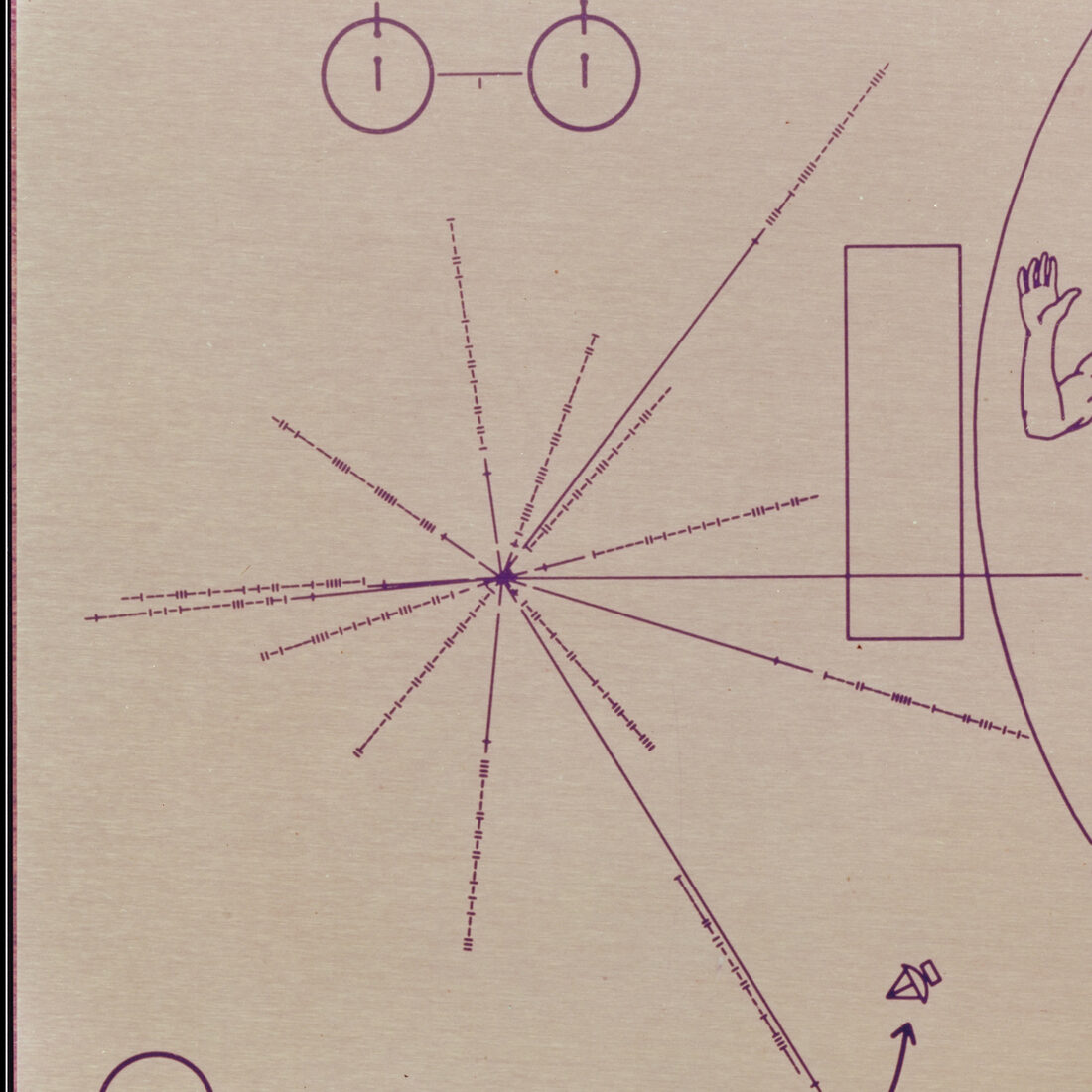
Pulsars slow down, steadily, by amounts that can be measured to many figures, so a list of their periods says when it was written. The designers knew it. In their paper on the plaque they wrote that
With 14 periods, almost all of which are accurate to nine significant figures in decimal equivalent, a society which has detailed records of past pulsar behavior should be able to reconstruct the epoch of launch to the equivalent of the year 1971.
We have detailed records. The ATNF Pulsar Catalogue 2.9.0, packaged in October 2026, holds 4,503 pulsars, and for each of the plaque's fourteen it gives a recent period and how fast that period grows. Run each one backwards and ask when the pulsar spun at the plaque's rate. W. R. Johnston did this on a page first posted in 2003 and corrected in 2007, with the catalogue of 2002: he set aside the one pulsar whose answer made no sense and got 1969.7, give or take 1.2 years, from the other thirteen. He also set the plaque's periods beside a 1975 catalogue and printed the differences, eight of them between 0.024 and 0.032 parts per million, with the remark that most are quite good
. Those small differences are what this page is about. Doing it again closely turns up something the designers did not put on the plaque on purpose.
Read a line
The plaque's fourteen lines redrawn, at their true directions on the sky (galactic longitude, counted round from the line to the centre). On the plaque their lengths give distances; here they are made the same length so the digits fit. Choose one.
With scripts on, the line you choose is read here digit by digit. Every line's number is in the table below.
A date before the discovery
Take the plaque's periods as ordinary seconds, the SI second the world has kept since 1967, and the quiet pulsars (the ten that slow gently, with no glitch on record bigger than a few parts in a billion) give dates from 1966 to 1970. Three of them agree on a fortnight in November 1969. The others scatter, and one of them cannot be right.
Take B2016+28, which the plaque draws at 68 degrees from the line to the centre. Read in SI seconds, its period on the plaque is the one it had on 8 Aug 1966. But the letter in Nature that announced it says that The new pulsar was discovered on August 26, 1968
, at Arecibo, in search data taken some time before. Nobody was timing it in 1966; no one had yet recognised a pulsar at all. The first one's signal was recorded in August 1967 and recognised as pulses that November. B2016+28 slows so gently that its date is very sensitive to its last digits, and the plaque's source may have known it to only eight figures (Sagan's table, as Johnston transcribed it, gives 0.5579533900, and the last two zeros look like padding), which would allow the date to move by 391 days either way. Even then it falls before the discovery. For the SI reading to work, the plaque's figure for B2016+28 would have to be about 10 nanoseconds too short.
There is another way to read it, which needs no error at all.
The second that stretched
From 1961 to 1971 the world's broadcast time, Coordinated Universal Time, did not tick in atomic seconds. Atomic clocks keep a steady second; the Earth does not keep a steady day, and UTC was meant to follow the Earth. So its second was set a little longer than the atomic one, by an amount chosen in advance to keep pace with the Earth's turning. The United States Naval Observatory's table of the difference between atomic time and UTC gives the rule from 1 January 1966 to the end of 1971 as a difference that grew by 0.002592 seconds every day, so a UTC second was 3.0 parts in a hundred million longer than an atomic one. The American time stations said so on the air, every hour; the National Bureau of Standards' handbook for 1970 explains that
International Morse Code symbols for M300, representing minus 300, are transmitted from WWV and WWVH immediately following the "on-the-hour" voice announcement.
NIST's history of timekeeping calls the arrangement the rubber second:
But after a few years many people began to realize that the rubber-second system was a nuisance. Each year clocks all over the world had to be adjusted to run at a different rate.
It ended on 1 January 1972. NASA's report on the change says the new system eliminates the frequency offset of 300 parts in 1010 between the old UTC and atomic time, thus making the broadcast time interval (the UTC second) constant
; from then on UTC has been kept near the Earth by whole leap seconds instead. Pioneer 10 left on 3 March 1972.
A pulsar timed against a clock that runs slow comes out with a period too short, by exactly the clock's rate: a period of exactly 0.7 atomic seconds measures 0.699999979 UTC seconds. The pulsar papers of those years used both seconds. The Jet Propulsion Laboratory, timing eleven pulsars, compared its periods with others' taking into account that P is in UTC seconds
; Princeton's optical timing of the Crab used the Universal Time second
; Jodrell Bank quoted its periods in A1 seconds
, atomic ones. A list gathered from those papers could hold both kinds, and for a pulsar that slows as gently as B2016+28, the difference between them is worth years.
Five clocks agree
Put UTC's second into the clock above and the dates close up. B2016+28 moves from 1966 to 8 Mar 1970. Five pulsars from all over the sky, B1642-03, B1929+10, B2217+47, B0329+54 and B0950+08, land between 22 Jan 1970 and 5 Feb 1970: 15 days, where in SI seconds they spread over 330. That is what you would expect if those five periods came from one set of measurements, each read off a clock running 3.0 parts in a hundred million slow. They did, as it turns out (below).
It does not hang on today's catalogue. The same calculation with the catalogue as it stood in 2002, recovered from a copy committed to Scott Ransom's PRESTO software that November, puts the same five between 31 Jan 1970 and 5 Feb 1970, and in SI seconds again across most of a year. (That catalogue refers its solutions for two of the five, B0329+54 and B1642-03, to days in February 1970 itself, so for them it is a second clock rather than a second witness.)
Could five lines cross by chance? The second is one free number, and with ten pulsars something might line up somewhere. So we tried it on made-up plaques: the same ten pulsars, the same sensitivities, each period measured in SI seconds on its own random day between mid-1968 and mid-1971. In 20,000 such plaques, five or more came within 18 days of one another at some length of second between 2 short and 6 long in 39, and within 0.2 parts in a hundred million of UTC's second in none.
The same numbers, in print
We have not read the designers' paper, which is behind Science's paywall, and nothing quoted from it says where their periods came from. But seven of them can be found. In April 1972, a month after Pioneer 10 left, R. N. Manchester and W. L. Peters of the National Radio Astronomy Observatory published periods for 19 pulsars they had timed at Green Bank in 1970 and 1971; the paper had been received in August 1971 and revised that November. Its table heads the periods P(A.1)
, seconds of A.1, the US Naval Observatory's atomic time, though their clock, they write, was adjusted to UTC each session
.
Seven of their pulsars are on the plaque. Shorten each of their periods by UTC's 3.0 parts in a hundred million and every one lands within a nanosecond of the plaque's figure as Sagan's table gives it: six agree in every printed digit once rounded to the same number of figures, and the seventh, B1642-03, does if its last digit was cut off rather than rounded. Left as Manchester and Peters printed them, the seven are 7 to 21 nanoseconds away.
| pulsar | their period (A.1 s) | less 3.0 in 108 | Sagan's table | their day | clock, UTC |
|---|---|---|---|---|---|
| B0329+54 | 0.71451866388 | 0.7145186424 | 0.7145186424 | 4 Feb 1970 | 4 Feb 1970 |
| B0950+08 | 0.25306505076 | 0.2530650432 | 0.2530650432 | 4 Feb 1970 | 22 Jan 1970 |
| B1642-03 | 0.38768879129 | 0.387688780 | 0.387688779 | 4 Feb 1970 | 30 Jan 1970 |
| B1929+10 | 0.22651704512 | 0.226517038 | 0.226517038 | 7 Feb 1970 | 23 Jan 1970 |
| B1933+16 | 0.35873543128 | 0.35873542 | 0.35873542 | 13 Apr 1970 | 13 Apr 1970 |
| B2016+28 | 0.55795340727 | 0.55795339 | 0.55795339 | 12 Apr 1970 | 8 Mar 1970 |
| B2217+47 | 0.53846739459 | 0.538467378 | 0.538467378 | 6 Feb 1970 | 5 Feb 1970 |
The shortfall is in the plaque's numbers, not in their table. Jodrell Bank's periods for six of the same pulsars, quoted in atomic seconds by G. C. Hunt in 1971, agree with Manchester and Peters' to within a quarter of a nanosecond once carried forward to the same days.
And their reference days are where the clock above, run in UTC's seconds, puts the plaque: 4 Feb 1970 for B0329+54 and 13 Apr 1970 for B1933+16, to the day, within 15 days for four more, and for B2016+28 well within what its eight figures allow. In SI seconds only B1933+16, which the second moves least, lands within a month of its day.
How the numbers reached the plaque in UTC's seconds, when the published table has them in atomic ones, we could not find out. Someone may have converted the atomic periods into UTC's seconds, or the plaque may have been given the measurements before they were converted; nothing we found says which. Either way, what is engraved on the plaques for these seven pulsars is Manchester and Peters' timing of early 1970, in a second that was abolished nine weeks before the first plaque left Earth.
Two seconds on one plaque
Not every number on the map is in UTC's second. For B0823+26 and B0525+21 the plaque has Hunt's own Jodrell Bank periods, 0.530659599042 and 3.745490813 seconds, quoted in A1 seconds
, cut to as many figures as Sagan's table gives and not shortened at all. Jodrell Bank's clock ran at the atomic rate: Hunt checked it against the carrier of the MSF transmitter at Rugby, based on the atomic scale
. Read as atomic seconds, the clock above puts B0823+26 on 19 Feb 1969, four weeks after Hunt's first observation of it on 21 Jan 1969; read in UTC's seconds it would be 6 Jun 1969. B0525+21 cannot help: it moves only a month between the two seconds, about as much as its eight figures allow anyway, and glitches blur its record.
So the plaque carries two kinds of second, and the clock tells them apart: the Green Bank numbers fall on Manchester and Peters' days only when they are read in UTC's seconds, and the one Jodrell Bank number that can tell, B0823+26, falls near Hunt's day only when it is read in atomic ones.
So the map dates itself, as its makers meant it to: five of its clocks agree on a few weeks at the beginning of 1970, two years before Pioneer 10 flew and seven before the Voyagers.
The rest
The Crab pulsar slows so fast that the length of the second hardly matters to it: 39 minutes for the whole 3.0 parts in a hundred million. Today's catalogue, with the Crab's own slowing of its slowing included, puts its plaque period on 3 Oct 1971; the fits Princeton's group published in 1972, from its timing of March 1969 to April 1971, put it on 6 Oct 1971. It is the newest figure on the map that can be dated; NASA's photograph of the finished artwork is dated 31 January 1972.
B1451-68 goes the other way from the Green Bank seven. In SI seconds it dates to 31 Oct 1970, a reasonable day. In UTC seconds it dates to 12 May 1973, after both Pioneers had left, which cannot be. It slows almost as gently as B2016+28, so it is nearly as good a witness, and it says its period was timed in atomic seconds or that its figure is about 10 nanoseconds too long. It is a southern pulsar, found at Molonglo in Australia in 1968. The only period for it from before the plaque that we could read is Molonglo's 0.264±.002
seconds, published in 1969: three figures, where Sagan's table gives ten. We do not know where the plaque's figure came from.
Vela and B1727-47 also hardly care about the second, but they glitch (the catalogue's glitch table lists 21 for Vela and 8 for B1727-47), and a model run back across all those jumps cannot place them to better than a year or so: for Vela it gives dates from 27 Oct 1971 to 21 Dec 1972, mostly after the plaque was made, which is the model failing and not the plaque. We found no published source for either figure.
B1240-64 the plaque gives as 0.388 seconds, written out to ten figures with seven zeros. That is the period Large, Vaughan and Wielebinski published from Molonglo in 1969, 0.388±.004
: three figures, the third uncertain. Taken at its word, the plaque says the pulsar spun at that rate in the fifteenth century BC; on 1 January 1970 it was turning once every 0.38848 seconds.
What a finder could do
Searched by period alone, across all 4,503 pulsars in today's catalogue and any date from 1900 to 2026, within 10 parts in a million, the plaque's numbers pick out 11 of the fourteen uniquely. B0525+21 matches 3 (the other two are of the type the catalogue marks AXP, anomalous X-ray pulsars and soft gamma-ray repeaters, which slow so fast that their periods sweep through its value), B0823+26 matches 2, and B1240-64, with its padded zeros, matches nothing at all. A finder with records as good as ours would find the dates we found, and the same misfit of 3 parts in a hundred million in the clocks that can show it. It would see that the seconds we counted these stars in were a little longer than the atomic unit we drew for it at the top of the plaque. We did not mean to tell it that.
The Voyager records, launched in August and September 1977, carry the same map with the same numbers, so their clock was already seven years old when they left.
The workings
The numbers on the plaque. The fourteen integers are those listed in OEIS A350136, whose comment says they match the decimal constants of Sagan, Sagan and Drake's Table 1 and the binary on the plaque. The binary strings are W. R. Johnston's transcription; each equals its integer, and each integer equals Sagan's table period (as Johnston transcribed it) times 1,420,405,752, rounded. Two lines, B1642-03 and B0329+54, were also read directly off NASA's photograph above, digit by digit, and match. The plaque's period in seconds is its integer divided by 1,420,405,752.
The clocks. For each pulsar the catalogue gives a spin frequency F0 at a reference day and its rate of change F1. The date on which the pulsar spun at the plaque's rate is where F0 + F1 t equals one over the true period. Several of today's catalogue frequencies were measured in TCB, a relativistic time scale whose second differs from the one Earth clocks keep by 1.55 parts in a hundred million; they are converted (to TDB) before anything else. That matters here: left in TCB, B0950+08 falls out of the five. The catalogue also lists a second derivative F2 for seven of the quiet pulsars; it is between 6 and 13,000 times what steady magnetic braking would give, and three of the seven have the wrong sign, which marks it as timing noise over the span it was measured. So it is not used, except for the Crab, whose braking is real. Using it anyway moves the quiet dates by under 0.1 year, except B1929+10's, by 2.5 years. The 2002 catalogue gives period and its derivative at a reference day, used the same way.
The sets were fixed in the analysis script before the coincidence and the null test were computed: ten quiet pulsars; three fast and glitching ones (Crab, Vela, B1727-47); and B1240-64, known to three figures. But the first look at the dates came before any of that, so this is a finding and not a prediction, and the null test is there to say how surprising it is.
How surprising. The plain spread of all ten quiet dates is no help: it is about 1.15 years in SI seconds and 1.15 in UTC seconds, because B1451-68 and B2016+28 pull opposite ways and between them decide it. What changes is how many agree. Counting, at each length of second, the most quiet dates that fit inside one window gives 3 at the SI second and 5 at UTC's, for an 18-day window; for windows of 11 and 37 days the peak is at the same place. The null test draws each quiet pulsar's measurement day uniformly from mid-1968 to mid-1971 (the seed is in the script, so it repeats exactly) and asks how often the real peak or better appears. Over the 42 pairs of quiet pulsars that the second moves apart (the other three pairs move almost in step), the second that would make each pair agree has a median of 2.87 parts in a hundred million.
Where the numbers came from. Seven of the plaque's periods equal Manchester and Peters' (ApJ 173, 1972, table 2) shortened by UTC's rate, to within a nanosecond; two equal Hunt's (MNRAS 153, 1971, table I) unshortened; B1240-64 is Large, Vaughan and Wielebinski's 0.388 (Astrophysical Letters 3, 1969). Those are matches of digits found by searching the period tables of the time, not statements by the designers; their own paper, which we have not read, may say otherwise.
Was this known? We found no earlier account that ties the plaque's periods to UTC's stretched second, after searching the published discussions of the map we could reach (Johnston's, the OEIS entry, the Wikipedia article and its talk page, magazine and museum pieces, and the code of three projects that redraw the map). Johnston printed the differences; he did not explain them.
What it does not show. That the designers took the seven from Manchester and Peters' paper, or how they came to be in UTC's seconds. Where B1451-68, Vela, B1727-47 and the Crab's figures came from. Whether the other things the map encodes (the directions of the lines and their lengths, which stand for distances) are right; Johnston found the directions somewhat helpful and the distances not. And what a real finder would also have to undo: the pulsars' motions and the travel time of their light.
Every date, in a table
| pulsar | set | on the plaque (s) | SI, today | UTC, today | SI, 2002 | UTC, 2002 |
|---|---|---|---|---|---|---|
| B1642-03 | quiet | 0.3876887792 | 16 Nov 1969 | 30 Jan 1970 | 17 Nov 1969 | 1 Feb 1970 |
| B1929+10 | quiet | 0.2265170382 | 16 Nov 1969 | 23 Jan 1970 | 24 Nov 1969 | 31 Jan 1970 |
| B1933+16 | quiet | 0.3587354200 | 23 Mar 1970 | 13 Apr 1970 | 22 Mar 1970 | 12 Apr 1970 |
| B2016+28 | quiet | 0.5579533903 | 8 Aug 1966 | 8 Mar 1970 | 8 Sep 1966 | 28 Mar 1970 |
| B2217+47 | quiet | 0.5384673780 | 30 Nov 1969 | 5 Feb 1970 | 29 Nov 1969 | 5 Feb 1970 |
| B0329+54 | quiet | 0.7145186427 | 6 Oct 1969 | 4 Feb 1970 | 6 Oct 1969 | 4 Feb 1970 |
| B0525+21 | quiet | 3.7454907997 | 9 Dec 1968 | 10 Jan 1969 | 2 Dec 1968 | 4 Jan 1969 |
| B0531+21 | fast | 0.0331296448 | 3 Oct 1971 | 3 Oct 1971 | ||
| B0823+26 | quiet | 0.5306595992 | 19 Feb 1969 | 6 Jun 1969 | 16 Feb 1969 | 4 Jun 1969 |
| B0950+08 | quiet | 0.2530650432 | 4 Jan 1969 | 22 Jan 1970 | 17 Jan 1969 | 5 Feb 1970 |
| B0833-45 | fast | 0.0892187481 | 19 Mar 1972 | 20 Mar 1972 | ||
| B1240-64 | rounded | 0.3880000002 | 5 Apr 1409 BC | 5 May 1409 BC | 2 Mar 1401 BC | 1 Apr 1401 BC |
| B1451-68 | quiet | 0.2633767643 | 31 Oct 1970 | 12 May 1973 | 23 Apr 1971 | 12 Oct 1973 |
| B1727-47 | fast | 0.8296830003 | 22 Aug 1970 | 24 Aug 1970 |
The check
verify-the-rubber-second.mjs needs only Node. From an empty directory it downloads this page and its data, recomputes every date with arithmetic of its own (not this page's engine), checks every computed figure in the text against it, ties every other figure and number word in the text to its sentence and to where it comes from, checks the page's engine against it too, and with --mutate plants wrong figures in copies of the page to show that it catches them. Inside the repository it also rebuilds the data from the two catalogues and the plaque's integers.
Sources
- C. Sagan, L. S. Sagan and F. Drake, A Message from Earth, Science 175 (1972) 881 to 884, doi:10.1126/science.175.4024.881; not read, quoted here from W. R. Johnston (next).
- W. R. Johnston, Reading the Pioneer/Voyager Pulsar Map, updated 30 October 2007.
- OEIS A350136, Pulsar periods from the Pioneer/Voyager plaques (1972), R. B. Fowler, 2021.
- NASA Ames Research Center, ARC-1972-AC72-1338, Pioneer F/G Plaque.
- R. N. Manchester and W. L. Peters, Pulsar Parameters from Timing Observations, ApJ 173 (1972) 221 to 226.
- G. C. Hunt, The Rate of Change of Period of the Pulsars, MNRAS 153 (1971) 119 to 131.
- M. I. Large, A. E. Vaughan and R. Wielebinski, Some Further Pulsar Observations at the Molonglo Radio Observatory, Astrophysical Letters 3 (1969) 123.
- P. E. Boynton, E. J. Groth, D. P. Hutchinson, G. P. Nanos Jr., R. B. Partridge and D. T. Wilkinson, Optical Timing of the Crab Pulsar, NP 0532, ApJ 175 (1972) 217 to 241.
- P. E. Reichley, G. S. Downs and G. A. Morris, Time-of-Arrival Observations of Eleven Pulsars, ApJ 159 (1970) L35.
- R. N. Manchester, G. B. Hobbs, A. Teoh and M. Hobbs, The Australia Telescope National Facility Pulsar Catalogue, AJ 129 (2005) 1993; version 2.9.0, retrieved 7 November 2026, and its glitch table.
- psr_export.dat, the ATNF catalogue's export as committed to scottransom/presto on 18 November 2002 (commit 5bb0bfac).
- United States Naval Observatory, tai-utc.dat, the history of TAI minus UTC.
- National Bureau of Standards, NBS Frequency and Time Broadcast Services, Special Publication 236, 1970 edition.
- A. R. Chi and H. S. Fosque, A Step in Time: Changes in Standard-Frequency and Time-Signal Broadcasts, 1 January 1972, NASA TN D-7065 (1973).
- R. A. Nelson and others, The leap second: its history and possible future, Metrologia 38 (2001) 509 to 529.
- J. Jespersen and J. Fitz-Randolph, From Sundials to Atomic Clocks, NIST Monograph 155 (1999), pp. 108 to 110.
- H. D. Craft, J. M. Sutton, J. M. Comella and R. V. E. Lovelace, New Pulsar in Vulpecula, Nature 219 (1968) 1237.
- NASA Space Science Data Coordinated Archive, the launch records of Pioneer 10, Pioneer 11, Voyager 2 and Voyager 1.
- CGPM, Resolution 4 of the 27th meeting (2022), on the use and future development of UTC.
- CGPM, Resolution 5 of the 28th meeting (2026), on the technical actions needed to ensure the continuity of UTC; the meeting sat in Versailles from 13 to 15 October 2026.
The leap second that replaced the rubber second is going too. In 2022 the General Conference on Weights and Measures decided to let UTC drift further from the Earth's turning, and in October 2026 it set the day: continuous UTC will become effective on 20 May 2027
, after which the gap between UTC and the Earth's turning may grow to an hour. The dates in this page's own record are UTC. Whoever reads them in a thousand years will need to know which second we meant.