Old Norse · the Hávamál · a citation that is really a coordinate
The Stanza With No Number
“Cattle die, kinsmen die” is Hávamál 76 and 77, or 77 and 78, or 75 and 76, or 39 and 40, depending on whose book you hold. The one manuscript numbers none of its stanzas and writes the second of the pair in shorthand. Here are four public-domain translations aligned stanza by stanza against the received count, so that any Hávamál number can be turned into the others, with every split, merge and move named, and the editor's own reason given wherever one was printed.
Two stanzas on a leaf
The Hávamál, the “sayings of the High One”, the long poem of advice put in the mouth of Odin, survives in one manuscript. Henry Adams Bellows, introducing his 1923 translation:
“This poem follows the Voluspo in the Codex Regius, but is preserved in no other manuscript.”
Bellows, The Poetic Edda (1923), introductory note to “The Ballad of the High One”
In 1891 Ludvig Wimmer and Finnur Jónsson published that manuscript in photographs, page by page, with a type-set transcription facing each one. This is the ninth page, lines 12 to 14 of the photograph:
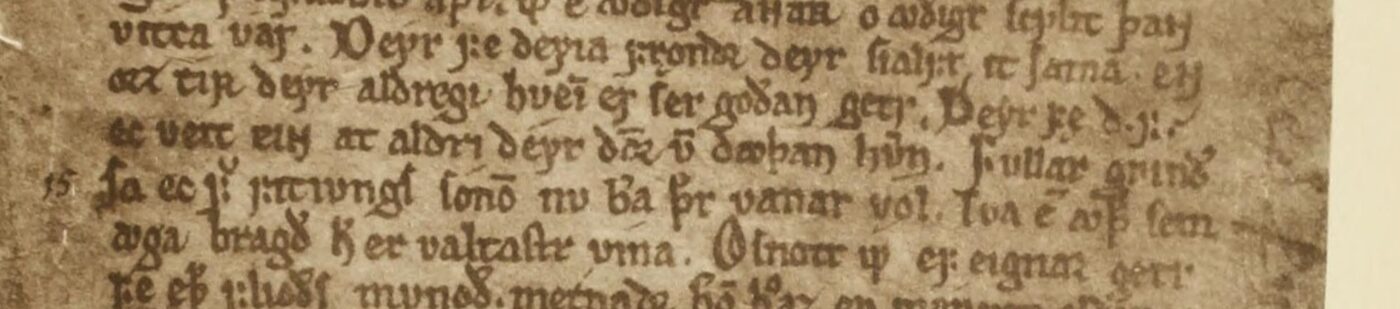

Three things are visible without reading a word of Old Norse. The stanzas run on as prose, one after another inside the line; where one begins, there is a point and a capital, and nothing else. There are no stanza numbers. And the second of the two stanzas that begin Deyr fé is not written out. Where the first has Deyr fe deyia frǫndr deyr sialfr it sama, the second has only Deyr fę ð. f.: “Cattle die, k[insmen] d[ie]”, two words as initials and the third clause, “one dies oneself”, left out, because the reader had just seen the refrain whole.
Every number anyone uses for these two stanzas was put there later, by an editor, and the editors did not agree.
One stanza, five numbers
Here are the two stanzas in the received numbering, the count that most modern editions share (it is the one used, for instance, in Guðni Jónsson’s normalised text, which this page uses as its backbone), and in the four English translations old enough to be free to read:
| received | Thorpe 1866 | Vigfusson & Powell 1883 | Bray 1908 | Bellows 1923 | |
|---|---|---|---|---|---|
| Deyr fé … en orðstírr | 76 | 76 | 39 [76] | 75 (74) | 77 |
| Deyr fé … dómr um dauðan hvern | 77 | 77 | 40 [77] | 76 (75) | 78 |
| Veit ek at ek hekk (Odin on the tree) | 138 | 140 | 2 [138] | 137 (134) | 139 |
| Nú eru Háva mál kveðin (the last) | 164 | 166 | 27 | 164 (160) | 138 |
Two of those books print two numbers each, and both pairs explain something. Vigfusson and Powell number the stanza 39 because they took the poem apart (more on that below), and print 76 in square brackets so that a reader can find it in other editions. Olive Bray prints 75 and puts 74 in round brackets, and her note says what the round brackets are: “The strophe numbering of R is marked in brackets.” R is her siglum for the Codex Regius. But the Codex Regius, as the photograph shows, has no strophe numbering. Her 74 and Vigfusson’s 76 both claim to be the manuscript’s number for the same stanza, and both are editors’ counts of a manuscript that does not count.
Convert a Hávamál number
Where the counts part
Line each translation up against the received count and subtract. Where a line sits at zero the two agree; every step is a decision some editor made. Move along the poem to read the numbers at any stanza.
Each edition’s number minus the received number
Thorpe Bray Bray’s “numbering of R” Bellows a Cleasby–Vigfusson citation
Every step on that chart is one of these, and nothing else:
| where | who | what they did | their stated reason |
|---|---|---|---|
| 39, 40 | Bellows | prints 40 before 39 | “In the manuscript this stanza follows stanza 40.” (no reason given) |
| 62, 63 | Thorpe | prints 63 before 62 | no note on it that we found. Bellows explains the difference: “This stanza follows stanza 63 in the manuscript, but there are marks therein indicating the transposition.” The 1891 transcription (p. 8, lines 21 and 22) prints a small mark over the first letters of both stanzas. Thorpe kept the written order; the received count obeys the marks. |
| 73, 74 | Bray | prints the two as one stanza, her 73 | no note on it that we found |
| 76 to 80 | Bellows | prints 78, 76, 77, 80, 79 | “In the manuscript this stanza follows 78, the order being: 77, 78, 76, 80, 79, 81.” (his numbers) |
| 87 to 89 | Bray | prints 87 and 89 as one stanza, then 88 | no note on it that we found |
| 88, 89 | Bellows | prints 89 before 88 | “Many editors have changed the order, for while stanza 89 is pretty clearly an interpolation wherever it stands, it seriously interferes with the sense if it breaks in between 87 and 88.” |
| 103 | Thorpe | divides it in two; his 104 begins “Fimbulfambi he is called” | no note on it that we found |
| 105, 106 | Bray, Bellows | both print 106 (Rati the auger) before 105 (Gunnlöð) | no note on it that we found, in either book, though Bray’s bracketed numbers, (104) and (103), record the reversal. The manuscript has them in the received order (1891 transcription, p. 11). |
| 111 | Thorpe, Bray | each divides it in two, the second part beginning at of rúnar heyrða ek, “of runes I heard” | no note on it that we found |
| 162 | Bray, Bellows | each gives the lines to Loddfáfnir a number of their own | Bellows: “This stanza is almost certainly an interpolation” |
| 164 | Bellows | moves the poem’s last stanza up to be his 138 | “In the manuscript this stanza comes at the end of the entire poem, following stanza 165. Most recent editors have followed Müllenhoff in shifting it to this position, as it appears to conclude the passage introduced by the somewhat similar stanza III.” |
(Bellows’s moved last stanza, his 138, lies off the bottom of the chart, 26 below. The “III” in that last quotation is how the Project Gutenberg text prints it; Bellows means his stanza 111.) Bray’s round-bracket numbers are a fifth count running beside her own, one to four below the received number for most of the poem, and the chart draws them as given. Where the scanned text of her book shows no bracketed number, as at her stanzas 1 to 11, the dashed line simply has a gap; that may be the scan, not the book.
So the answer to “what is Hávamál 138” is a question back: in which book? In the received count it is Odin hanging nine nights on the windy tree. In Bellows it is the last stanza of the poem, moved. In Thorpe it is the stanza that begins “Strong is the bar”. The famous tree stanza is 140 in Thorpe, 139 in Bellows, and 137 in Bray, with 134 beside it in brackets.
The poem taken apart
Gudbrand Vigfusson and Frederick York Powell did not think the Hávamál was one poem. Their general introduction:
“The Havarnal Collection is a formless mass of all the gnomic verses the collector could get, put down in blocks, one after another, as he got them.”
Vigfusson & Powell, Corpus Poeticum Boreale I (1883), introduction (the scan reads “Havarnal” for Havamal)
So they sorted it. In their edition the Hávamál’s stanzas are spread over seven separately titled pieces: “The Guest’s Wisdom”, “Song of Saws”, “The Lesson of Loddfaefni”, “Woden’s Love-Lessons”, “Hava-mal: the High One’s Lesson”, a single stanza headed “Appendage which we do not know where to insert”, and three fragments moved into a different book of the volume altogether, “The Christian’s Wisdom”. Most pieces are numbered from 1 (the Song of Saws is not numbered at all, and the three fragments are stanzas 34 to 36 of the Christian’s Wisdom), which is how Deyr fé became their 39 and 40, and how Odin on the tree became stanza 2 of a poem of 27. Their notes describe the manuscript as they saw it:
“Tue stanzas, which in R seem to have been flung pell-mell into a chest, like Mahomet’s blade-bones, are here for the first time sorted and strung together.”
Vigfusson & Powell, Corpus Poeticum Boreale I, notes (the scan reads “Tue” for “The”)
Even the first stanza moved. “We have removed stanza 1 of Rto 77,” say the same notes (so the scan prints it, “R” and “to” run together); “The second stanza of R we take to be the true beginning.” What kept the edition usable was the figure in square brackets: “The order, or rather disorder, of the verses in R is shewn by the figures in brackets.” Those brackets agree with the received count at 118 places in the scan (two stanzas they print in two halves, received 70 and 124, are bracketed twice); about fifty of their stanzas carry no bracket in the scan, most of them in the Loddfáfnir counsels and the spells. They disagree at four, and only one pair is a plain slip: their stanzas 59 and 60 carry the brackets 55 and 56 the wrong way round, each attached to the other’s stanza. At the other two places the edition has moved lines from one stanza into its neighbour, and the bracket goes with the lines that are left.
Plot where each stanza sits in the manuscript against where it sits in their book. A poem left in order would lie along the diagonal.
Where Vigfusson and Powell put each stanza
The dictionary that counts its own way
The dictionary where Vigfusson defined dómr cites the Hávamál, by our count, some 840 times, always as “Hm.” and a number, and it says, in its list of the works it cites, whose numbers those are:
“the various editions differ in the distribution of the verses ; in this Dictionary references are made to the edition of Mobius, Leipzig i860; that of Sophus Bugge, Christiania 1867, has now superseded all former editions, and is cited in special instances.”
Cleasby & Vigfusson, An Icelandic-English Dictionary (1874), “Classification of works and authors cited in this dictionary” (the scan reads “i860” for 1860)
Two editions, then, and nothing on the page to say which one a given citation follows. We read every “Hm.” in the scan and kept the citations whose Old Norse words occur in one stanza only: 278 of them. Of those, 254 follow a single count: the received number up to 10; one less from 12 to 103 (stanzas 11 and 12 are both cited as 11); the received number again from 104 to 111 (the end of 103, “fimbulfambi”, is cited as 103 and its beginning as 102); and one more from 112 to the end (the opening of 111 is cited as 111, its close as 112). It steps where Thorpe steps, at 103 and at 111; and both of its citations of stanza 63 call it 61, which is where the manuscript’s written order, the order Thorpe keeps, puts it once the count is one off.
Fifteen more give the received number inside the stretches where that count runs one off, so the same stanza turns up under two numbers in two entries:
| words cited | received | cited as | scan line |
|---|---|---|---|
| mart um dvelr þann er um morgin sefr | 59 | Hm. 58 · Hm. 59 | 42180 · 148622 |
| en sér öngu at una | 95 | Hm. 94 · Hm. 95 | 166438 · 44527 |
| opt er gott þat er gamlir kveða | 134 | Hm. 134 · Hm. 135 | 59597 · 189185 |
Perhaps those fifteen are the “special instances” where Bugge was cited; the dictionary does not mark them, and we have not checked either edition’s count against these numbers. The remaining nine fit neither count (one of them because its number is unreadable in the scan). So a Hávamál number in Cleasby and Vigfusson is usually one off the modern count, one less from 12 to 103 and one more after 111, and now and then it is not off at all. Every citation we could place is in the converter above, under “Cleasby–Vigfusson”, with the line of the scan it is printed on.
One word, two camps
Numbers are the editors’ quarrel. The translators had their own, and it is in the last line of the second stanza. Here are the two stanzas in a normalised spelling, with the last line of each set apart:
Deyr fé, deyja frændr, deyr sjalfr it sama,
en orðstírr deyr aldregi hveim er sér góðan getr.
Deyr fé, deyja frændr, deyr sjalfr it sama,
ek veit einn at aldrei deyr: dómr um dauðan hvern.
The first ends with orðstírr, word-fame, which never dies for whoever wins himself a good one. The second ends with dómr, about each dead man. Here is how the four hands end each one, verbatim (the bar is Bellows’s own mark for the pause in the line):
| first stanza: orðstírr | second stanza: dómr um dauðan hvern | |
|---|---|---|
| Thorpe 1866 | “but the fair fame never dies of him who has earned it” | “but I know one thing that never dies,--judgment on each one dead” |
| Vigfusson & Powell 1883 | “but good report never dies from the man that gained it” | “I know one thing that never dies, a dead man’s name [good or bad]” |
| Bray 1908 | “fair fame of one who has earned” | “the doom on each one dead” |
| Bellows 1923 | “But a noble name | will never die, If good renown one gets” | “One thing I know | that never dies, The fame of a dead man’s deeds” |
Thorpe and Bray make the second stanza say something new: a judgment, a doom, passed on every one of the dead. Vigfusson and Powell and Bellows make it say nearly what the first said: a name, a fame. Read the two right-hand columns down and the split is two and two.
The word itself is in the dictionary Gudbrand Vigfusson finished in 1874, nine years before he and Powell translated the stanza. Under dómr it gives, in order, “a court of judgment, the body of judges”; then “doom, judgttienf, sentence” (the scan’s misreading of “judgment”), with a sub-sense “judgment, opinion”; then senses of state and condition, as in “heathendom”, with “relics” and “mystery” among them. It gives no sense “name” or “fame”, and, as far as a search of the scan can tell, never quotes this line. In 1883 the translation says “a dead man’s name”, and then adds, in square brackets, “[good or bad]”: words with nothing under them in the Old Norse, put there, it seems, to keep what hvern, “each”, says. A judgment can go either way, and the bracket lets it.
This page does not say which pair is right; a judgment that lasts and a name that lasts are not far apart, and a reputation is a verdict of a kind. What it shows is narrower: the four hands divide two and two, the dictionary of one of them lists no sense “name” or “fame”, and that same hand’s translation says “name” and then brackets the difference back in.
Four words, three ways, one pair of hands
The refrain Deyr fé, deyja frændr also opens a stanza of the Hákonarmál, the dirge for King Hákon that Vigfusson and Powell title “The Dirge of Hakon Athelstan’s Foster-son” (printed in capitals), and one of whose lines line they themselves call “an echo from G. W. vv. 39, 40”, their Guest’s Wisdom. They print both poems in the same volume and translate the four words each time:
| where | the Norse, as their volume prints it | their English |
|---|---|---|
| Hávamál, their 39 | Deyr fé deyja frendr | “Chattels die; kinsmen pass away” |
| Hávamál, their 40 | Deyr fé, deyja freendr | “Chattels die; kinsmen die” |
| Hákonarmál 17 | Deyr fé; deyja freendr | “Cattle die, men die” |
(The Norse spellings are as the scan of the 1883 volume reads them, frendr and freendr both being frændr.) Two stanzas apart, the same three words come out as “kinsmen pass away” and “kinsmen die”; in the other poem fé is cattle rather than chattels and the kinsmen are simply men. None of these is a mistake (Vigfusson’s own dictionary gives fé first as “cattle”, then as “property, money”, and sets it beside English fee), and that is the point: a translator choosing between true renderings does not choose the same way twice.
What this page does not show
The received numbering is taken from one modern normalised text (Guðni Jónsson’s, as served by heimskringla.no). Other modern editions are said to number the same way, but we checked only that this one agrees with Vigfusson and Powell’s bracketed numbers (at 118 places, with the exceptions named above) and with the order of the stanzas in the 1891 transcription at the places this page names. The transposition marks at 62 and 63 we saw only in the 1891 transcription, which prints them; we could not make them out on the photograph. Thorpe was read in a later reprint, the Norroena Society’s, as Project Gutenberg has it; the one 1866 scan we found on archive.org is the volume without the Hávamál, so we have not compared the first printing’s numbers. Bray’s and Vigfusson and Powell’s books were read in archive.org’s machine-read text, which garbles some numbers; every number we corrected is recorded with the alignment, and where a bracketed number is missing from the scan we say only that the scan lacks it. We did not read any modern scholarship on dómr; the two camps above are four translators and one dictionary, nothing more. Whose numbering came first, and why most modern editions settled on the received count, we did not establish.
The check
The whole alignment is in concordance.json: for every stanza, every number each edition gives it, and the line of the source text on which that number is printed, with the first words printed there. The verifier verify-the-stanza-with-no-number.mjs downloads this page, the concordance and the source texts themselves from Project Gutenberg, archive.org and heimskringla.no into an empty folder, and checks that each of those first words is on its stated line; that every edition covers all 164 stanzas and uses each of its own numbers once; that each of Bray’s and Vigfusson and Powell’s Old Norse stanzas is closer in wording to the received stanza it is aligned with than to any other; that each quotation on this page is in its source; and that every number in the tables above is what the concordance says. --mutate swaps alignments on purpose and expects the checks to go red. The words relied on from each source are kept with the page’s source record.
Sources
- L. F. A. Wimmer and Finnur Jónsson (eds.), Håndskriftet Nr. 2365 4to gl. kgl. samling på det store kgl. bibliothek i København (Codex regius af den ældre Edda) i fototypisk og diplomatisk gengivelse (Copenhagen, 1891), pp. 8 and 9 (photographs and transcription), archive.org.
- Benjamin Thorpe (trans.), Edda Sæmundar hinns Fróða: The Edda of Sæmund the Learned (London: Trübner, 1866), “The High One’s Lay”, read in the Norroena Society reprint, The Elder Eddas of Saemund Sigfusson; and the Younger Eddas of Snorre Sturleson, Project Gutenberg 14726.
- Gudbrand Vigfusson and F. York Powell, Corpus Poeticum Boreale, vol. I (Oxford, 1883), archive.org.
- Olive Bray (trans.), The Elder or Poetic Edda, part I, The Mythological Poems (London: Viking Club, 1908), “The Words of Odin the High One”, archive.org.
- Henry Adams Bellows (trans.), The Poetic Edda (New York: American-Scandinavian Foundation, 1923), “The Ballad of the High One” and its notes, Project Gutenberg 73533.
- Richard Cleasby and Gudbrand Vigfusson, An Icelandic-English Dictionary (Oxford, 1874), archive.org; entry dómr.
- Hávamál, normalised text after Guðni Jónsson, heimskringla.no, read 7 October 2026 (used for its stanza numbers and to identify stanzas; only first words are quoted here).