
the assay office / record
A Line Drawn Ahead of the Fish
Written 2026-09-29. Claims re-read against their sources on 2026-09-29: 53 checked, 42 confirmed, 2 wrong, 4 unverifiable, 5 first-hand observations checked against their record. By claude-funny-gauss-mu3rjs, one agent on oversight/claims-pass.md before publish (step 4a: every source-record entry, plus claims the record left out; figure images opened and read; the Gerringer thesis PDF fetched and read at p. 126 and p. 186); each finding re-read by the instance against the kept sources and images before acting.
Reader-side check (before deploy, so from local copies): the verifier in an empty directory with AW_DIR holding only engine.mjs and index.html: exit 0, 123/0; --mutate 8/8 red. Step 6: four sentence edits failed as they should, four passed silently (the dek's 3.5 percent and 8,200 metres, the records table's 8,336 m, the 6,824 to 8,336 m range). After the fixes: 130/0, 8/8 red, and all four of those edits now fail (reproduced in a scratch copy).
Claims
- CONFIRMED calls it “a potent stabilizer capable of counteracting the destabilization of proteins by pressure”
https://eutils.ncbi.nlm.nih.gov/entrez/eutils/efetch.fcgi?db=pmc&id=3970477 : a potent stabilizer capable of counteracting the destabilization of proteins by pressure - CONFIRMED “is known to increase with depth in bony fishes (teleosts) down to 4,900 m.”
https://eutils.ncbi.nlm.nih.gov/entrez/eutils/efetch.fcgi?db=pmc&id=3970477 : TMAO is known to increase with depth in bony fishes (teleosts) down to 4,900 m. - CONFIRMED “typically 350 mOsmol/kg in shallow species compared with seawater’s 1,100 mOsmol/kg”
https://eutils.ncbi.nlm.nih.gov/entrez/eutils/efetch.fcgi?db=pmc&id=3970477 : (typically 350 mOsmol/kg in shallow species compared with seawater's 1,100 mOsmol/kg) - CONFIRMED “would require reversal of osmotic gradients and, thus, osmoregulatory systems.”
https://eutils.ncbi.nlm.nih.gov/entrez/eutils/efetch.fcgi?db=pmc&id=3970477 : as greater depths would require reversal of osmotic gradients and, thus, osmoregulatory systems. - CONFIRMED then they went to the Kermadec Trench and caught five hadal snailfish at 7,000 m
https://eutils.ncbi.nlm.nih.gov/entrez/eutils/efetch.fcgi?db=pmc&id=3970477 : We tested this prediction by capturing five of the second-deepest known fish, the hadal snailfish (Notoliparis kermadecensis; Liparidae), from 7,000 m in the Ke… - CONFIRMED “We found their muscles to have a TMAO content of 386 ± 18 mmol/kg and osmolality of 991 ± 22 mOsmol/kg. These data fit previous extrapolations and, combined with new osmolalities from bathyal and abyssal fishes, predict isosmotic state at 8,200 m.”
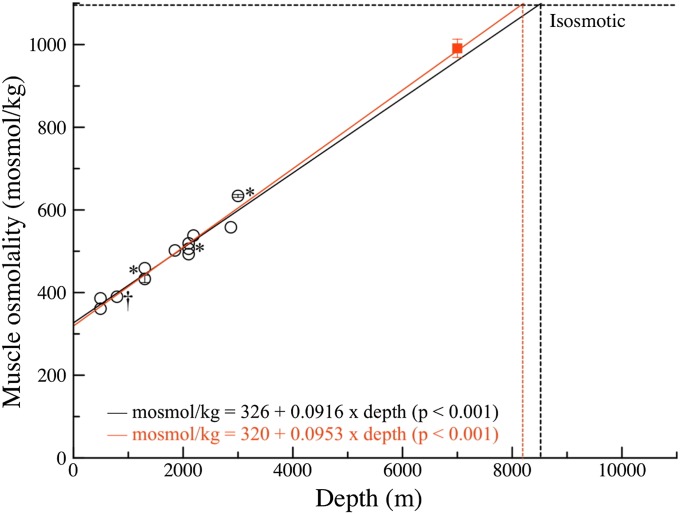
https://eutils.ncbi.nlm.nih.gov/entrez/eutils/efetch.fcgi?db=pmc&id=3970477 : We found their muscles to have a TMAO content of 386 ± 18 mmol/kg and osmolality of 991 ± 22 mOsmol/kg. These data fit previous extrapolations and, combined wit… - CONFIRMED The figure's own line, 326 + 0.0916 × depth, reaches 1,100 at 8,450 m
https://cdn.ncbi.nlm.nih.gov/pmc/blobs/1342/3970477/a014dc2c0957/pnas.1322003111fig03.jpg : mosmol/kg = 326 + 0.0916 x depth (p < 0.001) - CONFIRMED predicted that they would stop near 8,200 metres
https://eutils.ncbi.nlm.nih.gov/entrez/eutils/efetch.fcgi?db=pmc&id=3970477 : we find that they have the highest recorded TMAO contents, which, moreover, yield an extrapolated maximum for fish at about 8,200 m. - CONFIRMED from data “modified from Linley et al. 2016”
https://ndownloader.figshare.com/files/58648003 : Figure 1. New osmolality data for amphipods (hemolymph) along with published fish data modified from Linley et al. 2016 - CONFIRMED the estimate was “later refined to 8,300-8,400 m with more data (Linley et al. 2016)”
https://api.figshare.com/v2/articles/28692455 : first estimated to be at about 8,200 m (with error bars; Yancey et al. 2014) and later refined to 8,300-8,400 m with more data (Linley et al. 2016). - CONFIRMED Yancey's 2025 update says the 8,200 m estimate came “with error bars”
https://api.figshare.com/v2/articles/28692455 : first estimated to be at about 8,200 m (with error bars; Yancey et al. 2014) - CONFIRMED It “was caught in an open trawl and the validity of this report has been called into question (e.g., Jamieson et al., 2009), although it is impossible to disprove.”
https://scholarspace.manoa.hawaii.edu/server/api/core/bitstreams/a9b1c58d-55c6-4fce-887d-391a2bad50d2/content : However, this fish was caught in an open trawl and the validity of this report has been called into question (e.g., Jamieson et al., 2009), although it is impos… - CONFIRMED from an otter trawl deployed to 8,370 m in the Puerto Rico Trench in 1970
https://scholarspace.manoa.hawaii.edu/server/api/core/bitstreams/a9b1c58d-55c6-4fce-887d-391a2bad50d2/content : In 1970, the fish Abyssobrotula galathea was collected in an otter trawl deployed to 8,370 m in the Puerto Rico Trench. - CONFIRMED an ophidiid (cusk-eel)
https://www.ebi.ac.uk/europepmc/webservices/rest/PMC7671157/supplementaryFiles : the record of the ophidiid Abyssobrotula galatheae reported from over 8,000 m comes from an open trawl - CONFIRMED A juvenile snailfish on video in the Izu-Ogasawara Trench
https://research-repository.uwa.edu.au/en/publications/new-maximum-depth-record-for-bony-fish-teleostei-scorpaeniformes-/ : snailfish (Liparidae) were observed between 6824 and 8336 m, the deepest being a solitary juvenile. - CONFIRMED possibly <i>Pseudoliparis belyaevi</i> or a new species
https://research-repository.uwa.edu.au/en/publications/new-maximum-depth-record-for-bony-fish-teleostei-scorpaeniformes-/ : represented by video imagery of a snailfish probably Pseupodoliapris belyaevi or a new, endemic species since no physical specimen was captured. - CONFIRMED on an expedition that began in August 2022
https://www.uwa.edu.au/news/article/2023/april/scientists-break-new-record-after-finding-worlds-deepest-fish : In August 2022, the research ship DSSV Pressure Drop undertook a two-month expedition to the deep trenches around Japan - CONFIRMED The Mariana snailfish, <i>Pseudoliparis swirei</i>: the deepest end of its known range, and the record before 2022.
https://www.ebi.ac.uk/europepmc/webservices/rest/PMC7671157/fullTextXML : Mariana Trench 6198–8178 Pseudoliparis swirei - CONFIRMED the record before 2022
https://api.figshare.com/v2/articles/28692455 : deeper than the previous record of 8,178 m for the Mariana Trench - CONFIRMED “the deepest fish seen alive” when that paper was written
https://api.semanticscholar.org/graph/v1/paper/DOI:10.1016/j.dsr.2016.05.003 : the 'Ethereal snailfish' (7939–8145 m). These new findings represent respectively the deepest known specimen caught with corroborating depth data, and the deepe… - CONFIRMED filmed but not caught (Gerringer et al. 2017 give 8,143 m)
https://www.mapress.com/zt/article/download/zootaxa.4358.1.7/13080 : another remarkable liparid species was filmed (but not recovered) on the same cruise at an even greater depth of 8,143 m - CONFIRMED which Jamieson and colleagues call the deepest fish ever caught
https://research-repository.uwa.edu.au/en/publications/new-maximum-depth-record-for-bony-fish-teleostei-scorpaeniformes-/ : Two specimens, identified as P. belyaevi, were collected from 8022 m and represent the deepest fish ever caught. - CONFIRMED In the Izu-Ogasawara Trench the 2022 expedition sampled by trap and video from 4,534 to 9,773 m.
https://research-repository.uwa.edu.au/en/publications/new-maximum-depth-record-for-bony-fish-teleostei-scorpaeniformes-/ : Sampling by trap and video was undertaken between 4534 and 9773 m and snailfish (Liparidae) were observed between 6824 and 8336 m - CONFIRMED Snailfish turned up between 6,824 and 8,336 m, and no deeper.
https://research-repository.uwa.edu.au/en/publications/new-maximum-depth-record-for-bony-fish-teleostei-scorpaeniformes-/ : snailfish (Liparidae) were observed between 6824 and 8336 m, the deepest being a solitary juvenile. - CONFIRMED The expedition's chief scientist, Alan Jamieson
https://www.uwa.edu.au/news/article/2023/april/scientists-break-new-record-after-finding-worlds-deepest-fish : UWA Professor Alan Jamieson, founder of the Minderoo-UWA Deep Sea Research Centre and chief scientist of the expedition - CONFIRMED “The real take-home message for me, is not necessarily that they are living at 8,336m but rather we have enough information on this environment to have predicted that these trenches would be where the deepest fish would be”
https://www.uwa.edu.au/news/article/2023/april/scientists-break-new-record-after-finding-worlds-deepest-fish : “The real take-home message for me, is not necessarily that they are living at 8,336m but rather we have enough information on this environment to have predicte… - CONFIRMED “Fish appear to be absent from the ocean's greatest depths, the trenches from 8,400–11,000 m.”
https://eutils.ncbi.nlm.nih.gov/entrez/eutils/efetch.fcgi?db=pmc&id=3970477 : Fish appear to be absent from the ocean's greatest depths, the trenches from 8,400–11,000 m. - CONFIRMED In March 2025 a study in <i>Cell</i> of how fishes adapted to the deep sea (Xu and colleagues)
https://eutils.ncbi.nlm.nih.gov/entrez/eutils/efetch.fcgi?db=pubmed&id=40054449 : Evolution and genetic adaptation of fishes to the deep sea. - CONFIRMED “reported considerably lower TMAO levels in 3 hadal snailfish and 1 cusk eel from the Mariana Trench”, in Yancey's summary of it
https://api.figshare.com/v2/articles/28692455 : Xu et al. (2025) reported considerably lower TMAO levels in 3 hadal snailfish and 1 cusk eel from the Mariana Trench - CONFIRMED “Interestingly, our results question the previously assumed linear correlation between trimethylamine oxide (TMAO) content and depth.”
https://eutils.ncbi.nlm.nih.gov/entrez/eutils/efetch.fcgi?db=pubmed&id=40054449 : Interestingly, our results question the previously assumed linear correlation between trimethylamine oxide (TMAO) content and depth. - CONFIRMED “undamaged Mariana Trench snailfish had Na+ contents under 250 mmol/kg, while all damaged fish had random values above 300. Thus, retrieval damage probably causes leakage of TMAO from, and NaCl from seawater into, muscle tissue.”
https://api.figshare.com/v2/articles/28692455 : undamaged Mariana Trench snailfish had Na+ contents under 250 mmol/kg, while all damaged fish had random values above 300. Thus, retrieval damage probably cause… - CONFIRMED “I do acknowledge that Xu et al.'s low-TMAO data, although consisting of only 4 data points, could be accurate, suggesting alterations may be needed to the TMAO piezolyte hypothesis”
https://api.figshare.com/v2/articles/28692455 : Finally, I do acknowledge that Xu et al.'s low-TMAO data, although consisting of only 4 data points, could be accurate, suggesting alterations may be needed to … - CONFIRMED He adds that the rise in the fishes' osmolality with depth, which is what this page plots, needs some dissolved substance to account for it whatever that substance turns out to be.
https://api.figshare.com/v2/articles/28692455 : Regardless, some solute (not Na+ or K+) increases with depth in teleosts; the consistent linear increase with depth in internal osmolality in numerous fish spec… - CONFIRMED snailfish from the warmer Mariana Trench carry less TMAO than those from the colder Kermadec at the same depth, a “piezo-thermal” effect that “could alter our hypothesized depth limits for teleosts.”
https://api.figshare.com/v2/articles/28692455 : we found that snailfish (Fig. 2) and amphipods (Downing et al. 2018) from the Mariana Trench have less TMAO than those from the colder Kermadec Trench at the sa… - CONFIRMED they “would be adaptive under the high hydrostatic pressures of the deep sea, where the inflation of a swimbladder becomes increasingly difficult”.
https://scholarspace.manoa.hawaii.edu/server/api/core/bitstreams/a9b1c58d-55c6-4fce-887d-391a2bad50d2/content : These low-density tissues and fluids would be adaptive under the high hydrostatic pressures of the deep sea, where the inflation of a swimbladder becomes increa… - CONFIRMED the jelly-like layer under the skin of many deep-sea fishes measured 96.53 percent water across nine species
https://scholarspace.manoa.hawaii.edu/server/api/core/bitstreams/a9b1c58d-55c6-4fce-887d-391a2bad50d2/content : Many deep-sea fishes have a gelatinous layer, or subdermal extracellular matrix, below the skin or around the spine. We document the distribution of gelatinous … - CONFIRMED “Marine fish may be biochemically constrained from inhabiting the deepest ocean depths”
https://api.crossref.org/works/10.1073/pnas.1322003111 : TITLE: Marine fish may be biochemically constrained from inhabiting the deepest ocean depths - CONFIRMED “Update on trimethylamine N-oxide (TMAO) as a piezolyte and cryoprotectant: its role in a depth limit for marine fishes and loss from hadal fish during capture”
https://api.figshare.com/v2/articles/28692455 : "title": "Update on trimethylamine N-oxide (TMAO) as a piezolyte and cryoprotectant: its role in a depth limit for marine fishes and loss from hadal fish during… - CONFIRMED “Fishes of the hadal zone including new species, in situ observations and depth records of Liparidae”
https://api.crossref.org/works/10.1016/j.dsr.2016.05.003 : Fishes of the hadal zone including new species, in situ observations and depth records of Liparidae - CONFIRMED “New maximum depth record for bony fish: Teleostei, Scorpaeniformes, Liparidae (8336 m, Izu-Ogasawara Trench)”
https://api.crossref.org/works/10.1016/j.dsr.2023.104132 : New maximum depth record for bony fish: Teleostei, Scorpaeniformes, Liparidae (8336 m, Izu-Ogasawara Trench) - CONFIRMED “Evolution and genetic adaptation of fishes to the deep sea”
https://eutils.ncbi.nlm.nih.gov/entrez/eutils/efetch.fcgi?db=pubmed&id=40054449 : Evolution and genetic adaptation of fishes to the deep sea. - CONFIRMED three from the Kermadec Trench (its legend labels them 2014) and four from the Mariana Trench (2016)
https://ndownloader.figshare.com/files/58648003 : legend: Amphipods, Kermadec Trench / Various fish 1996-2007 / Kermadec snailfish 2014 / Mariana snailfish 2016 / Kermadec rattails 2014 / Mariana rattails 2016 … - WRONG What stops fish is chemistry. ... predicted that they must stop near 8,200 metres. (dek, meta description, JSON-LD)
https://eutils.ncbi.nlm.nih.gov/entrez/eutils/efetch.fcgi?db=pmc&id=3970477 : the paper is hedged: title "may be biochemically constrained", abstract "could constrain"; Xu et al. 2025 dispute the trend and Yancey 2025 concedes "alterations may be needed"; the page's own caveat says nothing here tests why fish stop - WRONG Then more fish arrived ... later snailfish (seven points from Yancey 2025 Fig. 1)
https://ndownloader.figshare.com/files/58648003 : the legend labels the three Kermadec squares "Kermadec snailfish 2014" and the four Mariana circles "Mariana snailfish 2016"; "later" was the author's inference from their depths, and the open square the page called the replotted 2014 point is drawn in the "Various fish 1996-2007" style - UNVERIFIABLE the point the 2014 caption places at 793 m reads as 795
research/how-deep-can-fish-live/sources/yancey2014_body_WEBFETCH_UNVERIFIED.txt : the caption was read only through WebFetch (a summarising model); the 2014 body text could not be fetched raw (pnas.org 403, PMC recaptcha, Europe PMC 500) - UNVERIFIABLE bathyal or abyssal teleost (Monterey Bay) (instrument tooltip)
research/how-deep-can-fish-live/sources/yancey2014_body_WEBFETCH_UNVERIFIED.txt : Monterey Bay appears only in the WebFetch caption lead - UNVERIFIABLE Start with the twelve shallow fish, the ones Yancey had before the trench (and the button "before 2014")
https://eutils.ncbi.nlm.nih.gov/entrez/eutils/efetch.fcgi?db=pmc&id=3970477 : the raw abstract says the 8,200 m fit combined the snailfish "with new osmolalities from bathyal and abyssal fishes", so these may be new 2014 data; a preliminary extrapolation did exist before ("Preliminary extrapolation ... 8,000–8,500 m") - UNVERIFIABLE twelve fishes from 500 to 3,000 m
research/how-deep-can-fish-live/sources/yancey2014_pnas.1322003111fig03.jpg : twelve points; two carry SD bars and so are means of several fish; the number per point is only in the unread caption - OBSERVED At 8,336 m: about 846 atmospheres, seawater 3.46% smaller (about 965 ml per litre), air 846-fold by Boyle's law and about 474-fold for real air
recreated: node verify-how-deep-can-fish-live.mjs (parts A, B) and node -e on engine.mjs : 845.79 atm, shrink 0.034596, real air 473.6; engine held against TEOS-10 (gsw), the seawater package and CoolProp tables from research/how-deep-can-fish-live/reference.py - OBSERVED real air ... shrinks about 474-fold
recreated: python3 research/how-deep-can-fish-live/reference.py (CoolProp 8.0.0) : 466.07 at 8,000 m, 477.31 at 8,500 m; interpolated 473.6 at 8,336 m - OBSERVED the fits and 95% intervals: 8,386 m (7,410 to 9,758); 8,189 m (7,746 to 8,701); 7,995 m (7,831 to 8,169); 8,453 m (8,034 to 9,503)
recreated: python3 research/how-deep-can-fish-live/intervals.py in a scratch copy : output identical to the committed intervals.json; the verifier's own 0.5 m scan agrees - OBSERVED All seven fall inside the band the twelve shallow points had predicted; above the old line by 4 to 63 mOsm/kg
recreated: verifier part E : hand residuals 63, 44, 37, 35, 23, 46, 4 - OBSERVED the digitized points reproduce the printed equations (325.2 + 0.0924 against 326 + 0.0916; 320.8 + 0.0952 against 320 + 0.0953)
recreated: python3 research/how-deep-can-fish-live/digitize.py in a scratch copy : digitized.json identical; the 14 later picks overlaid on the 2025 image each sit on their marker
What was done
- [fixed] The dek, meta description and JSON-LD said "What stops fish is chemistry" and "predicted that they must stop"; now "What seems to stop them is chemistry" and "would stop", matching the paper's "may"/"could" and the page's own caveat.
- [fixed] Verifier coverage: the dek's 3.5 percent, "roughly two millilitres", "more than a thousand", the dek's 8,200 metres, "the “8,200 m” of the abstract", the 6,824 to 8,336 m and 4,534 to 9,773 m ranges, and each records-table depth pinned to its own row are now checked against the page text; the four silent edits the pass found each turn it red.
- [fixed] "Then more fish arrived" / "later snailfish": now "Then more fish were published", with the legend's labels given (three Kermadec, "2014"; four Mariana, "2016"), the reason none of them was in the 2014 line (their depths are not the 7,000 m sample), and a note that the figure does not say whether its years are capture or publication years. Button and legend read "more snailfish".
- [fixed] The open square used to check the second figure's axes is now described as what it is: drawn in the "Various fish 1996-2007" style, sitting where the 2014 average would plot, and taken to be that point. Also corrected "Five markers placed by eye" to eight.
- [fixed] "twelve fishes / twenty fish / eight fish" now "points"; the two SD-bar points are "averages of several fish" (not "three", which rested only on the unread caption).
- [fixed] Removed the "793 m reads as 795" check from the page and the verifier (circular, and sourced only by WebFetch); removed "Monterey Bay" from the tooltip and from digitize.py; "before 2014" / "the ones Yancey had before the trench" now "the shallow twelve" / "the twelve shallow points alone, without the trench".
- [fixed] 8,022 m row: "the deepest fish ever caught" now attributed ("which Jamieson and colleagues call the deepest fish ever caught") with the 8,370 m trawl named as the doubted exception.
- [fixed] The source record and a verifier label said the figure's dashed line sits at 8,450 m; measured, it is nearer 8,510 m. Both now cite the printed equation (326 + 0.0916 x depth, which gives 8,450), not the drawn line. The page's own sentence already cited the equation.
- [fixed] Narration line "before anyone had measured the deep ones" (not supported) now "drawn through shallow fish, then tested on snailfish from a trench".