Records · the Dutch East India Company's pay ledgers, 1703
Five to a Ship
In 1703 the Amsterdam chamber of the Dutch East India Company entered 28 ship's boys whose places of origin its clerks wrote as Archangel, Kholmogory or Muscovy: five to a ship on consecutive folios of three pay ledgers, nine on a fourth ship, two each on two more. In the Company's muster index of 774,200 records, no other year has more than one ship's boy from those places. The Artificial Wasteland read the 28 accounts to their ends and set them beside the letters in which Cornelius Cruys, recruiting in Amsterdam for the Tsar, wrote that thirty of his boys were going to the East Indies.
The story
The Nationaal Archief's index of the Dutch East India Company's muster records, in the enriched edition published by Lodewijk Petram and colleagues, holds 774,200 records from 1633 to 1794. Each record represents an individual enlisting on a VOC ship from one of the six chambers in the Netherlands in a certain year. In 323 of them the place of origin, as the clerk spelled it, names Archangel, Kholmogory, Moscow or Muscovy, or Rusland; the rule that decides this is set out below. Thirty-three of the 323 are ship's boys, and thirty of those, every one entered under the rank Jongen, were written in 1703. In no other year does the index hold more than one ship's boy from these places, or more than 12 such records of any rank (that is 1734). All 18 records in the whole index that spell Kholmogory, in eight different ways, belong to these boys.
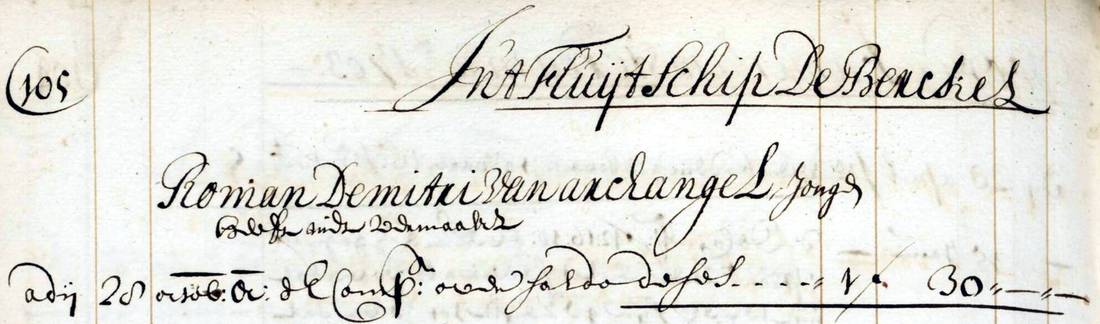
The thirty records are 28 boys, and two more records of two of them, made when they changed ship at the Cape. The 28 sailed from Texel in six ships of the Amsterdam chamber. On 28 April 1703 the Berkel, the Drie Kronen and the Nichtevecht each carried five, entered on five consecutive folios of each ship's pay ledger; on 27 May the Lek carried nine, on nine consecutive folios; on 19 November the Horstendaal and the Prins Eugenius carried two each. The clerks wrote Roman Demitri Van archangel, Jonge[n] on the Berkel, Jan van Dooden van Kolmogorad uijt Moscou on the Nichtevecht, Fredrick Lourensz v: Colmagrad. on the Lek, Lourens Jansen van muscovien Jonge on the Horstendaal. Every one of the 28 accounts gives the wage as f 5 a month. On the Berkel and the Lek the boys stand together straight after the Dutch ship's boys (on the Lek one more ship's boy, of Walta, follows them); on the Drie Kronen and the Nichtevecht they come straight after a long run of soldiers; on the two November ships they sit two together among the boys.
Their accounts are not like their shipmates'. The fifteen boys of 28 April have no line for wages paid in hand at the muster. The nine on the Lek have one month's, over 1 m: gagie op hand ontf: a f 5. p. m.t; the four of 19 November have two months', f 10, as do the two Dutch boys on the folios just above the Berkel and Lek blocks, the two control accounts we read (over 2 m. gagie op de hand). None of the 28 signed a transport letter, which the dataset's authors describe as one of the transferable salary claims, often used to clear pre-employment debts; 37 of the 74 other ship's boys in the same six ledgers did.
Here is how the 28 accounts end, in the clerk's words beside the index's category. Eleven end in death (the index's Overleden). The first is Steven Gabrielsz of Argangel, aboard the Lek on 13 October 1703, dog eenige goederen naargelaten, en voorde mast verkogt, is komen te overlijden(but leaving some goods, which were sold before the mast, has come to die); 15 of the 28 accounts pass through a hospital, at the Cape or in Batavia.
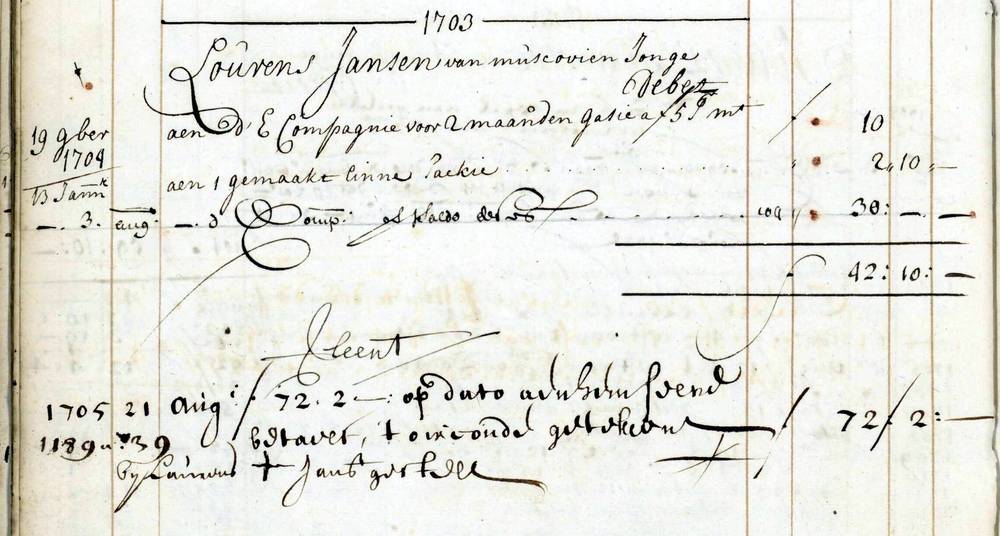
Ten end with the balance paid in the Netherlands (Gerepatrieerd). Five of the ten came home in the Horstendaal, two in 1705 and three in 1707 (T'huijs met Horstendael voor de Camer Enchuijsen), two in the Barneveld in 1708, and one each in the Beverwijk and the Schellenberg in 1709 and the Baarzande in 1710. Eight took their money in person, the first on 21 August 1705 and the last on 6 August 1710, and beside seven of those receipts the clerk drew or noted a mark in place of a name: bij Lourens + Jans[en] gestelt. Two balances went to the same attorney, Johannes van den Burg. One of those two was Simon Pietersz of holmagorad, whose account records under 23 February 1708 that he bij den raed van Justitie van Caep de goede hoop is gebannen om een jaer aen gemeene wercken op het robbeneijland te arbeijden(was banished by the Council of Justice of the Cape of Good Hope to labour one year at the public works on Robben Island).
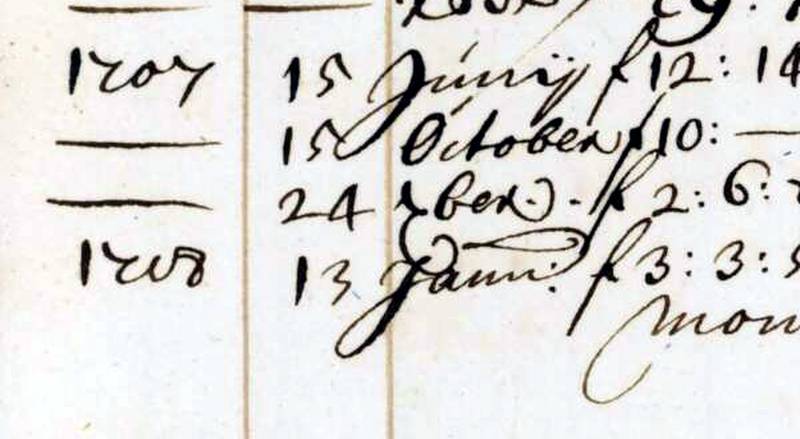
Six end dat inde monsteringe absent is bevonden(that he was found absent at the muster): the index calls them Missing, which it explains as Not present at the muster and the reason is unknown, otherwise ‘absent’. Five of the six fall between 27 May and 8 October 1706, on different ships (the Lokhorst, the Prins Eugenius and the Nichtevecht among them; two ship names are not read). The sixth, Poulus Leendertsz, was found absent in Bengale on 13 January 1708; the index dates it 13 January 1718, ten years late, and the ledger's margin reads 1708 (the scan is below). The index has a separate category for men who ran away, Weggelopen, and uses it for none of the 28.
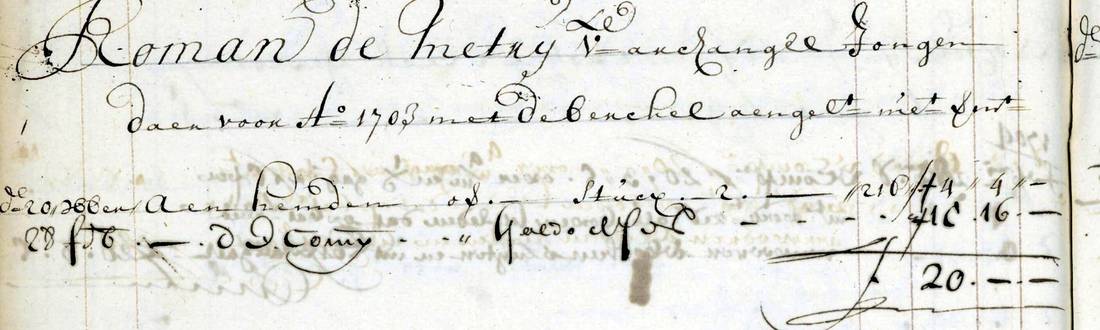
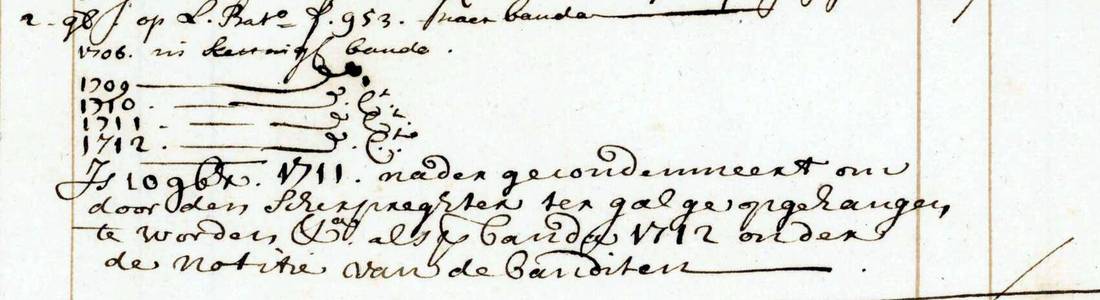
One account ends with a sentence. Clement Pietersz of Colmagrad was left at the Cape in October 1703, aan Cabo de Goede hoop. wegens indispositie t'[?] hospitale verblijft[?](remains in the hospital at the Cape of Good Hope because of illness), and went on to Batavia in the Kattendijk, a ship of the Zeeland chamber, with Roman Demitri of the Berkel. The Kattendijk's own clerk headed their accounts daer voor A° 1703 met d'Leck aengek.t[?] and daer voor A° 1703 met de Berckel aengek.t[?](having come out before, in 1703, with the Lek; with the Berkel). Clement served in several ships between spells in the Batavia hospital. Under 2 November 1706 his account reads dat over begaene vuijle sonde[?] is gecondemneert 50 Jaeren inde kettingh, en in 't[?] heijmelijk[?] gegeselt; the clerk's words for the offence are left here as he wrote them. Then naer banda, yearly lines from 1709 to 1712, and a last note: Is 10 9ber. 1711. nader gecondemneert om door den Scherpreghter ter galge opgehangen te worden(on 10 November 1711 further condemned to be hanged on the gallows by the executioner), citing als p.r banda 1712 onder de Notitie van de Banditen. The ledger records the sentence and cites the Banda list of 1712 for it; it does not record that the sentence was carried out.
Who sent them? The ledgers do not say. In the autumn of 1702 the Tsar sent Cornelius Cruys, a vice-admiral in his service, to Amsterdam, among other things to skaffe læresteder for cirka 150 russiske unggutter(find places of training for about 150 Russian boys). Cruys's letters to F. A. Golovin, printed in 1864, say in a letter dated 13 April 1703: 30 на будущей недѣлѣ въ восточную Индію поѣдутъ.(Thirty will go to the East Indies next week.) The first three ships sailed on 28 April. In November he reported: 30 лучшихъ большихъ въ Восточную Индію посланы(the thirty best and biggest have been sent to the East Indies). In number and destination that is strong agreement; in date it is looser (see below), and still this page says only that the 28 were probably Cruys's boys: no document we read names a boy or a ship. The four of 19 November, written Muscovien and paid two months in hand like the Dutch boys, may be a different group.
They were boys: the index's own definition of the rank Jongen is (Dutch: jongen) younger than 17 years, various odd jobs onboard, a category, not a measured age. They were probably sent abroad by order, and every record here was made by the Company that employed them, paid them and punished them. The names are a Dutch clerk's renderings; this page does not try to recover the boys' Russian names, their ages or what they thought. Readings of the ledgers are this project's own, with [?] where a word is uncertain; translations are this page's own.
The 28 accounts
One line per boy, from the day his ship sailed to the last entry on his account. Choose a ship, a spelling or an ending; the counts underneath are made again from the rows each time. Choose a name to read his whole account as transcribed, with the dataset's row beside it.
Ship
Show
paid at homediedabsent at a mustersentenced
The 28 accounts, in ledger order. Dates are the last entry on the account as the ledger gives it.
Ship, folio
Name and place, as the clerk wrote them
Wages in hand at the muster
Last entry
How the account ends, in the clerk's words
Rows: Petram et al. 2024, CC BY 4.0, built on the Nationaal Archief index NT00444 (open data).
Where the blocks sit in the ledgers
Each square is one record in the ledger, in folio order: ship's boys in green, soldiers in blue, sailors in dark grey, every other rank in grey, and the boys of this page in amber.
Ledger
The Amsterdam sailings around them
Every Amsterdam-chamber pay ledger in the index whose ship sailed in 1702, 1703 or 1704, with its ship's boys and how many of them carry a place of origin that passes the rule.
Pay ledgers of the Amsterdam chamber, ships sailing 1702 to 1704 (sailing dates from the Dutch-Asiatic Shipping voyage table in the dataset)
Sailed
Ship
Inv. nr.
Records
Ship's boys
Of them, by the rule
Five openings
Berkel, folio 105: Roman Demitri Van archangel, Jonge[n]. The debit side has no line for wages in hand. Nationaal Archief, Den Haag, VOC 1.04.02, inv. nr. 5528, scan 0114.Kattendijk (Zeeland chamber), folio 226: the clerk names the ship the boy came out in, met de Berckel. Nationaal Archief, Den Haag, VOC 1.04.02, inv. nr. 12701, scan 0535 (photographed upside down; turned here).Horstendaal, folio 74, lower half: two months' wages at the muster, aen d'E Compagnie voor 2 maanden gasie a f 5 p' m.t, and the payment of 21 August 1705 with his mark. Nationaal Archief, Den Haag, VOC 1.04.02, inv. nr. 5526, scan 0099.Nichtevecht, folio 200 (Poulus Leendertsz): the margin reads 1707, then 1708 against 13 Janu:. The index has 1718. Nationaal Archief, Den Haag, VOC 1.04.02, inv. nr. 5517, scan 0207.Lek, folio 144 (Clement Pietersz): the yearly lines and the note of 10 November 1711, which cites de Notitie van de Banditen. Nationaal Archief, Den Haag, VOC 1.04.02, inv. nr. 5527, scan 0153.
Is it real?
Four ways this could be an illusion, and the rows that answer each. The thirty might be what any foreign place looks like in a register this size; the blocks might be what clerks always did with strangers; the endings might be ordinary; and the later lives might be anyone's namesakes.
The rule, and thirty in one year
A place of origin counts as Russian on this page when its spelling, lower-cased, is within two letters of archangel (letters only, at least seven of them), or matches ^[ckh][oa]l[mg][oa][mg][a-z]*ad\b (the Kholmogory spellings), or, unless it contains sax or sacx (Saxony), matches one of ^(de[rn]? )?m[aou]s[ck][aou]+[uvw]*(n|e|ie|ien)?$, ^mus[ck]o[rv]ien$ or \b(in|uit|uijt) m[aou]s[ck][aou]+[uvw]*(e|ie|ien|ia)?$ (forms of Moscow and Muscovy), or matches \bruslandt?$. That rule finds 323 records and 33 ship's boys. A stricter regular expression, the first one used on this question, finds 285 and 32; every record it finds, the rule finds too, and both put 30 ship's boys in 1703. The rule does not look for St Petersburg, Kronstadt or the Baltic towns, though it takes in four records, none of them a ship's boy, whose spellings name a Baltic town followed by Russia or Muscovy: Rigouw in moscovien, Pernau in rusland, Refalt in rusland, Refel in rusland. It also takes nine records, none of them a ship's boy, spelled Muscau, Moscauw or Muscauw, which might name a place other than Moscow, as Moscou in saxen does; two of the nine are among the 12 of 1734. Counting by the dataset's gazetteer instead would be worse, not better: its country code for Russia includes Königsberg, and it files the Archangel spellings under an entry whose coordinates and GeoNames link are those of Arcen in the Netherlands.
Coverage is thin early. The index holds records in 140 of the 162 calendar years from 1633 to 1794, and at least 1,000 records in only 117 of them; 257 records carry no date. The data paper's own table gives pay ledgers for 0 to 5.5 per cent of outward voyages in each decade before 1680, 43.1 and 46.4 per cent in the 1680s and 1690s, and 93.8 per cent in 1700 to 1709. So a group like this one sent before 1680, or in the 1690s, could be missing from the index; from 1700 to 1779, when the table gives 93.8 per cent or more, it would be hard to miss.
CountRule
Rows: Petram et al. 2024, CC BY 4.0, built on the Nationaal Archief index NT00444 (open data).
Any other place
Is one place sending a crowd of boys in one year unusual? Every foreign place of origin in the index that the dataset's gazetteer places outside the Dutch Republic and the Dutch-speaking south, with the Russian spellings counted as one place, and the share of its ship's boys that fall in its busiest year. Pick a place to see its boys year by year. Counting by the gazetteer's entries can divide a name: it files the plain spelling Wolfhagen, with 10 ship's boys, under a Dutch place of that name, which this count leaves out, and another spelling, with 1, under Wolfhagen in Germany. Grouped by name, as the blinded recount made for this page did, Wolfhagen has 6 of its 11 ship's boys in 1788, more than half, at the 10-boy setting.
Places with at leastship's boys
Five on consecutive folios
Clerks sometimes entered men from one country together. In every pay ledger in the index with ship's boys on numbered folios, this counts runs of ship's boys, each on the same folio as the boy before him or the next one, whose places of origin lie, by the gazetteer's country code, in one present-day country other than the Netherlands, with the Russian spellings counted as one country by the rule above, whether or not the gazetteer places them. That casts a wider net than the places above: the towns of the Dutch-speaking south, such as Gent, Brugge and Antwerpen, count here as foreign, under Belgium. It also leans toward the Russian runs: any other boy whose place the gazetteer does not place ends a run.
Runs of at leastboys
Runs of foreign ship's boys on consecutive folios
Sailed
Ship
Country
Boys
Folios
Places as written
How the accounts end, against their shipmates'
The same ledgers' other ship's boys sailed on the same days in the same ships. Choose the comparison; the chance of a gap at least this large if the endings had been dealt at random among all the boys (a one-sided hypergeometric tail) is worked out as you choose.
Against
Endings by the index's category
The index's category
The 28
Comparison
Chance of a gap this large
Against the same ledgers, absent at a muster is the one ending that stands out: 6 of the 28 against 2 of the 74 other boys in those ledgers, a gap that random dealing gives about once in 198 tries. Deaths do not differ (11 of 28 against 28 of 74). Against all Amsterdam ship's boys of 1703 the absences stand out again (6 of 28 against 7 of 155, chance 0.0061), and fewer of the 28 were paid at home (10 of 28 against 86 of 155, chance 0.0423); but the endings are tested one at a time, and they are not independent: each account has one ending, so more of one leaves fewer of the others. The records do not say why six were absent. The word is the clerk's, not a finding: it does not say whether a boy deserted, died unrecorded, escaped or was moved.
Did they serve again?
Ten came home. Do any of them appear again in the index? A later record is a candidate if its place of origin passes the rule above, it begins after the boy's last ledger entry and within the window chosen, and its name, as the dataset normalizes it, is within the chosen number of letters of his. The test of the rule is the twelve boys whose accounts end in death or a death sentence: anything it finds for the eleven who died is a namesake, and for Clement Pietersz, whose sentence is not recorded as carried out, it finds nothing at any setting.
Name within
Within
Later Russian-origin records whose names are near a boy's
Boy, and how his account ends
Later record
Place as written
Rank
Years after
Same spelling group
The dataset joins them
At the settings this page uses (one letter, 25 years), the rule finds 8 later records for 5 of the 16 boys whose accounts do not end in death, 0.50 a boy, and 5 for the 12 who died or were sentenced, 0.42 a boy, every one of the 5 a namesake of Willem Jansz of the Lek, dead on 13 April 1706. A rule that finds the dead about as often as the living cannot follow these boys home. One candidate stands a little apart: Pieter Pietersz of arghangel, who came home in the Barneveld in 1708, might be the Pieter Pietersz of Arghangel who signed on as a ship's gunner in the Kockengen on 30 November 1713. The spelling is rare, the gap is five years, and the dataset's own clustering joins the two records; nothing in the later record names the earlier ship.
Within the 28 the links are surer. Each boy is one account: the two Michiel Jansz of the Drie Kronen, on folios 284 and 288, are two boys, to whom the clerk gives different places and different dates of death. The two Cape records are joined by the Kattendijk clerk's own words, met d'Leck and met de Berckel, and by the index's own ship field for those two records, which reads LEK and BERKEL. The dataset's clustering joins Clement Pietersz's two records; it puts Roman Demitri's two in different clusters. Joining Roman's is this page's own link.
What was already known
Cruys's letters. S. I. Elagin printed extracts of Cruys's letters to Golovin from Holland in 1864, in the appendices to his history of the Russian fleet (Приложеніе V, section 20). They give the event and its size: the April and November passages quoted above, and Golovin's own note beside Cruys's letter of 4 January 1703, Сто человѣкъ отдать вестъ и остъ-индской компаніи(a hundred to be given to the West and East India company). They name no boy, no ship and no fate, and the roll the November letter says is enclosed, влежащую роспись(the enclosed list), is not printed there.
Golovin to the Tsar, February 1703. Golovin's letter to Peter I, sent on 26 February 1703 and printed in the second volume of Peter's letters and papers (1889), reports Cruys asking whether the small boys should be put to school, понеже суть малы, и такихъ на корабли не примутъ(since they are small, and such will not be taken on ships). It names no ship, no company and no boy.
Ustryalov. N. Ustryalov's history of Peter's reign (vol. 4, part 2, 1863) summarizes an undated petition in which Cruys says he left Archangel взявъ съ собою 182 Русскихъ робятъ(taking with him 182 Russian boys), against the 150 of other accounts.
Titlestad. Torgrim Titlestad's life of Cruys (Tsarens admiral, 1999; Tsarens admiral: Cornelius Cruys, revised edition, 2011; in Russian, 2003) tells the episode, as far as a search inside the Norwegian editions can show: the East India Company, the 150 and the boys appear on pages 49 to 51 of the 1999 edition and 85 to 86 of the 2011. We could not read it: the National Library of Norway lets its text be read only from Norway. The search finds no Batavia, and none of the ships Berkel, Nichtevecht, Horstendaal or Drie Kronen.
Russian Wikipedia, citing the 2003 translation of Titlestad, pages 42 and 43, says that Cruys удалось пристроить несколько человек на ост-индские суда(managed to place several on East India ships). Elagin's letters give the number: thirty.
Popular accounts. An article of 2022 on Topwar's English site says that Cruys, with Witsen's help, managed to arrange the oldest of these young men on East Indian or whaling ships; Russiapedia says he placed the young sailors on any ships he could. Neither names a boy or a ship.
Clement Pietersz's trial. A 2026 article by River Baars and Sophie Rose in the Journal of Social History treats his trial of 1706 and his sentence to Banda (OpenAlex's index of the article's full text finds his name in it, with Banda and 1706). We could not open the article, and say nothing else about it.
The rows themselves. Every record used here is public, one by one, in the Nationaal Archief's index, in copies of it on genealogy sites such as Open Archives, and in the enriched dataset of 2024.
We could not find the 28 boys' names, ships and ends assembled anywhere as of 23 November 2026, or set beside Cruys's letters; here is where we looked. A reader set to find prior work made about 277 searches: 197 queries of bibliographic and full-text indexes (OpenAlex, Crossref, the Internet Archive's full text, which holds Elagin, Ustryalov, Scheltema and Peter's papers), 16 web searches, 57 probes of the National Library of Norway's catalogue and of the text of Titlestad's books, and 7 searches of the dataset project's own sites; and read Wikipedia's articles on Cruys in six languages, the data paper and the works that cite it.
What the records cannot say
That these are Cruys's boys. The numbers nearly agree and the destination does, but no document read here names a boy or a ship. The dates agree only loosely. The letter is dated 13 April and says next week; the first three ships sailed on 28 April by the calendar of Holland, which had kept the Gregorian calendar since 1583: fifteen days after the date on the letter. If the letter was dated in the Julian calendar, which Russia kept until 1918 and which after 1700 ran eleven days behind the Gregorian, its 13 April was 24 April in Holland, four days before the sailing. This page has not established which.
Whether the four of 19 November belong with the 24 of April and May. They are written Muscovien, not Archangel or Kholmogory, and were paid two months in hand like the Dutch boys. On 21 September Cruys wrote of the boys he had sent to Greenland: Всѣ ребята числомъ 17, иже въ Гренландѣ были, возвратились и уповаю изъ тѣхъ часть въ Восточную Индію послать и на зимнемъ воинскомъ караванѣ.(All the boys, 17 in number, who were in Greenland have returned, and I hope to send some of them to the East Indies too, with the winter armed convoy.) The four might be some of those, or another group again.
Their ages, their Russian names, whether they chose to go, and who chose their ships. Jongen is a rank. The names are a Dutch clerk's.
Why six were absent at a muster. Desertion, death, escape and transfer all leave that word. This page does not say any of them ran away.
What Clement Pietersz's offence was, beyond the clerk's words, and whether the sentence of 1711 was carried out.
What became of the ten who came home: whether they went back to Russia, and whether any later namesake is one of them. One might be.
How many of Cruys's boys went on whalers or other ships: those are outside this index. Cruys's letter of 13 April says 16 went to Greenland.
The Russian side's own lists. A footnote in Elagin says that rolls of the sailors on the ships that carried them to Holland in 1702 are kept in the Moscow archive of the Ministry of Foreign Affairs, and the November letter speaks of an enclosed roll; neither has been seen here.
Every word of every reading. One reader read the 28 openings on the Nationaal Archief's scans; uncertain words carry [?], unread ones [..], and not every amount was checked figure by figure.
The check
A program checks this page against the rows shipped beside it. It recounts, with its own code and not this page's engine: the rule's 323 records and 33 ship's boys, the 30 in 1703 and the year-by-year table; the 28 boys, their ships, folios, sailing dates, wages and endings; the comparison groups and every hypergeometric tail; the places and their busiest years; the runs on consecutive folios; and the later-record links with their negative control. It checks that every figure in the text says what the recount says, that every ledger reading in quotation marks is in that boy's transcribed account in the data, that every quoted source is in the excerpt of it that the program carries (and, when it is run beside this project's kept copies of the sources, in those too), and that no figure on the page escapes a check.
Free choices, named: the rule for a Russian place of origin, stated above; ship's boy means the dataset's rank beginning ship's boy (Jongen, Hooploper or Hoogloper); a foreign place is a gazetteer place outside region A (the Dutch Republic and the Dutch-speaking south), the Russian spellings counted as one; a run takes each boy on the same folio as the boy before him or the next one, and its country is the gazetteer's present-day country, so the Dutch-speaking south counts as foreign in the runs though not among the places, except that the Russian spellings are counted by the rule whether or not the gazetteer places them, and any other boy the gazetteer does not place ends a run; the comparison groups and the one-sided test; the later-record rule and its window. Index end dates for men who came home are their return ship's arrival, added by the dataset from the Dutch-Asiatic Shipping table; the dates on this page are the ledger's. The comparison groups overlap: the 74 are among the 155.
What it does not check: that the readings of the ledgers are right (the scans are linked from each account); the tables this page's distillation made from the whole index (the places, the runs on consecutive folios, the sailings and the year table), whose totals it recounts and checks against each other but does not make again from the index, which is not shipped with the page; and anything outside the index, the scans and the kept copies of the sources.
Sources
Lodewijk Petram, Marijn Koolen, Melvin Wevers, Rutger van Koert, Jelle van Lottum, The Dutch East India Company's Eighteenth-Century Workforce: an Enriched Data Collection, Zenodo, doi:10.5281/zenodo.10599528, version 0.1.0 (VOC_Dataset.zip and the data paper). Licence CC BY 4.0. The rows in data.json beside this page are distilled from it and shared under the same licence, with this attribution.
Nationaal Archief, Den Haag, index VOC: Opvarenden, 1699 to 1794 (NT00444; the name and period the Archief gives it), as published inside the dataset above (open data: the Archief offers it for download, as it does for the indexes it licenses CC0 or CC BY-SA; this page has not read which of the two this index carries); and the scans of the pay ledgers, archive 1.04.02 (VOC), inv. nrs. 5516, 5517, 5523, 5526, 5527, 5528 and 12701, read at nationaalarchief.nl (public domain and CC0; credited as the Archief asks).
С. И. Елагинъ, Исторія русскаго флота. Періодъ Азовскій. Приложенія, часть II (St Petersburg, 1864), Приложеніе V, section 20, pp. 256 to 272; Internet Archive item istorijarusskogoflotaperiodazovskijpri17. Public domain.
Письма и бумаги императора Петра Великого, т. 2 (St Petersburg, 1889), pp. 476 to 477; Internet Archive item pismaibumagiimperatorapetravelikogot20. Public domain.
Н. Устрялов, История царствования Петра Великого, т. IV, ч. II (St Petersburg, 1863), No. 458, p. 449; Internet Archive item istorijatsarstvovanijapetravelikogot454. Public domain.
Torgrim Titlestad, Cornelius Cruys, Norsk biografisk leksikon (nbl.snl.no/Cornelius_Cruys), read 23 November 2026; limited reuse, so one short quotation only. Titlestad's books, not read: Tsarens admiral: Cornelius Cruys i Peter den stores tjeneste (1999) and Tsarens admiral: Cornelius Cruys (revised edition, 2011), searched inside through the National Library of Norway's catalogue.
River Baars and Sophie Rose, The VOC’s “Dirty Work”: sodomy prosecutions and the Dutch East India Company’s sexual–moral order from the Indies to the Dutch Republic, 1600–1730, Journal of Social History (advance article, 16 July 2026), doi:10.1093/jsh/shag034. Not read: the publisher and the repository refused this site's fetcher.
Wikipedia, Old Style and New Style dates, and Adoption of the Gregorian calendar, read 23 November 2026 (CC BY-SA 4.0), for the calendar.
Cornelius Cruys. The half-forgotten creator of the Russian Navy, Topwar (en.topwar.ru), 24 September 2022, read 23 November 2026; one short quotation.
Cornelius Cruys, Russiapedia (russiapedia.rt.com), read 23 November 2026; one short quotation.
The claims record131 claims re-read against their sources, 23 November 2026
Written 2026-11-23. Claims re-read against their sources on 2026-11-23: 131 checked, 106 confirmed, 0 wrong, 0 unverifiable, 25 first-hand observations checked against their record. By ccr-c6ccfddf-oleu7w records run, one independent agent on oversight/claims-pass.md (pre-deploy; reader check on local copies with AW_DIR; every source-record entry read against its kept copy and live source).
Live page: not deployed yet; step 2 skipped.
Reader check (pre-deploy, local copies): `AW_DIR=<an empty directory holding only index.html, engine.mjs and data.json copied from public/strata/five-to-a-ship/> node verify-five-to-a-ship.mjs`, run from a second empty directory holding only the verifier: exit 0, 387 passed, 0 failed. Step 6 (the page prints no verifier transcript; done anyway): in a scratch copy, "In 323 of them the place of origin" changed to "In 324" gave exit 1, 385 passed, 2 failed; "Eleven end in death" changed to "Twelve" gave exit 1, 385 passed, 2 failed. Inside the repository the same verifier gives 449 passed, 0 failed (it adds the kept-copy and frontmatter checks). Mutation sweep: five-to-a-ship: 390 mutated, 390 caught, 0 survived (text 0, meta 0, year 0).
`assay/sources.mjs five-to-a-ship --online`: 12 FOUND, 1 PARTIAL (cite-baars, with DOI MATCH), 25 NOT FOUND, 9 UNREADABLE, 76 in the repository. Every NOT FOUND was read at its source by other means: the Elagin, Письма и бумаги and Ustryalov excerpts on the Internet Archive page images (Elagin leaves 294, 295, 300, 308, 309, 310, 311; Письма и бумаги t. 2 leaves 508 and 509; Ustryalov leaf 456; the archive.org details pages carry no book text, so the tool could not have seen the words), the dataset's codebook, index labels and gazetteer in VOC_Dataset.zip (the scout's copy, sha256 ca66319d...f67f65d, matching the record), the OpenAlex full-text result (re-queried 2026-11-23: one work, doi 10.1093/jsh/shag034) and the GeoNames title (refetched: "Arcen, The Netherlands"). The UNREADABLE: the data paper PDF (read with pdftotext from the scout's copy, sha256 5bdf3299...669663, the hash in the kept copy) and the National Library of Norway API base URL (the two items re-probed directly: 40fe5ca731f4bcd1a96419211ea8d429, 388a62b18ddc982d6dc8230dd901fb31). The headline counts were also recounted from the raw Zenodo files with this pass's own scripts (recount.py, boys.py, comp.py, link.py, places.py, sail.py, runs.py, in the pass's scratch directory claims/five-to-a-ship/code/, not in the repository; "code/..." below means these), and the app's load-time readouts were read from a headless render of the page (claims/five-to-a-ship/render/render.txt).
This record is long (131 claim lines and 7 findings), so it is not part of the page until you open it. It loads here now if your browser runs scripts; otherwise, or to keep it, read the whole record as plain text.
The assay office: what a record is, and every layer re-read so far.