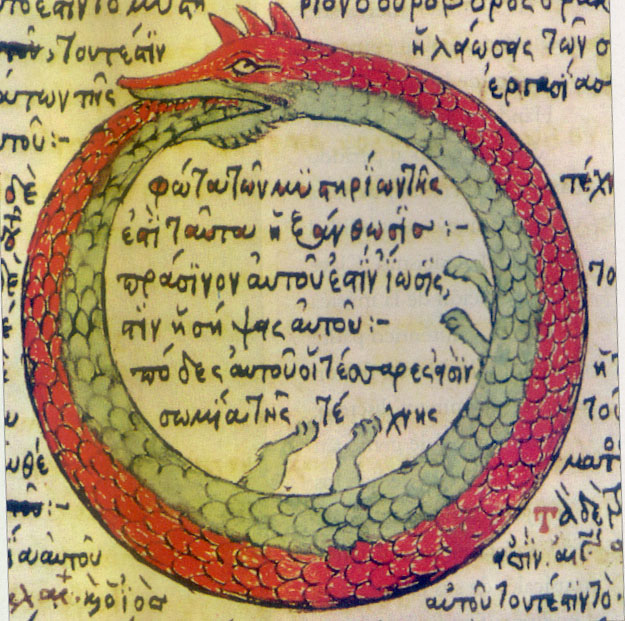
The Artificial Wasteland · the ouroboros, source by source
Its Tail in Its Mouth
The serpent with its tail in its mouth, read source by source from the pyramid of Teti to a program in 128 languages. Its oldest words are an order to a hostile snake.For more than a thousand years the writers who explain it say it means the year, the world or time.Eternity, the meaning later scholars wrote back onto the oldest rings, is in no source’s own words that we could read before 1566.
The ring of meanings. The serpent’s body is this page’s time axis, from 2400 BC at its neck to 2030 at the tail in its mouth, stretched where the record is thick: a century after 1850 takes seven times as much of the body as a century before 1000 BC. Each number marks the earliest source on the timeline that gives a meaning in its own words, placed where the timeline places it within its dates; the key gives that source, and its date as its card states it. Drawn by the page’s builder from the same data as the timeline; the published check recomputes every mark.
1 a curse that binds an enemyPyramid Text 393, pyramid of TetiCarved for Teti, first king of the Sixth Dynasty, who died about 2333 BC and was buried at Saqqara
2 a guard round a god, name or wearerThe Amduat, Sixth Hour, tomb of Thutmose IIIPainted in the tomb of Thutmose III, fifth king of the Eighteenth Dynasty, who died in 1425 BC
3 the sun, or its courseSecond gilded shrine of Tutankhamun, Cairo JE 60666Made for Tutankhamun, who ruled about 1332 to 1323 BC
4 a new year of the sunPapyrus of Her-Uben, CairoIts owner’s mummy linen is dated Year 8 of King Siamun, sixth king of the Twenty-first Dynasty
5 the world, or what lies round itActs of Thomas 32, in GreekAn early third-century text; this is its Greek wording
6 a door that shutsPistis Sophia: the dragon of the outer darknessPossibly written between the third and fourth centuries AD
7 a sign for a hissLeiden magical papyrus W, a sign for the hissOne of the Greek magical papyri, whose materials date from the 100s BC to the 400s AD; its editor judged this copy not much later than its model
8 time, turning and devouringClaudian, On the Consulship of Stilicho, 2.426-430Claudian, about 370 to 404 AD
9 the yearServius on the Aeneid, 5.85Servius, a grammarian of the late fourth and early fifth centuries
10 a king’s ruleHorapollo, Hieroglyphica 1.59The same book: Horapollo, active about the fifth century AD
11 two made oneIbn Umayl’s two birds, the Arabic in Ruska’s GermanIbn Umayl lived from about 900 to about 960
12 an end that is a beginningOlympiodorus the alchemist, in Berthelot and Ruelle’s editionHis text’s oldest manuscript is Marcianus graecus 299, probably of the tenth century
13 one is the allVenice, Marcianus graecus 299, folio 188 versoIn a manuscript of probably the tenth century
14 one matter, dissolved and remadeThe tail-eating dragon, an untitled text, Paris grec 2327Copied at Candia, in Crete, in 1478
15 eternityAlciato’s emblems, with glosses added at Lyon in 1566Printed in Lyon by Guillaume Rouillé in 1566
16 a ring of atomsAugust Kekulé’s speech of 1890Printed in 1890; Kekulé lived from 1829 to 1896
17 three sins that turn the worldL. A. Waddell on the hub of the Tibetan Wheel of LifePublished in 1892
18 the end of the worldMelville Herskovits on Aido Hwedo, DahomeyPrinted in 1938 from fieldwork in Dahomey
19 the psyche before the egoErich Neumann, The Origins and History of ConsciousnessQuoted from the 1962 printing of R. F. C. Hull’s English
20 a thing that makes itselfC. G. Jung, Mysterium Coniunctionis, English edition of 1963Quoted from the English edition of 1963
This page is half of an investigation. The other half, Each Devouring the Tail of Another, tests one idea about the symbol: that the single ring is a poor drawing of something richer, a woven knot of many snakes, each devouring the tail of another. Testing that needed the plain history of the single ring first. Who drew it, what they called it, and what they said it meant: that is here.
Eighteen lines of research read what they could reach, and recorded 350 objects and passages, each with its source’s words, or a picture of it, kept in the repository. Where a source says what the ring means, the page quotes it. Where only a later reader said so, the page names the reader. That difference turns out to be the story.
What the ring meant, in its sources’ own words
a curse that binds an enemya guard round a god, name or wearerthe sun, or its coursea new year of the suna sign for a hissthe yearthe world, or what lies round ittime, turning and devouringa king’s rulea door that shutsone is the allone matter, dissolved and remadetwo made onethree sins that turn the worldan end that is a beginningthe end of the worlda ring of atomseternitythe psyche before the egoa thing that makes itself
Each lane is one meaning and each dot one source, placed at its date; the axis is stretched where the record is thick, and each band of it is marked. A filled dot is a source whose own words give the meaning. Untick the box and hollow rings join them: meanings that later readers gave to the same sources. Choose a dot to read its words. The cards below each section carry the same sources, in full.
An order to a snake
The oldest words we found are carved in the pyramid of Teti, first king of the Sixth Dynasty, among the Pyramid Texts on the walls of pyramids at Saqqara.In James Allen’s translation, spell 393 says Your tail is in your mouth, shunned snake.Raymond Faulkner made it an order: Your tail be on your mouth, O šnṯ-snake!Gaston Maspero, in his edition of 1894, said the spells in this stretch contain only courts exorcismes, short exorcisms. The tail in the mouth is not yet a picture of anything. The words are said to a dangerous snake, to stop it.
About nine centuries later, in the tomb of Thutmose III, the Amduat (the Darnells call it the Book of the Hidden Chamber) draws a reclining man encircled by a many-headed serpent.Bucher’s edition of the tomb’s text gives it five heads; the Darnells count four.Its caption, in John and Colleen Darnell’s translation: He of Many Faces as protector. He exists in this fashion—his tail in his mouth.Erik Hornung, as John Darnell reports him, called this serpent ein ikonographischer Vorläufer of the ouroboros, an iconographic forerunner.The Darnells add that the drawing does not quite do what the caption says: the tail is only near the mouth of the serpent. Here the ring guards.
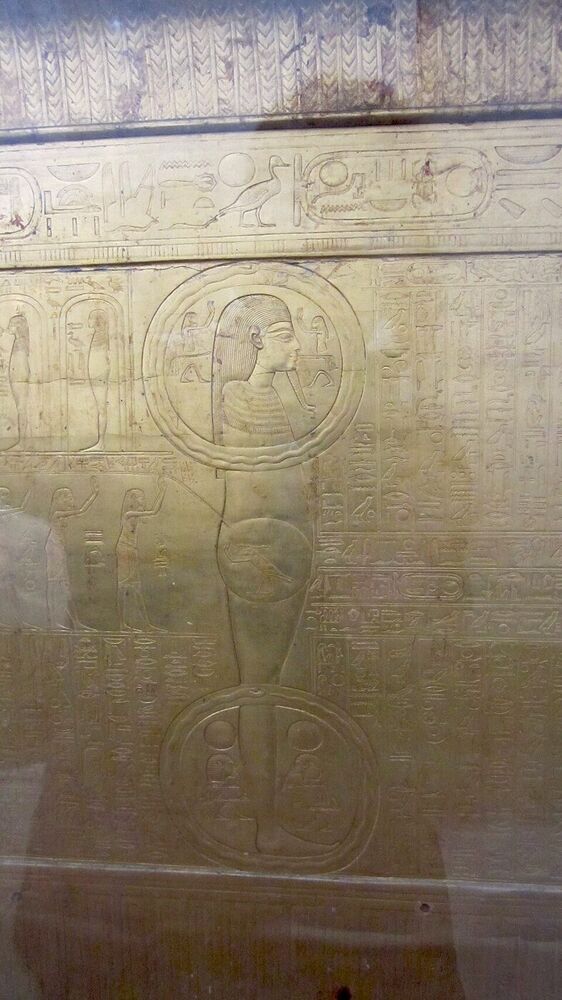
About a century after that, on the second gilded shrine of Tutankhamun, two serpents ring a giant figure, one round its head and one round its feet, and the upper one is labelled Mehen.John Darnell reads the cryptic caption as Adoration of the circling one—the circling one is Re/the sun disk.The tails do literally touch the mouths of the serpents, the Darnells write.On the drawings and photographs we could look at, no tail goes into a mouth.The shrine is often called the first known ouroboros, but the Amduat in Thutmose III’s tomb is older, and its caption already says his tail in his mouth.
The giant figure on Tutankhamun’s second shrine, its head and feet each ringed by a serpent. Photograph by A. Parrot, 2015, through the display glass; Wikimedia Commons, CC0.where it comes from
The ring could also be a punishment. A papyrus copied in the twelfth year of Alexander, the son of Alexander carries a book of spells against the serpent Apep, and its curse says thy tail shall be placed in thy mouth, and thou shalt chew thine own skin.Its instructions, in Wallis Budge’s translation of 1890: Make a figure of a serpent having his tail in his mouth, and a knife stuck in his back, and cast it upon the ground.
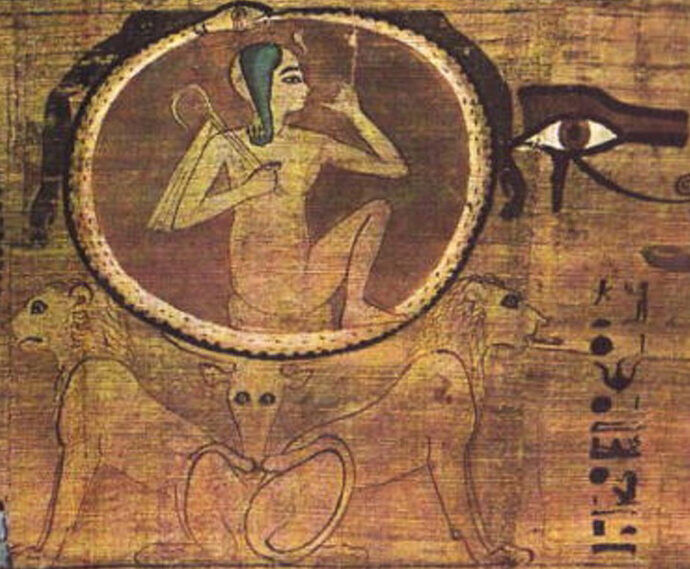
On a papyrus made for a woman called Her-Uben, the sun’s disk is ringed by a serpent biting its tail, and the caption of the scene, in Alexandre Piankoff and Natacha Rambova’s translation, ends The new year of Re in the barge of Re in the sky.The same editors, describing the picture in 1957, called the serpent the symbol of eternity.The caption speaks of a new year. The word eternity is theirs.
Dana Reemes, who wrote a dissertation on the Egyptian ouroboros, concluded that the icon was never a discrete symbol in Egypt, but rather a possible variant amongst related iconography that might convey similar meanings.
Carved for Teti, first king of the Sixth Dynasty, who died about 2333 BC and was buried at Saqqara
Pyramid Text 393, pyramid of Teti
Your tail is in your mouth, shunned snake, your surrounding has been surrounded, great bull.
Allen, The Ancient Egyptian Pyramid Texts (2005), p. 91
Your sycamore be your grain, your grain be your sycamore! Your tail be on your¹ mouth, O šnṯ-snake! Turn, turn yourself about, O Great Bull! [. . .] the Great One, whom he has cursed, escapes.
Faulkner, The Ancient Egyptian Pyramid Texts (1969), p. 129
a curse that binds an enemy
Painted in the tomb of Thutmose III, fifth king of the Eighteenth Dynasty, who died in 1425 BC
The Amduat, Sixth Hour, tomb of Thutmose III
He of Many Faces as protector. He exists in this fashion—his tail in his mouth.
Darnell and Darnell 2018, p. 192
a guard round a god, name or wearer
Made for Tutankhamun, who ruled about 1332 to 1323 BC
Second gilded shrine of Tutankhamun, Cairo JE 60666
Adoration of the circling one—the circling one is Re/the sun disk.
Darnell 2004, OBO 198, p. 78
Two uroboroi, the upper one labeled "Mehen," encircle the head and feet of this giant figure.
Darnell 2004, OBO 198, p. 374
the sun, or its course
Its owner’s mummy linen is dated Year 8 of King Siamun, sixth king of the Twenty-first Dynasty
Papyrus of Her-Uben, Cairo
“Commons file 'Horus-Harpocrates in the Sun.jpg': the child in the sun disk ringed by a serpent, on the lions of the horizon; identified by us as scene 3 of the papyrus of Her-Uben A (Piankoff and Rambova 1957, pap. no 1; Niwinski's Cairo 91)”where it comes from
The new year of Re in the barge of Re in the sky.
A. Piankoff and N. Rambova, Mythological Papyri (1957), p. 73
a new year of the suneternity, given by A. Piankoff and N. Rambova, 1957: the symbol of eternity
Copied in the twelfth year of Alexander, the son of Alexander
The book against Apep, Bremner-Rhind papyrus
he shall triumph over thee, thy tail shall be placed in thy mouth, and thou shalt chew thine own skin
R. O. Faulkner, 'The Bremner-Rhind Papyrus—IV', Journal of Egyptian Archaeology 24 (1938), pp. 41-53, at p. 44 (col. 30, 16-17)
Make a figure of a serpent having his tail in his mouth, and a knife stuck in his back, and cast it upon the ground, saying, "Apepi, Fiend, Betet."
Budge 1890, Archaeologia 52, p. 455
a curse that binds an enemy
A word for a drawing
The Greek word is an adjective, οὐροβόρος, devouring its tail, said of a δράκων, a serpent.The great Greek lexicon cites it from two magical papyri and an alchemist, and misses a third papyrus, in Berlin.In 1866 Gustav Parthey, editing two magical papyri of the Berlin museum, noted that οὐροβόρος fehlt den Lexicis: the word was missing from the dictionaries.
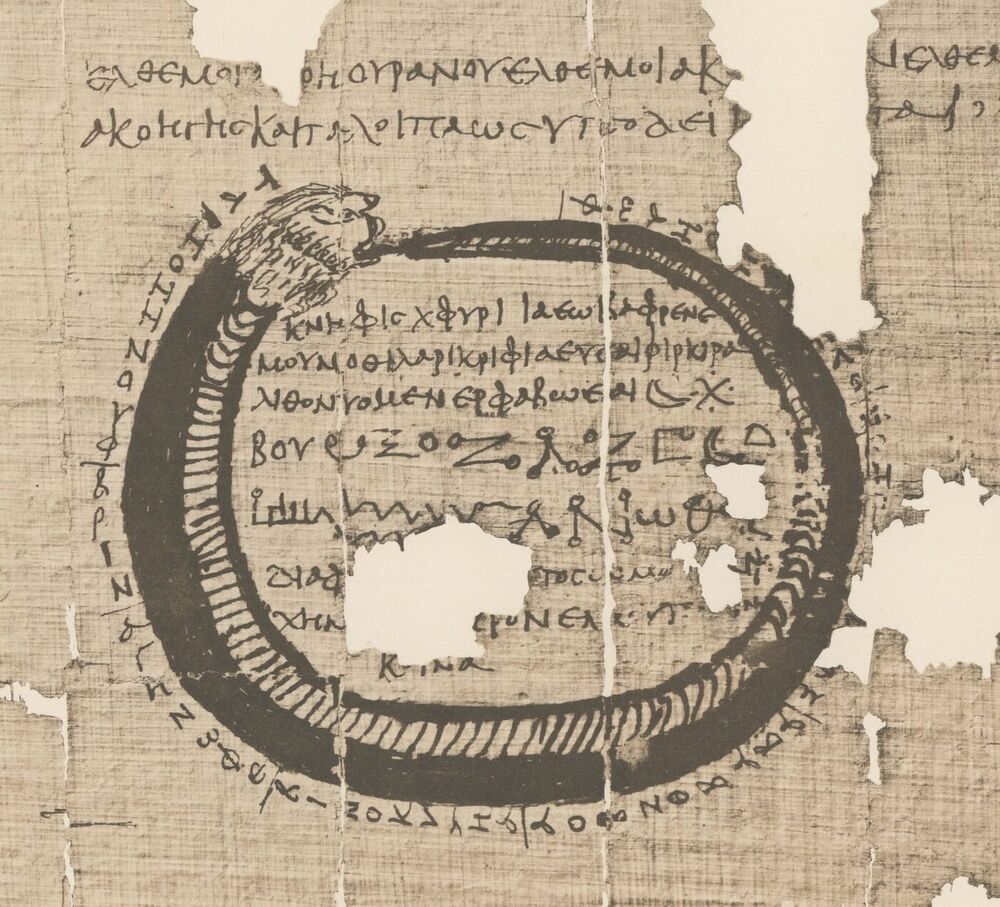
In a London papyrus the word is an instruction. A recipe for a φυλακτηριον σωματοφυλαξ προς δαιμονας, a bodyguard against daimons, ends by telling the reader to draw the serpent ουροβορος with names in its middle, and the series of charms it closes, as its editor F. G. Kenyon wrote, concludes with a diagram of a serpent with his tail in his own mouth, enclosing magical signs and words.
The drawing that ends the phylactery in London magical papyrus 121, from Kenyon’s facsimile plate of 1893 (public domain).where it comes from
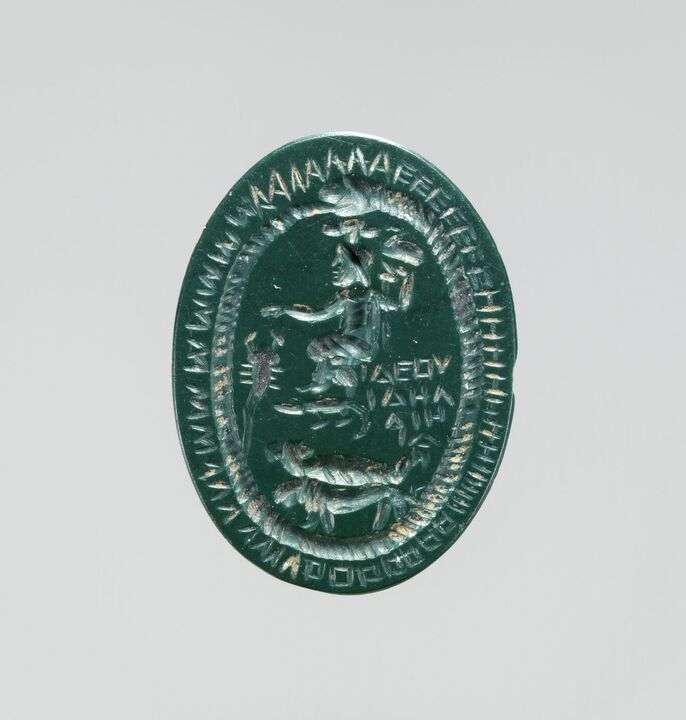
A papyrus in Leiden makes the ring a sign for a sound: in place of the hiss, draw δράκοντα δάκνοντα τὴν οὐράν, a serpent biting its tail.Another Leiden recipe, for a finger-ring cut in heliotrope, wants a serpent engraved on it στεφάνου σχήματι, in the shape of a wreath, with its tail in its mouth.None of the magical papyri we read says the ring means time, or eternity.In 1891 Albrecht Dieterich said the many gems with tail-biting serpents were meant to show den Sonnenlauf, the course of the sun; in 1887 C. W. King called the coiled serpent round the names Iao and Abraxas an emblem of Eternity.
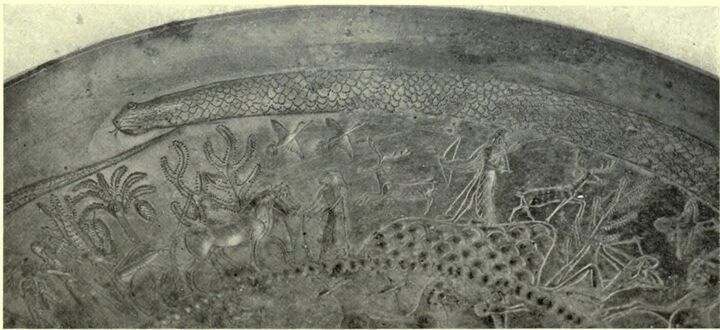
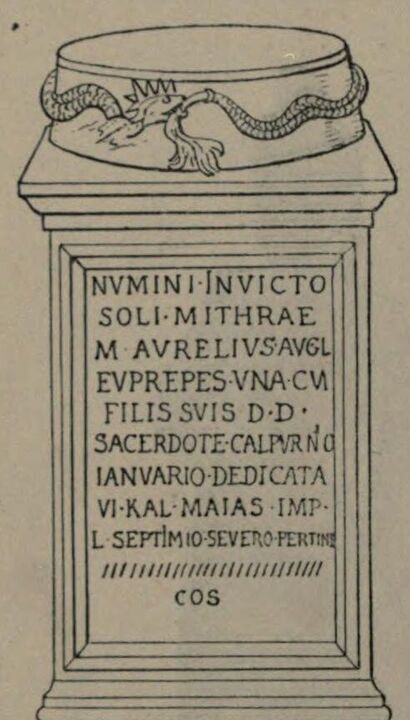
Outside Egypt, a gilt silver bowl buried at Palestrina in the first half of the seventh century BC has a serpent coiled round its frieze, with head and tail slightly overlapping; Helbig compared it, Charles Clermont-Ganneau reports, to the Egyptian and Phoenician serpent that bites its tail, symbole bien connu de l’univers.In Rome a pedestal dedicated to Mithras, dated by its inscription to AD 194, is ringed by a bearded serpent se mordant la queue, biting its tail.Franz Cumont, in 1902, called that serpent the image bien connue de l’éternité, the well-known image of eternity.
Buried in the first half of the seventh century BC
Gilt silver bowl from the Bernardini tomb, Palestrina
“C. Densmore Curtis, 'The Bernardini Tomb', Memoirs of the American Academy in Rome 3 (1919), Plate 21, fig. 2: '2, Detail from inside of No. 25. (See p. 39).'”where it comes from
Between the outer frieze and the rim is coiled a serpent, with head and tail slightly overlapping.
C. Densmore Curtis, "The Bernardini Tomb", Memoirs of the American Academy in Rome 3 (1919), pp. 9-90, p. 39
the world, or what lies round it, given by Helbig, as Clermont-Ganneau reports: symbole bien connu de l’univers
Dated by the museum to the second century CE
Green jasper gem, Metropolitan Museum 10.130.1390
“Jasper intaglio: Seated Serapis on crocodile (the Met's title); obverse, figure inside a serpent ring”where it comes from
"title": "Jasper intaglio: Seated Serapis on crocodile"
The Metropolitan Museum of Art Collection API, object 248222
the sun, or its course, given by A. Dieterich, 1891, of the many gems with tail-biting serpents: den Sonnenlauf darstellen sollteneternity, given by C. W. King, 1887, of the coiled serpent round Iao and Abraxas: emblem of Eternity
Kenyon dated the hand to the third century; the British Library catalogue gives the fourth
London magical papyrus 121, a phylactery
ουροβορος τα δε □□ μεσον του δρακοντος και οι χαρακτηρεςtail-devouring, and the [names] in the middle of the serpent, and the characters
F. G. Kenyon (ed.), Greek Papyri in the British Museum: Catalogue, with Texts, vol. 1, London 1893, Papyrus CXXI, p. 102 (text, l. 586) and p. 103 (l. 587) · translated by this investigation
φυλακτηριον σωματοφυλαξ προς δαιμονας προς φαντασματαPhylactery, a bodyguard against daimons, against phantoms
F. G. Kenyon (ed.), Greek Papyri in the British Museum: Catalogue, with Texts, vol. 1, London 1893, Papyrus CXXI, p. 102, l. 579 · translated by this investigation
a guard round a god, name or wearer
Its Greek hand dated to about AD 300 to 350
Leiden magical papyrus J 384, a finger-ring of heliotrope
δράκων ἑστὼς ⁽¹⁸⁾ ενκύμων ⁽¹⁹⁾ στεφάνου σχήματι οὐρὰν ἐν τῷ στόματι ἔχων, ἔστω δὲ ἐντὸς τοῦ δράκοντος κάνθαρος ἀκτεινωτὸς ⁽²⁰⁾ ἱερόςlet there be a serpent, pregnant (?), in the form of a wreath, having its tail in its mouth, and let there be inside the serpent a sacred scarab with rays
Leemans 1885, p. 29 · translated by this investigation
no meaning given
One of the Greek magical papyri, whose materials date from the 100s BC to the 400s AD; its editor judged this copy not much later than its model
Leiden magical papyrus W, a sign for the hiss
Ἀντὶ δὲ τοῦ συριγμοῦ δράκοντα δάκνοντα τὴν ⁽⁷⁾ οὐράν, ὥστε εἶναι τὰ δύο ποππυσμόν, καὶ συριγμόν, ἱερακοπρόσωπον κορκόδειλον καὶ ἐννεάμορφον ἐπάνω ἑστῶτα, καὶ κύκλῳ τούτων δράκοντα καὶ τὰς ἑπτὰ φωνάς.And in place of the hiss [draw] a serpent biting its tail, so that the two [sounds] are, popping and hiss: a hawk-faced crocodile and the nine-formed [god] standing on top, and in a circle around these a serpent and the seven vowels.
Leemans 1885, p. 85 (Pap. W, Pagina 2) · translated by this investigation
a sign for a hiss
Dated by its inscription to AD 194
Pedestal dedicated to Mithras, Rome, CIL VI 724
“F. Cumont, Textes et monuments figurés relatifs aux mystères de Mithra II (1896), p. 208, fig. 36”where it comes from
entouré d'un serpent à longue barbe, se mordant la queue, sculpté en relief. Six rayons se dressent sur sa tête, et sa queue est ornée d'un petit croissant.encircled by a long-bearded serpent biting its tail, carved in relief. Six rays rise on its head, and its tail is adorned with a small crescent.
F. Cumont, Textes et monuments figurés relatifs aux mystères de Mithra II (1896), p. 208, mon. 25 · translated by this investigation
eternity, given by F. Cumont, 1902: image bien connue de l’éternité
The year, the world, time
From about AD 400, writers start to explain the ring.
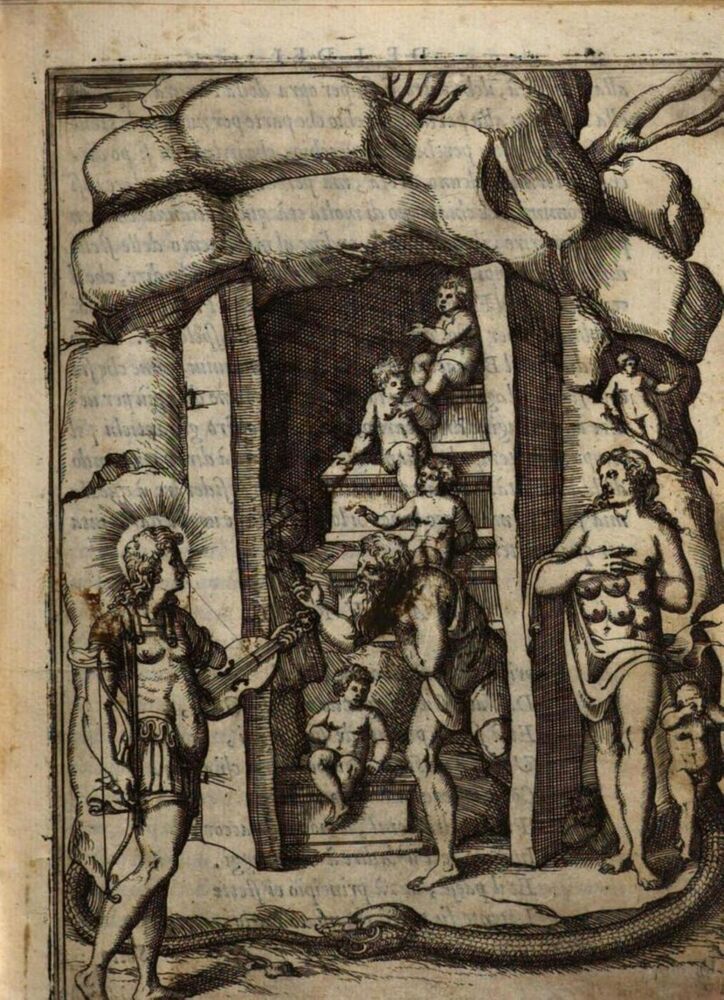
Servius, a grammarian writing around AD 400, says that among the Egyptians, before letters were invented, the year was shown by picto dracone caudam suam mordente, quia in se recurrit: a painted serpent biting its tail, because the year runs back into itself.Martianus Capella gives Saturn a fire-breathing serpent devouring the end of its tail, quem credebant anni numerum nomine perdocere: which, they believed, taught the number of the year by its name.The poet Claudian puts a serpent round inmensi spelunca aevi, the cave of boundless aevum, the age without measure, and has it consume all things with quiet power: caudamque reductam ore vorat tacito relegens exordia lapsu, it devours its bent-back tail and, gliding silently, retraces its beginning.
Macrobius says the Phoenicians made the serpent in orbem redactum caudamque suam devorantem, bent into a circle and devouring its tail, so that the world might be seen to feed on itself and roll back into itself.Horapollo’s book of hieroglyphs says that to write the universe the Egyptians paint ὄφιν ... τὴν ἑαυτοῦ ἐσθίοντα οὐρὰν, a serpent eating its own tail.The same book’s serpent for eternity is another animal: its tail is ὑπὸ τὸ λοιπὸν σῶμα κρυπτομένην, hidden under the rest of its body.A third serpent, with its tail in its mouth and the king’s name written in its coil, stands for a king.In the sixth century John Lydus called the circle ἴδιον τοῦ χρόνου εἰς ἑαυτὸν ἀναστρέφοντος, the very property of time, which turns back into itself, and wrote that this is why the Egyptians carve δράκοντα οὐρηβόρον on their pyramids: they posit an abyss with a serpent in it, from which the perceptible gods and the perceptible universe came.
Every one of these writers who says what the tail-biter means gives it the year, the world, time, or a king. None says it means eternity, though Claudian sets it round the cave of aevum, a word later readers would translate as eternity: his translator Maurice Platnauer, in 1922, glossed the serpent Eternity, in the sense of endless time.
Venice, 1571: Claudian’s cave as Vincenzo Cartari’s Imagini pictured it, with one long serpent along the foreground taking the end of its tail in its jaws. Cartari’s text says the serpent round the cave shows “l’effetto del tempo”, the effect of time.where it comes from
Servius, a grammarian of the late fourth and early fifth centuries
Servius on the Aeneid, 5.85
annus enim secundum Aegyptios indicabatur ante inventas litteras picto dracone caudam suam mordente, quia in se recurrit.for, according to the Egyptians, before letters were invented, the year was indicated by a painted serpent biting its own tail, because it runs back into itself.
Servius on Aeneid 5.85, ed. G. Thilo, Servii ... commentarii, vol. I (Leipzig, 1881), p. 603, archive.org invergiliicarmin01servuoft leaf n706 (page image) · translated by this investigation
the year
Claudian, about 370 to 404 AD
Claudian, On the Consulship of Stilicho, 2.426-430
inmensi spelunca aevi, quae tempora vastothe cave of boundless aevum, which with its vast lap
Claudian, De consulatu Stilichonis 2.426, ed. M. Platnauer (1922) · translated by this investigation
[427] suppeditat revocatque sinu. complectitur antrum, [428] omnia qui placido consumit numine, serpens [429] perpetuumque viret squamis caudamque reductam [430] ore vorat tacito relegens exordia lapsu.A serpent surrounds this cave, engulfing everything with slow but all-devouring jaws; never ceases the glint of his green scales. His mouth devours the back-bending tail as with silent movement he traces his own beginning.
Claudian, De consulatu Stilichonis 2.424-430, ed. and tr. M. Platnauer, Claudian II (Loeb, 1922), pp. 32-33, archive.org claudianwithengl02clauuoft leaves n41-n42 (page images); LacusCurtius transcription · translated by Maurice Platnauer (1922)
time, turning and devouringeternity, given by M. Platnauer, 1922, in a note to his translation: Eternity, in the sense of endless time
Martianus Capella, active about 410 to 420
Martianus Capella, 1.70: Saturn’s serpent
praetendebat dextera flammiuomum quendam draconem caudae suae ultima deuorantem, quem credebant anni numerum nomine perdocere.In his right hand he held out a certain fire-breathing serpent devouring the end of its own tail, which, they believed, taught the number of the year by its name.
Martianus Capella 1.70, ed. F. Eyssenhardt (Leipzig, 1866), p. 21, archive.org bub_gb__7RpaHQgl3sC leaf n92 (page image) · translated by this investigation
the year
Macrobius, active about AD 400
Macrobius, Saturnalia 1.9.12
Hinc et Phoenices in sacris imaginem eius exprimentes draconem finxerunt in orbem redactum caudamque suam devorantem, ut appareat mundum et ex se ipso ali et in se revolvi.Hence also the Phoenicians, representing his image in their sacred rites, fashioned a serpent bent into a circle and devouring its own tail, so that it may be seen that the world is both nourished from itself and rolls back into itself.
Macrobius, Saturnalia 1.9.12, ed. L. von Jan, vol. II (1852), p. 70, archive.org bub_gb_IjNCAAAAIAAJ leaf n91 (page image); LacusCurtius transcription of the same edition · translated by this investigation
the world, or what lies round it
Horapollo, active about the fifth century AD
Horapollo, Hieroglyphica 1.2
Κόσμον βουλόμενοι γράψαι, ὄφιν ζωγραφοῦσι τὴν ἑαυτοῦ ἐσθίοντα οὐρὰν, ἐστιγμένον φολίσι ποικίλαις.When they would represent the universe, they delineate a serpent bespeckled with variegated scales, devouring its own tail.
Horapollo, Hieroglyphica 1.2, ed. and tr. A. T. Cory (London: Pickering, 1840), pp. 7-8, archive.org hieroglyphicsofh00hora leaves n24-n25 · translated by A. T. Cory (1840)
the world, or what lies round iteternity, given by Erasmus, in the Adages, crediting Horus: non annum, sed aevum
The same book: Horapollo, active about the fifth century AD
Horapollo, Hieroglyphica 1.59
ὄφιν ζωγραφοῦσι κοσμοειδῶς ἐσχηματισμένον, οὗ τὴν οὐρὰν ἐν τῷ στόματι ποιοῦσι· τὸ δὲ ὄνομα τοῦ βασιλέως ἐν μέσῳ τῷ εἰλίγματι γράφουσινthey depict a serpent in the form of a circle, whose tail they place in his mouth, and they write the name of the king in the middle of the coil
Horapollo, Hieroglyphica 1.59, ed. and tr. A. T. Cory (1840), p. 80, archive.org hieroglyphicsofh00hora leaf n97 · translated by A. T. Cory (1840)
a king’s rule
John Lydus, AD 491 to about 565
John Lydus, On the Months, 3.4
ὃ δὴ ἴδιον τοῦ χρόνου εἰς ἑαυτὸν ἀναστρέφοντος καὶ μηδαμοῦ περατουμένουwhich is the very property of time, turning back into itself and nowhere bounded
John Lydus, De mensibus 3.4, ed. R. Wuensch (Leipzig, 1898), p. 39 · translated by this investigation
δράκοντα οὐρηβόρον ταῖς πυραμίσιν ἐγγλύφουσιν. ἄβυσσον γὰρ ὑποτίθενται καὶ δράκοντα ἐν αὐτῇ, ἐξ οὗ τοὺς αἰσθητοὺς θεοὺς καὶ αὐτὸ δὲ τὸ πᾶν αἰσθητὸν γενέσθαι βούλονται.[the Egyptians, according to a sacred account,] carve a tail-eating serpent on the pyramids. For they posit an abyss and a serpent in it, from which they hold that the perceptible gods and the perceptible universe itself came into being.
John Lydus, De mensibus 3.4, ed. R. Wuensch (Leipzig: Teubner, 1898), p. 39, archive.org ioannislaurenti00wuengoog leaf n143 (page image) · translated by this investigation
time, turning and devouringthe world, or what lies round it
One is the all
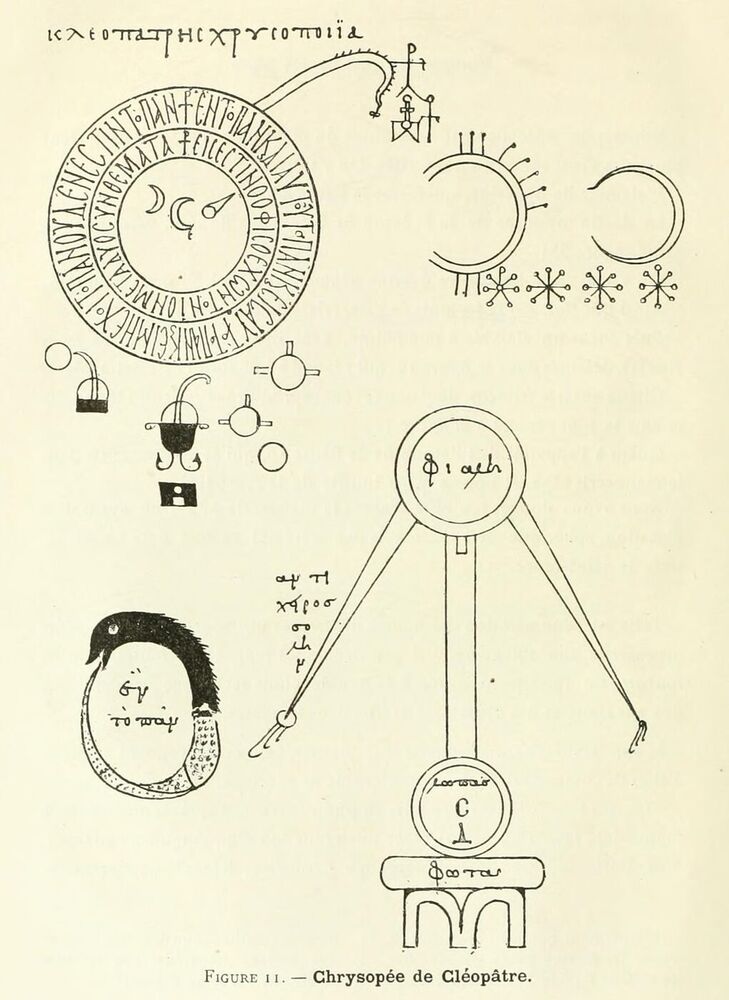
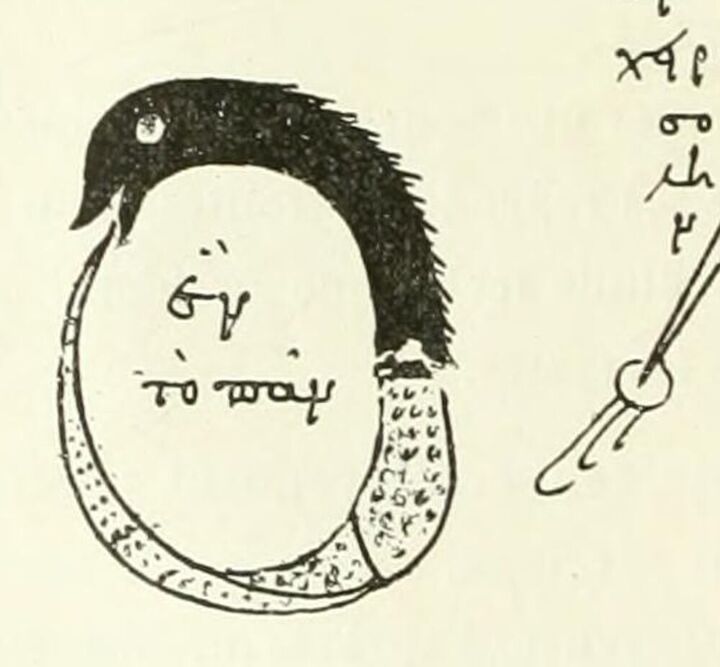
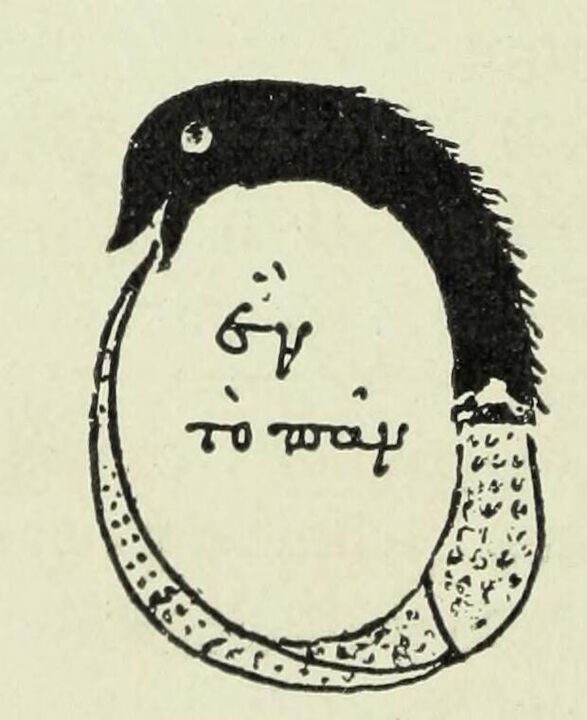
In a Venice manuscript of probably the tenth century, a page of alchemical drawings has the serpent round the words Ἓν τὸ πᾶν, which Marcellin Berthelot translated le tout est un: the all is one.The alchemist Olympiodorus says certain Egyptian sacred scribes, wishing to engrave the cosmos on obelisks, carve the tail-eating serpent, its body spotted like the stars, and that Agathodaimon, putting τὴν ἀρχὴν ἐν τῷ τέλει, the beginning in the end, meant a tail-eating serpent.
The page headed Cleopatra’s gold-making (Κλεοπάτρης Χρυσοποιία) in Marcianus gr. 299, fol. 188 verso, a manuscript probably of the tenth century, as Berthelot reproduced it in 1887. The serpent ring at the lower left holds the words ἓν τὸ πᾶν, one is the all. Berthelot read the three circles at the top as the serpent too, because the outer one runs out into a tail.where it comes from
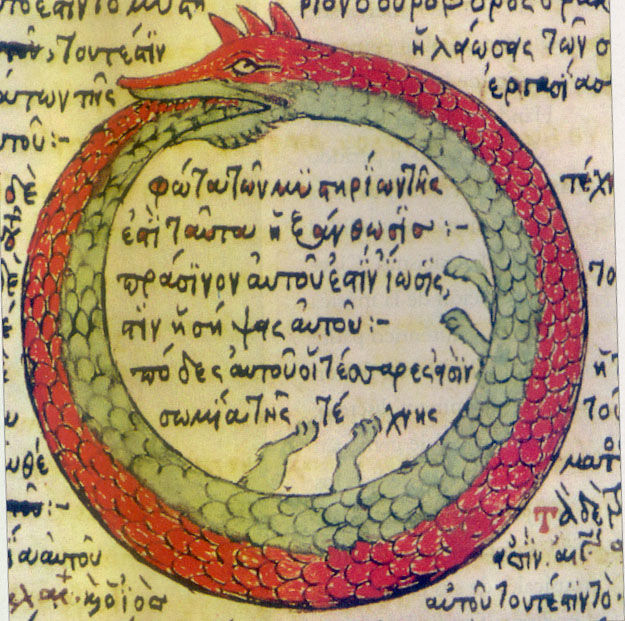
An untitled text, in a manuscript copied in Crete in 1478, explains the figure as the work itself: ὁ οὐροβόρος δράκων is the composition, devoured and melted together, dissolved and transformed in rotting.Its four feet are the four bodies, its three ears three sublimates.The work is done οὐχ ἑτέρᾳ καὶ ἑτέρᾳ, ἀλλ’ αὐτῇ μιᾷ: not with one thing and another, but with itself alone.
Paris, BnF grec 2327, a manuscript of 1478, fol. 279: the second drawing of the serpent in that book, a four-legged, eared dragon whose body runs round the page and comes back, tapering, between its open jaws. The Greek text is written inside the ring.where it comes from
In a manuscript of probably the tenth century
Venice, Marcianus graecus 299, folio 188 verso
“Detail of FIGURE 11. — Chrysopée de Cléopâtre: the small ring-serpent with ἓν τὸ πᾶν (lower left of the page)”where it comes from
7° Vers le bas à gauche, est figuré le serpent Ouroboros, avec l'axiome central : Ἓν τὸ πᾶν; le tout est un.Towards the bottom on the left the serpent Ouroboros is drawn, with the central axiom: One the all; the all is one.
M. Berthelot and Ch.-Em. Ruelle, Collection des anciens alchimistes grecs, Paris: Steinheil, 1887-1888, vol. 1, Introduction p. 134 (page image n167) · translated by this investigation
one is the all
His text’s oldest manuscript is Marcianus graecus 299, probably of the tenth century
Olympiodorus the alchemist, in Berthelot and Ruelle’s edition
Ἱερογραμματεῖς γάρ τινες τῶν Αἰγυπτίων βουλόμενοι κόσμον ἐγχαράξαι ἐν τοῖς ὀβελίσκοις ἢ ἐν τοῖς ἱερατικοῖς γράμμασιν, δράκοντα ἐγκολάπτουσιν οὐροβόρον· τὸ δὲ σῶμα αὐτοῦ κατάστικτον ὑπάρχει πρὸς τὴν διάθεσιν τῶν ἀστέρων.For certain of the Egyptian sacred scribes, wishing to engrave the cosmos on the obelisks or in the hieratic letters, carve a tail-eating dragon; and its body is spotted after the arrangement of the stars.
M. Berthelot and Ch.-Em. Ruelle, Collection des anciens alchimistes grecs, Paris: Steinheil, 1887-1888, vol. 1, Texte grec p. 80 lines 9-12 (page image n381) · translated by this investigation
τὴν ἀρχὴν ἐν τῷ τέλει θεὶς, καὶ τὸ τέλος ἐν τῇ ἀρχῇ. Δράκων γὰρ οὐροβόρος βούλεται εἶναι, οὐ φθονῶν ὡς δοκοῦσί τινες ἀμύητοι· ἀλλὰ φανερὸν τοῦτό ἐστιν, ὦ μύστα, πληθυντικῇ τῇ φωνῇ, ὠά.(as Agathodaimon too) putting the beginning in the end and the end in the beginning. For he means it to be a tail-eating dragon, not out of grudging, as some uninitiated people think; but this is plain, O initiate, from the plural word: eggs.
M. Berthelot and Ch.-Em. Ruelle, Collection des anciens alchimistes grecs, Paris: Steinheil, 1887-1888, vol. 1, Texte grec p. 80 lines 1-3 (page image n381) · translated by this investigation
the world, or what lies round itan end that is a beginning
Copied at Candia, in Crete, in 1478
The tail-eating dragon, an untitled text, Paris grec 2327
Τοῦτο γάρ ἐστιν τὸ μυστήριον ὁ οὐροβόρος δράκων, τουτέστι συμφαγώνεται καὶ συγχωνεύεται, λειώνεται καὶ μεταλλάττεται τὸ σύνθεμα ἐν τῇ σήψειFor this is the mystery: the tail-eating dragon; that is, the composition is devoured together and melted together, ground down and changed in the putrefaction
M. Berthelot and Ch.-Em. Ruelle, Collection des anciens alchimistes grecs, Paris: Steinheil, 1887-1888, vol. 1, Texte grec p. 21 line 20 to p. 22 line 18 (page images n322, n323) · translated by this investigation
οἱ τέσσαρες αὐτοῦ πόδες ἐστὶν ἡ τετρασωμία· τὰ δὲ τρία ὦτα αὐτοῦ εἰσιν αἱ τρεῖς αἰθάλαι.its four feet are the four-bodies (tetrasomia); its three ears are the three sublimates
M. Berthelot and Ch.-Em. Ruelle, Collection des anciens alchimistes grecs, Paris: Steinheil, 1887-1888, vol. 1, Texte grec p. 22 lines 1-3 (page image n323) · translated by this investigation
one matter, dissolved and remade
A door that shuts
In Pistis Sophia, a book possibly written in the third or fourth century, the outer darkness is a dragon: souls condemned to it are led into the jaws of his tail, and he turneth his tail into his own mouth and shutteth them in.Release is the same act reversed: he will draw his tail out of his mouth and let go that soul.The same book makes the disk of the sun a great dragon whose tail was in his mouth.
In the Greek Acts of Thomas a serpent says it is kin to the one outside the ocean, οὗ ἡ οὐρὰ ἔγκειται τῷ ἰδίῳ στόματι, whose tail lies in his own mouth; the Syriac version has instead whose mouth is closed.The Talmud tells of a cave closed by a snake, an akhna, that would not open its mouth; Rashi, in the eleventh century, explains that a great snake made itself like a wheel round the mouth of the cave and put its tail into its mouth, and no one could go in.
Possibly written between the third and fourth centuries AD
Pistis Sophia: the dragon of the outer darkness
have been led into the outer darkness into the jaws of his tail, he turneth his tail into his own mouth and shutteth them in.
G. R. S. Mead, Pistis Sophia: A Gnostic Miscellany (London: J. M. Watkins, 1921), p. 268, ch. 127
if it indeed is in the dragon of the outer darkness, he will draw his tail out of his mouth and let go that soul.
G. R. S. Mead, Pistis Sophia: A Gnostic Miscellany (London: J. M. Watkins, 1921), p. 271, ch. 130
a door that shuts
The same book, possibly written between the third and fourth centuries AD
Pistis Sophia: the disk of the sun
And the disk of the sun was a great dragon whose tail was in his mouth and who reached to seven powers of the Left and whom four powers in the form of white horses drew.
G. R. S. Mead, Pistis Sophia: A Gnostic Miscellany (London: J. M. Watkins, 1921), p. 296, ch. 136
the sun, or its course
An early third-century text; this is its Greek wording
Acts of Thomas 32, in Greek
συγγενὴς δέ εἰμι ἐκείνου τοῦ ἔξωθεν τοῦ ὠκεανοῦ ὄντος, οὗ ἡ οὐρὰ ἔγκειται τῷ ἰδίῳ στόματι·and I am kin to him who is outside the ocean, whose tail lies in his own mouth
Max Bonnet (ed.), Acta Thomae, in Lipsius and Bonnet, Acta Apostolorum Apocrypha II.2 (Leipzig, 1903), p. 149, lines 1 to 3 · translated by this investigation
the world, or what lies round it
Rashi, 1040 to 1105
Rashi on the Talmud, Bava Kamma 117b
הדרא ליה עכנא - נחש גדול עשה עצמו כגלגל ומקיף את פי המערה ונותן זנבו לתוך פיו ואין אדם יכול ליכנס:An akhna encircled it: a great snake made itself like a wheel and surrounded the mouth of the cave and put its tail into its mouth, and no one could go in.
Rashi on Bava Kamma 117b, s.v. הדרא ליה עכנא (Vilna edition, Sefaria) · translated by this investigation
a door that shuts
Round all lands
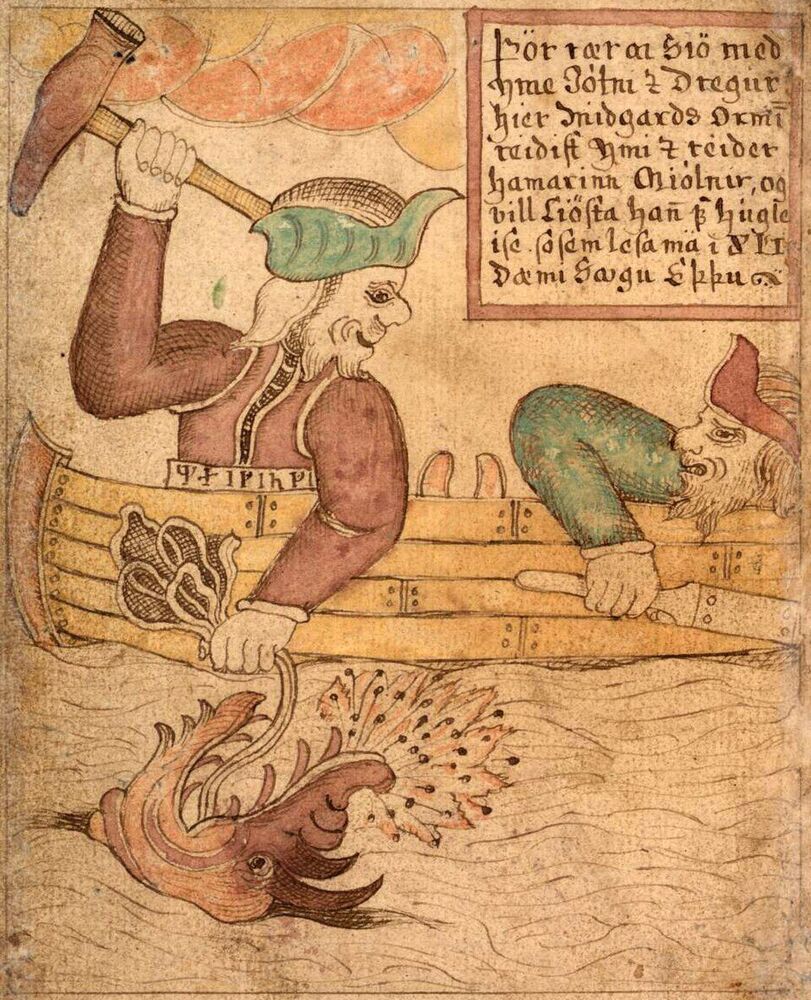
In the Edda of Snorri Sturluson, who lived from 1179 to 1241, a serpent thrown into the deep sea grows until it lies in the midst of the ocean encompassing all the land, and bites upon its own tail.A skaldic poem in Finnur Jónsson’s edition calls the serpent Umbgjǫrð allra landa, the girdle of all lands.In the older poetry we read, its tail is never in its mouth. Snorri is the only source we found that puts it there.
Thor and the giant Hymir fishing, with Jörmungandr, the serpent round all lands, on the hook: an Icelandic manuscript drawing that Wikimedia Commons dates to 1765-1766 and gives to Jakob Sigurðsson (Reykjavík, SÁM 66, fol. 79v).where it comes from
Snorri Sturluson, 1179 to 1241
Snorri Sturluson, Edda, Gylfaginning 34
ok ox sa ormr sva, at hann liɢr imiðiv hafinv of ꜹll lond ok bitr isporð ser.and that serpent grew so that it lies in the middle of the ocean around all lands and bites its own tail
Finnur Jonsson (ed.), Edda Snorra Sturlusonar, Kobenhavn 1931, p. 34, lines 22-25 (leaf n100) · translated by this investigation
the world, or what lies round it
How it came to mean eternity
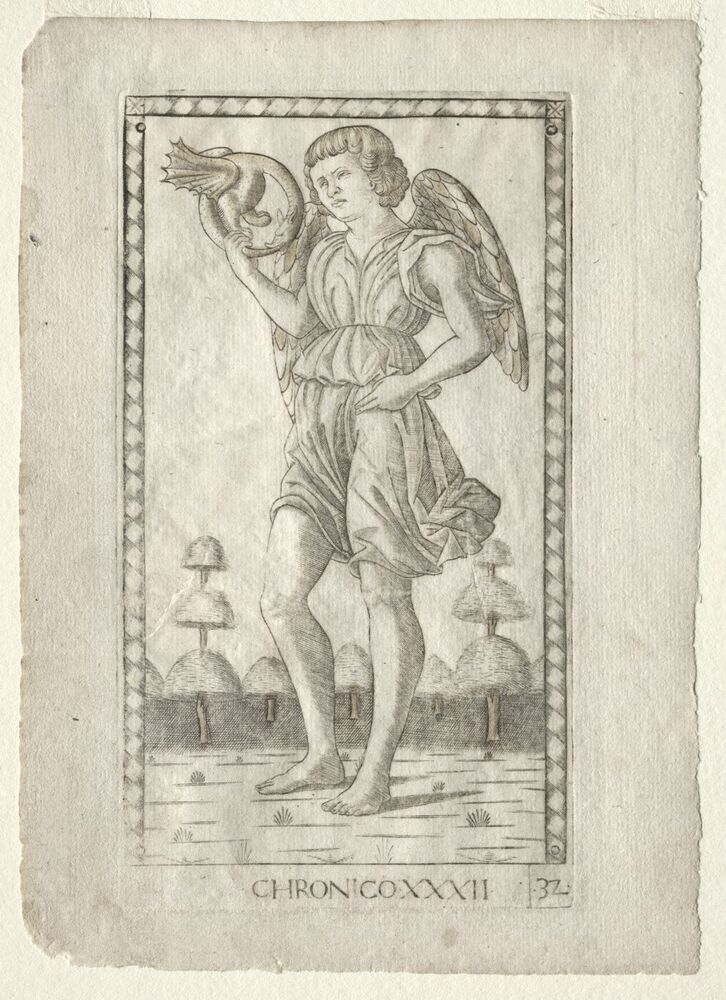
For a thousand years after Servius, the Latin West kept his meaning. Isidore of Seville, who died in 636, copied his sentence almost word for word.John Scottus, glossing Martianus, wrote DRACO Saturni solarem annum significat: Saturn’s dragon signifies the solar year, and the tail it devours is winter.Notker of St Gall, around the year 1000, put it into German: a fiery dragon dér daz iâr bezéichenet, which signifies the year.Boccaccio set Claudian’s serpent in his chapter on Eternity and still read it as time: it devours its tail ut ex hoc actu percipiamus temporis circularem lapsum, so that we may see the circular gliding of time.
CHRONICO, an engraving of the Ferrarese Tarocchi dated before 1467: a winged figure of Time holds up a dragon biting its tail. The Cleveland Museum of Art, CC0.where it comes from
When Aldus printed Horapollo’s Greek in Venice in 1505, the two serpents were still apart: the cosmos is the serpent eating its tail, and eternity (αἰών) the serpent with its tail hidden under its body.Erasmus, in his Adages, describes the serpent with its tail in its mouth as the year, and adds that Horus says a carved serpent represents non annum, sed aevum: not the year but the age, eternity.
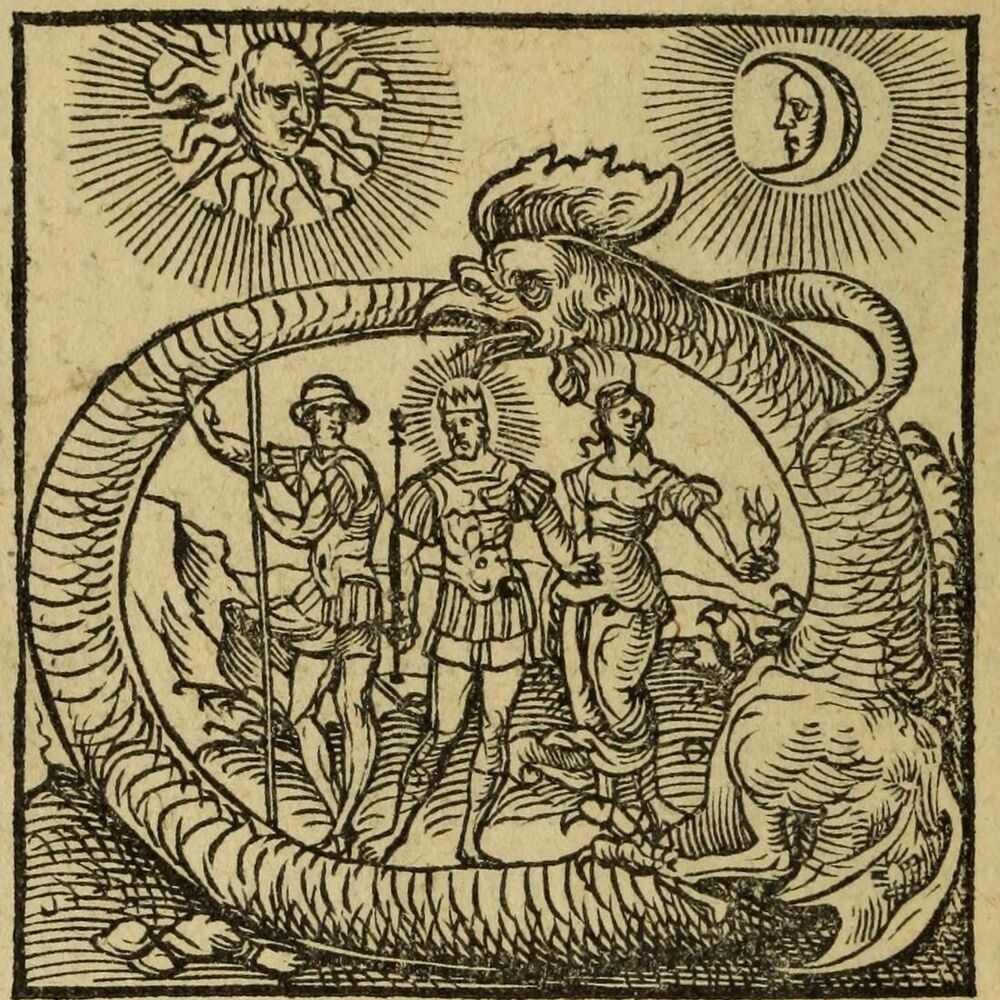
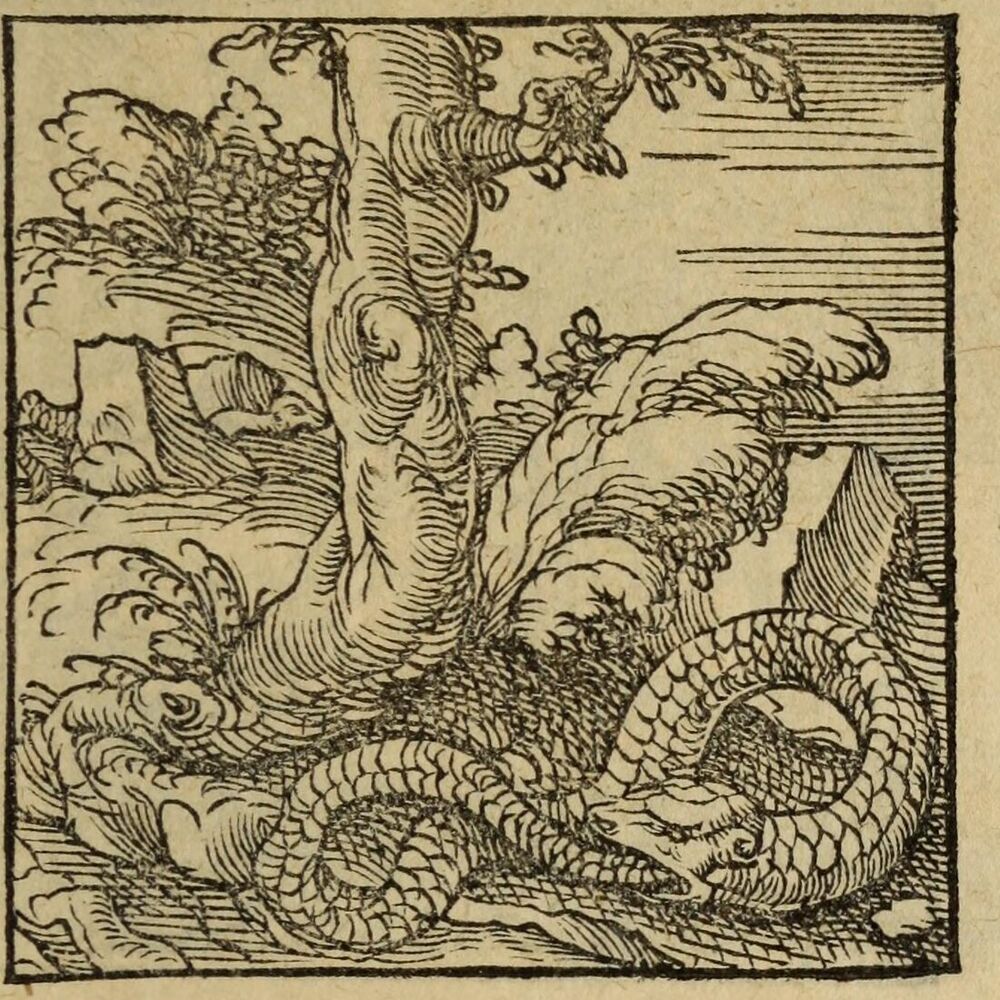
In 1543 a French Horapollo with woodcuts was printed in Paris for the bookseller Jacques Kerver. The chapter on the age and the years of time says the Egyptians painted a basilisk couurāt sa cueue du reste de sō cors, covering its tail with the rest of its body. The woodcut printed with that sentence shows a cock-headed basilisk biting its tail.
Paris, 1543: the woodcut printed with the chapter that says the basilisk covers its tail with its body. Boston Public Library copy, via the Internet Archive; public domain.where it comes fromThe next woodcut in the same book, for the chapter on how they signified the world: a scaly serpent in loose loops on the ground, its head appearing to hold the thin end of its tail. An unclear shape with an eye at the lower left may be a second head, or a rock or a root.where it comes from
In 1556 Pierio Valeriano wrote that most people confuse the figures, the ring with its tail hidden and the ring with its tail bitten; whatever is said of the world and the year, he held, belongs to the bite.Ten years later a Lyon edition of Alciato’s emblems, printed in 1566, added short glosses for the first time, and the gloss under an emblem of Triton inside a serpent ring reads Anguis in sese reuolutus, æternitatem: the snake turned back on itself, eternity.In 1577 Claude Mignault, in his commentary on the same emblem, wrote Serpens in se reuolutus, æternitatem designat, vt docet Orus Niliacus in ipso Hieroglyph. principio: the serpent turned back on itself designates eternity, as Horus of the Nile teaches at the very beginning of his Hieroglyphics.The beginning of Horapollo’s book is the chapter in which eternity’s serpent hides its tail.In 1593 Cesare Ripa’s Iconologia gave the ring to Eternity: Il Serpe in giro, dimostra, che l’eternità si pasce di se stessa, the serpent in a ring shows that eternity feeds on itself.The same book’s entry for the Year still calls the serpent biting its tail antichissima figura dell’Anno, a most ancient figure of the year.
The Lyon gloss of 1566 is the earliest place, in everything we read, where a source in its own words gives the tail-biting ring the meaning eternity.The steps before it are on paper: a scholar who credits Horus with the age, a printer’s picture that contradicts its text, and a scholar who calls the result a confusion.
Isidore of Seville, about 560 to 636
Isidore of Seville, Etymologies 5.36
Sic enim apud Aegyptios indicabatur ante inventas litteras picto dracone caudam suam mordente, quia in se recurrit.For so among the Egyptians, before letters were invented, it [the year] was indicated by a painted dragon biting its tail, because it runs back into itself.
Isidore, Etymologiae 5.36.2, ed. W. M. Lindsay (Oxford 1911), LacusCurtius transcription · translated by this investigation
the year
Notker Labeo, about 950 to 1022, who translated Martianus Capella
Notker’s German Martianus
trûog er án dero zéseuuun éinen fíurenten drácchen . dér daz iâr bezéichenet . sînen zágel slíndentenhe carried in his right hand a fiery dragon, which signifies the year, swallowing its tail
Notker, ed. P. Piper, Die Schriften Notkers und seiner Schule I (Freiburg i. B. and Tuebingen 1882), p. 746, lines 4-25 · translated by this investigation
the year
Giovanni Boccaccio, 1313 to 1375
Boccaccio, Genealogy of the Pagan Gods, 1.1
eumque dicit revoluto in caudam ore eam devorantem, ut ex hoc actu percipiamus temporis circularem lapsum. Nam semper anni unius finis principium est sequentis, et sic erit durante tempore.and he says it devours its tail with its mouth turned back, so that from this act we may perceive the circular gliding of time. For the end of one year is always the beginning of the next, and so it will be as long as time lasts.
Boccaccio, Genealogie 1.1, ed. V. Romano (Bari 1951), vol. 1, p. 16 · translated by this investigation
time, turning and devouring
Dated before 1467 by the museum
Tarocchi engraving CHRONICO, Cleveland Museum of Art
In his right hand, Chronico holds up a dragon biting its own tail, an emblem of for “all-devouring Time.”
Cleveland Museum of Art, record 1924.432.32 (fetched 2026-11-16)
time, turning and devouring, given by the Cleveland Museum of Art, in its record: all-devouring Time
Printed by Aldus in Venice in 1505
Horapollo in Greek, printed by Aldus, Venice 1505
[Κ]όσμον βουλόμενοι γράψαι, ὄφιν ζωγραφοῦσι τὴν ἑαυτοῦ ἐσθίοντα οὐρὰν, ἐστιγμένον φολίσι ποικίλαις.Wishing to write the cosmos, they paint a serpent eating its own tail, speckled with variegated scales.
Horapollo 1.2, Aldine 1505, p. 111 · translated by this investigation
αἰῶνα δ' ἑτέρως γράψαι βουλόμενοι, ὄφιν ζωγραφοῦσιν, ἔχοντα τὴν οὐρὰν, ὑπὸ τὸ λοιπὸν σῶμα κρυπτομένηνBut wishing to write eternity in another way, they paint a serpent having its tail hidden under the rest of its body
Horapollo 1.1, Aldine 1505, p. 111 · translated by this investigation
the world, or what lies round it
Read in the Venice printing of 1520
Erasmus, Adages, “Festina lente”, Venice printing of 1520
Effingebant serpentem ita circumvolutum, ut caudam ore teneret insertam, innuentes annum semper iisdem vicibus temporum reciprocantibus in sese recurrereThey fashioned a serpent coiled round so that it held its tail inserted in its mouth, meaning that the year always runs back into itself with the same alternations of the seasons
Erasmus, Adagiorum chiliades (Venice 1520), f. 119v · translated by this investigation
Etiam si Horus Aegyptius, cuius extant duo super huiusmodi symbolis libri, serpentis scalptura non annum, sed aevum repraesentari tradit, Annum aut[em] tum Isidis, tum Phoenicis imagine.Even if Horus the Egyptian, of whom two books on symbols of this kind survive, reports that the carving of a serpent represents not the year but aevum, and the year by the image of Isis or of the phoenix.
Erasmus, Adagiorum chiliades (Venice 1520), f. 119v · translated by this investigation
the year
Printed in Paris for Jacques Kerver in 1543
Horapollo in French, Paris: Kerver, 1543, book 1 chapter 1
Aultrement ilz paignoient vng serpēt appelle Basilisque couurāt sa cueue du reste de sō corsOtherwise they painted a serpent called basilisk, covering its tail with the rest of its body
Orus Apollo de Aegypte (Paris: Kerver, 1543), book 1 ch. 1 · translated by this investigation
time, turning and devouring
Printed in Basel in 1556
Pierio Valeriano, Hieroglyphica, Basel 1556, f. 105r
plerosq[ue] figurã eius in orbem circunducti, & caudã nunc occultantis, nunc admordentis, nunc depascẽtis, cõfunderemost people confuse its figure, drawn round in a ring, with the tail now hidden, now biting, now feeding on it
Valeriano, Hieroglyphica (Basel 1556), f. 105r · translated by this investigation
Quaecunq[ue] de mundi anniq[ue] varietate reciprocationeq[ue] dicta sunt, ea per caudi morsum intelligunt[ur].Whatever has been said of the variation and reciprocation of the world and of the year is understood by the bite of the tail.
Valeriano, Hieroglyphica (Basel 1556), f. 105r · translated by this investigation
the world, or what lies round itthe year
Printed in Lyon by Guillaume Rouillé in 1566
Alciato’s emblems, with glosses added at Lyon in 1566
Anguis in sese reuolutus, æternitatem: Concha personans, famã, quibus vnà conuenientibus, æterna scientiæ & eloquentiæ fama significatur.The snake turned back on itself, eternity; the sounding conch, fame; and all of them together signify the eternal fame of knowledge and eloquence.
Alciato, Omnia Emblemata (Lyon: Rouillé, 1566), p. 153, gloss · translated by this investigation
eternity
Printed by Plantin in Antwerp in 1577
Claude Mignault on Alciato’s emblem, Antwerp 1577
Serpens in se reuolutus, æternitatem designat, vt docet Orus Niliacus in ipso Hieroglyph. principio.The serpent turned back on itself designates eternity, as Horus of the Nile teaches at the very beginning of the Hieroglyphics.
Mignault, Omnia Andreae Alciati Emblemata cum commentariis (Antwerp: Plantin, 1577), p. 450 · translated by this investigation
eternity
Printed in Rome in 1593
Cesare Ripa, Iconologia, Rome 1593: Eternity
Il Serpe in giro, dimostra, che l'eternità si pasce di se stessa, nè si fomenta di cosa alcuna esteriore;The serpent in a ring shows that eternity feeds on itself and is nourished by nothing outside it;
Ripa, Iconologia (Rome 1593), p. 72 · translated by this investigation
eternity
Printed in Rome in 1593
Cesare Ripa, Iconologia, Rome 1593: the Year
Il Serpe posto in circolo, che morda la coda, è antichissima figura dell'Anno:The serpent set in a circle, biting its tail, is a most ancient figure of the year:
Ripa, Iconologia (Rome 1593), p. 15 · translated by this investigation
the year
Two in one
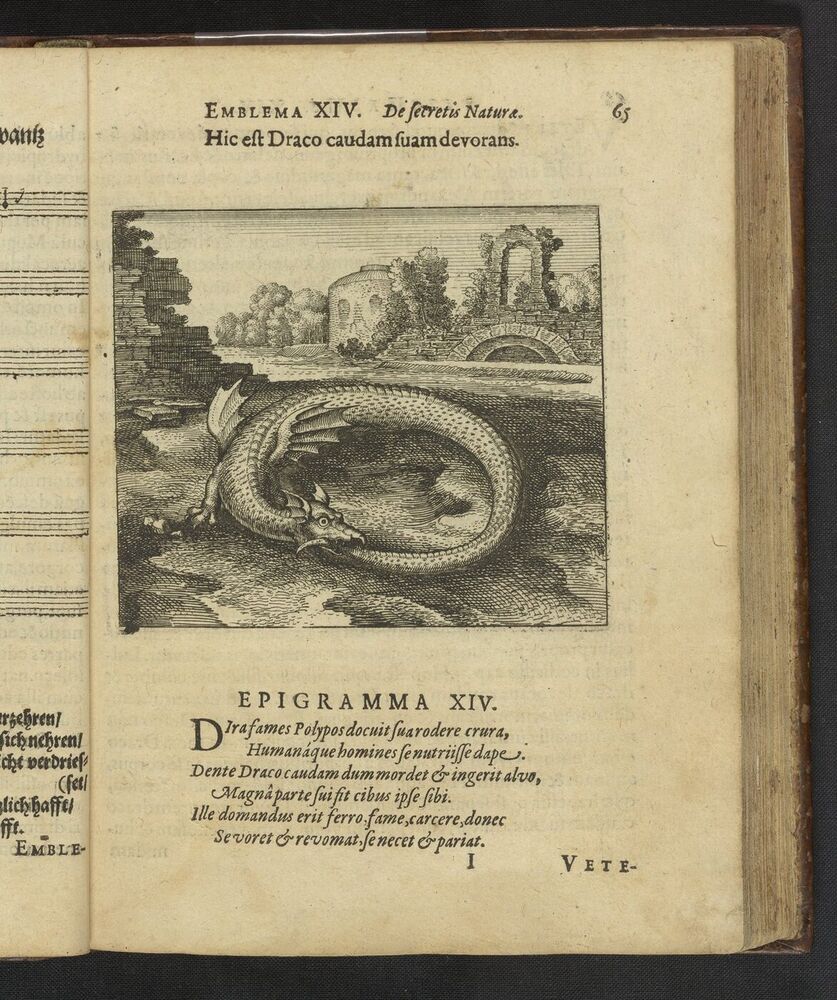
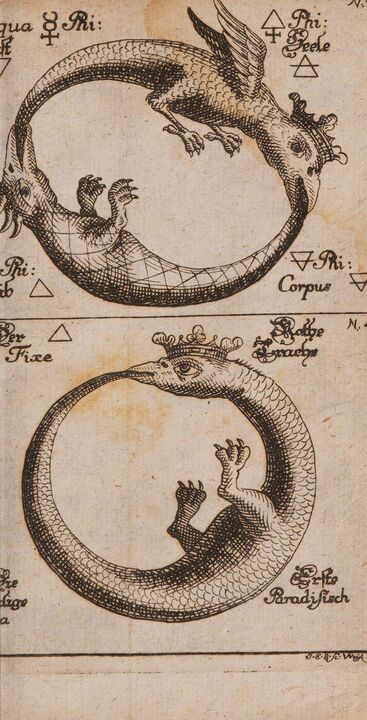
The alchemists of the Arabic and Latin traditions read the ring as more than one thing, in both directions. Ibn Umayl, who lived in the tenth century, describes two birds, each seizing the other’s tail with its beak, which, in Julius Ruska’s German, bildeten einen einzigen Kreis, das Bild von Zwei in Einem: formed one single circle, the image of two in one.A book printed in Paris in 1612 under the name of Nicolas Flamel says the ancient Egyptians painted ces Serpens & Dragõs, these serpents and dragons, in a circle, the head biting its tail, to say they had come out of one and the same thing.Michael Maier, in 1618, reported that others read the tail-devouring dragon as the year, but that the philosophers meant by it serpentem, qui alium sui generis devoret: a serpent that devours another of its own kind.And in a book printed at Erfurt in 1735 the single ring is what is left when ein Wurm den andern gefressen, one worm has eaten the other: diese 2. in eins gebracht, these two brought into one.
These are alchemists explaining a figure they had inherited. They say nothing certain about where it came from. What they say about many serpents in one ring is weighed on the other half of this investigation, Each Devouring the Tail of Another.
Oppenheim, 1618: Emblem XIV of Michael Maier’s Atalanta fugiens, “Hic est Draco caudam suam devorans”, this is the dragon devouring its tail. A winged dragon lies curled in a ring with the end of its own tail in its mouth; the Science History Institute, whose copy this is, credits the engraving to Matthaeus Merian.where it comes from
Ibn Umayl lived from about 900 to about 960
Ibn Umayl’s two birds, the Arabic in Ruska’s German
abgeschnitten, der andere besass beide Flügel, und jeder der beiden Vögel fasste mit seinem Schnabel den Schwanz des anderen, ihn packend, als ob der (geflügelte) Vogel mit dem Verstümmelten wegfliegen, der Verstümmelte aber den anderen zu sich herabziehen wollte. So bildeten die beiden Vögel einen einzigen Kreis, das Bild von Zwei in Einem.[of the one, both wings were] cut off, the other had both wings, and each of the two birds seized with its beak the tail of the other, gripping it, as if the (winged) bird wanted to fly away with the mutilated one, but the mutilated one wanted to pull the other down to itself. So the two birds formed one single circle, the image of Two in One.
Julius Ruska, 'Studien zu Muhammad Ibn Umail al-Tamimi's Kitab al-Ma' al-Waraqi wa'l-Ard an-Najmiyah', Isis 24, no. 2 (1936), p. 313 · translated by our translation of Ruska's German
two made one
Printed in Paris in 1612
The hieroglyphic figures of “Nicolas Flamel”, Paris 1612
Ce sont ces Serpens & Dragõs que les anciẽs Egyptiẽs ont peint en vn rõd, la teste mordãt sa queuë, pour dire qu'ils estoiẽt sortis d'vne mesme chose, & qu'elle seule se suffisoit, & qu'en son cõtour & circulatiõ elle se parfaisoit.These are the Serpents and Dragons which the ancient Egyptians painted in a circle, the head biting its tail, to say that they had come out of one and the same thing, and that it alone was sufficient to itself, and that in its contour and circulation it perfected itself.
Trois traitez de la philosophie naturelle ... plus, Les figures hierogliphiques de Nicolas Flamel (Paris: Guillaume Marette, 1612), p. 68 · translated by this investigation
one matter, dissolved and remade
Printed in 1618
Michael Maier, Atalanta fugiens, 1618, discourse 14
Quod licet alii exponant de anno in se redeunte & circulum referente, tamen primitus à philosophis suis rebus accommodatum fuit, qui per hunc draconem intelligi volunt serpentem, qui alium sui generis devoret & hic vocatur propriè sulphur; prout omnes innumeris locis testantur.Although others explain this of the year returning into itself and describing a circle, yet it was originally applied by the philosophers to their own matters, who by this dragon want to be understood a serpent which devours another of its own kind; and this is properly called sulphur, as all of them testify in innumerable places.
Maier, Atalanta fugiens (1618), Discursus XIV, p. 66 · translated by this investigation
one matter, dissolved and remade
Printed in Erfurt in 1735
Abraham Eleazar, Uraltes chymisches Werck, Erfurt 1735, figure N. 4
“Engraved plate with figures N. 3 (two dragons, winged and crowned above, wingless below, each with the other's tail in its mouth) and N. 4 (one crowned dragon, 'Der Fixe', 'Rothe Drache', its own tail in its mouth)”where it comes from
Koche dieses Feuer mit Feuer, bis es stehend bleibet, so hast du das Fixeste, welches alle Dinge durchdringet, und hat ein Wurm den andern gefressen, und kommet diese Figur heraus: N. 4.Cook this fire with fire until it stays standing [fixed]; then you have the most fixed, which penetrates all things, and one worm has eaten the other, and this figure comes out: N. 4.
Uraltes chymisches Werck (Erfurt 1735), part 2, p. 8 · translated by this investigation
HIer hast du nun diese 2. in eins gebracht:Here you have now brought these 2 into one:
Uraltes chymisches Werck (Erfurt 1735), part 2, p. 9 · translated by this investigation
two made one
Elsewhere
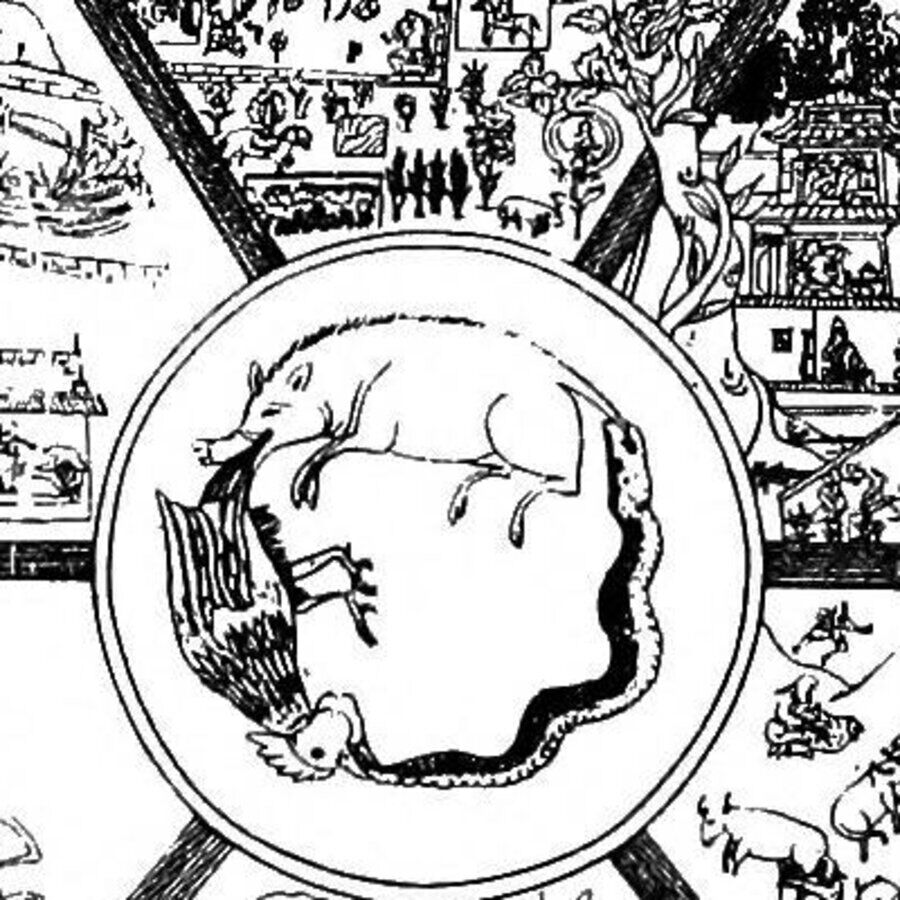
In India, a Vedic verse compares a rite to aher iva sarpaṇaṃ, the creeping of a snake, and names no tail; the tail in the mouth is the gloss of the commentator Sayana, who died in 1387: the snake mukhena puchasya daṅsanaṃ kṛitvā valayākāro bhavati, bites its tail with its mouth and becomes ring-shaped.In Tibet, the hub of the Wheel of Life, as L. A. Waddell described it in 1892, is a pig which has hold of the tail of (2) a cock which has hold of the tail of (3) a snake which in its turn, has hold of the pig’s tail, three sins that form a circle which revolves continuously around the world.
In Dahomey in 1864 Richard Burton saw girls waving white flags upon which were horned and rainbow-coloured serpents swallowing their own tails.Melville Herskovits, in 1938, recorded that the snake Aido Hwedo lies coiled underneath the earth, supporting it, and that when the iron fails the serpent will begin to eat his tail and the earth will fall into the sea.There the tail-eating is the end of the world, not its endlessness.
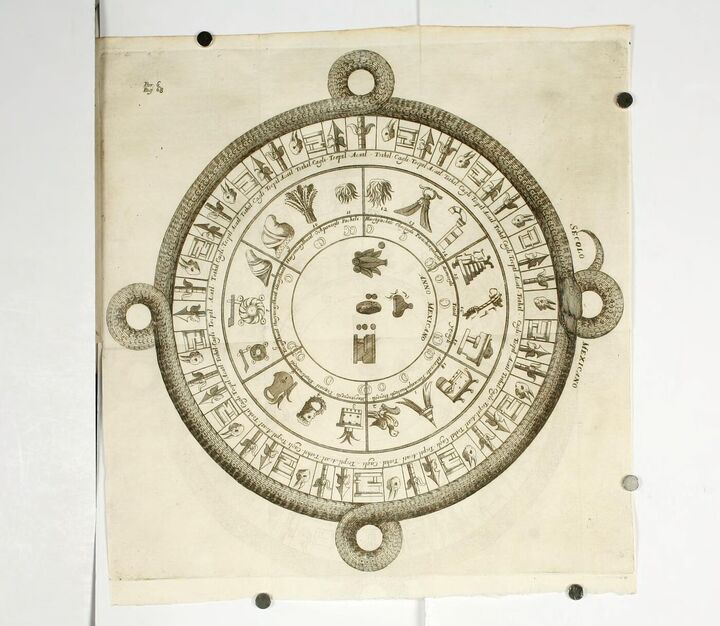
In Mexico, the ring often called an Aztec ouroboros goes back to an engraving printed in Naples in 1699, from a drawing given to Giovanni Francesco Gemelli Careri, of a serpent wound round the wheel of the Mexican century.In 1792 Antonio de León y Gama read its mouth taking the end of its last loop as donde terminaba un Ciclo allí comenzaba el otro: where one cycle ended, the next began.
The hub of the Tibetan Wheel of Life in the plate L. A. Waddell published in 1895: a pig, a cock and a snake, each holding the next one’s tail, their bodies not crossing. In 1892 Waddell wrote that the pig symbolizes ignorance, the cock desire or lust, and the snake anger or hate; his 1895 book calls the three vices lust, ill-will and stupidity and says they are figured as a dove, a serpent and a pig. The bird in the plate is a cock.where it comes from
Sayana died in 1387
Sayana on the Aitareya Brahmana 3.43
5. aher iva | ṣākalaṣabdaḥ sarpaviṣeshavācī | ṣākalanāmno 'heḥ sarpaviṣeshasya yathā sarpaṇaṃ gamanaṃ tathaivāyam agnishṭomaḥ | sa ca sarpaṇakāle mukhena puchasya daṅsanaṃ kṛitvā valayākāro bhavati | tatra kiṃ mukhaṃ kiṃ vā pucham iti na jñāyate |'Like of a snake': the word śākala names a particular kind of snake. As is the creeping, the going, of the snake, the particular serpent named śākala, so is this Agniṣṭoma. And that (snake), while creeping, makes a biting of its tail with its mouth and becomes ring-shaped. There it is not known which is the mouth and which the tail.
Sayana, commentary on Aitareya Brahmana 3.43.5, in Theodor Aufrecht (ed.), Das Aitareya Brahmana, Bonn 1879, p. 300 (Auszüge aus dem Commentar) · translated by this investigation
an end that is a beginning
Printed in Naples in 1699; read by Antonio de León y Gama in 1792
The “Mexican century”, in Gemelli Careri’s Giro del mondo
“Folding plate 'SECOLO MEXICANO' (52-year wheel encircled by a looped serpent), marked 'Par. 6 Pag. 68'”where it comes from
Era un circolo, intorno al quale s'aggirava un serpente. Il corpo del serpente contenea quattro divisioni.It was a circle, around which a serpent wound. The body of the serpent contained four divisions.
G. F. Gemelli Careri, Giro del mondo, Parte VI, Naples: G. Roselli, 1699, p. 60 · translated by this investigation
Circunscribian á este periodo de años una culebra que hacia quatro inflexîones ó vueltas, una en cada quadrante del círculo, empezando desde la cabeza, en cuya boca entraba la extremidad de la última inflexîon; denotando con esto, que donde terminaba un Ciclo allí comenzaba el otro: en esta forma está la estampa que trae el Dr. Gemelli Carreri en el tomo 6. de su Giro del mundo.Around this period of years they drew a snake that made four bends or turns, one in each quadrant of the circle, beginning from the head, into whose mouth entered the end of the last bend; signifying by this that where one Cycle ended, there the next began: in this form is the print that Dr. Gemelli Carreri gives in volume 6 of his Giro del mundo.
A. de León y Gama, Descripcion histórica y cronológica de las dos piedras, México 1792, p. 16, §4 · translated by this investigation
an end that is a beginning, given by Antonio de León y Gama, 1792: donde terminaba un Ciclo allí comenzaba el otro
Printed in 1864
Richard Burton at Abomey, Dahomey
Then came two girls, waving round and round small white flags,upon which were horned and rainbow-coloured serpents swallowing their own tails.
Richard F. Burton, A Mission to Gelele, King of Dahome, vol. II, London: Tinsley Brothers, 1864, p. 52
no meaning given
Published in 1892
L. A. Waddell on the hub of the Tibetan Wheel of Life
The three original sins or 'chief Causes of Demerit' are depicted as (1) a pig which has hold of the tail of (2) a cock which has hold of the tail of (3) a snake which in its turn, has hold of the pig's tail. The triad thus form a circle which revolves continuously around the world. The pig symbolizes Ignorance, the cock animal Desire or Lust, and the snake Anger or Hate.* These are at the core of re-birth, and if these three sins be avoided or overcome then virtue results and merit is accumulated.
L. A. Waddell, 'The Buddhist Pictorial Wheel of Life', JASB 61, Part I, No. 3 (1892), p. 136
three sins that turn the world
Printed in 1938 from fieldwork in Dahomey
Melville Herskovits on Aido Hwedo, Dahomey
Aido Hwedo (also referred to here as Dą) is the snake deity who, coiled underneath the earth, is envisaged as supporting it. It is believed that the red monkeys forge bars of iron which this serpent eats and that when the iron fails the serpent will begin to eat his tail and the earth will fall into the sea. See below, vol. ii, pp. 248-249.
Melville J. Herskovits, Dahomey: An Ancient West African Kingdom, vol. I, New York: J. J. Augustin, 1938, p. 67, n. 1
the end of the world
A ring of atoms, and an English word
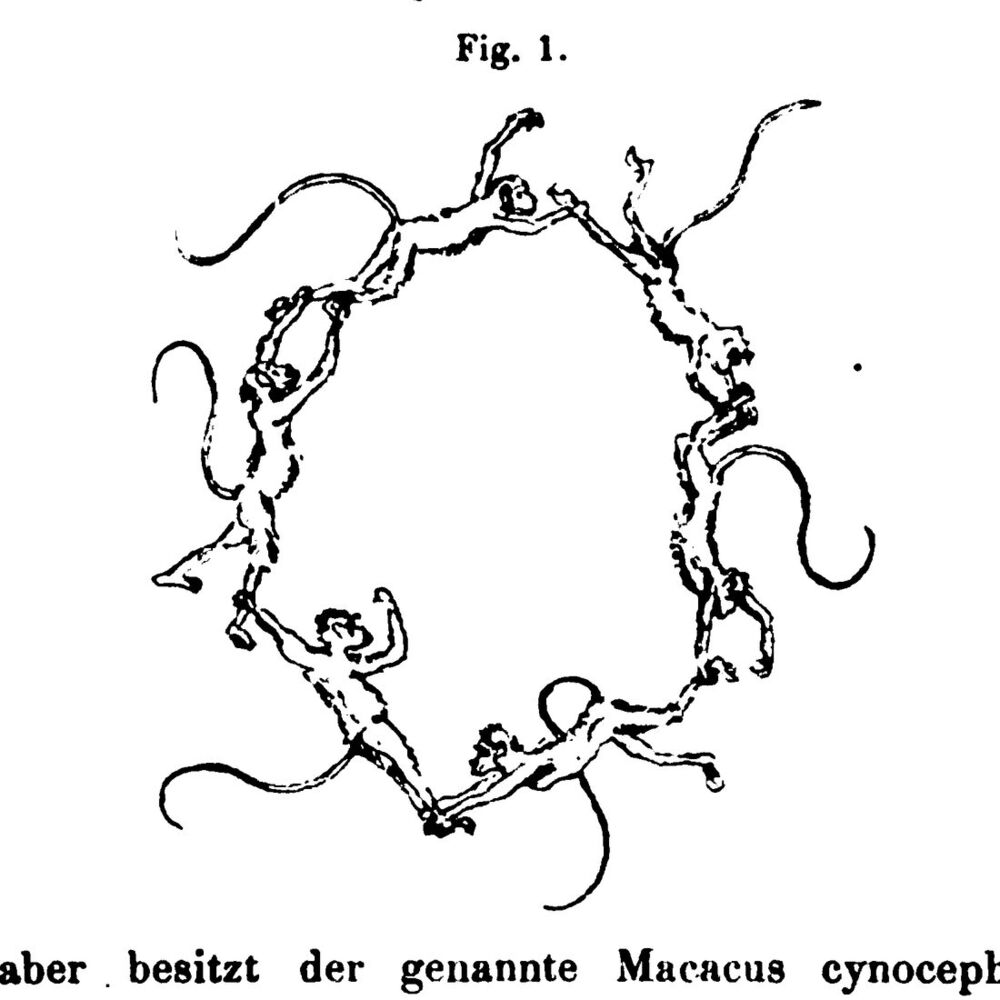
In 1890 August Kekulé told how the atoms had once danced before his eyes in long rows, twisting like snakes, until Eine der Schlangen erfasste den eigenen Schwanz: one of the snakes seized its own tail.He does not use the word ouroboros, and in the printed report of the celebration nobody does.
Berlin, 1886: six monkeys hold one another in a closed ring, in a joke issue of the Berichte, the Berichte der Durstigen Chemischen Gesellschaft, signed with the pen name F. W. Findig: “ein höchst vollkommenes Analogon des Kekulé’schen Benzolsechsecks”, a most perfect analogue of Kekulé’s benzene hexagon. Their tails touch nothing. Kekulé told of his reverie four years later.where it comes from
The earliest English use we found is in a chemistry textbook of 1897, where G. D. Hinrichs points to the Ouroborus on the first page of this book and here at its close.In 1899 Paul Gibier wrote of the Ouroboros (the serpent which feeds on itself, and is rolled in a circle, with two interlaced triangles inside it indicating the two currents in contrary directions, which represent the life of the world.
Printed in 1890; Kekulé lived from 1829 to 1896
August Kekulé’s speech of 1890
Wieder gaukelten die Atome vor meinen Augen. Kleinere Gruppen hielten sich diesmal bescheiden im Hintergrund. Mein geistiges Auge, durch wiederholte Gesichte ähnlicher Art geschärft, unterschied jetzt grössere Gebilde von mannigfacher Gestaltung. Lange Reihen, vielfach dichter zusammengefügt; Alles in Bewegung, schlangenartig sich windend und drehend. Und siehe, was war das? Eine der Schlangen erfasste den eigenen Schwanz und höhnisch wirbelte das Gebilde vor meinen Augen.Again the atoms juggled before my eyes. Smaller groups this time kept modestly in the background. My mind's eye, sharpened by repeated visions of a like kind, now distinguished larger formations of manifold shape. Long rows, in many places more densely joined together; everything in motion, winding and turning itself snake-like. And look, what was that? One of the snakes seized its own tail, and mockingly the formation whirled before my eyes.
Gustav Schultz, "Bericht über die Feier der Deutschen Chemischen Gesellschaft zu Ehren August Kekulé's", Berichte der Deutschen Chemischen Gesellschaft 23 (1890), pp. 1265-1312; Kekulé's reply pp. 1302-1311, p. 1306 · translated by this investigation
a ring of atoms
Published in 1897
G. D. Hinrichs, Introduction to General Chemistry, 1897
“Ouroboros with 'ἓν τὸ πᾶν' (called 'the Ouroborus' in the text), foot of p. 382, Lecture 100”where it comes from
Also the Ouroborus on the first page of this book and here at its close.
G. D. Hinrichs, Introduction to General Chemistry. A Graded Course of One Hundred Lectures, St. Louis: C. G. Hinrichs, 1897, p. 382
no meaning given
Published in New York in 1899
Paul Gibier, Psychism, New York 1899
That is what has been figured by the ancient initiated ones in the Ouroboros (the serpent which feeds on itself, and is rolled in a circle, within which an ascending and a descending triangle are interlaced, indicating the two currents in contrary directions, which represent the life of the world.)
Paul Gibier, Psychism; analysis of things existing, New York: Bulletin Publishing Co., 1899, p. 235
the world, or what lies round it
Eternity, and the self
In E. R. Eddison’s novel The Worm Ouroboros, of 1922, a king wears the worm on his thumb, which doctors have from of old made for an ensample of eternity, whereof the end is ever at the beginning and the beginning at the end for ever more. By then the eternity reading could be presented as ancient.Erich Neumann made the uroboros the symbol of the pre-ego epoch, and hence of the prehistoric world.C. G. Jung saw in it the thought of devouring oneself and turning oneself into a circulatory process.And Yusuke Endoh’s Quine Relay is a Ruby program that generates a program in another language, which generates the next, through 128 languages, until the last generates the original Ruby code again; its README calls it an uroboros quine.
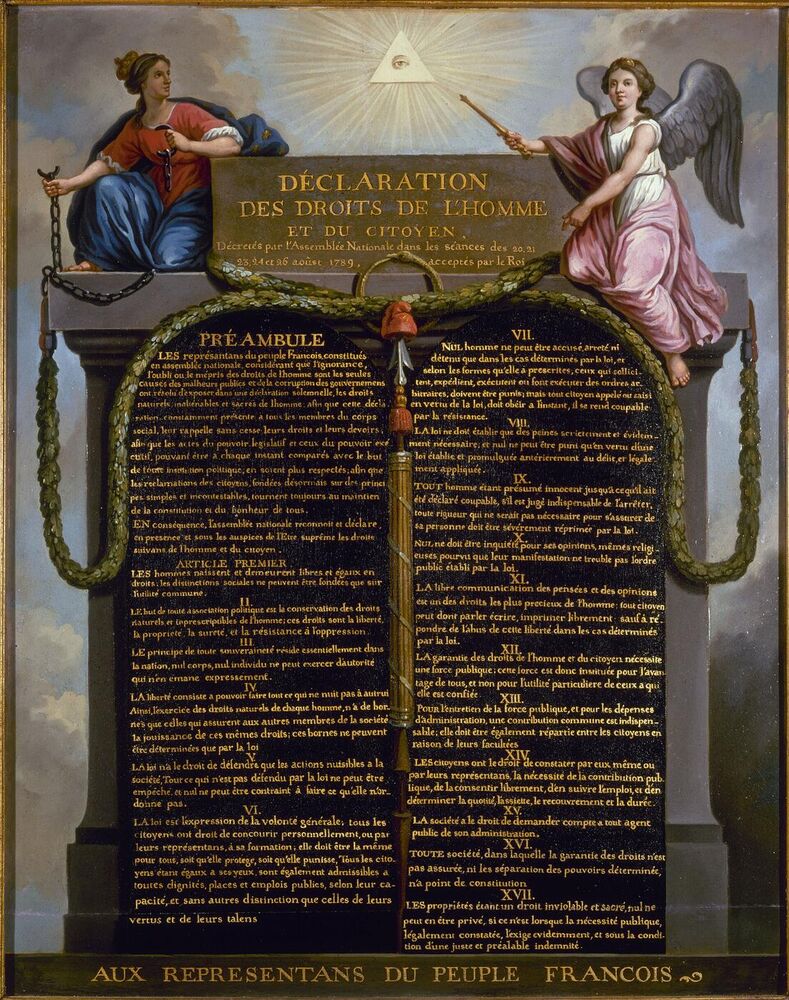
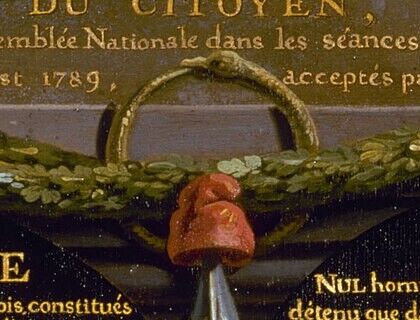
Paris, about 1789: Jean-Jacques-François Le Barbier’s painting of the Declaration of the Rights of Man and of the Citizen. At the top centre, hanging from the cornice above the two tablets, is a gold ring formed by one serpent, its tail at or in its mouth, with a garland through it and the red Phrygian cap below. The painting does not say what the ring means. Musée Carnavalet, P809.where it comes fromThe ring at the size of the 1920-pixel copy on Commons, not enlarged: one serpent, its tail at or in its mouth, with the garland through it and the red Phrygian cap below.where it comes from
Published in 1922
E. R. Eddison, The Worm Ouroboros, 1922
Rightfully, having such a timeless life, this King weareth on his thumb that worm Ouroboros which doctors have from of old made for an ensample of eternity, whereof the end is ever at the beginning and the beginning at the end for ever more.
E. R. Eddison, The Worm Ouroboros: A Romance, ill. Keith Henderson, London: Jonathan Cape, 1922, p. 196
eternity
Quoted from the 1962 printing of R. F. C. Hull’s English
Erich Neumann, The Origins and History of Consciousness
It is the symbol of the pre-ego epoch, and hence of the prehistoric world.
Erich Neumann, The Origins and History of Consciousness, tr. R. F. C. Hull, vol. II, New York: Harper Torchbooks, 1962, p. 281
the psyche before the ego
Quoted from the English edition of 1963
C. G. Jung, Mysterium Coniunctionis, English edition of 1963
In the age-old image of the uroboros lies the thought of devouring oneself and turning oneself into a circulatory process, for it was clear to the more astute alchemists that the prima materia of the art was man himself. The uroboros is a dramatic symbol for the integration and assimilation of the opposite, i.e., of the shadow.
C. G. Jung, Mysterium Coniunctionis, CW 14, London: Routledge & Kegan Paul, 1963, p. 365, para. 513
a thing that makes itself
Its README, as read in November 2026
Yusuke Endoh’s Quine Relay
It explains how to write a quine, an ascii-art quine, and an uroboros quine like this quine-relay.
Y. Endoh, Quine Relay, README.md (master), fetched 2026-11-16
...(through 128 languages in total)...
same
a thing that makes itself
What is usually said
Claims about the ouroboros that are often repeated, or that came up as leads in our own research, and what the sources say.
What is said
Verdict
What the sources say
Plato described the ouroboros (English Wikipedia, in revisions of 2006 and 2014).
FALSE
The Timaeus describes the body of the world as one creature that feeds on its own waste, αὐτὸ γὰρ ἑαυτῷ τροφὴν τὴν ἑαυτοῦ φθίσιν παρέχον, his own waste providing his own food. It names no serpent, no tail and no mouth.
Horapollo says the serpent means eternity: so Erasmus reported in the Adages, and Mignault wrote in 1577.
MISLEADING
His tail-eater means the cosmos; his serpent for eternity hides its tail under its body.
Tutankhamun’s shrine shows the First known representation of the ouroboros (English Wikipedia’s caption).
CONTESTED
The Amduat in the tomb of Thutmose III, a century older, has a ringed serpent whose caption says his tail in his mouth; Hornung called it a forerunner.
On the shrine the two serpents are holding their tails in their mouths (English Wikipedia).
MISLEADING
The tails do literally touch the mouths, the Darnells write.On the drawings and photographs we could look at, no tail goes into a mouth.
On the shrine The whole divine figure represents the beginning and the end of time. (English Wikipedia)
UNSUPPORTED
John Darnell: the arrest of time is most likely not an aspect of the nature of the giant deity on the first side of the shrine.
In Egypt the serpent biting its tail is the symbol of eternity (Piankoff and Rambova, 1957).
MISLEADING
The Egyptian captions we read do not say eternity: one speaks of The new year of Re, and in the book against Apep the tail in the mouth is a curse.
The Venice alchemical manuscript Marcianus graecus 299 is of the 6th or 7th centuries (English Wikipedia, Theodoros Pelecanos).
FALSE
Sherwood Taylor, 1930: it is of the tenth or eleventh century.
The famous red-and-green ouroboros of Paris grec 2327 is on folio 196.
FALSE
Berthelot, 1885: folio 196 has three bands, red, yellow and green; folio 279 has two, rouge et vert.
The Norse world serpent is an ancient pagan ouroboros.
MISLEADING
Only Snorri’s Edda, from the thirteenth century, has it bite its tail; the older poems we read call it the girdle of the lands.
In the Aitareya Brahmana the Vedic rituals are compared to a snake biting its own tail. (English Wikipedia)
MISLEADING
The verse speaks of a snake’s creeping; the tail-biting ring is the commentator Sayana’s gloss, made in the fourteenth century.
The Hongshan pig-dragon, a 6,000-year-old grave amulet, may be the precursor to the OUROBOROS (White Snake Projects, 2015).
UNSUPPORTED
On the Musée Guimet’s piece the tail lies below the snout, separated from it by a slit cut through the stone; nothing is in the mouth.
The Fon serpent Aido Hwedo lies coiled round the earth with its tail in its mouth.
MISLEADING
Herskovits, 1938: the serpent supports the earth from underneath, and when the iron fails the serpent will begin to eat his tail.
The Aztecs had the ouroboros, as the symbol of their 52-year cycle.
MISLEADING
The image is the engraving Gemelli printed in 1699; on the Sun Stone, Twin serpents, whose heads and tails almost meet, surround the calendar.
Kekulé dreamed of the ouroboros.
MISLEADING
His words are Eine der Schlangen erfasste den eigenen Schwanz, one of the snakes seized its own tail; the name is a later gloss.
The word’s first known use in English is 1921 (Merriam-Webster).
FALSE
It is in print as Ouroborus in 1897 and Ouroboros in 1899.
Rashi says Leviathan encircles the whole world.
MISLEADING
The commentary on that page of the Talmud is Rashbam’s, and it gives the encircling to the female Leviathan.
Southwestern Iran is a second early center of the ouroboros (van der Sluijs and Peratt, 2009).
UNSUPPORTED
The authors widen the word to take in enclosing serpents in general; the one figure they cite that we could open shows a coiled serpent with its tail far from its mouth.
The badge of the Order of the Dragon (1408) is an ouroboros.
MISLEADING
By the translation of its statute that Wikipedia quotes, the dragon is bent into a circle, its tail winding around its neck.
The check
Eighteen research agents each took one province of the record and read what the house’s rules let them reach: before fetching from a site, each read its robots.txt and logged the verdict in its province’s robots.tsv.Every excerpt they kept for a witness or a claim check is checked against the copy saved in the repository, and the catalogue that this page is built from refuses one that is not there.The cards, the timeline’s data and this page’s source record are built from that catalogue by one script, so the words on a card are the words in the record. The page’s claims about the world are marked, in its source, with where each one comes from. Two agents that did not write the page read every marked claim against its source before it was published. They found that the page had first put the earliest eternity at 1584: the research had missed two earlier printings, of 1566 and 1577, and the page was corrected before publication.
One error of ours: while gathering the dates of kings and authors, we fetched about fifty pages from a path of Wikipedia that its robots.txt disallows. The files were deleted unused, and the dates on this page were read again from Wikipedia’s article pages, which it allows.
What we could not read is listed in each province’s dossier in the repository, under research/ouroboros/provinces/.
Pictures
Every picture on this page is a public-domain or openly licensed copy that the research downloaded, recording who made it, where it is held, where it came from and the day it was retrieved. Each picture’s rights were then read again at its source, by research/ouroboros/pictures/check-rights.mjs: each entry below quotes what the source says, or says that it states none or that its statement could not be read, and gives our reading of it, naming the law it rests on where that matters, as where a picture is in the public domain in the United States and its status elsewhere cannot be shown. This page serves its own copies, so a reader’s browser asks no museum or archive for anything. A caption in quotation marks quotes the picture’s title in the research’s record.
Where each of the 22 pictures comes from
A. Parrot (photograph), “Ra-Osiris in the Enigmatic Book.JPG” (photograph 31 December 2015; object late 18th Dynasty (burial of Tutankhamun)). Cairo, Egyptian Museum JE 60666 (Carter 237), second shrine of Tutankhamun, exterior long side with the giant figure. Its source: https://commons.wikimedia.org/wiki/File:Ra-Osiris_in_the_Enigmatic_Book.JPG, read 2026-11-16, says: licence “CC0 (http://creativecommons.org/publicdomain/zero/1.0/deed.en)”. Our reading: The photographer released this photograph under CC0; the shrine it shows is ancient. The picture: https://commons.wikimedia.org/wiki/File:Ra-Osiris_in_the_Enigmatic_Book.JPG, retrieved by the research on 2026-11-16. The research's kept copy: 960 px Commons thumbnail (the 2248 x 4000 original was not fetched: upload.wikimedia.org asked for thumbnail sizes) resized to 787 x 1400, JPEG quality 82, metadata stripped. Self-hosted at public/strata/its-tail-in-its-mouth/img/tut-shrine2-giant.jpg, 562 by 1000 pixels (metadata stripped, JPEG quality 80). Records: research/ouroboros/provinces/01-egypt-early/media/provenance.json and research/ouroboros/pictures/rights.json.
unknown Theban painter, 21st Dynasty (papyrus); photographer not named on Commons, “Commons file 'Horus-Harpocrates in the Sun.jpg': the child in the sun disk ringed by a serpent, on the lions of the horizon; identified by us as scene 3 of the papyrus of Her-Uben A (Piankoff and Rambova 1957, pap. no 1; Niwinski's Cairo 91)” (papyrus: late 21st Dynasty (owner's mummy linen dated year 8 of Siamun, per Niwinski 1989); Commons upload 2013). Egyptian Museum, Cairo, S.R.VII.10256 = 14.7.35.6 (Niwinski 1989, p. 285, 'CAIRO 91'). Its source: https://commons.wikimedia.org/wiki/File:Horus-Harpocrates_in_the_Sun.jpg, read 2026-11-16, says: licence “Public domain (https://creativecommons.org/publicdomain/mark/1.0/)”; licence “PDM”. Our reading: A faithful photograph of a flat ancient painting. Commons marks it public domain, and says that such a photograph of a flat old work is in the public domain in the United States and that reuse may be restricted in some other countries. The picture: https://commons.wikimedia.org/wiki/File:Horus-Harpocrates_in_the_Sun.jpg, retrieved by the research on 2026-11-16. The research's kept copy: original 690 x 569 px JPEG re-encoded at quality 82, not resized. Self-hosted at public/strata/its-tail-in-its-mouth/img/02-commons-heruben-a-disk-child-serpent.jpg, 690 by 569 pixels (metadata stripped, JPEG quality 80). Records: research/ouroboros/provinces/02-egypt-later/media/provenance.json and research/ouroboros/pictures/rights.json.
unknown scribe of London Papyrus 121 (the drawing); photographic plate published by the British Museum (F. G. Kenyon, ed.), “The ring-serpent (ouroboros) drawing that ends the phylactery recipe of London Papyrus 121 (PGM VII): detail of plate 59, 'PAPYRUS CXXI. (9). Cols. 16, 17. 3rd Cent.'” (papyrus: 3rd to 5th century AD (palaeographic; Kenyon 1893: 3rd century; British Library catalogue: 4th century); plate: 1893). British Library (formerly British Museum), Papyrus 121, frame Papyrus 121 (3), col. 16 end / col. 17 (Kenyon's ll. 579-592, = PGM VII.579-592); the plate: Greek Papyri in the British Museum. Facsimiles [vol. I], London 1893, plate 59. Its source: https://hdl.handle.net/2333.1/2z34twmq, read 2026-11-16: the page builds its rights statement with a script, and the statement is not in the page as served. Our reading: A collotype plate published in London in 1893: in the public domain in the United States, where works published before 1931 are free. We could not read the holder’s own statement. The picture: https://hdl.handle.net/2333.1/2z34twmq, retrieved by the research on 2026-11-16. The research's kept copy: resized to 1400 px on the longest side, JPEG quality 82, metadata stripped. Self-hosted at public/strata/its-tail-in-its-mouth/img/pgm7-kenyon-1893.jpg, 1000 by 907 pixels (metadata stripped, JPEG quality 80). Records: research/ouroboros/provinces/03-greek-word-magic/media/provenance.json and research/ouroboros/pictures/rights.json.
Photograph by Pompeo Sansaini (credited by Curtis, p. 10, 'The photographs are all due to the skill and patience of Pompeo Sansaini', read in OCR); published by C. Densmore Curtis, “C. Densmore Curtis, 'The Bernardini Tomb', Memoirs of the American Academy in Rome 3 (1919), Plate 21, fig. 2: '2, Detail from inside of No. 25. (See p. 39).'” (photograph before 1919; published 1919). In 1919: Museo Preistorico (formerly Museo Kircheriano), Rome, per Curtis p. 9-10 (OCR). In 2017: Museo nazionale etrusco di Villa Giulia, Rome, per the Wikimedia Commons description of Sailko's photograph. Its source: https://archive.org/metadata/memoirsofamerica03ameruoft, read 2026-11-16, says: possible-copyright-status “NOT_IN_COPYRIGHT”; copyright-region “US”. Our reading: Published in 1919: in the public domain in the United States, the region the Internet Archive’s determination names. The photographer’s dates are not known to us, so we cannot show its status elsewhere. The picture: https://archive.org/download/memoirsofamerica03ameruoft/page/n136_w1400.jpg, retrieved by the research on 2026-11-16. The research's kept copy: cropped to fig. 2, resized to 1400 px wide, JPEG quality 82. Self-hosted at public/strata/its-tail-in-its-mouth/img/16-palestrina-bowl-curtis1919-pl21-fig2-serpent-head.jpg, 720 by 330 pixels (metadata stripped, JPEG quality 80). Records: research/ouroboros/provinces/16-near-east-entwined/media/provenance.json and research/ouroboros/pictures/rights.json.
unknown Roman-period gem engraver, “Jasper intaglio: Seated Serapis on crocodile (the Met's title); obverse, figure inside a serpent ring” (2nd century CE (the Met's objectDate)). The Metropolitan Museum of Art, New York, accession 10.130.1390 (Gift of Miss Helen Miller Gould, 1910); green jasper, 1.9 x 1.4 x 0.2 cm. Its source: https://collectionapi.metmuseum.org/public/collection/v1/objects/248222, read 2026-11-16, says: isPublicDomain “true”; creditLine “Gift of Miss Helen Miller Gould, 1910”. Our reading: The Met marks this photograph public domain and releases it under its Open Access programme. The picture: https://collectionapi.metmuseum.org/public/collection/v1/objects/248222, retrieved by the research on 2026-11-16. The research's kept copy: resized to 1400 px on the longest side, JPEG quality 82, metadata stripped. Self-hosted at public/strata/its-tail-in-its-mouth/img/met-10.130.1390-serapis-ouroboros-gem-obverse.jpg, 686 by 720 pixels (metadata stripped, JPEG quality 80). Records: research/ouroboros/provinces/03-greek-word-magic/media/provenance.json and research/ouroboros/pictures/rights.json.
Drawing published by Franz Cumont (1868-1947), 'd'après un croquis original', “F. Cumont, Textes et monuments figurés relatifs aux mystères de Mithra II (1896), p. 208, fig. 36” (1896). Vatican, Museo Chiaramonti (per Cumont 1896). Its source: https://archive.org/metadata/textesetmonument02cumouoft, read 2026-11-16, says: possible-copyright-status “NOT_IN_COPYRIGHT”; copyright-region “US”. Our reading: Published in 1896; Franz Cumont died in 1947. In the public domain in the United States, the region the archive names, and wherever copyright ends seventy years after the author’s death. The picture: https://archive.org/download/textesetmonument02cumouoft/page/n223_w1400.jpg, retrieved by the research on 2026-11-16. The research's kept copy: cropped to fig. 36, JPEG quality 82. Self-hosted at public/strata/its-tail-in-its-mouth/img/16-mithraic-pedestal-ad194-cumont1896-fig36.jpg, 410 by 720 pixels (metadata stripped, JPEG quality 80). Records: research/ouroboros/provinces/16-near-east-entwined/media/provenance.json and research/ouroboros/pictures/rights.json.
Illustrator of Vincenzo Cartari's Imagini, 1571 edition (not identified for this copy; the Metropolitan Museum's record of its 1571 copy, Internet Archive item mma_le_imagini_de_i_dei_de_gli_antichi_347175, lists Giuseppe Salviati and Bolognino Zaltieri among the creators, medium 'Etchings'; not checked against this copy), “The cave of Eternity after Claudian, with the serpent biting its tail along the foreground (full page plate, no caption)” (1571 (date of the edition)). Biblioteca Nazionale Centrale di Roma copy, digitized by Google; Internet Archive item bub_gb_q2rUgJmE2-oC, scan leaf n65 (plate between pp. 34 and 36). Its source: https://archive.org/metadata/bub_gb_q2rUgJmE2-oC, read 2026-11-16, says: licenseurl “http://creativecommons.org/publicdomain/mark/1.0/”. Our reading: A book printed in 1571: in the public domain everywhere, and marked so at its source. The picture: https://archive.org/download/bub_gb_q2rUgJmE2-oC/page/n65_w1400.jpg, retrieved by the research on 2026-11-16. The research's kept copy: resized to 1014 x 1400 px, JPEG quality 82, metadata stripped. Self-hosted at public/strata/its-tail-in-its-mouth/img/cartari-1571-cave.jpg, 724 by 1000 pixels (metadata stripped, JPEG quality 80). Records: research/ouroboros/provinces/08-medieval-renaissance-emblems/media/provenance.json and research/ouroboros/pictures/rights.json.
Unknown Byzantine scribe and draughtsman of Venice, Biblioteca Nazionale Marciana, gr. 299 (the original page); photogravure made for M. Berthelot's edition, “FIGURE 11. — Chrysopée de Cléopâtre (the page headed Κλεοπάτρης Χρυσοποιία)” (manuscript: end of the 10th or beginning of the 11th century (Berthelot, CAAG vol. 1, Introduction p. 129); reproduction published 1887). original: Venice, Biblioteca Nazionale Marciana, gr. 299 (Berthelot's 'manuscrit de Saint-Marc'), fol. 188 verso; reproduction: M. Berthelot and Ch.-Em. Ruelle, Collection des anciens alchimistes grecs, vol. 1 (Paris: G. Steinheil, 1887), Introduction p. 132. Its source: https://archive.org/metadata/collectiondesanc01bert, read 2026-11-16, states no rights. Our reading: Published in Paris in 1887; Berthelot died in 1907 and Ruelle in 1912. In the public domain in the United States and wherever copyright ends seventy years after the author’s death. The picture: https://archive.org/download/collectiondesanc01bert/page/n165_w2166.jpg (item https://archive.org/details/collectiondesanc01bert, University of Toronto copy, scanned 2009), retrieved by the research on 2026-11-16. The research's kept copy: cropped to the plate (title to caption), longest side 1400 px, JPEG quality 82, metadata stripped. Self-hosted at public/strata/its-tail-in-its-mouth/img/marcianus-299-f188v-chrysopoeia.jpg, 729 by 1000 pixels (metadata stripped, JPEG quality 80). Records: research/ouroboros/provinces/06-greek-alchemy/media/provenance.json and research/ouroboros/pictures/rights.json.
Anonymous illuminator of Paris, BnF, grec 2327 (the manuscript's colophon names the scribe Theodoros Pelekanos of Corfu, as reported by Fernández García 2018 after Mertens 1995; not read in the original); photographer unknown, “Ouroboros drawing heading the text CAAG I.vi (four-legged, eared serpent in red and green, text written inside the ring)” (1478 (date of the manuscript: Berthelot, CAAG vol. 1, Introduction p. 129, 'écrit en 1478')). Paris, Bibliothèque nationale de France, grec 2327, fol. 279 (recto, per CAAG I.vi head-note 'Transcrit sur A, f. 279 r.'); identification checked by the research against the text visible in the image and Berthelot's colour note for f. 279. Its source: https://commons.wikimedia.org/wiki/File:Serpiente_alquimica.jpg, read 2026-11-16, says: licence “Public domain (https://creativecommons.org/publicdomain/mark/1.0/)”; licence “PDM”. Our reading: A faithful photograph of a manuscript page copied in 1478. Commons marks it public domain, and says that such a photograph of a flat old work is in the public domain in the United States and that reuse may be restricted in some other countries. The picture: https://commons.wikimedia.org/wiki/File:Serpiente_alquimica.jpg ; original file https://upload.wikimedia.org/wikipedia/commons/7/71/Serpiente_alquimica.jpg, retrieved by the research on 2026-11-16. The research's kept copy: the Commons original kept unchanged (625 x 621 px, 147 KB JPEG; within the size limits, not re-encoded). Self-hosted at public/strata/its-tail-in-its-mouth/img/paris-gr-2327-f279.jpg, 625 by 621 pixels (metadata stripped, JPEG quality 80). Records: research/ouroboros/provinces/06-greek-alchemy/media/provenance.json and research/ouroboros/pictures/rights.json.
Unknown Byzantine scribe and draughtsman of Venice, Biblioteca Nazionale Marciana, gr. 299 (the original page); photogravure made for M. Berthelot's edition, “Detail of FIGURE 11. — Chrysopée de Cléopâtre: the small ring-serpent with ἓν τὸ πᾶν (lower left of the page)” (manuscript: end of the 10th or beginning of the 11th century (Berthelot, CAAG vol. 1, Introduction p. 129); reproduction published 1887). original: Venice, Biblioteca Nazionale Marciana, gr. 299 (Berthelot's 'manuscrit de Saint-Marc'), fol. 188 verso; reproduction: M. Berthelot and Ch.-Em. Ruelle, Collection des anciens alchimistes grecs, vol. 1 (Paris: G. Steinheil, 1887), Introduction p. 132. Its source: https://archive.org/metadata/collectiondesanc01bert, read 2026-11-16, states no rights. Our reading: Published in Paris in 1887; Berthelot died in 1907 and Ruelle in 1912. In the public domain in the United States and wherever copyright ends seventy years after the author’s death. The picture: https://archive.org/download/collectiondesanc01bert/page/n165_w2166.jpg (item https://archive.org/details/collectiondesanc01bert, University of Toronto copy, scanned 2009), retrieved by the research on 2026-11-16. The research's kept copy: cropped from the same page image to the small serpent (and a sliver of the neighbouring still), 1000 px wide, JPEG quality 82, metadata stripped. Self-hosted at public/strata/its-tail-in-its-mouth/img/berthelot-1887-fig11-detail-ring-serpent.jpg, 720 by 667 pixels (metadata stripped, JPEG quality 80). Records: research/ouroboros/provinces/06-greek-alchemy/media/provenance.json and research/ouroboros/pictures/rights.json.
Jakob Sigurðsson (as given on the Commons file page), “Thor and Hymir fishing; Jörmungandr on the hook (manuscript illustration)” (1765-1766 (as given on the Commons file page; not otherwise checked)). Reykjavík, Stofnun Árna Magnússonar, SÁM 66, fol. 79v (shelfmark as given on the Commons file page). Its source: https://commons.wikimedia.org/wiki/File:S%C3%81M_66,_79v,_Thor_and_J%C3%B6rmungandr.jpg, read 2026-11-16, says: licence “Public domain (https://creativecommons.org/publicdomain/mark/1.0/)”; licence “PDM”. Our reading: A faithful photograph of an eighteenth-century drawing. Commons marks it public domain, and says that such a photograph of a flat old work is in the public domain in the United States and that reuse may be restricted in some other countries. The picture: https://commons.wikimedia.org/wiki/File:S%C3%81M_66,_79v,_Thor_and_J%C3%B6rmungandr.jpg, retrieved by the research on 2026-11-16. The research's kept copy: 960 px wide Wikimedia thumbnail, re-encoded at JPEG quality 82, metadata stripped. Self-hosted at public/strata/its-tail-in-its-mouth/img/sam66-thor-fishing.jpg, 811 by 1000 pixels (metadata stripped, JPEG quality 80). Records: research/ouroboros/provinces/09-norse-and-interlace/media/provenance.json and research/ouroboros/pictures/rights.json.
Master of the E-Series Tarocchi (Italian, active 1460s) (the museum's attribution), “Genius of Time (from the Tarocchi, series B: Cosmic Principles & Virtues, #32); lettered CHRONICO XXXII 32” (before 1467 (museum: creation_date 'before 1467', earliest 1457, latest 1467)). The Cleveland Museum of Art, Dudley P. Allen Fund, 1924.432.32. Its source: https://www.clevelandart.org/art/1924.432.32, read 2026-11-16, says: share_license_status “CC0”. Our reading: The Cleveland Museum of Art releases this image under CC0. The picture: https://www.clevelandart.org/art/1924.432.32, retrieved by the research on 2026-11-16. The research's kept copy: resized to longest side 1400 px, JPEG quality 82, metadata stripped. Self-hosted at public/strata/its-tail-in-its-mouth/img/tarocchi-chronico.jpg, 726 by 1000 pixels (metadata stripped, JPEG quality 80). Records: research/ouroboros/provinces/08-medieval-renaissance-emblems/media/provenance.json and research/ouroboros/pictures/rights.json.
Unidentified woodcutter of the Kerver Horapollo (the catalogue record: 'The 5 x 5 cm. woodcuts have been attributed to Jean Cousin (probably the elder) and to Jean Goujon. Mortimer opines that at least two different artists were involved.'), “Woodcut for book 1, chapter 1, 'Comment & par quelles figures ilz signifioient laage & les ans du temps': a cock-headed basilisk biting its tail, encircling three figures, with sun and moon above” (1543 (colophon: 'acheve de imprimer le xxiij iour de Novembre Mil cinq cens.xliij', per the catalogue record)). Boston Public Library, Rare Books Department, copy of the 1543 Kerver edition; Internet Archive orusapollodeaegy00hora, scan leaf n15 (leaf a ii verso). Its source: https://archive.org/metadata/orusapollodeaegy00hora, read 2026-11-16, states no rights. Our reading: A book printed in Paris in 1543: in the public domain everywhere. The picture: https://archive.org/download/orusapollodeaegy00hora/page/n15_w2000.jpg, retrieved by the research on 2026-11-16. The research's kept copy: woodcut cropped from the page, 1100 x 1100 px, JPEG quality 84, metadata stripped. Self-hosted at public/strata/its-tail-in-its-mouth/img/kerver-1543-basilisk.jpg, 1000 by 1000 pixels (metadata stripped, JPEG quality 80). Records: research/ouroboros/provinces/08-medieval-renaissance-emblems/media/provenance.json and research/ouroboros/pictures/rights.json.
Unidentified woodcutter of the Kerver Horapollo (see the entry above), “Woodcut for book 1, chapter 2, 'Comment ilz signifient le monde': a scaly serpent coiled on the ground in a landscape, apparently holding its tail end in its jaws” (1543 (colophon: 'acheve de imprimer le xxiij iour de Novembre Mil cinq cens.xliij', per the catalogue record)). Boston Public Library copy; Internet Archive orusapollodeaegy00hora, scan leaf n16 (leaf a iii recto). Its source: https://archive.org/metadata/orusapollodeaegy00hora, read 2026-11-16, states no rights. Our reading: A book printed in Paris in 1543: in the public domain everywhere. The picture: https://archive.org/download/orusapollodeaegy00hora/page/n16_w2000.jpg, retrieved by the research on 2026-11-16. The research's kept copy: woodcut cropped from the page, 1100 x 1100 px, JPEG quality 84, metadata stripped. Self-hosted at public/strata/its-tail-in-its-mouth/img/kerver-1543-monde.jpg, 1000 by 1000 pixels (metadata stripped, JPEG quality 80). Records: research/ouroboros/provinces/08-medieval-renaissance-emblems/media/provenance.json and research/ouroboros/pictures/rights.json.
Michael Maier (author); Matthaeus Merian (engraver, per the holding institution's record), “Emblema XIV. Hic est Draco caudam suam devorans” (1618 (Oppenheim: Hieronymus Galler for Johann Theodor de Bry)). Science History Institute, Roy G. Neville Historical Chemical Library, QD25 .M354 1618. Its source: https://digital.sciencehistory.org/works/pg15bf75x, read 2026-11-16, says: Rights “Public Domain Mark 1.0”; Credit line “Courtesy of Science History Institute”. Our reading: A book printed in 1618. The Science History Institute marks its image with the Public Domain Mark and asks for its credit line, which is given here: Courtesy of Science History Institute. The picture: https://digital.sciencehistory.org/works/pg15bf75x, retrieved by the research on 2026-11-16. The research's kept copy: the institution's 'Small JPG' (1200 x 1434 px) re-encoded at JPEG quality 82, metadata stripped; longest side 1400 px or less. Self-hosted at public/strata/its-tail-in-its-mouth/img/maier-1618-emblem-14.jpg, 837 by 1000 pixels (metadata stripped, JPEG quality 80). Records: research/ouroboros/provinces/07-arabic-latin-alchemy/media/provenance.json and research/ouroboros/pictures/rights.json.
engraver signing 'J.E.B. sc.' (reading uncertain); book attributed to 'R. Abraham Eleazar', “Engraved plate with figures N. 3 (two dragons, winged and crowned above, wingless below, each with the other's tail in its mouth) and N. 4 (one crowned dragon, 'Der Fixe', 'Rothe Drache', its own tail in its mouth)” (1735 (Erfurt: Augustinus Crusius)). Wellcome Library (scan at the Internet Archive, item b33020541, leaf n304). The scan cuts off the left edge of the plate; the complete plate is visible in the BSB copy (archive.org 10912552bsb, leaf n14), whose rights statement is NoC-NC, so it was not copied. Its source: https://archive.org/metadata/b33020541, read 2026-11-16, says: rights “This work is available under the Creative Commons, Public Domain Mark (http://creativecommons.org/publicdomain/mark/1.0/)”. Our reading: A book printed in 1735; the scan of the Wellcome Collection’s copy is marked with the Public Domain Mark. The picture: https://archive.org/details/b33020541, retrieved by the research on 2026-11-16. The research's kept copy: resized to 1400 px on the longest side, JPEG quality 82, metadata stripped. Self-hosted at public/strata/its-tail-in-its-mouth/img/eleazar-1735-plate-N3-N4-wellcome.jpg, 367 by 720 pixels (metadata stripped, JPEG quality 80). Records: research/ouroboros/provinces/07-arabic-latin-alchemy/media/provenance.json and research/ouroboros/pictures/rights.json.
Plate in L. A. Waddell, The Buddhism of Tibet, or Lamaism (London: W. H. Allen, 1895), after a Tibetan painting of the Wheel of Life (Waddell: 'The Tibetan form of the picture here given'), “The Wheel of Life, Picturing the Buddhist Theory of the Universe. [To face p. 108.]” (1895 (book); the Tibetan original undated). Cornell University Library copy, scanned: https://archive.org/details/cu31924023203288, leaf n136. Its source: https://archive.org/metadata/cu31924023203288, read 2026-11-16, states no rights. Our reading: Published in London in 1895; Waddell died in 1938. In the public domain in the United States and wherever copyright ends seventy years after the author’s death. The picture: https://archive.org/download/cu31924023203288/page/n136.jpg, retrieved by the research on 2026-11-16. The research's kept copy: crop of the hub (400 x 400 px region at x=780, y=1050 of the full scan), enlarged to 900 px, JPEG quality 85, metadata stripped. Self-hosted at public/strata/its-tail-in-its-mouth/img/waddell-1895-hub.jpg, 900 by 900 pixels (metadata stripped, JPEG quality 80). Records: research/ouroboros/provinces/10-south-east-asia/media/provenance.json and research/ouroboros/pictures/rights.json.
Engraver not named; after a drawing given to Gemelli Careri by Carlos de Sigüenza y Góngora (per Gemelli, pp. 72-73), “Folding plate 'SECOLO MEXICANO' (52-year wheel encircled by a looped serpent), marked 'Par. 6 Pag. 68'” (Published 1699). Getty Research Institute copy, Internet Archive girodelmondodeld06geme, scan leaf n93. Its source: https://archive.org/metadata/girodelmondodeld06geme, read 2026-11-16, states no rights. Our reading: An engraving published in 1699: in the public domain everywhere. The picture: https://archive.org/details/girodelmondodeld06geme, retrieved by the research on 2026-11-16. The research's kept copy: Whole plate image (2379x2068) resized to 1400 px on the long side, JPEG quality 82, metadata stripped. Self-hosted at public/strata/its-tail-in-its-mouth/img/gemelli-careri-1699-giro-vi-secolo-messicano-wheel.jpg, 720 by 626 pixels (metadata stripped, JPEG quality 80). Records: research/ouroboros/provinces/11-africa-americas-oceania/media/provenance.json and research/ouroboros/pictures/rights.json.
anonymous artist; article signed with the pseudonym 'F. W. Findig' (attributed by Richard Anschütz, 1929, to Otto Nikolaus Witt, according to the Deutsches Museum catalogue; Anschütz not read), “Fig. 1 of 'F. W. Findig: Zur Constitution des Benzols': six monkeys (Macacus cynocephalus) forming a ring, 'ein höchst vollkommenes Analogon des Kekulé'schen Benzolsechsecks'” (1886 (the issue's session is dated 20 September 1886; the article is signed 'Im Mai 1886')). Berichte der Durstigen Chemischen Gesellschaft, No. 20, p. 3536; the scanned copy is a Harvard Library copy bound with the Berichte for 1887, digitised by Google; excerpted into a PDF by Daniel M. Perrine and uploaded to the Internet Archive (item BerichteDerDurstigenChemischenGesellschaft), PDF page 25. Its source: https://archive.org/metadata/BerichteDerDurstigenChemischenGesellschaft, read 2026-11-16, says: licenseurl “http://creativecommons.org/publicdomain/zero/1.0/”. Our reading: Printed in Berlin in 1886 under a pen name, and marked CC0 by the uploader of the archive copy. The author has been named as Otto Nikolaus Witt, who died in 1915; if that is right, it is in the public domain wherever copyright ends seventy years after the author’s death, and as an 1886 publication it is in the United States. The picture: https://archive.org/details/BerichteDerDurstigenChemischenGesellschaft, retrieved by the research on 2026-11-16. The research's kept copy: page image extracted at its native 600 ppi (1-bit) with pdfimages, cropped to the figure with its caption, scaled to 1100 px, JPEG quality 82. Self-hosted at public/strata/its-tail-in-its-mouth/img/durstige-1886-fig1.jpg, 1000 by 1000 pixels (metadata stripped, JPEG quality 80). Records: research/ouroboros/provinces/12-kekule/media/provenance.json and research/ouroboros/pictures/rights.json.
Unnamed draughtsman or engraver for G. D. Hinrichs (photo-engravings by Sanders Engraving Co., St. Louis, per the copyright page); the figure copies the ouroboros of the Greek alchemical manuscripts as published by Marcellin Berthelot (the manuscript is not named by Hinrichs), “Ouroboros with 'ἓν τὸ πᾶν' (called 'the Ouroborus' in the text), foot of p. 382, Lecture 100” (1897 (publication)). University of Illinois Library copy (bookplate: class 540, book H59), digitized by the Internet Archive in 2017; archive.org item introductiontoge00hinr, scan leaf n391 (printed p. 382). Its source: https://archive.org/metadata/introductiontoge00hinr, read 2026-11-16, states no rights. Our reading: Published in the United States in 1897: in the public domain there. The picture: https://archive.org/details/introductiontoge00hinr, retrieved by the research on 2026-11-16. The research's kept copy: cropped from the 2392x3883 scan to the drawing (620x760 px), metadata stripped, JPEG quality 82. Self-hosted at public/strata/its-tail-in-its-mouth/img/hinrichs-1897-p382-ouroborus.jpg, 587 by 720 pixels (metadata stripped, JPEG quality 80). Records: research/ouroboros/provinces/13-modern/media/provenance.json and research/ouroboros/pictures/rights.json.
Jean-Jacques-François Le Barbier (1738-1826), “Déclaration des droits de l'homme et du citoyen (whole painting)” (circa 1789 (Commons record: 'circa 1789')). Paris, Musée Carnavalet, inv. P809 (Commons record: 'Accession number P809'; '1896: given by Georges Clemenceau'). Its source: https://commons.wikimedia.org/wiki/File:Declaration_of_the_Rights_of_Man_and_of_the_Citizen_in_1789.jpg, read 2026-11-16, says: licence “Public domain (https://creativecommons.org/publicdomain/mark/1.0/)”; licence “PDM”; licence “CC0 (http://creativecommons.org/publicdomain/zero/1.0/deed.en)”; file metadata, copyright holder “CC0 Paris Musées / Musée Carnavalet”. Our reading: A painting of about 1789, in the public domain; Paris Musées released this photograph of it under CC0. The picture: https://commons.wikimedia.org/wiki/File:Declaration_of_the_Rights_of_Man_and_of_the_Citizen_in_1789.jpg, retrieved by the research on 2026-11-16. The research's kept copy: resized to longest side 1400 px, JPEG quality 74 (to stay under 400 KB), metadata stripped. Self-hosted at public/strata/its-tail-in-its-mouth/img/le-barbier-1789.jpg, 789 by 1000 pixels (metadata stripped, JPEG quality 80). Records: research/ouroboros/provinces/08-medieval-renaissance-emblems/media/provenance.json and research/ouroboros/pictures/rights.json.
Jean-Jacques-François Le Barbier (1738-1826), “Detail at the size of the 1920-pixel copy: the serpent ring above the Phrygian cap, at the top centre of the Déclaration des droits de l'homme et du citoyen” (circa 1789 (Commons record: 'circa 1789')). Paris, Musée Carnavalet, inv. P809 (Commons record: 'Accession number P809'). Its source: https://commons.wikimedia.org/wiki/File:Declaration_of_the_Rights_of_Man_and_of_the_Citizen_in_1789.jpg, read 2026-11-16, says: licence “Public domain (https://creativecommons.org/publicdomain/mark/1.0/)”; licence “PDM”; licence “CC0 (http://creativecommons.org/publicdomain/zero/1.0/deed.en)”; file metadata, copyright holder “CC0 Paris Musées / Musée Carnavalet”. Our reading: A painting of about 1789, in the public domain; Paris Musées released this photograph of it under CC0. This detail is cut from the 1920-pixel copy on Commons at its own size, not enlarged. The picture: https://commons.wikimedia.org/wiki/File:Declaration_of_the_Rights_of_Man_and_of_the_Citizen_in_1789.jpg, retrieved by the research on 2026-11-16. The research's kept copy: the 1920-pixel copy (1920 x 2434, sha256 f8c3b348dc8b3175d217409350ae56436f7bb24be450451435708a3ef6c0d1c1) cropped to the 420 x 320 region at x 760, y 560, the region the research's earlier detail used, at its own size and not enlarged, JPEG quality 90, metadata stripped. Self-hosted at public/strata/its-tail-in-its-mouth/img/le-barbier-1789-ring.jpg, 420 by 320 pixels (metadata stripped, JPEG quality 80). Records: research/ouroboros/pictures/provenance.json and research/ouroboros/pictures/rights.json.
Sources
Every source this page cites, with the date it was read.
A. G. Brodeur (tr.), The Prose Edda by Snorri Sturluson, New York: American-Scandinavian Foundation, 1916, p. 42 (leaf n73) · archive.org/details/proseedda00snor, read 2026-11-16
A. M. Roberts, "Islamicate Alchemy in Greek Letters on the First Page of Marcianus graecus 299", Byzantinische Zeitschrift 115/1 (2022), p. 342 · zenodo.org/records/6450098, read 2026-11-16
Charles Clermont-Ganneau, L'imagerie phénicienne et la mythologie iconologique chez les Grecs, Ire partie: La coupe phénicienne de Palestrina, Paris: Ernest Leroux, 1880, p. 8 · archive.org/download/limageriephenici00cler/page/n53_w1400.j…, read 2026-11-16
F. G. Kenyon (ed.), Greek Papyri in the British Museum: Catalogue, with Texts, vol. 1, London 1893, Papyrus CXXI, p. 102 (text, l. 586) and p. 103 (l. 587) · archive.org/download/cu31924022695088/page/n127_w2000.jpg, read 2026-11-16
F. Sherwood Taylor, "A Survey of Greek Alchemy", Journal of Hellenic Studies 50 (1930) 109-139, p. 112 (page image n114) · archive.org/details/in.ernet.dli.2015.70877, read 2026-11-16
G. Parthey, Zwei griechische Zauberpapyri des Berliner Museums, Berlin 1866 (Abhandlungen der Königl. Akademie der Wissenschaften zu Berlin 1865), pp. 124, 132, 143 · archive.org/details/b24855972, read 2026-11-16
Gustav Schultz, "Bericht über die Feier der Deutschen Chemischen Gesellschaft zu Ehren August Kekulé's", Berichte der Deutschen Chemischen Gesellschaft 23 (1890), pp. 1265-1312; Kekulé's reply pp. 1302-1311, p. 1306 · archive.org/download/kekules-dreams-1890/Kekule%27s%20dreams…, read 2026-11-16
H. G. Liddell, R. Scott, H. Stuart Jones, R. McKenzie, A Greek-English Lexicon, 9th ed., Oxford 1940, vol. 2, p. 1274 (s.v. οὐροβόρος) and p. 1273 (s.v. οὐρηβόρος) · archive.org/download/b31364949_0002/page/n261_w2400.jpg, read 2026-11-16
Julius Ruska, 'Studien zu Muhammad Ibn Umail al-Tamimi's Kitab al-Ma' al-Waraqi wa'l-Ard an-Najmiyah', Isis 24, no. 2 (1936), p. 313 · archive.org/details/sim_isis_1936-02_24_2, read 2026-11-16
Macrobius, Saturnalia 1.9.12, ed. L. von Jan, vol. II (1852), p. 70, archive.org bub_gb_IjNCAAAAIAAJ leaf n91 (page image); LacusCurtius transcription of the same edition · penelope.uchicago.edu/Thayer/L/Roman/Texts/Macrobius/Saturna…, read 2026-11-16
Max Bonnet (ed.), Acta Thomae, in Lipsius and Bonnet, Acta Apostolorum Apocrypha II.2 (Leipzig, 1903), p. 149, lines 1 to 3 · archive.org/details/ActaApostolorumApocrypha2, read 2026-11-16
Notker, ed. P. Piper, Die Schriften Notkers und seiner Schule I (Freiburg i. B. and Tuebingen 1882), p. 746, lines 4-25 · archive.org/details/dieschriftennot00capegoog, read 2026-11-16
R. O. Faulkner, 'The Bremner-Rhind Papyrus—IV', Journal of Egyptian Archaeology 24 (1938), pp. 41-53, at p. 44 (col. 30, 16-17) · archive.org/details/in.ernet.dli.2015.70998, read 2026-11-16
The other half.Each Devouring the Tail of Another asks whether the single ring is a poor drawing of a woven knot of many snakes, each devouring the tail of another, and weighs every plural ring the record holds against predictions written down before the research began.
The claims record417 claims re-read against their sources, 16 November 2026
Written 2026-11-16. Claims re-read against their sources on 2026-11-16: 417 checked, 375 confirmed, 20 wrong, 1 unverifiable, 21 first-hand observations checked against their record. By two agents on oversight/claims-pass.md, one for each half of the source record (c001 to c126, and c127 on), dispatched by claude-epic-gates-wpqedf, who re-read every finding against its source (the 1566 and 1577 page images included) before fixing.
The pass read every entry of assay/sources/its-tail-in-its-mouth.json against its kept copy, and the live source where the copy could not settle it, after running scripts/robots-policy.mjs on every URL (one refusal, the Glasgow Alciato site, not fetched; one reference-tier host, not fetched). Ids are those of the record the checkers were given (commit 749d9bb131); a span added later moved every id from c072 on up by one. Of 18 MINOR lines, 16 are counted as confirmed and 2 (the "steps before it" and "every claim is marked" sentences) as wrong. Both checkers independently found that the page's headline year was wrong: the same reading of the ring as eternity is in Alciato's emblems as glossed at Lyon in 1566 and in Claude Mignault's full commentary of 1577, which the research had missed.
**The pictures pass (2026-11-16, later the same day).** The page gained public-domain and openly licensed pictures, each with an apparatus of where it comes from, and a drawn figure, the ring of meanings. One agent on oversight/claims-pass.md, who did not make them, looked at every picture against its caption, its alt text, the catalogue witness and the provenance record, and read the rights of 37 pictures again at 30 sources (robots policy first). Its first report found fifteen things; all were fixed, a re-check found each fixed and three small new points, which were fixed, and a final check of the last commit confirmed them. The lines below the earlier ones are that pass: one per entry the pictures added to assay/sources, and the first pass's wrong and near-miss findings that were not marked claims.
This record is long (417 claim lines and 23 findings), so it is not part of the page until you open it. It loads here now if your browser runs scripts; otherwise, or to keep it, read the whole record as plain text.
The assay office: what a record is, and every layer re-read so far.