Artificial Wasteland · the Life vein
It Depends, and Here Is On What
Thirteen phrasings, six answers, one page. Not one of the six answers is a rule. One is a rate, one is a field, one is a budget, one is a pair of voices at once, one is an absence of evidence, and one is a geometry.
Ask the internet why horses need horseshoes and you will get a rule. Ask it why they wear blinders, why they sleep standing up, why they neigh, why they have manes, why the police still ride them, and you will get five more rules. Every one of those rules is a variable with its condition filed off.
This page answers thirteen phrasings of six questions in one place, because they are not thirteen questions, and because the interesting thing they have in common is the shape of their answers. None of the six is a rule. One is a rate, one is a field, one is a budget, one is two voices at once, one is an absence of evidence, and one is a geometry. Where the evidence is good this page says so and shows you the instrument. Where it is thin it says that instead, which turned out to be more often than expected: somewhere in here you will find that the three numbers every textbook prints about equine vision do not add up, that the welfare threshold for how long a horse must lie down cannot deliver the sleep it was derived from, that nobody has ever measured what a mane does, and that the randomised trial of mounted policing this page was commissioned to cite does not exist.
Everything numeric here is in one file with its source, the page reads that file rather than repeating it, and the program that checks the page against it is published. The pictures are public domain or openly licensed and self-hosted, with their papers in order at the bottom.
§1 · the answer is a rate
Why do horses need horseshoes?
Most of them do not. A hoof is not a fixed object. Horn is produced at the coronary band at one rate and abraded off at the ground at another, and a horseshoe is a device for slowing the second one. Not stopping it: in the one crossover study that measured the difference, shoeing cut wear at the toe by about 61 per cent and had no detectable effect at all at the sides of the same feet. So the question is never does a horse need shoes. It is which of those two numbers is larger, and that is settled by the ground the animal works on, the distance it covers and the horn it happens to grow. Set the two rates below and watch the answer change.
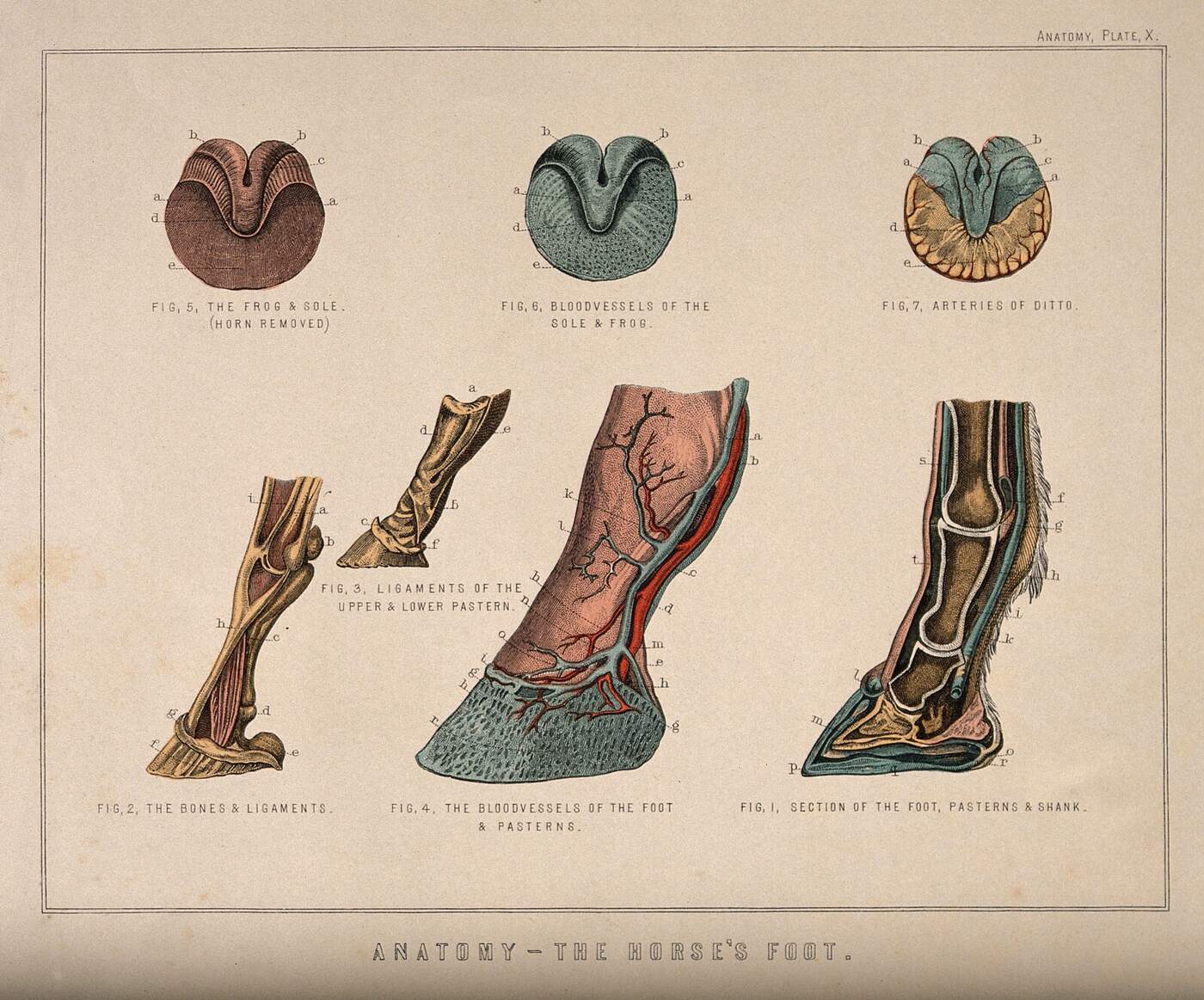
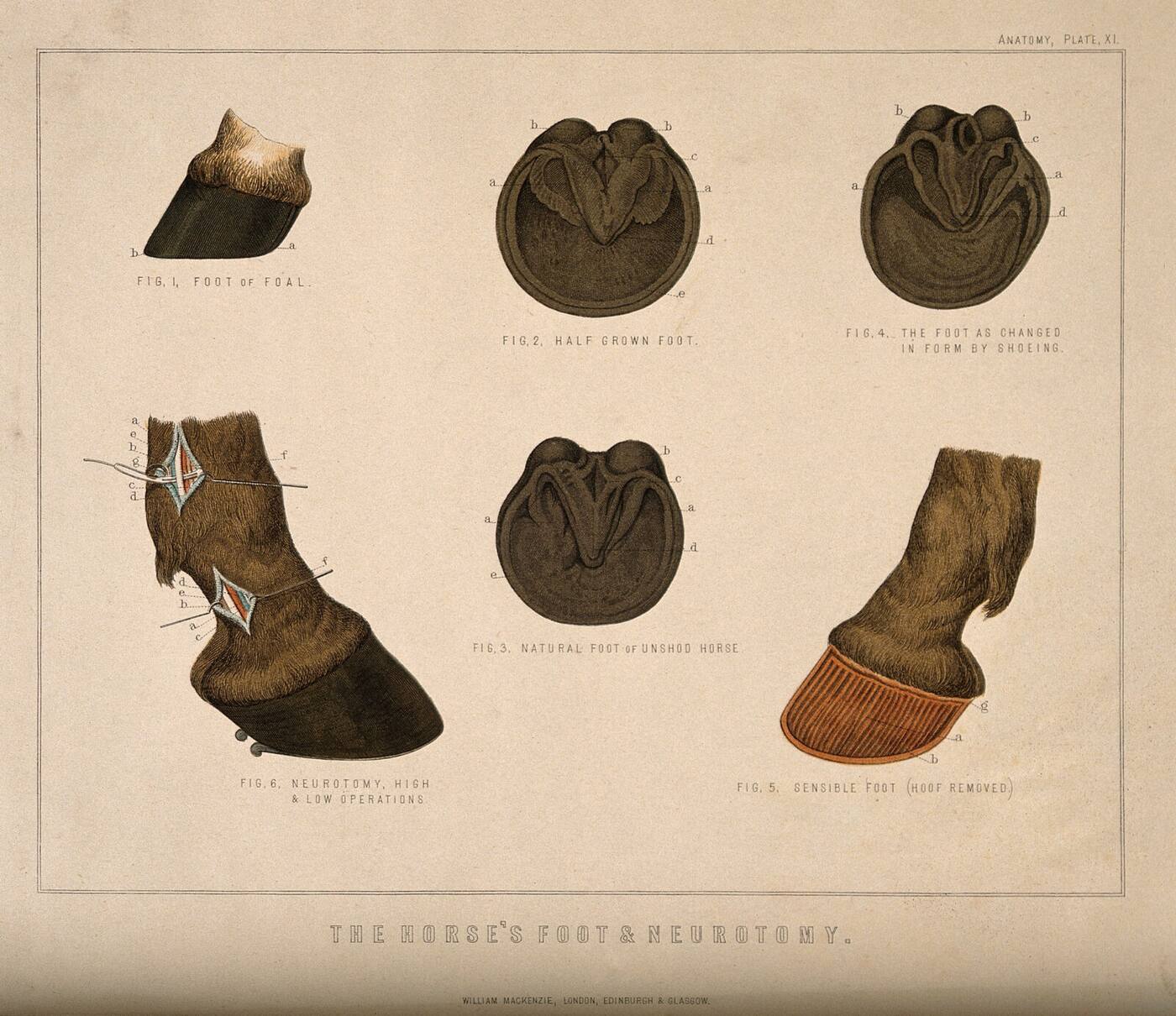
The wall of a hoof is a cornified epidermal appendage of the third digit: the same class of structure as a fingernail or a claw, made from the same family of keratins. The entire mass of a half-tonne animal, at speed, passes through four of them. They are also being manufactured continuously, from the top down, which is the fact the popular answer leaves out. A horse standing in a field is replacing its feet whether anyone attends to them or not.
How fast? This has been measured properly, more than once, and the numbers agree. Forty-two Lipizzaner stallions at the Spanish Riding School grew 0.25 mm of wall a day at the toe, which Josseck and colleagues report as seven millimetres every twenty-eight days and, in the same sentence, as a wall renewal period of 11 months. Shetland ponies on unrestricted feed managed 0.384 mm a day and the same ponies on restricted feed only 0.254, which is a fifty per cent difference from the feed bucket alone. The same mares' shod forefeet managed 0.19. The range across the studies this page read is 0.19 to 0.38 mm a day, and the folk figure of about a centimetre a month sits comfortably inside it.
A slightly lower anchor, 0.18 mm a day, circulates in this literature attached to a 1998 trial. Going and looking for it, that daily rate is not in that paper's own abstract at all: it appears only in a later paper's citation of it. So it is not on the slider below. That is a small thing, and it is the kind of small thing that turns a range into a rumour.
Wear is the other half of the budget and it is in a much worse state. There are, as far as this page can establish, two studies that actually measured how fast a horse wears its feet away, both on sand or pasture. Malone and Davies watched eleven barefoot Quarter Horse mares lose 0.169 mm a day in a sand paddock, against 0.059 when the same horses were shod. Semi-feral ponies on summer pasture reached 0.52 in the high-wear case, which is more than any horse in the literature grows. That last figure comes with a caveat the page will not bury: the sentence it is quoted from states no time unit, in a paper that labels its growth rates as daily explicitly two paragraphs earlier. Reading it as a daily rate is an inference, and it is the inference the top of the slider rests on.
And nobody has published a wear rate for a horse working on a road. That is the single most conspicuous hole under the most confidently answered horse question on the internet. Nor, for that matter, has anyone measured how long it takes wear to consume a wall: there is no published depletion time for a hoof at all.
The hoof budget
a tap and a drain, in millimetres per day
Malone and Davies 2019: eleven Quarter Horse mares, seven weeks shod and seven barefoot.
Published range: every measurement study ever made of this, from Butler and Hintz 1977 to Malone and Davies 2019.
Published range: two studies, both on sand or pasture. There is no measured figure for road work, so the top of this slider is where the evidence stops.
The vertical lines on the chart are your chosen interval. Six to eight weeks is convention, not a measurement, but what happens when you stretch it has been measured.
Why do horses need shoes?
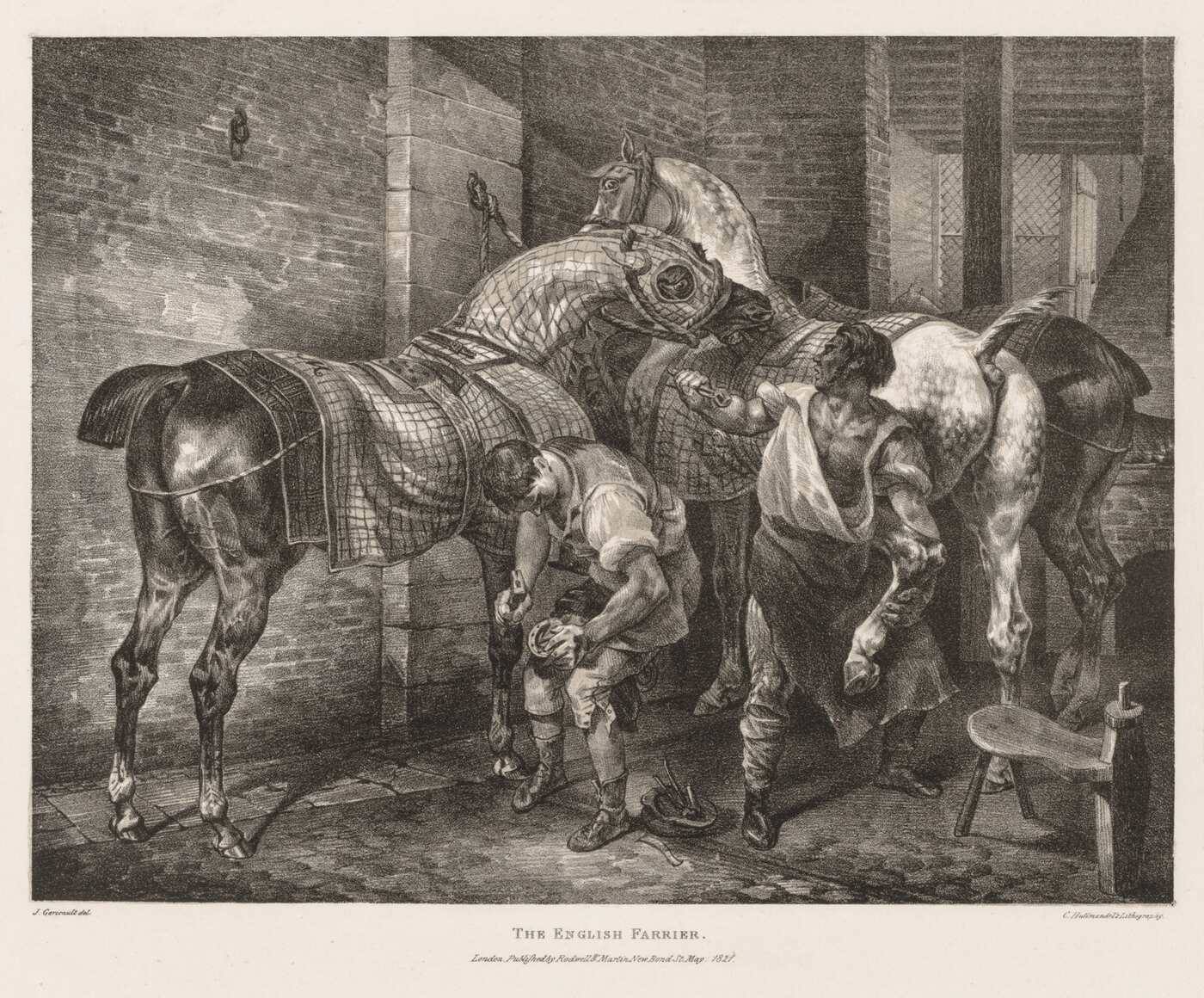
Why do horses need shoes, put like that, has a shorter answer: because we took an animal evolved for dry open range and asked it to carry weight over surfaces it did not evolve on, for distances it did not choose, and on some of those surfaces the drain runs faster than the tap. A horseshoe is the cheapest available way to close the tap end off entirely. It is not a correction of a defect in the horse. It is a correction of a mismatch between a rate and a job.
Why do horses wear shoes?
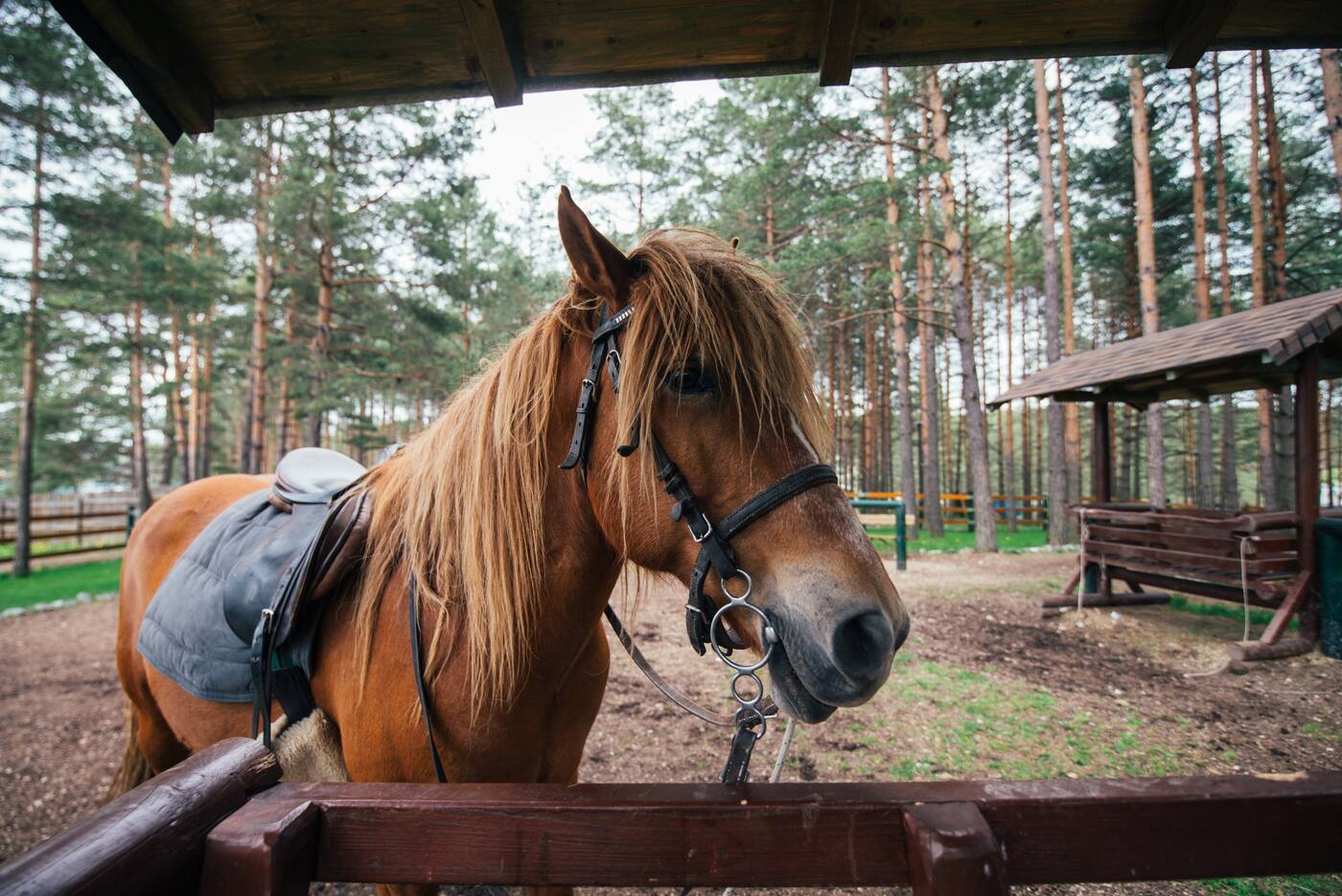
Why do horses wear shoes rather than something else is partly an accident of metallurgy and partly a fact about the foot: the wall is thick enough at the toe to take a nail through dead horn and nothing else about a hoof offers a purchase. Modern alternatives exist, glue-on shoes and hoof boots among them, and one of them, a split-toe design, has been shown to leave heel movement statistically indistinguishable from barefoot where a conventional nailed shoe does not.
Why are horses shoed?
Why are horses shoed is the same question with a spelling most farriers would correct: the past participle is shod. The answer is the budget above, plus a list of genuine clinical indications that has nothing to do with wear at all. Therapeutic shoeing for laminitis, for navicular disease, for a broken wall, for a horse whose sole is too thin to protect itself: in those cases the shoe is doing a different job, and in at least one of them the biomechanical benefit is properly measured rather than asserted.
Why do horses wear horseshoes?
Why do horses wear horseshoes, historically, is a question with a less certain answer than the internet suggests. The dates that circulate for the invention of the nailed shoe are mostly untraceable, the Roman evidence is genuinely disputed among archaeologists, and the hipposandal, a strap-on iron plate, is a different device from a nailed shoe and gets conflated with one constantly. The honest summary is that nailed shoes are securely attested in Europe from the early medieval period and that everything earlier is argued about.
What people say
"All horses need shoes." and "No horse needs shoes." These are the two positions, and neither is a finding. A systematic scoping review of forty-six studies of shoeing and gait, published in 2025, concluded in its own abstract that there was "little consensus among unrelated studies", with small samples, single breeds and no randomisation as the standing limitations. Anybody who tells you this question is settled is telling you about themselves.
Two measured things do cut across the argument, in opposite directions. Loading the distal limb with 0.6 kg per foot raised metabolic rate at trot by 6.7 per cent, an order of magnitude more than the same mass carried on the back: mass on the foot is expensive, which is the strongest quantitative argument the barefoot side has. And fourteen previously barefoot horses scored lower on lameness after twelve weeks shod behind. Neither settles anything, and neither is usually quoted by the side it does not suit. Nobody has ever measured the oxygen cost of an actual set of horseshoes, which is a cheap experiment sitting unperformed in the middle of a century-old argument.
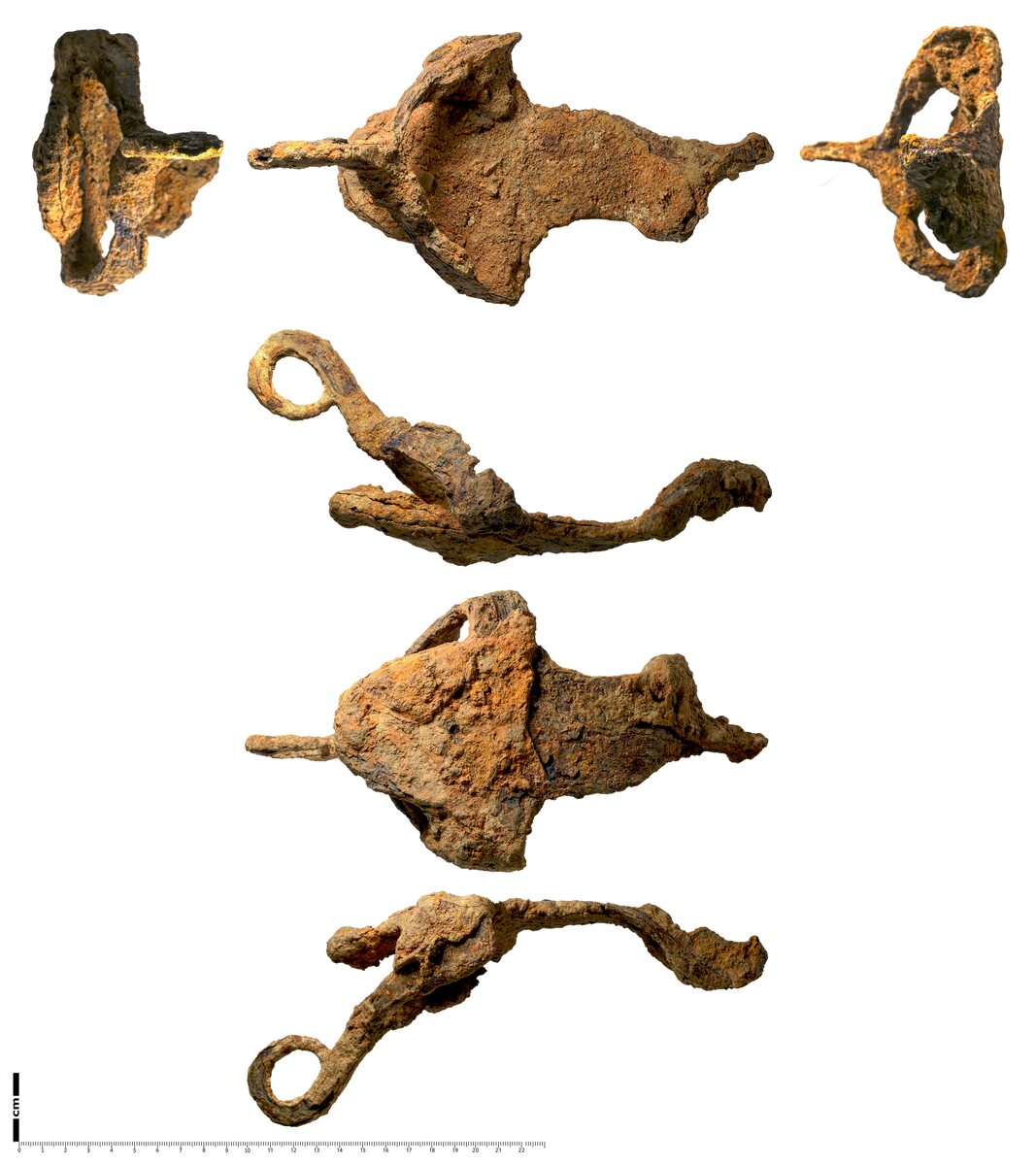
What the six-week cycle is actually for
At the surplus rates above, a foot gains something like three to six millimetres at the toe over six weeks. That sounds too small to matter, and the reason it matters has been measured: over an eight-week shoeing interval the hoof angle of sound Warmbloods fell from 55.4 to 51.9 degrees, and the moment about the coffin joint rose significantly while the moment about the joint above it did not. In plain terms, the growth quietly increases the load on the deep digital flexor tendon. The trim is not tidying. It is resetting a lever.
What nobody has measured
How fast a hoof wears on tarmac. The oxygen cost of a real set of shoes. Whether restricted heel expansion under a nailed shoe does any harm at all, which is asserted constantly and demonstrated nowhere. And the thing repeated in every barefoot discussion, that a transition takes six to twelve months: a search of the veterinary literature for a study of barefoot transition returns nothing.
§2 · the answer is a field
Why do horses wear blinders?
Because "blinders" is not one thing, and neither is the field it acts on. The three questions in this section look like one question and are not. They cover at least seven distinct devices, aimed at four different targets, only two of which are the visual field at all. And the field they are aimed at is stranger than the popular account: a horse's sharp vision is a horizontal band, not a spot, and its two-eyed window is small and points down its nose, not straight ahead.
Start with the number everybody quotes. A horse, it is said, sees about 350 degrees around itself, with a monocular field of 195 degrees per eye and a binocular overlap of 65 degrees in front. Those three figures are printed side by side in textbooks and reviews, and they are not three independent measurements. For two laterally placed eyes the total is fixed by the other two: T = 2M − B. Put the canonical numbers in and you get 325, not 350. The set is 25 degrees short of itself, and the gap runs from 15 to 40 degrees depending on which variant of the numbers you pick up. To reach 350 with a 65 degree overlap a horse would need a monocular field of 207.5 degrees, which is more than any source prints.
That is not a nitpick, because it is the only quantitative thing anyone ever says about what these devices do. If the caudal blind wedge is not known to better than twenty degrees, then nothing that claims to enlarge it is known either. Drag the two sliders and see how much has to move before the published total is reachable.
The field, and the devices over it
seen from above, nose at the top
A confident answer that was tested and died
For decades the textbook explanation of why a horse raises and lowers its head was the ramp retina: a sloped retina giving the animal a passive focus it selected by head position. It was evaluated in 1975 and rejected, and in 1999 a second team found the axial length variation ran the opposite way from the one the ramp required, and measured acuity at 16.5 cycles per degree in the visual streak against 2.7 in the periphery. A horse rotating its head to put a distant object on its worst retina would be doing something very strange. What replaced the ramp is the finding this whole section rests on: the horse lifts its nose because the binocular window is down the nose, with a blind area directly in front of the forehead. The idea was still being discussed in a comparative ophthalmology review in 2025, half a century after it was killed.
Why do they cover horses' eyes?
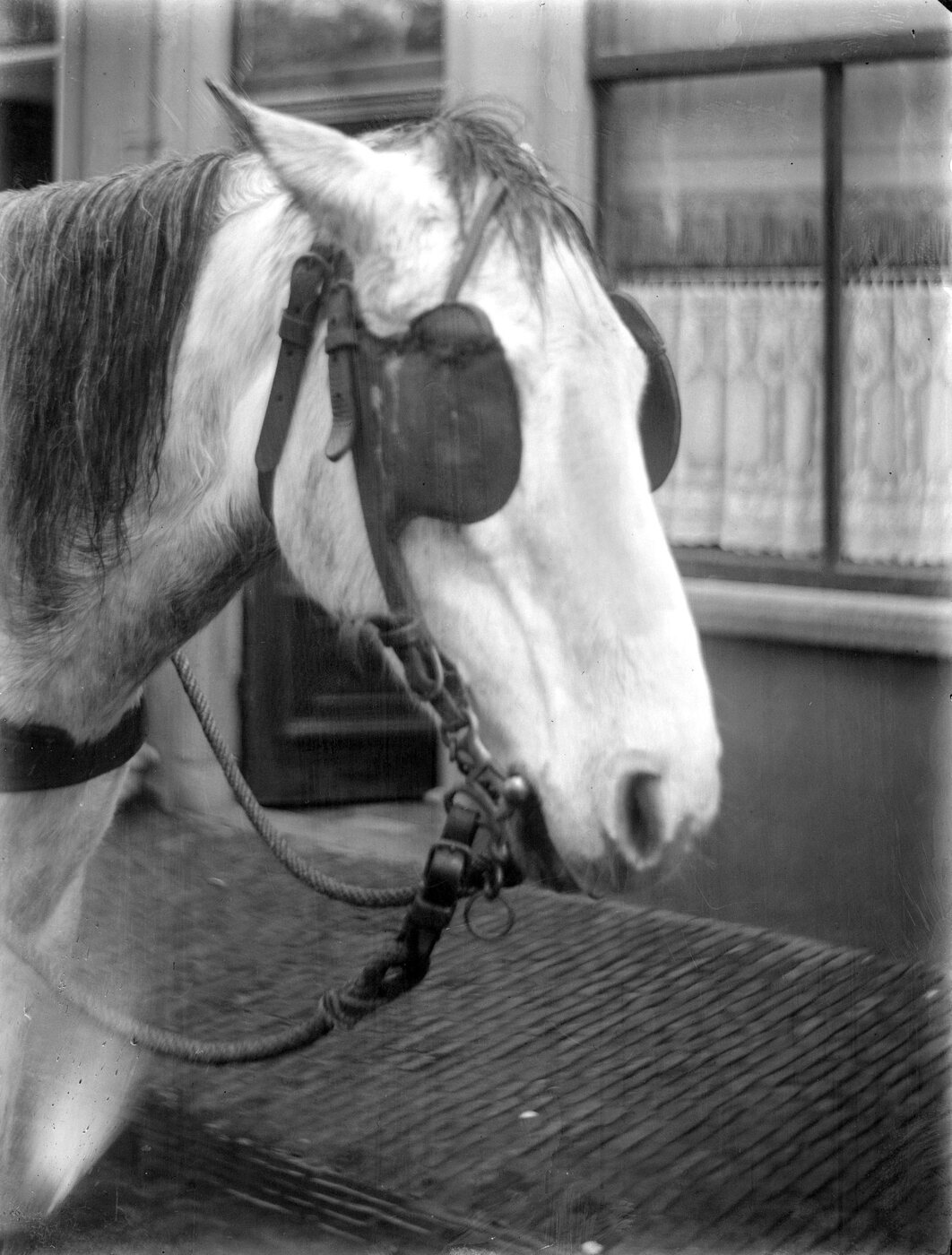
Why do they cover horses' eyes depends entirely on what is doing the covering, and the British Horseracing Authority's own rulebook distinguishes seven declarable items where common speech has one. A hood has ear covers and no eye cowls at all. Blinkers have cowls "cutting out all vision to the rear but permitting full forward vision". A visor is blinkers with holes cut in the cowls. An eyeshield replaces the cowls with transparent mesh. An eyecover blanks one eye entirely. Cheek pieces are strips of sheepskin on the bridle. Note that the taxonomy is written entirely in terms of construction and never once in terms of degrees: the sport that regulates these devices most tightly has never specified what any of them removes.
It has not been measured anywhere else either. Searches of the veterinary and vision literature for a measurement of the equine visual field with and without a blinker return nothing. What can be said follows from the geometry: the rear field is the monocular field, the low-acuity motion-detecting part, so a blinker takes a bite out of the periphery and does not touch the sharp band or the binocular window. The one number that exists about eye cover in use is a risk figure, not a performance figure. Across 806764 British flat starts, horses wearing eye cover for the first time had 1.83 times the odds of race-day fatality. Horses that had worn it before were at no elevated risk at all. That pattern points at novelty rather than at the equipment, and it is observational: trainers fit first-time blinkers to horses that are already running badly, so the decision to fit is anything but random.
Why do horses wear masks?
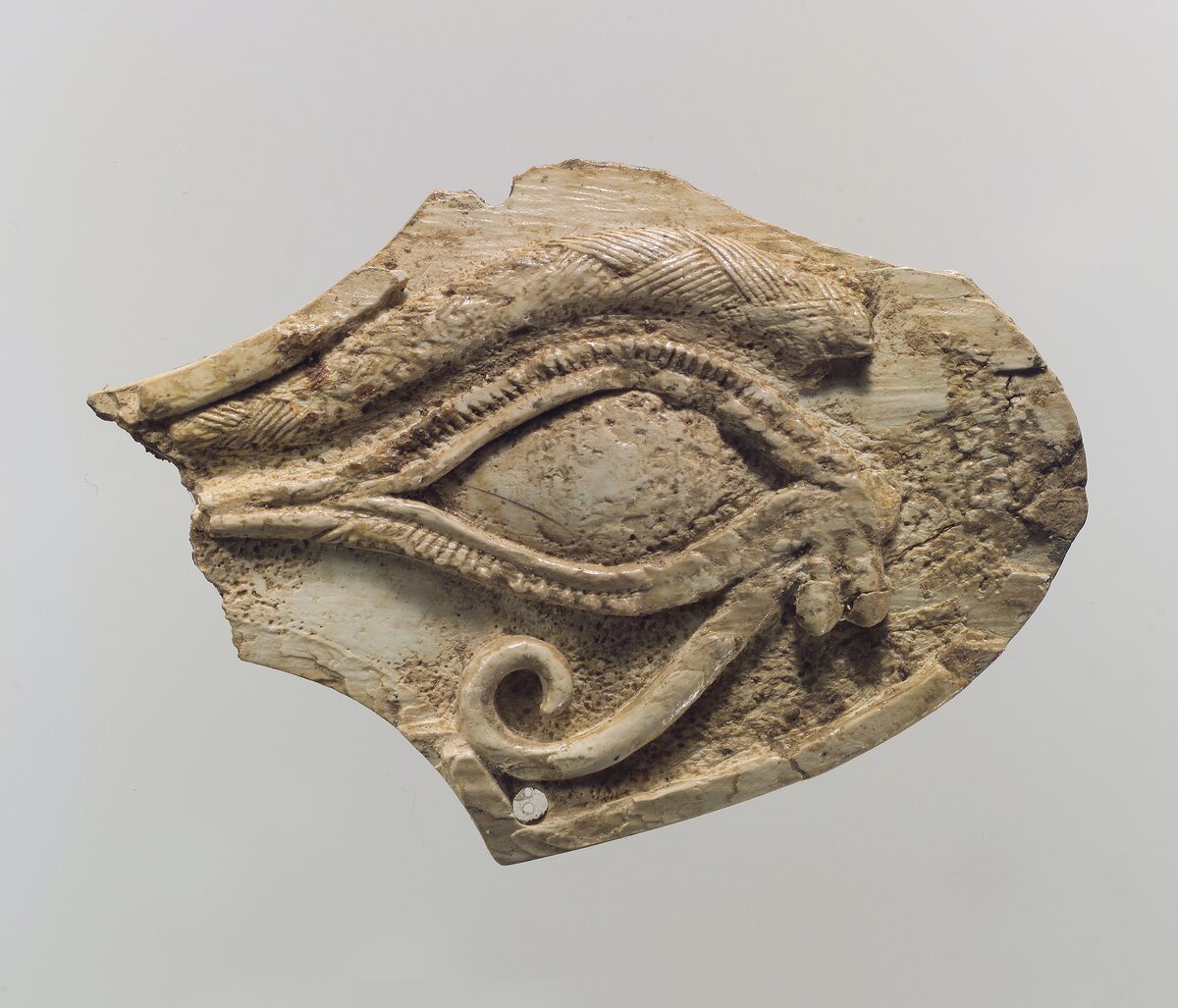
Why do horses wear masks is the question in this group with the clearest mechanism and the emptiest evidence base. A fly mask is mesh over the eyes, and it is not a vision device at all: it is aimed at insects and at photons. The photon half has a real, quantified story behind it, and it is about a disease rather than a mask. Ocular squamous cell carcinoma in horses rises with altitude and solar radiation and falls with latitude, hits unpigmented breeds hardest, and in Belgian horses is carried by a recessive variant in DDB2, a gene whose protein locates ultraviolet damage in DNA so it can be repaired. Horses homozygous for it had four times the risk. Sunlight breaks the DNA, the repair pathway is broken, the tumour follows. That is a mechanism worth covering a face for.
And yet: no study has ever shown that fitting a fly mask prevents any of it. Not the carcinoma, not uveitis flares, not photosensitivity. The UV figures printed on the packaging, 90 and 95 and 98 and 99 per cent, are manufacturer claims; there is no peer-reviewed measurement of the spectral transmittance of any equine fly-mask mesh, nor of what looking through one does to acuity. Where a mask has been evaluated, it did poorly: among owners of headshaking horses using light-blocking masks, only 3.8 per cent found them effective alone and 50.0 per cent found them not effective at all, while a nose net, which covers no part of the eye, improved roughly 75 per cent of cases in a field trial. For that condition, covering the nose works and covering the eyes mostly does not.
Why do horses wear blinders?
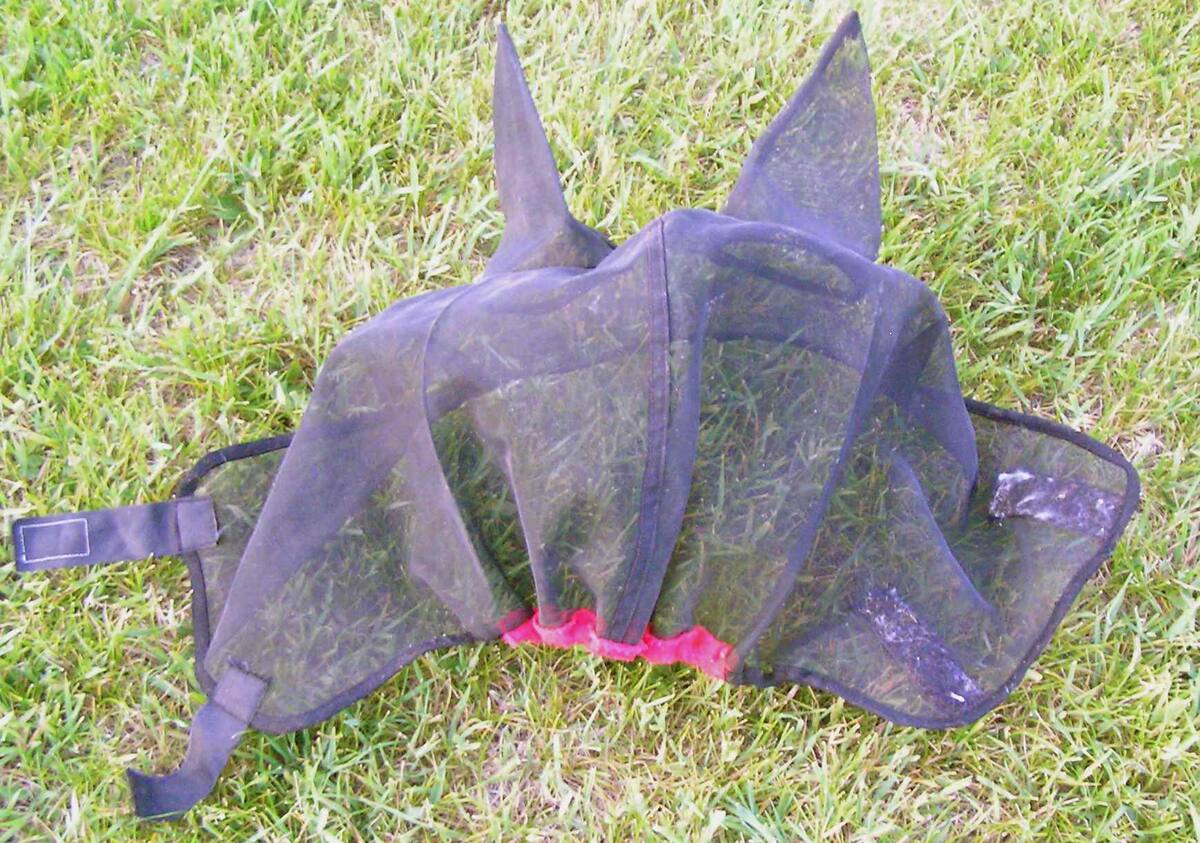
Why do horses wear blinders, in the harness sense, has a Victorian answer that runs against the modern one. Edward Fordham Flower, who led the great campaign against the bearing-rein, allowed in 1885 that blinkers "may afford protection to the eyes, if the driver is careless or cruel with his whip", and then argued that covering a horse's eyes makes it more reactive, not less: a horse that hears a thing and cannot see it is the alarmed one. Admiral Rous put it in a letter Flower printed: "a horse hearing an unusual noise becomes alarmed when he cannot discover the cause, but with his eyes open he is as sensible as a human creature."
Read that first clause carefully, because this page had it wrong in draft and its own audit caught it. Flower's whip sentence is concessive, a grudging aside inside an argument against the device, and it is not evidence that whip protection was the period's stated purpose. The stated purpose is in Black Beauty, chapter 10, and it is the modern one: fear of what is behind, and of the vehicle following. What is genuinely striking is that the chapter putting that case is a sustained argument against blinkers, and that Sewell also has a character make, correctly, the point about lateral eye placement that this section opened with. The prediction underneath Flower and Rous, that covering the rear field makes a horse more reactive to what it cannot locate, is testable. Nobody has tested it in a hundred and forty years.
What people say
"They all narrow the horse's vision so it can only look forward and concentrate." Every clause of that fails. They are not one thing. A blinker takes the rear, by the rulebook's own definition, which says it permits full forward vision. A fly mask removes no field by intent and an ear bonnet touches the visual system not at all. And the one folk claim with any evidence against it, that a blindfold calms a frightened horse, points the other way: blindfolded horses in two studies took longer, needed more lead-rope pressure, refused more and ran higher heart rates. The one exception is telling. Faced with an obstacle that was visually frightening, blindfolded horses got past it faster and with less resistance. A blindfold is a tool for refusal, not for panic, which is exactly backwards from the barn-fire story everyone tells.
What nobody has measured
This page could find no perimetry study of the equine visual field of the kind routinely done on humans, and on birds. Every degree figure here is reconstructed from ocular anatomy or quoted from a review quoting a 1977 comparative book chapter, and the figures are not commensurable with each other. The caudal blind wedge has no published angle and neither does the blind area in front of the forehead. Nobody has measured what a blinker, a visor or a French cup removes. Nobody has measured a fly mask's transmittance or an ear bonnet's attenuation in decibels. There is no peer-reviewed literature on shadow rolls of any kind. And the European Union's 439,000-character scientific opinion on the welfare of horses in transport does not contain the word "blindfold" once. It uses "blinker" exactly once, to recommend removing them before loading, filed under restriction of movement, beside bandages and hobbles, rather than under anything to do with vision.
§3 · the answer is a budget
Why do horses sleep standing up?
They do not, or rather they only do half of it standing. A horse can hold drowsiness and slow-wave sleep on its feet, and that is most of its sleep. It cannot sustain paradoxical sleep there, the stage a human would call REM, because that stage abolishes the muscle tone the standing posture is made of, and a horse that enters it standing begins to fall and wakes. So the answer depends on which stage you mean, and the half that cannot be held standing has a floor underneath it.
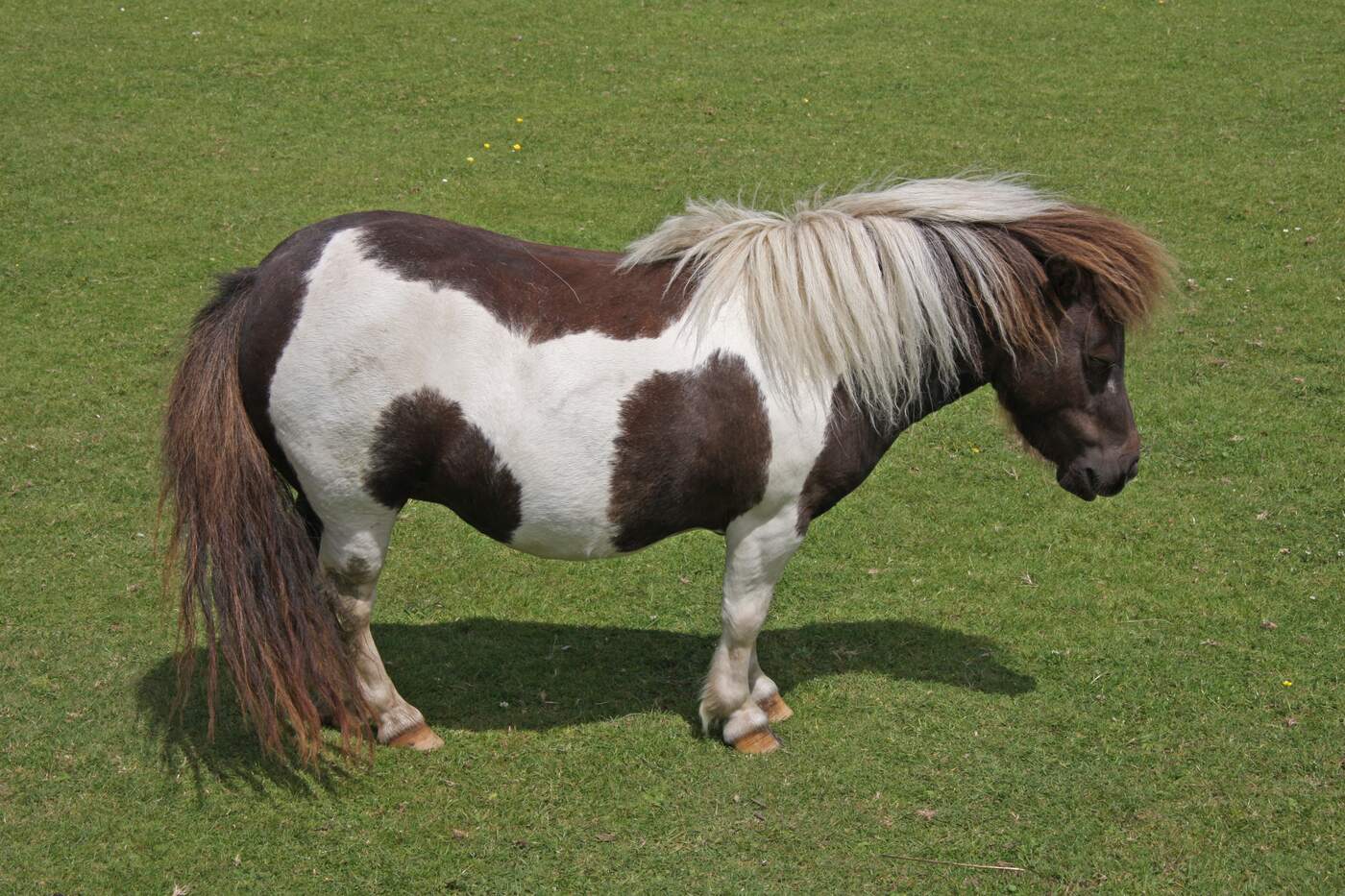
How standing gets cheap
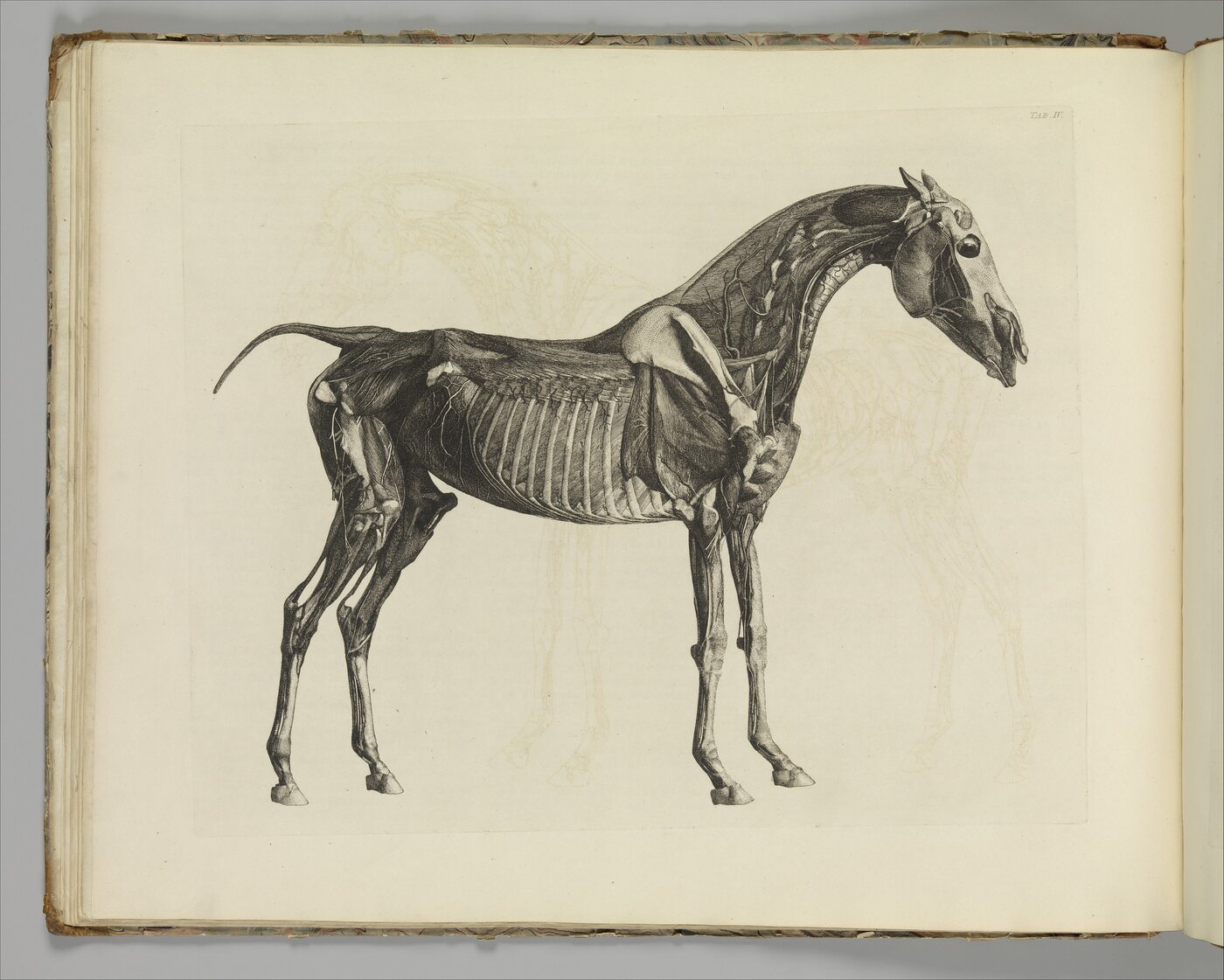
The mechanism has a name, the stay apparatus, and a textbook description that turns out to be wrong in an interesting way. The patella hooks over a ridge on the femur, the medial patellar ligament loops over it, and the stifle is held in extension; a pair of effectively ligamentous structures then tie the hock to the stifle so that if one cannot flex, neither can the other. Everything below is held by tendon. On the authors' own calculation this is about a 98 per cent mechanical saving.
What the textbooks said, and what the one direct measurement found, differ. The received account is that the lock is passive, costing nothing. When Schuurman and colleagues took fresh isolated hind limbs, locked the patella by hand and applied small loads, the limb collapsed immediately every time, and in standing horses they recorded continuous low-level activity in the vastus medialis holding it. The apparatus makes standing cheap. It does not make it free, and a horse is not a deckchair.
The half that cannot be bought standing
Pooled across the polysomnography studies, a horse sleeps about 231 minutes in twenty-four hours, roughly a quarter of what a human sleeps, of which about 40 minutes is paradoxical sleep in bouts averaging 3.7 minutes. Meanwhile a tracked population of eighty-three horses spent 75.6 per cent of the day standing and lay down for a mean of 67.4 minutes, with a range from nothing at all to 319. 13 of the eighty-three never lay down during the study at all, staying up for more than seventy-two hours.
Where the rule is partly a definition
"Paradoxical sleep only happens lying down" is the sentence this section turns on, and it needs a qualifier the popular version never carries. Horse sleep is scored with the criteria written for human sleep, and those criteria include muscle atonia in the definition of the stage. Under that definition the stage is ruled out standing before anyone measures anything. What the recordings actually show is narrower and more interesting: healthy horses with normal lying behaviour essentially never sustain it on their feet, but horses that will not or cannot lie down do enter it standing, over and over, and the way you know is that they start to collapse. One surface-EEG study caught it in one of five horses with numerous partial collapses, and the largest series score such epochs by the dozen. So the floor is real. The wall around it is partly made of scoring rules.
Now put the two published numbers in the same sentence, which is what nobody seems to have done. The welfare literature uses a threshold of 30 minutes of recumbency a day, derived in as many words from the observation that horses need some minimum of paradoxical sleep. The paradoxical sleep durations it derives that from run from 22.5 to 57.6 minutes a night. You cannot fit forty minutes of anything into thirty minutes of lying down.
The budget, and what it cannot hold
it is not sustained standing, so it cannot exceed the lying down
Measured mean 67.4 min in 83 tracked horses. Thirteen of them managed none at all.
The published spread, 22.5 to 57.6 minutes a night, from the very studies the 30-minute threshold was derived from.
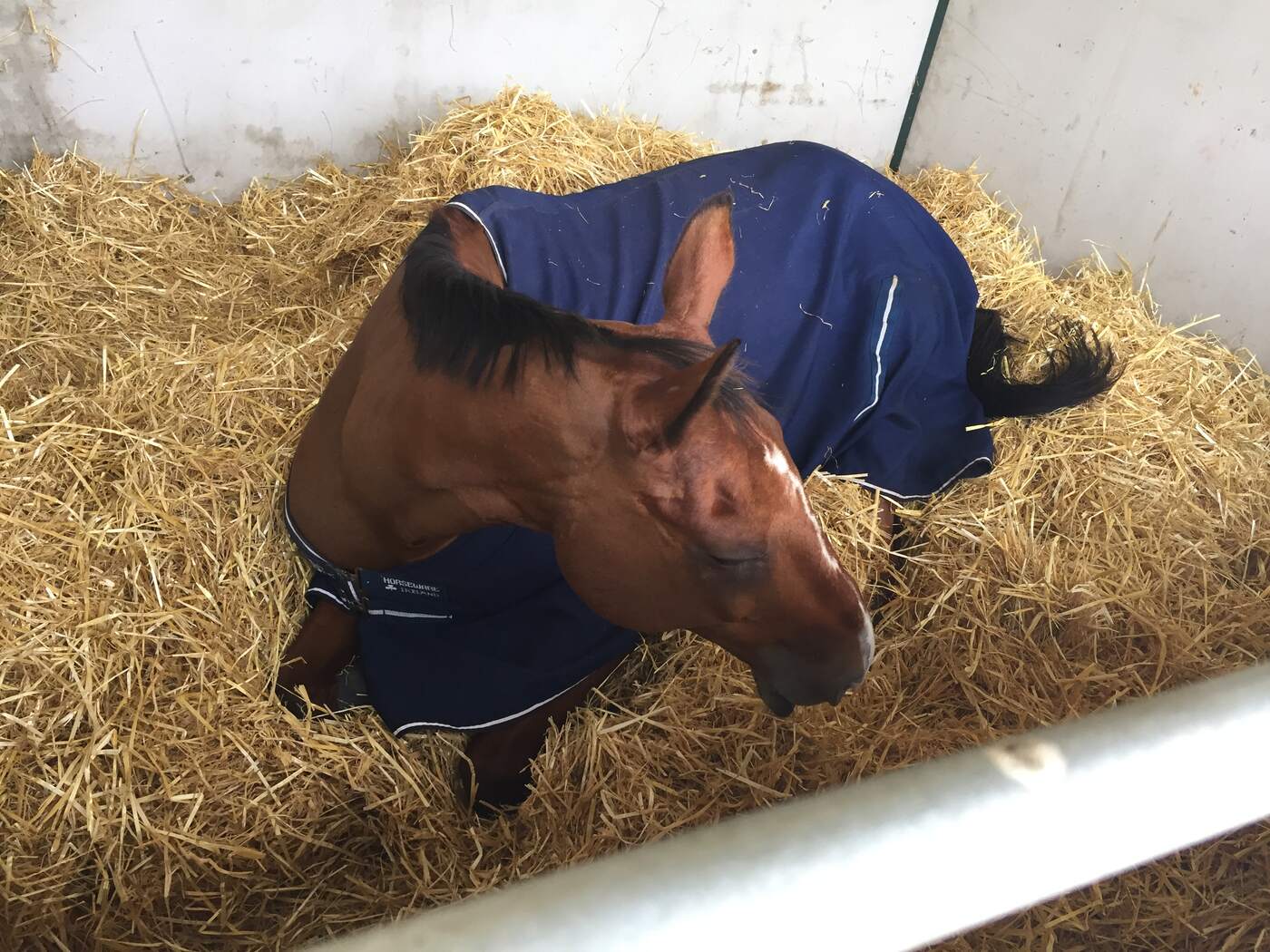
What people say
"Horses sleep standing up." Half true and load-bearing in the wrong place. They doze standing, which is most of the budget; they must lie down for the rest of it, and horses that cannot lie down, from pain or a stall too small or a herd position too insecure, go paradoxical-sleep deficient and begin to buckle. The evolutionary story underneath, that a prey animal on open steppe cannot afford the seconds it takes to rise, is a plausible narrative and not a measurement: nobody has published a time-to-rise figure against a predation risk.
What nobody has measured
The energy cost of standing against lying down, in a horse. It is the quantity the whole explanation turns on and it has never been measured in this species. The thirty-minute recumbency threshold has never been titrated against paradoxical-sleep sufficiency; it was inferred. Nobody knows how long a horse can go without lying down before the collapse episodes begin. And the sentinel story, that horses in a group take turns keeping watch, is repeated everywhere and rests on very little.
§4 · the answer is two voices at once
Why do horses neigh?
To call to a horse that has gone out of sight, in two voices at once. The whinny is a contact call, and it is the reason this section exists rather than being a line in somebody's list of animal noises: every whinny analysed in the study that looked contains two fundamental frequencies that are not multiples of each other. Not a harmonic and its overtones. Two independent sources, sounding together, from one animal. As of February 2026 we know they are not even the same kind of source.
The measurement: 267 whinnies from eighteen horses on five Swiss farms, recorded at five to ten metres, in five situations built around companions leaving and returning. Biphonation was present in 100 per cent of them. The lower fundamental, around 400 Hz, tracked emotional arousal, validated against the horses' own heart rates. The higher one, above 1000 Hz, tracked emotional valence, whether the situation was a good one or a bad one. Two channels, carrying two different things, in one call.
Then the mechanism, which is newer than most things on this page. Using excised larynges breathed with helium, CT scans, endoscopy, and the voices of horses with laryngeal nerve damage, Lefevre and colleagues showed in Current Biology in February 2026 that the high fundamental is not tissue vibration at all. It is an aerodynamic whistle, formed inside the larynx. The helium is the elegant part: a whistle's frequency depends on the speed of sound in the gas and shifts when you change the gas, and a vibrating vocal fold does not. So a whinnying horse is doing two unrelated things with one organ at the same time, and one of them is whistling.
Two voices, and how you can tell
listen, then watch the ratio
A single source is a harmonic series: every component is a whole multiple of one fundamental. So if you track the strongest thing in a low band and the strongest thing in a high band, and the two belong to one voice, their ratio is a whole number in every frame, and it stays that number however wildly the pitch slides, because the whole stack slides together. Two independent sources are under no such obligation. The statistic below is the mean distance from that ratio to the nearest whole number.
The recording is the supplementary audio published with the 2015 paper, trimmed and not otherwise altered. The page reads those samples and runs the transform in front of you; it is not showing you a picture of somebody else's analysis.
The instrument that did not work, reported rather than hidden
The first version of this test asked a simpler question: can one fundamental, with a decent share of its harmonics present, account for every peak in the spectrum? On synthesised signals it discriminates perfectly. On a real whinny it is unreliable, because a real call slides in pitch, its peaks smear across bins, and a low enough fundamental can be fitted to a noisy peak list by luck. It was replaced rather than tuned until it agreed, and it is mentioned here because a page that only ever reports the instrument that worked is telling you less than it knows.
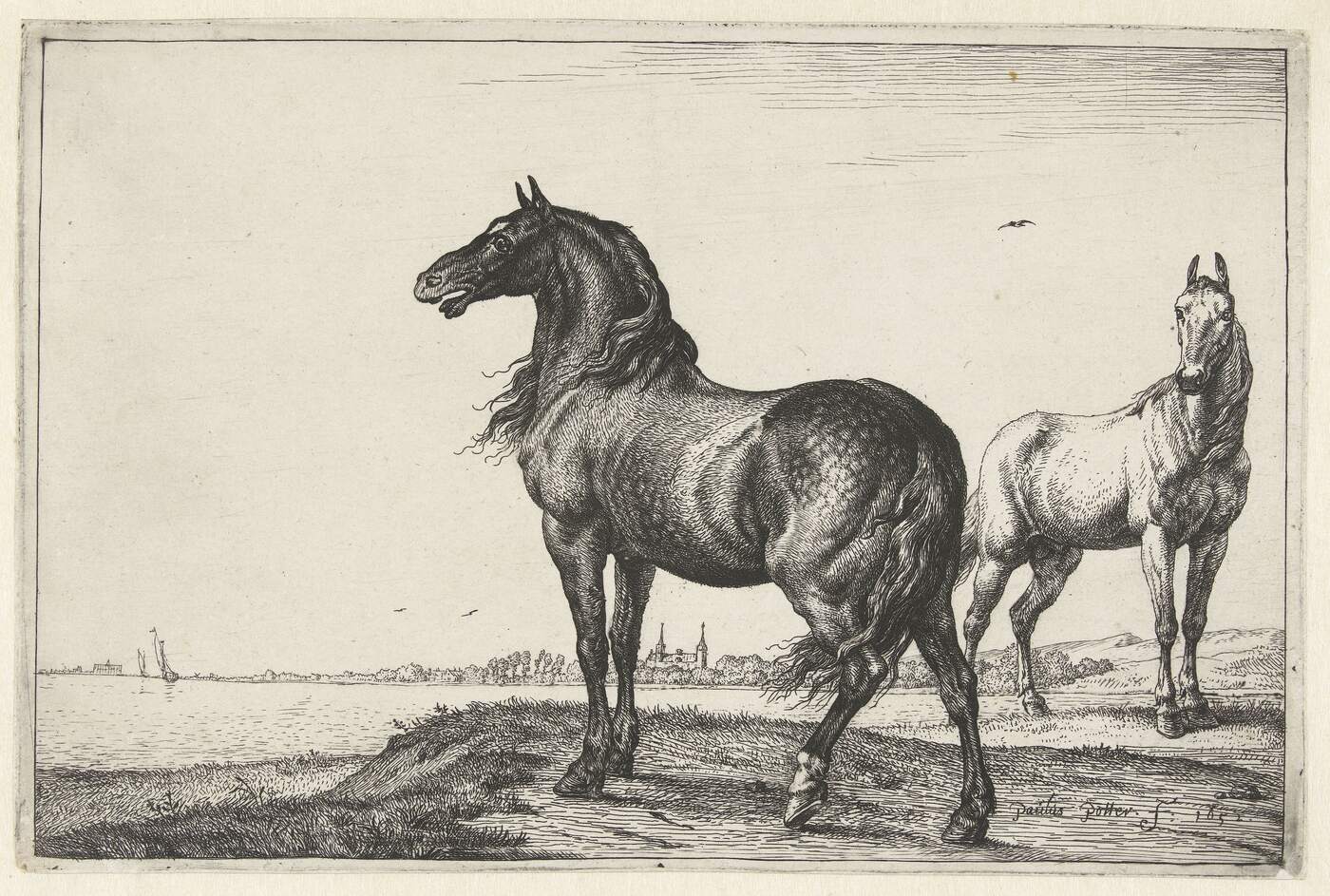
Why do horses nay?
Why do horses nay is the same question with the homophone: the word is neigh, and nay is the archaic negative. It is worth a line rather than a page, but it is evidence about something real. A search engine sees two questions and a corpus answers them twice; the two are one question and the page you are reading is the shape that follows from noticing.
What people say
"A horse neighs when it is happy to see you." The call is about separation and reunion, not about you, and it carries arousal and valence on two separate channels, so "happy" is one of the two things it encodes and not the loud one. The nicker is the close-range greeting. The snort has been argued to mark positive states, and that claim has one research group behind it and no independent replication this page could find, which is the honest thing to say about it.
§5 · the answer is an absence
Why do horses have manes?
Nobody knows, and the confident answers you will find are not standing on anything. Four explanations circulate: warmth, flies, signalling, protection in a fight. Of those, 0 have ever been tested on an equid mane. Not one experiment. The comparative morphology, by contrast, is genuinely good, and it points mostly away from the popular answers.
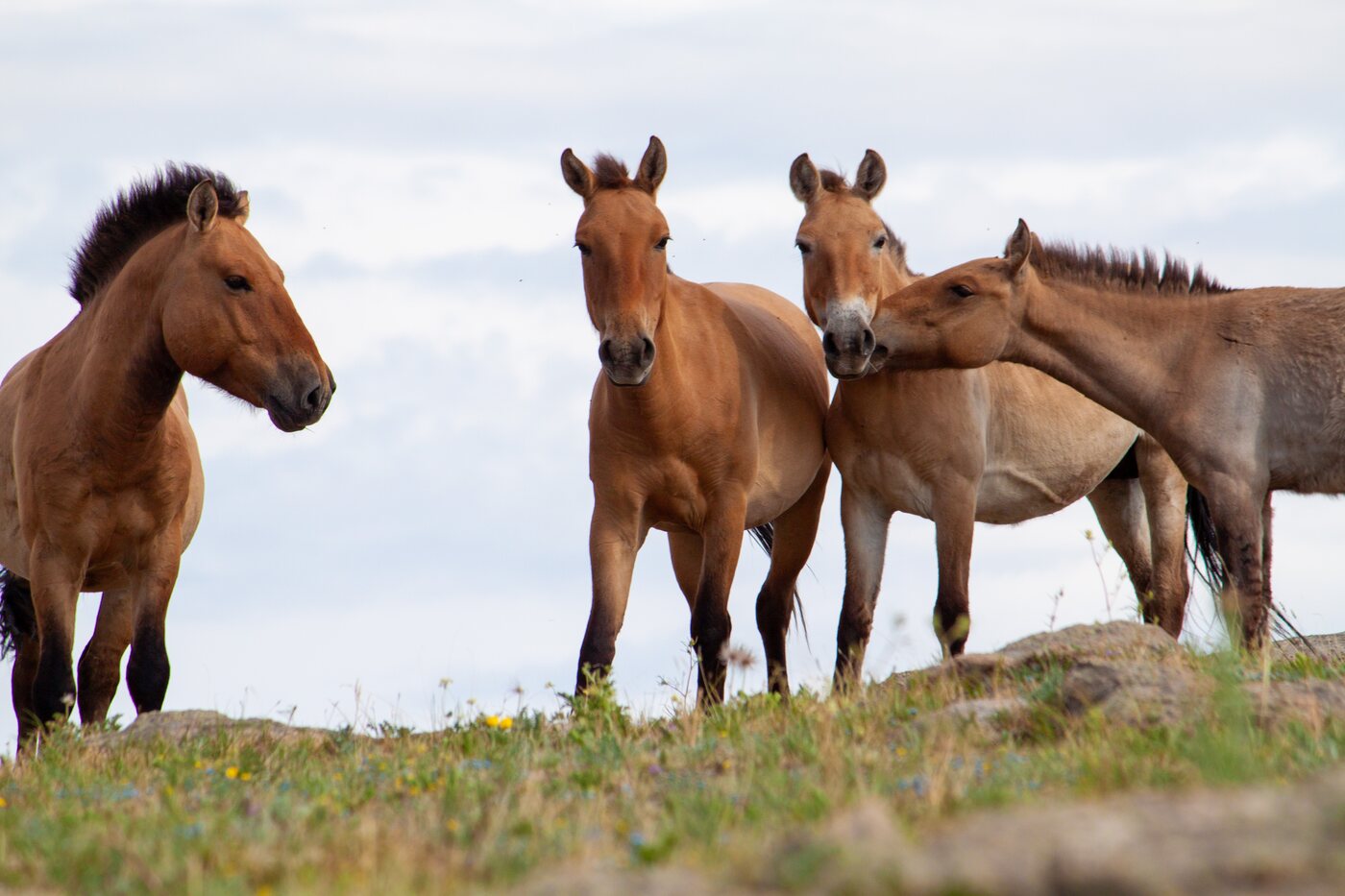
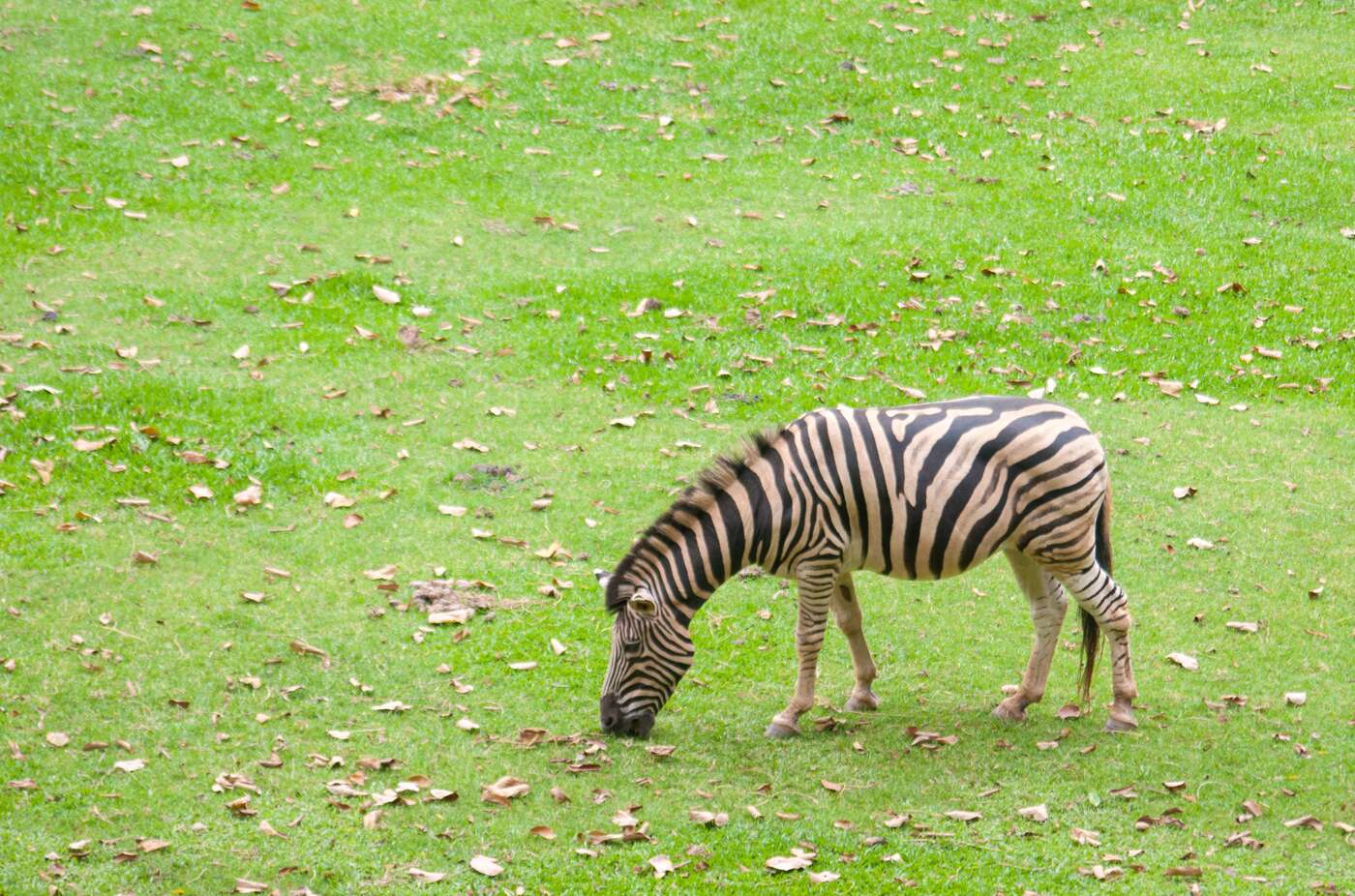
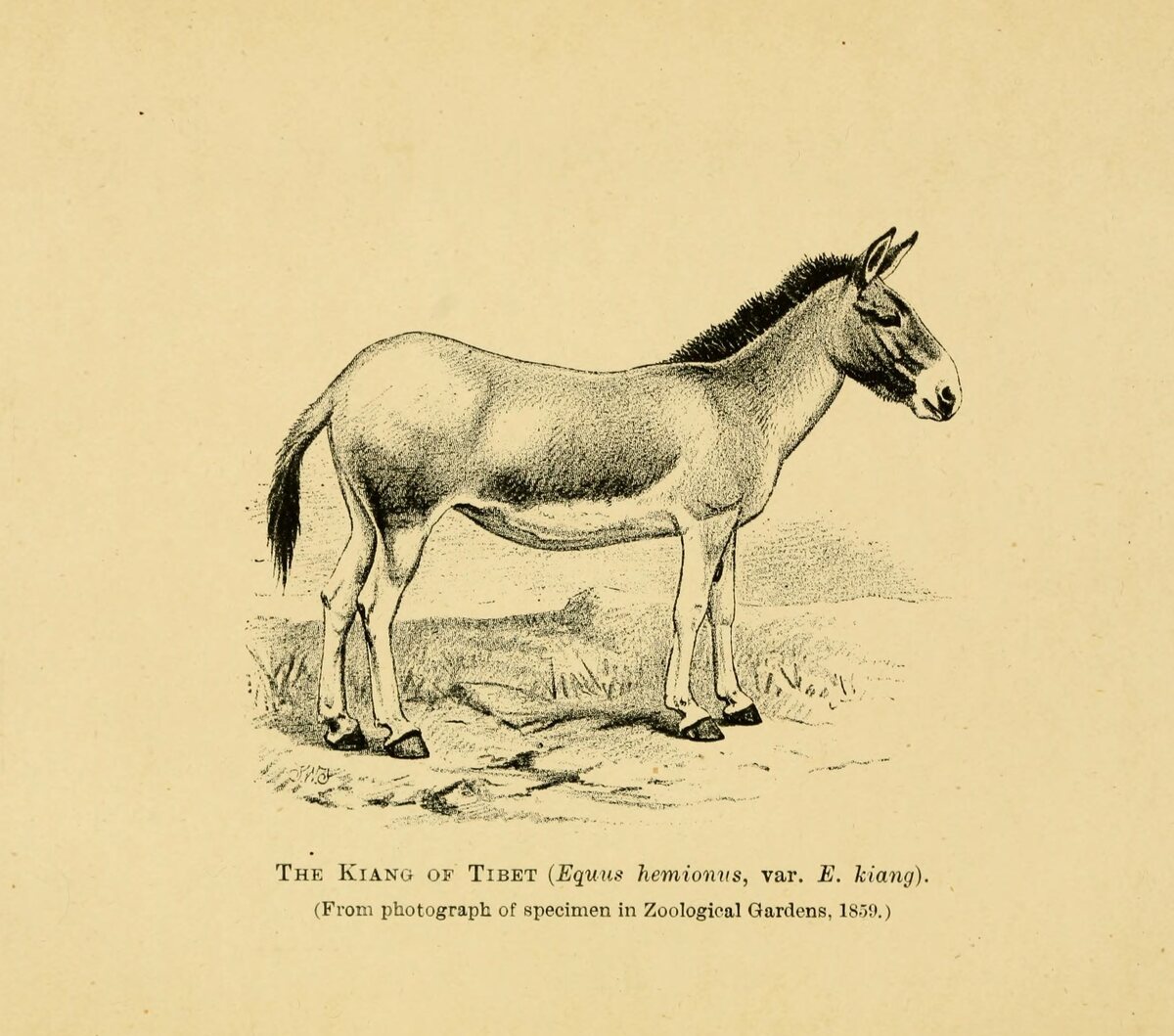
Start with what is solid. Across the family, the mane that falls is the horse's, and nearly every other equid carries one that stands up. The taxonomist of record describes the horses as having a mane that "tends, at least in winter and/or with increasing age, to fall to one side", the asses as having a short clipped one, the zebras as having long thick upright ones. Of the eight rows below, 6 are erect and 1 falls.
The family, and what is actually claimed about it
every row carries its source
| Species | Mane | Forelock | Where the row comes from |
|---|
Two rows are marked contested and the page means it. The kiang's mane is called "relatively long" on one page of a volume and "upright and relatively short" twenty-five pages later in the same volume. And Przewalski's horse is inside the very subgenus whose diagnosis says the mane falls with winter and age, which complicates the tidy domestication story considerably.
Why do horses have a mane?
Why do horses have a mane, asked in the singular, is usually asked expecting the warmth answer or the fly answer. Here is what those two are standing on.
Warmth has never been tested on any equid. The one large mammal whose mane has been instrumented is the lion, and the measurement went the wrong way for the thermal story: maned males ran a mean core temperature two tenths of a degree lower than females.
Flies is worse than untested. Nobody has tested whether a mane deters an insect, but where insects land on a horse has been measured, and it does not help. Tabanid horseflies land overwhelmingly on the legs and lower body, 76 per cent on the legs in cattle, so the crest is not where they go. Biting midges are the reverse, and this is the part that matters: on a bait horse in Ireland in 1984 the preferential landing and blood-feeding sites were along the mane and the lower legs, and 40.3 per cent of the ten thousand midges attracted took a full blood meal, mostly there. The mane region is somewhere biting insects go to, not somewhere they are kept off. It is also the predilection site for sweet itch, which is the disease those midges cause.
Signalling has nothing at all. Neck protection has one test, and not on a horse: in lions, the mane area was not a preferential target of attacks and mane injuries were not more lethal, and the authors reported no compelling evidence of effective protection. And the whole quantitative literature on the domestic horse's mane as a structure is a study of which side it falls on: five hundred and twenty-six Quarter Horses, 69 per cent to the right.
The evidence audit
switch between the claim and what stands behind it
| The explanation | what would settle it | tier |
|---|
What people say
"Wild horses have upright manes, and the floppy mane is what domestication did." Tidy, widely repeated, and it does not survive the family. Whole wild populations of plains zebra in a band running from Mount Kenya to southern Sudan are sparse-maned or maneless in three quarters of individuals, and in Somali populations manelessness is fixed; a maneless zebra was painted at the Mughal court in 1621. Manelessness is not a thing domestication did to anyone. And the subgeneric diagnosis that covers Przewalski's horse says horse manes fall with age and winter anyway. The falling mane does look like a horse-lineage character. What it is for is a different question, and the answer to that one is that nobody has asked it with an experiment.
§6 · the answer is a geometry
Why do police use horses?
Not for mobility, and the evidence is thinner than the confidence around it. The honest answer is a geometry: a mounted officer's eyes sit about eighty centimetres above the head-top plane of an adult crowd, and a standing officer's eyes sit about four centimetres below it. That is not a multiplier, it is a change of state, and everything else people claim for the police horse is either downstream of it or unevidenced.
A correction this page had to make to itself
This section was commissioned on the understanding that there is a randomised controlled trial of mounted police patrol. There is not. The paper that gets cited that way is a genuine randomised crossover experiment, in Perth rather than London, in which the words "mounted", "horse" and "equine" do not appear at all. The real flagship evidence is a 2015 RAND and Oxford study, and it describes itself, in its own words, as a quasi-experiment because the treatment was not randomised, adding that a direct causal effect therefore cannot be demonstrated. That correction came from the research rather than from the brief, and it is the first thing this section has to say.
What that study did measure is worth the trip. Across twenty-eight observed patrol shifts, mounted officers generated 6.5 times as many public engagements as officers on foot: 332 per shift against 50. Then look at how that total is made, because this is the part nobody quotes. The engagements longer than a minute, the category that contains every actual conversation and everything crime-related, come in at 12 per shift mounted and 12 per shift on foot. Identical. The entire 6.5 times is made of acknowledgements and of crowds gathering: being noticed, pointed at, photographed, patted. The horse does not buy more policing conversations. It buys being seen.
The sight line
similar triangles, and a threshold you are on one side of
The British road design standard specifies an equestrian eye height range of 1.5 to 2.7 metres. An adult on a 16.2 hand horse works out at about 2.48 m, and that figure is an estimate: no published measurement of saddle seat height above ground was found.
The first two numbers are arithmetic on measured heights. The third is a toy: it treats a crowd as a lattice of heads at the mean spacing implied by the density, and it has never been validated against a real crowd. It is here because it gives a far less impressive answer than the first two, and that contrast is the honest shape of this section.
The ten-foot cop
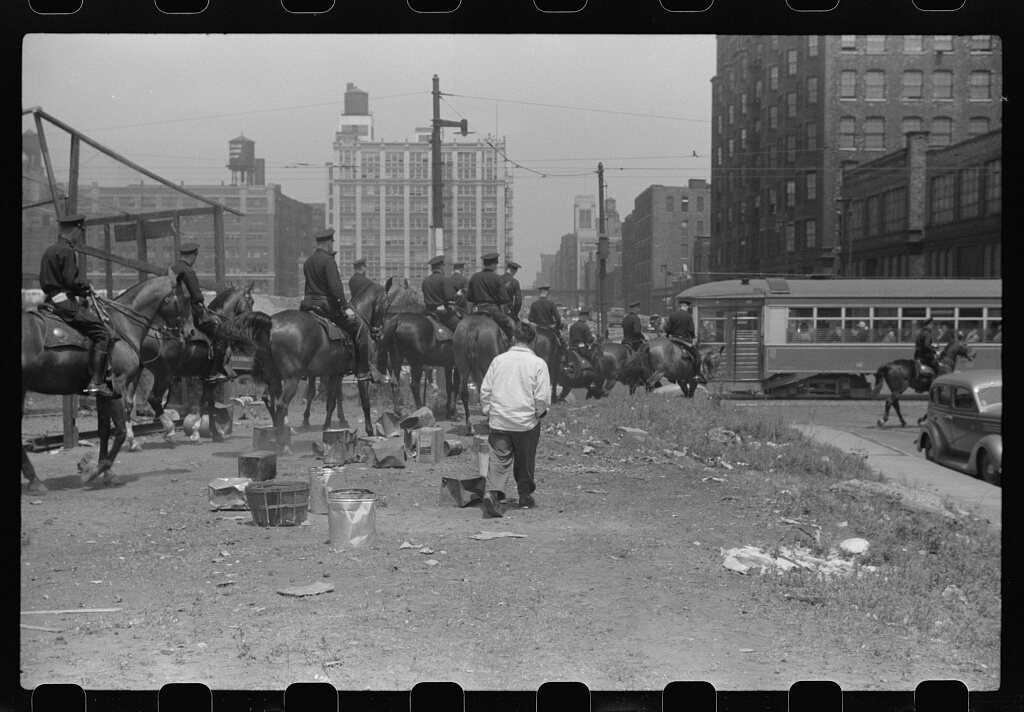
The claim that one mounted officer is worth some number of officers on foot, usually between four and twelve, circulates endlessly, and the first draft of this page said it traced to nothing. It does not trace to nothing. It traces to 1912, and to 1906 before that: it is in print in a New York paper reprinting a police magazine on the Chicago mounted squad, credited to the fire chief James Horan, and separately in the mouth of a New York school superintendent. The reason given, in both, is not reach or speed or coverage. It is that people are frightened of horses and fall back. So the oldest version of the claim already agrees with the modern evidence about what the horse is actually doing, which is working on the crowd's attention rather than on the officer's capacity.
What it has never been is a measurement. Nobody has tested it in the hundred and twenty years since, and the one study that could have does not mention it. The nickname does not help either: ten feet is 3.05 metres and a helmeted officer on a 16.2 hand horse tops out at about 2.6.
What the evidence does support is narrower and more interesting. The horse changes what a crowd notices, and it does so through a real and computable geometry. The conspicuity ratio falls somewhere between five and fourteen times, depending on helmets, and it happens to bracket the 6.5 times engagement figure. That is a coincidence and must be read as one. Nobody has shown the engagement ratio is caused by the height ratio, and the study's own qualitative account points at something else entirely: the horse as an opener of conversations, people coming out to their doors. The report says plainly it could not separate the horse from the height from the rider.
What nobody has measured
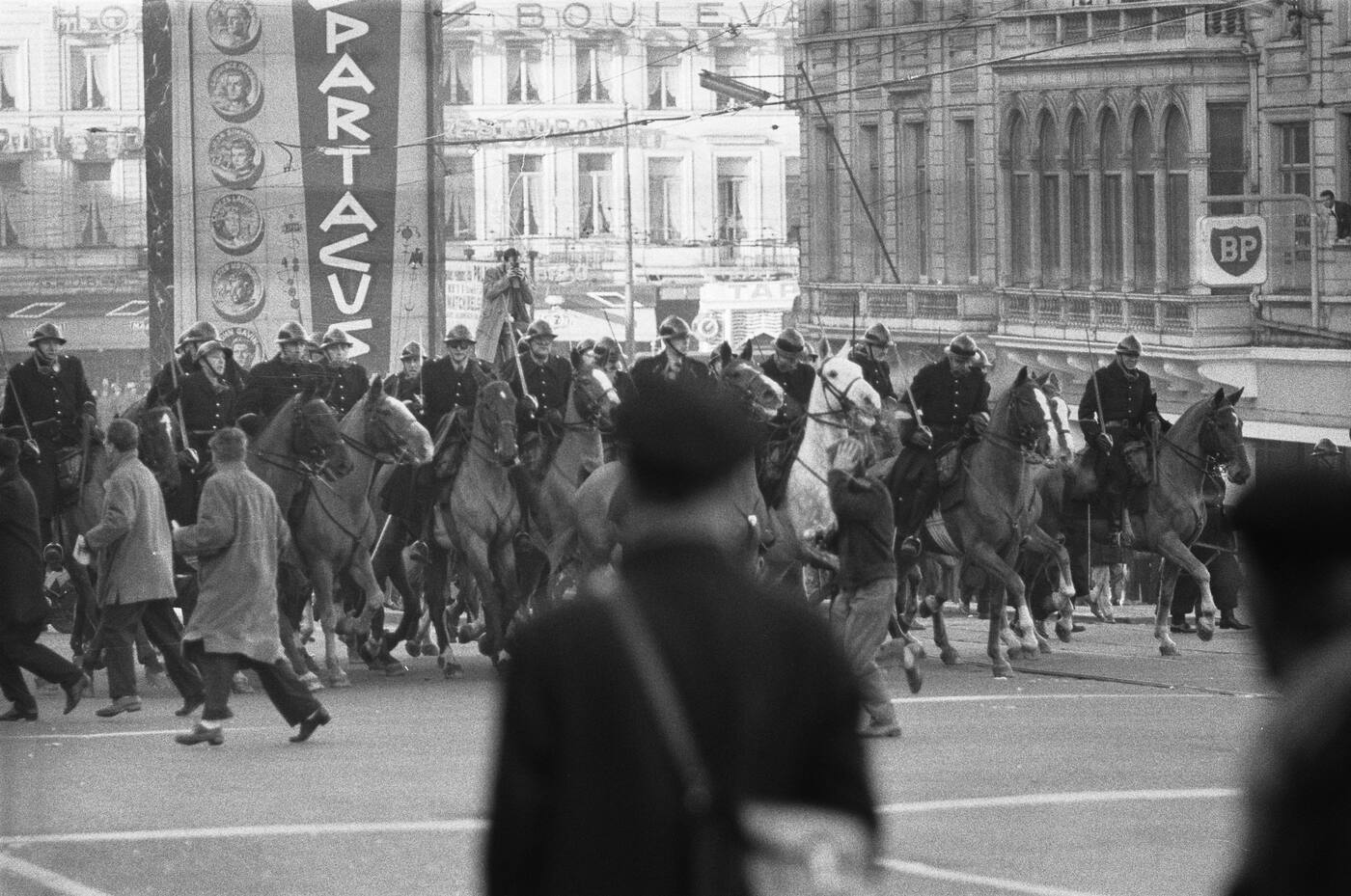
Whether mounted patrol reduces crime. Whether the engagement ratio is caused by height, by the animal, or by the fact that a mounted officer is not going anywhere in a hurry. What a mounted line does to a crowd, as against what doctrine says it does. And the oldest question in the file, whether a police horse is a good use of a police horse, which involves a welfare literature this page has not tried to summarise.
The check
What a program checks, and what it cannot
Most of this page is a reading of the veterinary and behavioural literature, and no program can check whether a paper says what a page claims it says. That was done by hand: each of the six sections was researched from primary sources, then put through two hostile audits, one that re-resolved every citation against Crossref and Europe PMC looking for papers that do not exist or numbers that are not in them, and one told to find the literature that disagrees. Both of them changed the page. The sources are named here so you can go and disagree too.
What a program can check is the part where this page does arithmetic in front of you, and that is what research/the-conditional-horse/verify.mjs does:
- Every empirical number is declared in figures.json with its source, a confidence tier and, where the literature gives one, a range. Nothing is typed into the prose by hand. A figure left provisional fails the check.
- The check reads the shipped page and compares every number in the prose against that file. Edit a sentence without editing the data, or the data without the sentence, and it goes red.
- It confirms that all thirteen question phrasings this page claims to answer actually appear on it, word for word.
- It re-derives the visual field arithmetic, and asserts that the canonical published triad does not close and is short by the amount the page states.
- It runs the two-voices test on its own controls, and requires it to pass on one synthesised voice and fail on two, because a test that cannot fail measures nothing. Then it runs the same code on the published whinny and asserts the verdict the page prints.
- It works the hoof budget, the sleep budget and the sight line against cases computed by hand in its own comments.
- It requires every self-hosted image and recording to carry creator, title, institution, a verbatim rights statement, a record URL and a retrieval date, and refuses any licence this project may not use.
You can read it at /checks/research/the-conditional-horse/verify.mjs, and the engine it checks is the same file the page runs: engine.mjs.
What the audit changed
Every section here was written from a research pass and then put through two hostile audits, one re-resolving each citation and one told to find the contradicting literature. They changed the page in ways worth stating rather than absorbing silently, because a page that shows you only its final answer is hiding the most informative part of how it got there. The five that mattered most:
- The draft said a horseshoe sets wear to zero. Measured, it cuts wear at the toe by about 61 per cent and has no detectable effect at the sides of the same feet.
- The draft marked where a hoof in deficit reaches live tissue on its own chart. That line divided a wall length by a wall thickness, two orthogonal axes, and it is gone rather than corrected, because no depletion time for a hoof has ever been published.
- The draft called the equine visual field figures an error nobody had noticed. They are hedged, drawn from different papers and stated in different planes, so the honest word is incommensurable, and the stronger finding underneath is that the blind wedges have no published angle at all.
- The draft said the flat-racing odds ratio was the only number that exists on racing eye cover. A larger jump-racing study exists and points the other way.
- The draft said the stated purpose of a Victorian blinker was whip protection. That rests on one concessive aside inside an argument against the device, and the period's actual stated purpose is the modern one.
- The draft said paradoxical sleep happens only lying down, full stop. Standing episodes are on record, in horses that will not lie down, and the impossibility is partly built into the human scoring criteria the stage is defined by.
- The draft said nobody has measured where insects land on a horse relative to its mane. Somebody did, in 1984, and the mane turned out to be one of the two places biting midges prefer, which is worse for the protection story than silence would have been.
- The draft wrote "absent" in the forelock column for three wild equids on the strength of a source that never mentions forelocks for any of them. Those cells now say "not described", because silence is not absence.
- The draft said the one-mounted-officer-equals-ten claim traces to nothing. It traces to 1906 and 1912, and the reason given then is the same one the modern evidence supports.
- And one of this page's own citations was wrong in its pinpoint: a road design standard was quoted accurately and given clause numbers that do not exist in it. The sentence stayed; the invented clause numbers went.
What this page could not settle
Listed plainly, because in several sections the gap is the finding.
- The horse's visual field has never been measured by perimetry. Every degree figure in circulation is reconstructed from ocular anatomy or quoted from a review quoting a 1977 book chapter, and the standard set is mutually inconsistent by 15 to 40 degrees.
- No published wear rate exists for a horse working on a road, which is the surface the horseshoe question is really about.
- Nobody has measured what any eye covering removes, in degrees. Not blinkers, not visors, not a fly mask's transmittance, not an ear bonnet's attenuation. There is no peer-reviewed literature on shadow rolls at all.
- Whether horses have a standing paradoxical-sleep state of their own has not been tested, because the criteria used to score it were written for humans and rule it out by definition.
- Nobody has tested whether a mane does anything, on any equid, for any of the five explanations offered. The nearest test is on a lion, and it did not support protection.
- No depletion time for a hoof has ever been published, and the upper wear figure this page uses comes from a sentence that states no time unit.
- Nothing has tested whether a fly mask prevents ocular squamous cell carcinoma, the disease whose mechanism is the entire argument for wearing one.
- The energy cost of standing against lying down has never been measured in a horse, and the 30-minute recumbency threshold in welfare use was inferred rather than titrated.
- The two papers on the whinny give different values for the lower fundamental, around 400 Hz in 2015 and about 200 Hz in 2026, probably because the later figure comes partly from excised larynges. This page prints both.
- Not one experiment has ever been performed on an equid mane.
- There is no randomised trial of mounted policing, and the best study says of itself that it cannot demonstrate a causal effect.
Sources
Every figure's full citation, with the sentence it came from where this page has one, is in figures.json. The load-bearing ones, by section:
- Hooves. Josseck, Zenker and Geyer 1995, Equine Vet J 27:175 (growth rate and wall renewal). Butler and Hintz 1977, J Anim Sci 44:257 (feed and growth). Malone and Davies 2019, Animals 9:1017 (shod against barefoot, growth and wear). Florence and McDonnell 2006, Equine Vet J 38:642 (self-trimming ponies). Moleman and colleagues 2006, Equine Vet J 38:170 (what stretching the interval does to the coffin joint). Wickler and colleagues 2004, Equine Vet J 36:772 (mass on the foot). Aoun, Takawira and Lopez 2025, Vet Surg 54:31 (the scoping review that finds no consensus).
- Eyes. Harman, Moore, Hoskins and Keller 1999, Equine Vet J 31:384 (the ramp retina killed; the streak; the binocular window down the nose). Sivak and Allen 1975, Vision Research 15:1353. Timney and Keil 1992, Vision Research 32:2289 (acuity). Carroll and colleagues 2001, Journal of Vision 1:80 (the two cone pigments). Rosanowski and colleagues 2018, PLoS ONE 13:e0194299 (eye cover and race-day fatality). Copelin, Hayman, Bergeron and Merkies 2024, Appl Anim Behav Sci 271:106180 (blindfolds). Mills and Taylor 2003, Vet Rec 152:41 (nose nets). Flower, Bits and Bearing-Reins, 1885. Sewell, Black Beauty, 1877.
- Sleep. Schuurman, Kersten and Weijs 2003, J Anat 202:355 (the stay apparatus is not passive). Greening and McBride 2022, Front Vet Sci 9:916737 (the pooled architecture). Kelemen and colleagues 2021, Animals 11:3189 (83 horses, recumbency measured). Burla and colleagues 2017, Front Vet Sci 4:23 (where the 30-minute threshold comes from).
- Voice. Briefer, Maigrot, Mandel, Briefer Freymond, Bachmann and Hillmann 2015, Scientific Reports 5:9989 (biphonation, arousal and valence; and the recording on this page). Lefevre and colleagues 2026, Current Biology, doi:10.1016/j.cub.2026.01.004 (the high frequency is an aerodynamic whistle).
- Manes. Groves 2002, "Taxonomy of living Equidae", in Equids: Zebras, Asses and Horses, IUCN (every row of the table, and the single occurrence of the word "forelock" in its 204 pages). Whishaw and Kolb 2017 (which side it falls on). Townley, Baker and Quinn 1984, Equine Vet J 16:117 (where midges actually land on a horse). West and colleagues 2006, Animal Behaviour 71:609 (the one test of mane-as-armour, in lions). Trethowan and colleagues 2017 (the lion mane temperature measurement, which went the wrong way for warmth).
- Police. Giacomantonio, Bradford, Davies and Martin 2015, Making and Breaking Barriers, RAND RR-830-ACPO, doi:10.7249/RR830. Design Manual for Roads and Bridges CD 143 v2.0.1 (equestrian eye height). ANSUR II (standing and sitting eye height). The Sun (New York), 18 August 1912, and a 1906 attestation, for the origin of the ten-officer claim.
The pictures, and their papers
Nineteen assets, all public domain or openly licensed, all verified at the holding institution and all served from this site rather than hotlinked. One is share-alike, used because no cleaner image of a recumbent sleeping horse could be found, and it says so in its own block. The recording is trimmed and otherwise untouched, because the page runs a Fourier transform on it.
Why one page
Because they are one question, asked thirteen ways, and answering each one separately would mean writing the same conditional six times and losing the thing they have in common. A search engine sees "why do horses need horseshoes" and "why do horses wear shoes" and "why are horses shoed" as three demands. They are one demand with three spellings, and the honest response to it is one page that answers all three in the same breath and says which of them is a misspelling.