Port of London · 1900 to 1913 · read from the records
The Fifth Death Since January
Between 1900 and 1913 the Port of London’s medical officer told of eight incidents in which, as he reported them, ten people died in the cabins of vessels laden with dung, refuse and other “offensive cargoes”. The same reports list 255 entries for barges found with a nuisance due to their defective structure, 208 of them in lists of notices served on the owners. The Artificial Wasteland read the two together: a barge named William Hordle was served on 25 September 1901, and 644 days later the master of a barge of that name was found in her fore-cabin and did not survive.
The story, in the order the records give it
On 30 January 1900 one of the Port of London's sanitary inspectors boarded the ketch Susie, lying off Silvertown with a cargo of “saccharine scum”, and on opening the companion found the master and his wife dead. On 29 July 1900 two men were found dead in the after-cabin of the barge Webster at Wakeley's Wharf, Southwark, laden with dung and vegetable refuse (The Lancet gives the date as 30 July). That December The Lancet, reviewing the Port medical officer's report, printed both cases and his remedy. Dr W. Collingridge, it said, held that “it is necessary that the barges should be constructed with a double bulkhead, that there should be a space between the bulkheads, that this space should be freely open to the air, and that a pump should be provided to free it from foul fluids”: two walls between hold and cabin, with open air between them, as the rules already required of canal boats.
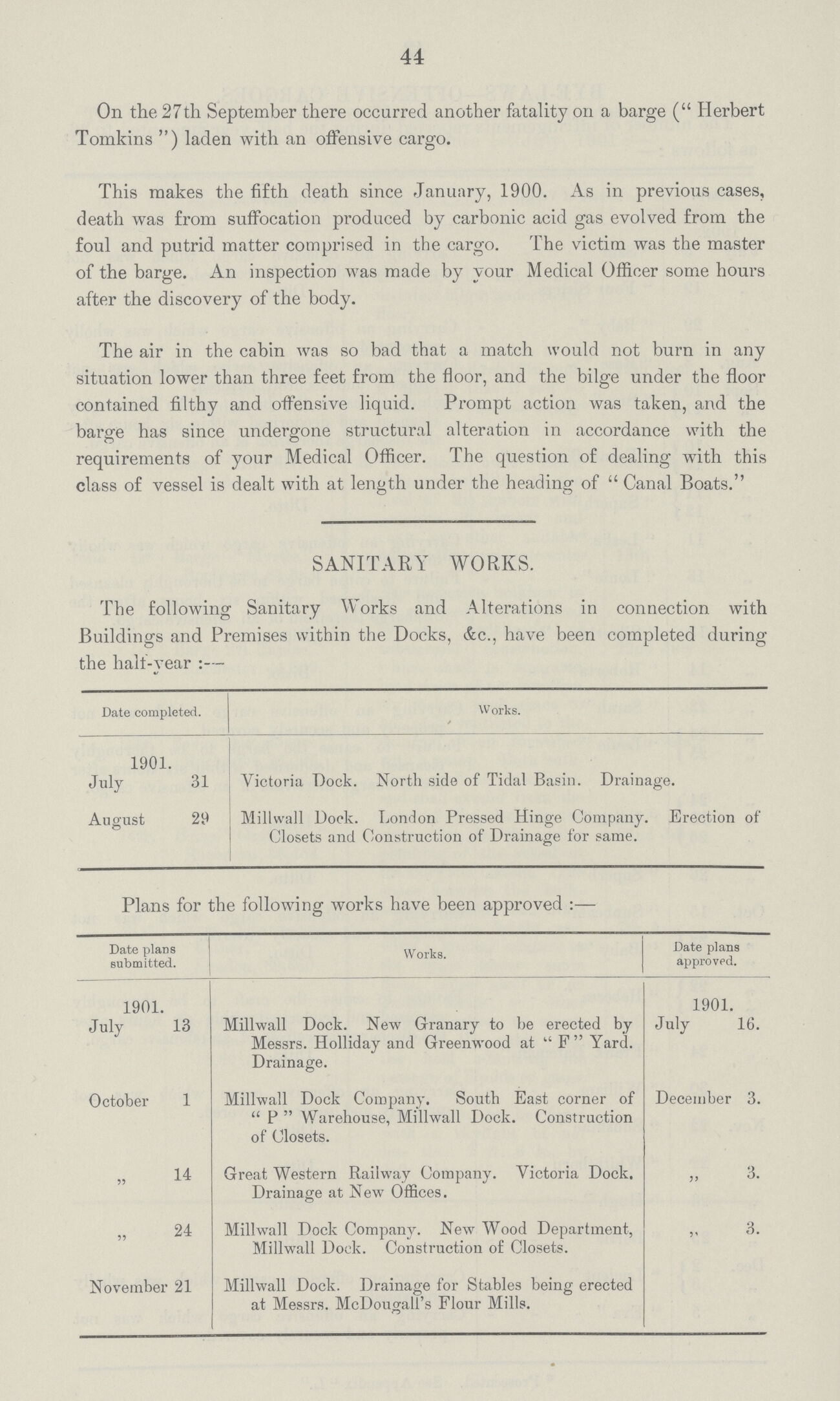
Herbert Williams became the Port's medical officer in June 1901. On 27 September 1901 the master of the barge Herbert Tomkins was found dead in her after-cabin off Blackfriars, and Williams wrote: “This makes the fifth death since January, 1900.” In the same report he wrote of the sailing barges that “They are in all cases used as dwellings. Frequently women and children are carried”; that most were registered under the Merchant Shipping Act, not as canal boats, and so were not bound by the canal boats' rule of two bulkheads; and that even that rule was “not sufficient”. He printed the barges served with notices to abate the nuisance, and the alteration he required.
The owners resisted, and then, after a test case, “agreed to carry out the requirements of the Port Sanitary Authority without reserve, and paid the costs of the proceedings” (the report for 1902, p. 47). In July 1903 the masters of the William Hordle and the Alert were found in their fore-cabins; both juries found death from natural causes, and Williams disagreed. The Board of Trade, asked to help, issued instructions on 5 January 1904 that applied to such a barge only when a surveyor inspected her “upon registry or re-registry, or upon a complaint being made”; and, as the officer tells it, the Board wrote to him that the question “had better be dealt with by the Port of London Sanitary Authority, and that the Board had instructed their Principal Officer to co-operate as far as he possibly could”.
On 28 October 1904 the master of the Grange was found dead in her fore-cabin; a newspaper the next day named him, Albert Warren. On 10 June 1908 a man died in the fore cabin of a barge that, the inspector told the inquest, “was not inhabited”, so the Authority had no power over it. On 23 April 1913 the master of the Agreement went into her fore cabin and died; the inquest's verdict was that he had “either been asphyxiated or choked”, and the report gives the gas from the cargo as his father's opinion.
That is eight incidents and ten deaths in all, each as the officer reported it. Set beside his lists of barges served with notices, three of the incident barges share a name with a barge in the lists, and one of those links is probable: a barge named William Hordle was served on 25 September 1901, no compliance is printed for her, and 644 days later the master of a barge of that name was found in her fore-cabin and did not survive.
Eight incidents, as the officer told them
Each card gives the officer's passage as printed, the verdict as he reports it, and what else the records hold. Step through them on the strip: the count of the dead runs as you go, as he reported them.
Thirteen years, eight incidents
Each rust mark is an incident, larger for more deaths. The teal ticks below the line are notices served on barges whose names the incidents share; a solid curve joins a notice that came before the death, a dashed one a notice that came after it or may be another barge.
Incident 1 of 8
: the ketch Susie
2 dead: the Master of the vessel and his wife
Vessel, as printed
the ketch "Susie," of Littlehampton, 75,233
Place, as printed
lying off Silvertown
Cabin
not stated ("on opening the companion")
Cargo, as printed
a cargo of "saccharine scum"
Inquest, as printed
a coroner's inquest, held at Woolwich on the 2nd February, 1900
Verdict, as the officer reports it
it was proved that the couple had been suffocated in their sleep by the fumes from the cargo entering the cabin
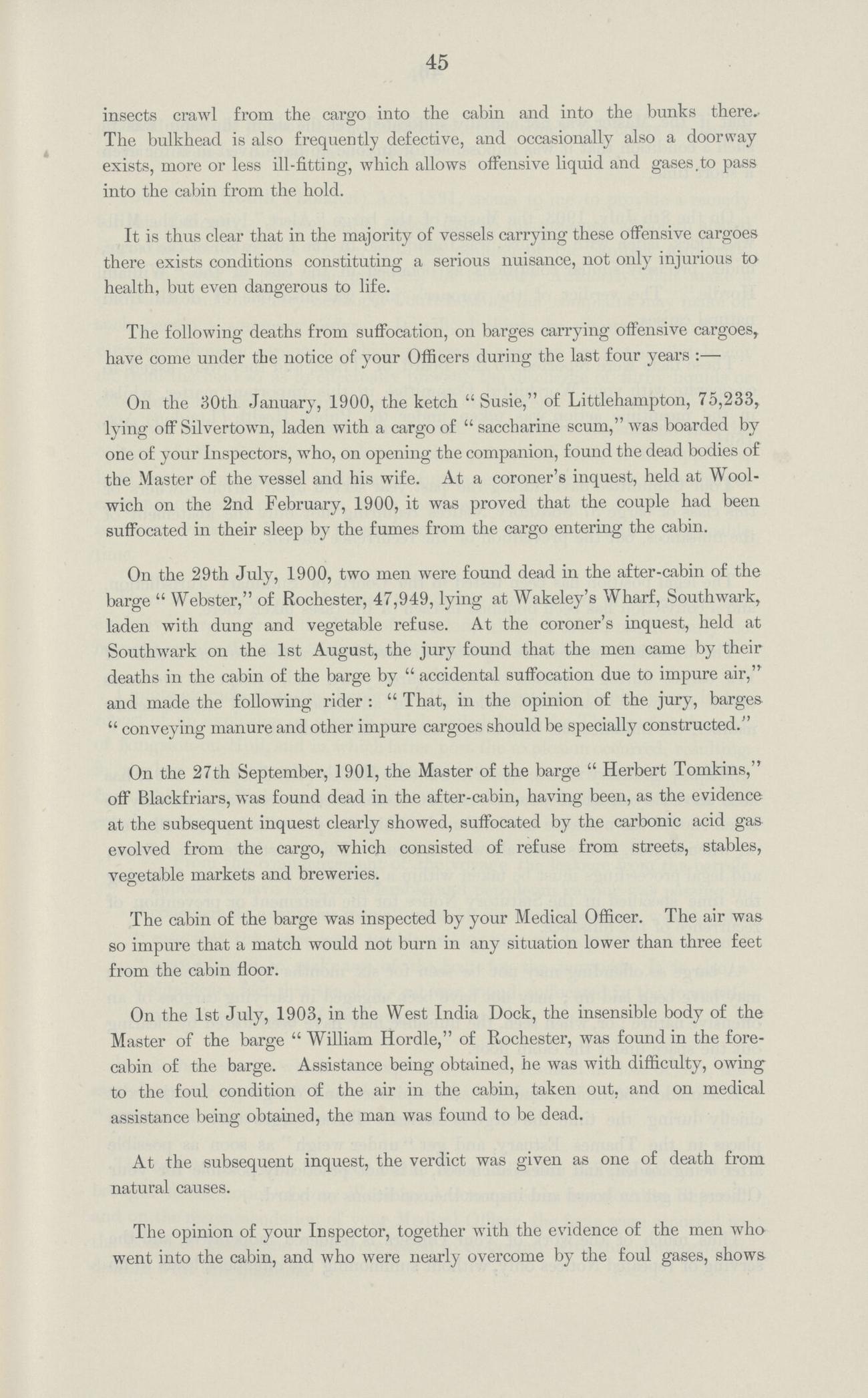
On the 30th January, 1900, the ketch "Susie," of Littlehampton, 75,233, lying off Silvertown, laden with a cargo of "saccharine scum," was boarded by one of your Inspectors, who, on opening the companion, found the dead bodies of the Master of the vessel and his wife. At a coroner's inquest, held at Woolwich on the 2nd February, 1900, it was proved that the couple had been suffocated in their sleep by the fumes from the cargo entering the cabin.
The report for 1903, p. 45, Wellcome b19884229 image 47 · page scan
What else the records hold
The Lancet of 15 December 1900, reviewing Dr W. Collingridge's half-yearly report for the Port (no Port report for 1900 is digitised), tells the same case without the vessel's name: “On Jan. 30th, 1900, a ketch was found off Silvertown. On examining the cabin the inspector found the master and his wife both dead.”
The earliest notice in the lists is dated 26 March 1901, after this death. The ketch's official number, 75,233, is not in them.
Incident 2 of 8
: the barge Webster
2 dead: two men
Vessel, as printed
the barge "Webster," of Rochester, 47,949
Place, as printed
lying at Wakeley's Wharf, Southwark
Cabin
after-cabin
Cargo, as printed
dung and vegetable refuse
Inquest, as printed
the coroner's inquest, held at Southwark on the 1st August
Verdict, as the officer reports it
"accidental suffocation due to impure air," with the rider "That, in the opinion of the jury, barges conveying manure and other impure cargoes should be specially constructed."
On the 29th July, 1900, two men were found dead in the after-cabin of the barge "Webster," of Rochester, 47,949, lying at Wakeley's Wharf, Southwark, laden with dung and vegetable refuse. At the coroner's inquest, held at Southwark on the 1st August, the jury found that the men came by their deaths in the cabin of the barge by "accidental suffocation due to impure air," and made the following rider: "That, in the opinion of the jury, barges conveying manure and other impure cargoes should be specially constructed."
The report for 1903, p. 45, Wellcome b19884229 image 47 · page scan
What else the records hold
The Lancet tells this case too, with two differences from the 1903 retelling: it gives the date as “July 30th, 1900”, and the cargo as “market and dustbin refuse in a state of decomposition”. It adds the medical evidence at the inquest: “death was caused by asphyxia due to gases given off from the cargo”.
The Webster's official number, 47,949, is not in the notice lists.
Incident 3 of 8
: the barge Herbert Tomkins
1 dead: the master of the barge
Vessel, as printed
a barge ("Herbert Tomkins")
Place, as printed
off Blackfriars (1903 report)
Cabin
after-cabin (1903 report)
Cargo, as printed
refuse from streets, stables, vegetable markets and breweries (1903 report)
Inquest, as printed
the subsequent inquest (1903 report; no place or date)
Verdict, as the officer reports it
no verdict quoted; "as the evidence at the subsequent inquest clearly showed, suffocated by the carbonic acid gas evolved from the cargo" (1903 report)
On the 27th September there occurred another fatality on a barge ("Herbert Tomkins") laden with an offensive cargo. This makes the fifth death since January, 1900. As in previous cases, death was from suffocation produced by carbonic acid gas evolved from the foul and putrid matter comprised in the cargo. The victim was the master of the barge. An inspection was made by your Medical Officer some hours after the discovery of the body. The air in the cabin was so bad that a match would not burn in any situation lower than three feet from the floor, and the bilge under the floor contained filthy and offensive liquid. Prompt action was taken, and the barge has since undergone structural alteration in accordance with the requirements of your Medical Officer.
The half-yearly report to 31 December 1901, p. 44, Wellcome b19884205 image 52 · page scan
On the 27th September, 1901, the Master of the barge "Herbert Tomkins," off Blackfriars, was found dead in the after-cabin, having been, as the evidence at the subsequent inquest clearly showed, suffocated by the carbonic acid gas evolved from the cargo, which consisted of refuse from streets, stables, vegetable markets and breweries. The cabin of the barge was inspected by your Medical Officer. The air was so impure that a match would not burn in any situation lower than three feet from the cabin floor.
The report for 1903, p. 45, Wellcome b19884229 image 47 · page scan
What else the records hold
The first passage holds the officer's count: “This makes the fifth death since January, 1900.” His report for 1903 tells the death again, with the place and the cargo.
The roll has a notice to a barge of this name: list A, entry 9, “Herbert Tomkins,” London, 54,768, dated 1 October 1901, four days after the death, and reported complied with on “25th Oct.” So this notice came after the death, not before it: the same report says “the barge has since undergone structural alteration”. The Mercantile Navy List for 1894 has one line for the name: “Herbert Tomkins, London”.
Incident 4 of 8
: the barge William Hordle
1 dead: the Master of the barge
Vessel, as printed
the barge "William Hordle," of Rochester
Place, as printed
in the West India Dock
Cabin
fore-cabin
Cargo, as printed
not stated
Inquest, as printed
the subsequent inquest (no place or date)
Verdict, as the officer reports it
the verdict was given as one of death from natural causes
On the 1st July, 1903, in the West India Dock, the insensible body of the Master of the barge "William Hordle," of Rochester, was found in the fore-cabin of the barge. Assistance being obtained, he was with difficulty, owing to the foul condition of the air in the cabin, taken out, and on medical assistance being obtained, the man was found to be dead. At the subsequent inquest, the verdict was given as one of death from natural causes. The opinion of your Inspector, together with the evidence of the men who went into the cabin, and who were nearly overcome by the foul gases, shows
The report for 1903, pp. 45-46, Wellcome b19884229 image 47 · page scan
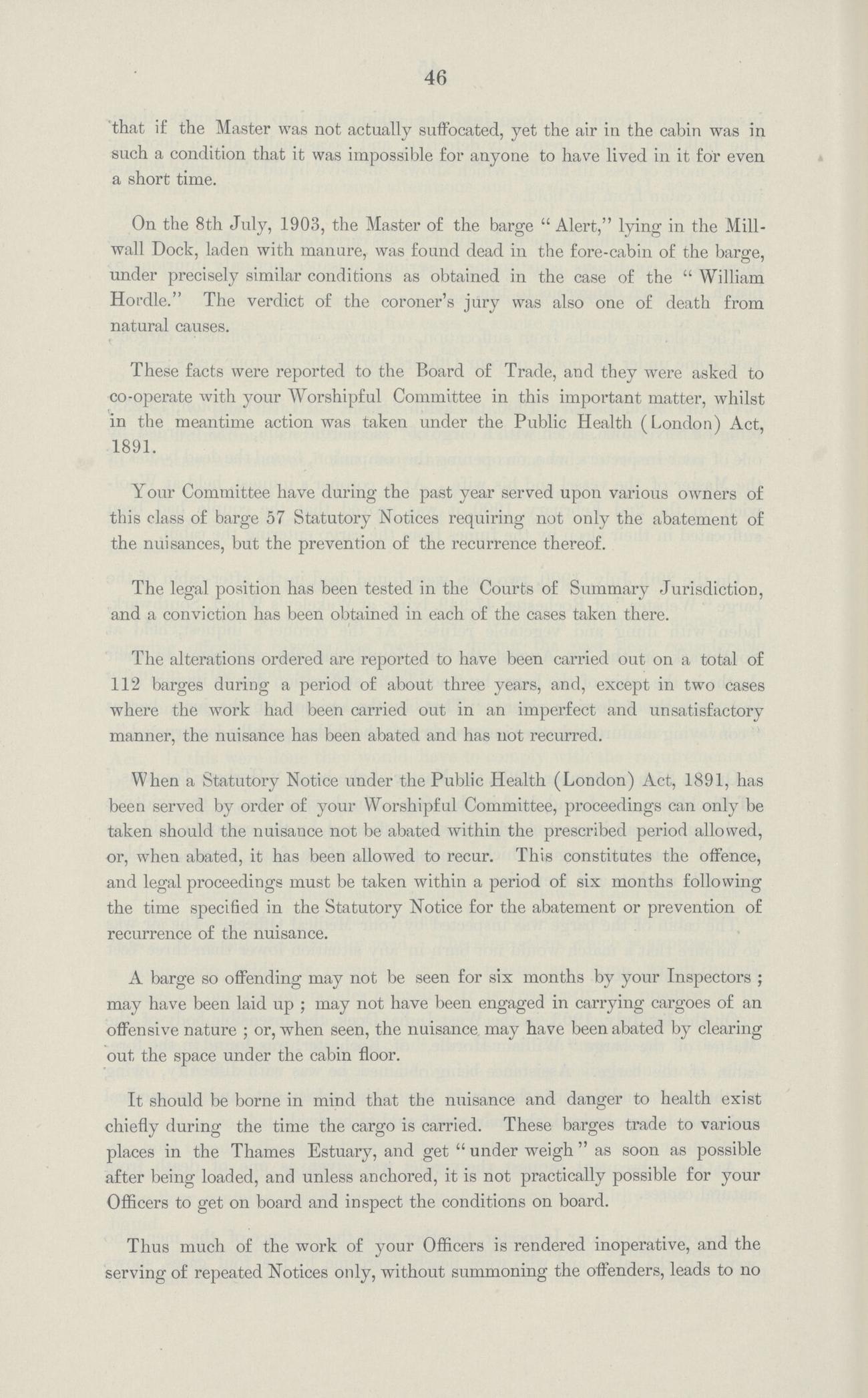
that if the Master was not actually suffocated, yet the air in the cabin was in such a condition that it was impossible for anyone to have lived in it for even a short time.
The report for 1903, p. 46, Wellcome b19884229 image 48 · page scan
What else the records hold
The jury found death from natural causes. The officer did not agree, and wrote that the air in the cabin was such that “it was impossible for anyone to have lived in it for even a short time”. The page counts this death because he did; it is his attribution, not the jury's.
The roll has a notice to a barge of this name: list A, entry 8, “William Hordle,” Harwich, 17,804, served on 25 September 1901. Its column for the date complied with prints three dots, and she is not among the barges listed as complied with in 1902. From the notice to the death is 644 days.
The 1903 passage calls her “of Rochester”. The notice list and the Mercantile Navy List for 1894 (“17804 William Hordle, Harwich”, a spritsail barge built at Lambeth in 1848) say Harwich, and so does every year of the Mercantile Navy List that the Crew List Index Project indexes, from 1857 to 1915. The National Archives' catalogue of closed registers has the same official number and names no port (BT 110/444/32: “Ship William Hordle , official number: 17804”, registry closed in 1919). The reports do not explain the difference. The 1894 list has one vessel of the name, and the Crew List Index Project finds one, so the link holds by name; no official number is printed with the death.
Incident 5 of 8
: the barge Alert
1 dead: the Master of the barge
Vessel, as printed
the barge "Alert,"
Place, as printed
lying in the Millwall Dock
Cabin
fore-cabin
Cargo, as printed
manure
Inquest, as printed
the coroner's jury (no place or date)
Verdict, as the officer reports it
The verdict of the coroner's jury was also one of death from natural causes.
On the 8th July, 1903, the Master of the barge "Alert," lying in the Millwall Dock, laden with manure, was found dead in the fore-cabin of the barge, under precisely similar conditions as obtained in the case of the "William Hordle." The verdict of the coroner's jury was also one of death from natural causes.
The report for 1903, p. 46, Wellcome b19884229 image 48 · page scan
What else the records hold
The jury found death from natural causes. The officer counts this death as one of his; the jury did not put it down to the cargo.
The roll has an “Alert,” Faversham, 45,236: list A, entry 45, served on 14 December 1901, with no compliance printed. If she is this barge, the notice came 571 days before the death. But the 1903 passage prints no port and no number, the Mercantile Navy List for 1894 has 43 entries for the name, two of them of London, and the Crew List Index Project shows two spritsail-rigged vessels called Alert in the Mercantile Navy List of 1900, one of Faversham and one of London. The link is possible, no more.
Incident 6 of 8
: the sailing barge Grange
1 dead: the Master of the sailing barge
Vessel, as printed
the sailing barge "Grange," of Rochester
Place, as printed
not stated
Cabin
fore-cabin
Cargo, as printed
stable refuse, composed principally of moss litter and horse dung
Inquest, as printed
the inquest subsequently held on the body of the Master of the barge (no place or date; the medical officer attended)
Verdict, as the officer reports it
no verdict quoted; the jury "unanimously recommended that the facts should be brought to the notice of the owner, and that this barge should have the hold absolutely cut off from the inhabited quarters by a properly constructed gas-tight bulkhead"
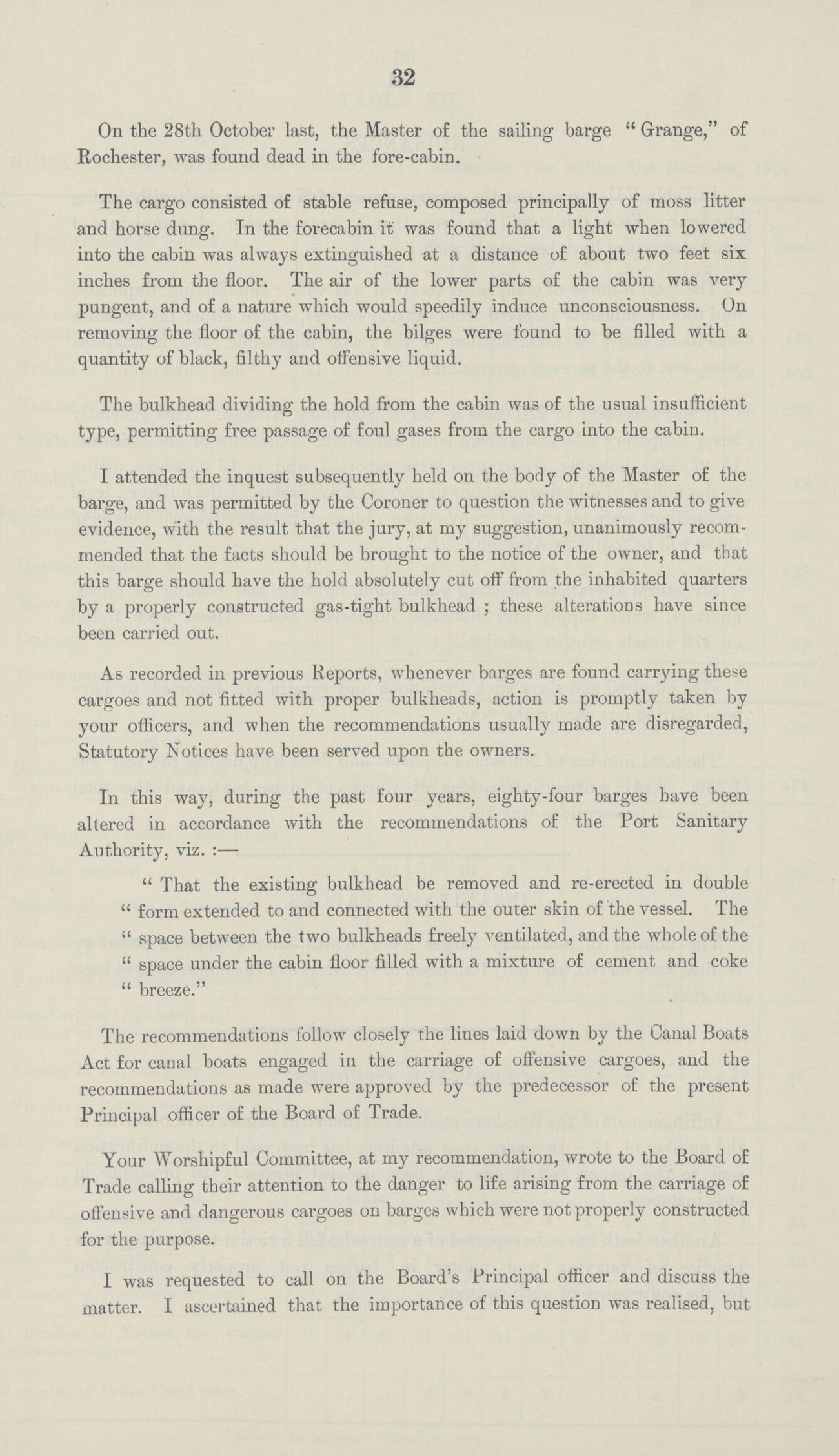
On the 28th October last, the Master of the sailing barge "Grange," of Rochester, was found dead in the fore-cabin. The cargo consisted of stable refuse, composed principally of moss litter and horse dung. In the forecabin it was found that a light when lowered into the cabin was always extinguished at a distance of about two feet six inches from the floor. The air of the lower parts of the cabin was very pungent, and of a nature which would speedily induce unconsciousness. On removing the floor of the cabin, the bilges were found to be filled with a quantity of black, filthy and offensive liquid. The bulkhead dividing the hold from the cabin was of the usual insufficient type, permitting free passage of foul gases from the cargo into the cabin. I attended the inquest subsequently held on the body of the Master of the barge, and was permitted by the Coroner to question the witnesses and to give evidence, with the result that the jury, at my suggestion, unanimously recommended that the facts should be brought to the notice of the owner, and that this barge should have the hold absolutely cut off from the inhabited quarters by a properly constructed gas-tight bulkhead ; these alterations have since been carried out.
The report for 1904, p. 32, Wellcome b19884230 image 36 · page scan
What else the records hold
The Daily Mirror of the next day, 29 October 1904, names him: “Soon after the barge had left Chelsea with a cargo of refuse on board, the captain, Albert Warren, went down into the fore-cabin.” He is the only one of the ten whose name we found. The report gives no verdict, only the jury's recommendation.
The investigation found no list of barges served with notices in the reports for 1903 to 1905, so the roll cannot say whether the Grange had been served.
Incident 7 of 8
: a barge not named
1 dead: a man, who was employed on a sailing barge
Vessel, as printed
another barge lying alongside (not named)
Place, as printed
not stated
Cabin
fore cabin
Cargo, as printed
an offensive cargo
Inquest, as printed
An inquest was held (no place or date; a Sanitary Inspector attended)
Verdict, as the officer reports it
"death by misadventure."
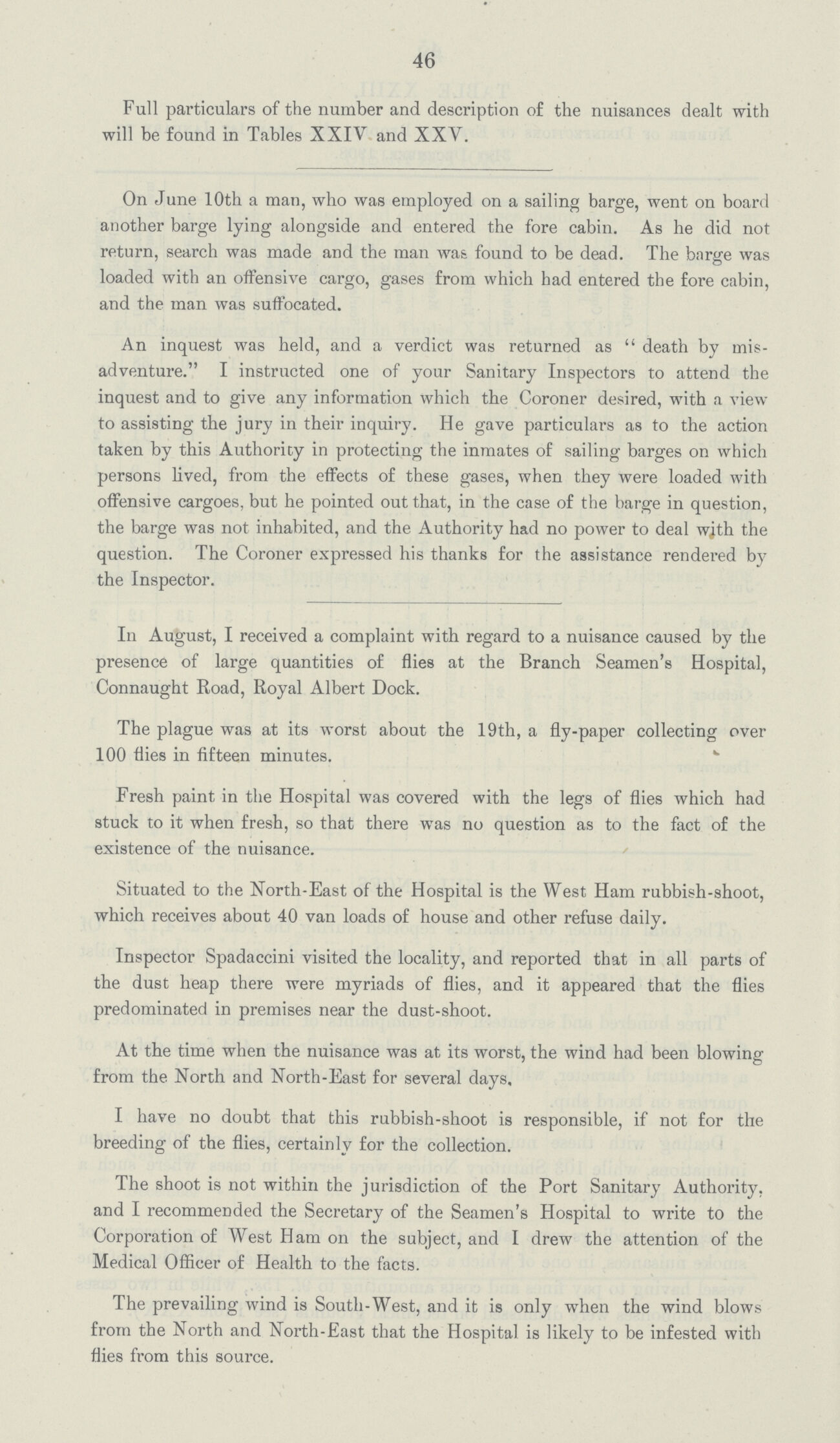
On June 10th a man, who was employed on a sailing barge, went on board another barge lying alongside and entered the fore cabin. As he did not return, search was made and the man was found to be dead. The barge was loaded with an offensive cargo, gases from which had entered the fore cabin, and the man was suffocated. An inquest was held, and a verdict was returned as "death by misadventure." I instructed one of your Sanitary Inspectors to attend the inquest and to give any information which the Coroner desired, with a view to assisting the jury in their inquiry. He gave particulars as to the action taken by this Authority in protecting the inmates of sailing barges on which persons lived, from the effects of these gases, when they were loaded with offensive cargoes, but he pointed out that, in the case of the barge in question, the barge was not inhabited, and the Authority had no power to deal with the question. The Coroner expressed his thanks for the assistance rendered by the Inspector.
The report for 1908, p. 46, Wellcome b19884278 image 50 · page scan
What else the records hold
The barge is not named, so nothing can be linked. The inspector told the inquest that the Authority acted for sailing barges “on which persons lived”, and that this one “was not inhabited”.
Incident 8 of 8
: the barge Agreement
1 dead: the master of the barge
Vessel, as printed
the barge "Agreement," of Rochester, official number 78,529
Place, as printed
not stated (taken to St. Thomas' Hospital; inquest at Lambeth Mortuary)
Cabin
fore cabin
Cargo, as printed
a cargo of manure, which had been in the barge for two days
Inquest, as printed
An inquest was held at Lambeth Mortuary on the 26th April
Verdict, as the officer reports it
a verdict was returned to the effect that he had either been asphyxiated or choked
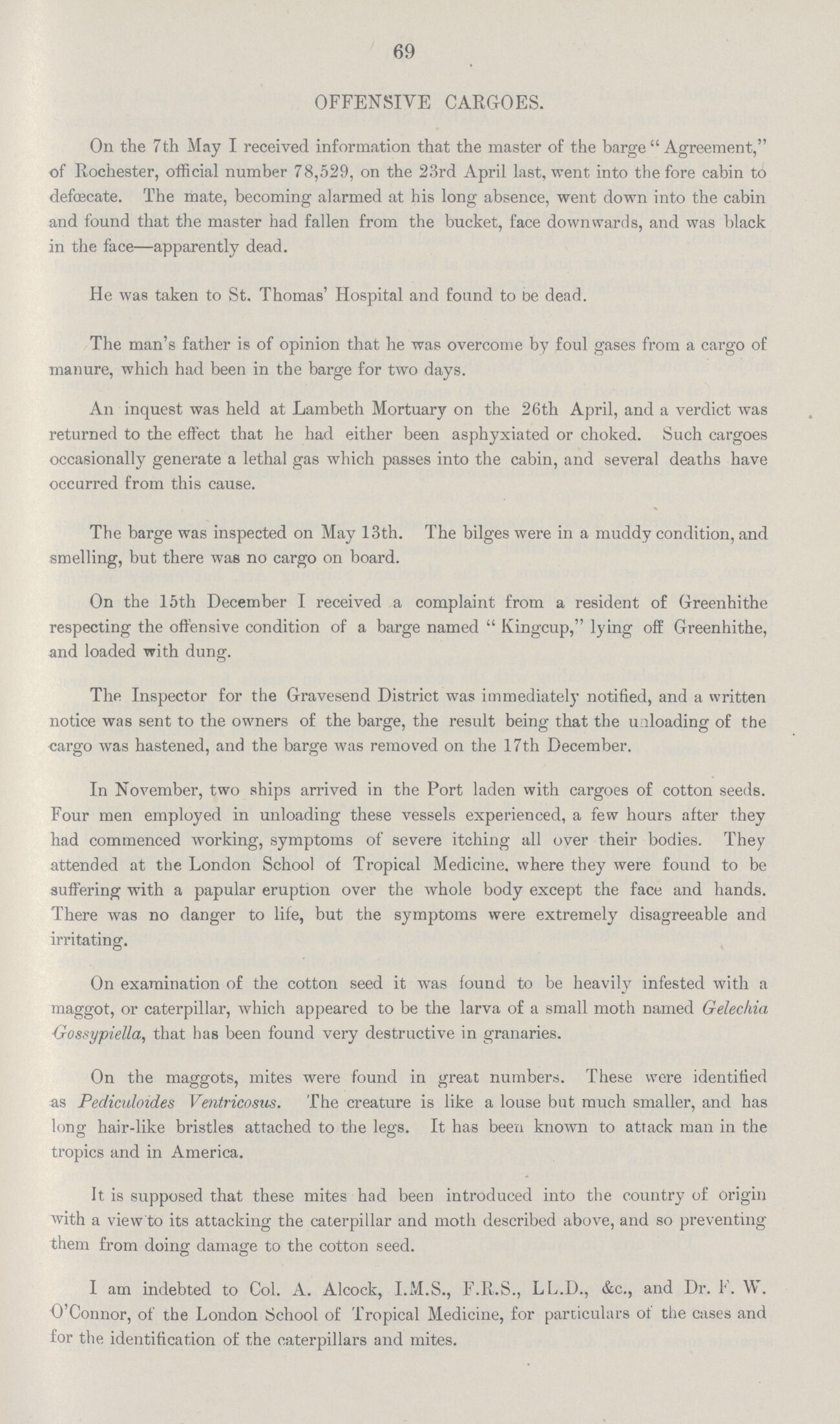
On the 7th May I received information that the master of the barge "Agreement," of Rochester, official number 78,529, on the 23rd April last, went into the fore cabin
[Part of the passage is left out here: it finishes the sentence with why he went into the cabin, and tells how the mate found him there.]
He was taken to St. Thomas' Hospital and found to be dead. The man's father is of opinion that he was overcome by foul gases from a cargo of manure, which had been in the barge for two days. An inquest was held at Lambeth Mortuary on the 26th April, and a verdict was returned to the effect that he had either been asphyxiated or choked. Such cargoes occasionally generate a lethal gas which passes into the cabin, and several deaths have occurred from this cause. The barge was inspected on May 13th. The bilges were in a muddy condition, and smelling, but there was no cargo on board.
The report for 1913, p. 69, Wellcome b19884308 image 75 · page scan
What else the records hold
The inquest's verdict was that he had “either been asphyxiated or choked”. That gas from the cargo overcame him is, in the report, his father's opinion; the officer adds that “several deaths have occurred from this cause”.
The officer heard of the death on 7 May, and the barge was inspected on 13 May, with “no cargo on board”. The Agreement's official number, 78,529, is not in the notice lists, the last of which is for 1906.
The roll: the barges he named
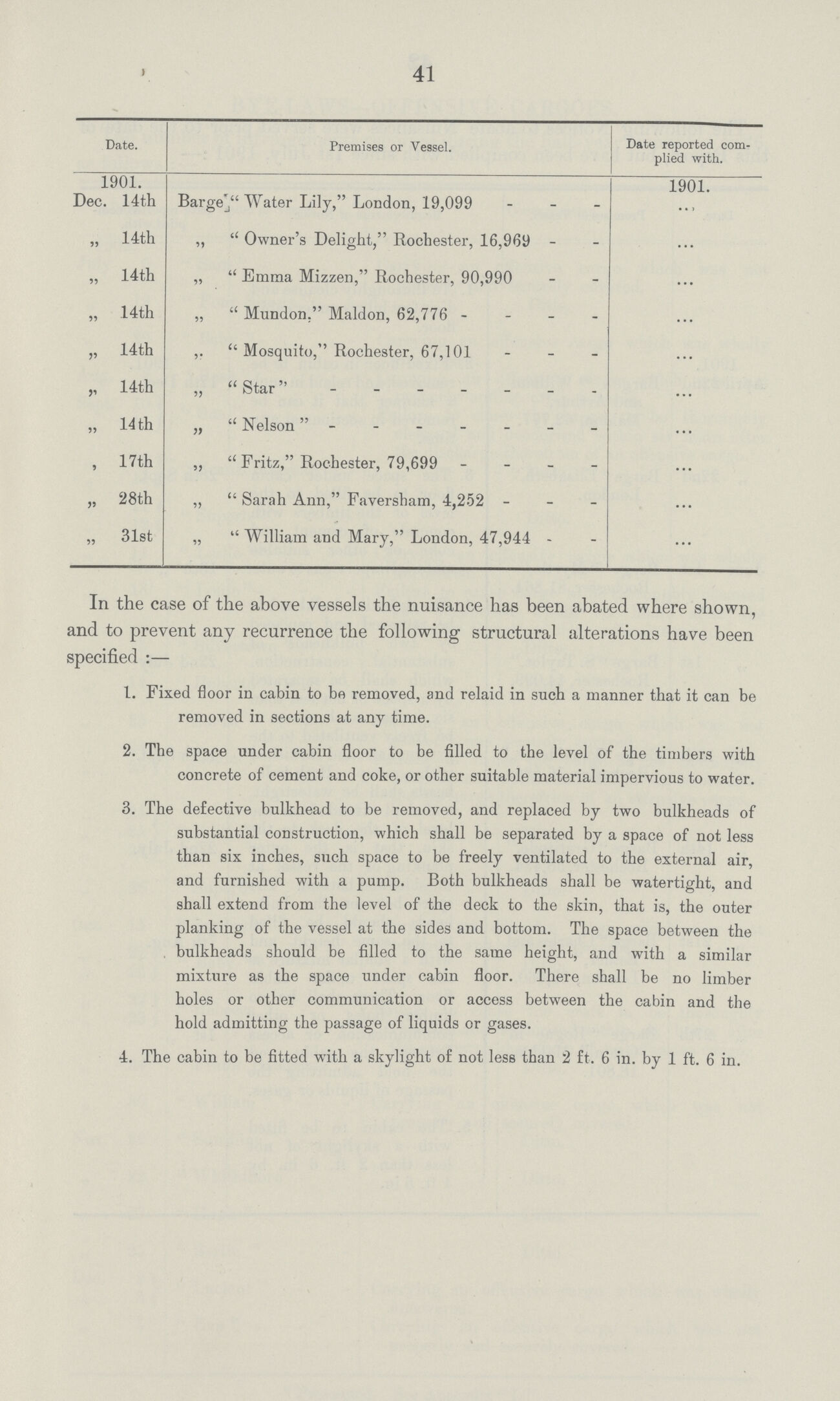
From the spring of 1901 the Port Sanitary Committee had notices served on barges whose cabins were fouled from the hold. The officer printed them by name in the reports for 1901 and 1902, and in 1906 a table of the barges found with such a nuisance that year: 255 entries in five lists, 208 of them in the four lists of notices. Six entries of Appendix P of 1902 carry the official numbers of barges in the 1901 list, though each under another date (and one under another port); read as the same notices, those 208 entries hold at most 202 different notices. The 1901 list says why: “Owing to deficient and defective bulkheads, filthy liquids and gases were allowed to pass into the cabins, thus causing a serious nuisance”. It also prints the alteration he specified; the third of its four items reads:
“The defective bulkhead to be removed, and replaced by two bulkheads of substantial construction, which shall be separated by a space of not less than six inches, such space to be freely ventilated to the external air, and furnished with a pump.”
The half-yearly report to 31 December 1901, p. 41, Wellcome b19884205 image 49 · page scan
Filter the roll
Each row as printed: name, port, official number and the date reported complied with are the report's own; the dates are the dates printed against each barge.
List, entry
Date printed
Name
Port
Official no.
Complied, as printed
Owner (1906)
Page
The table is built from data.json when the page's script runs.
The rows are transcribed from reports digitised by Wellcome Collection and licensed CC BY-NC 4.0 (credit: Wellcome Collection). The shipped table, data.json, may be reused on the same terms: with that credit, and not for commercial purposes.
What the lists show, and what they do not
The officer's own count checks against his own list. The report for 1902 says “One hundred and twenty-three barges have been reported as defective”; its Appendix O, counted by this page: .
Of the 67 notices of August to December 1901 (list A), a date complied with is printed for 15 by 31 December 1901, and Appendix P of 1902 shows 6 of the same barges complied with during 1902. For 46 no compliance is printed in these lists. A blank does not show that a notice was ignored: the report for 1902 says “Twenty-six of these Notices are known to have been complied with during the year” and does not say which.
The table of 1906 is not a list of notices: it names “the barges which have been found during the year carrying, or engaged in the carrying of cargoes of offensive matter, and on which there has been a nuisance due to the defective structure of the vessel”, and adds owners and addresses: 47 entries for 45 barges, with 30 different lines of owner and address. Of the 45, 12 had been served in 1901 or 1902. The table names them as the owners of barges found with a nuisance that year, and says no more about them.
The earliest notice in the lists is dated 26 March 1901, before Herbert Williams took office. The report for 1902 names the owners who resisted, “especially those represented by the Kent and Essex Brickmasters' and Flint Merchants' Association”; their test case ended with the owners agreeing to the requirements and paying the costs. While the report for 1906 was in preparation (the Port Sanitary Committee submitted it to the Court of Common Council on 11 April 1907), a deputation of the Trade Union Congress Parliamentary Committee asked the President of the Board of Trade for “the sanitary inspection of all barges navigating the Thames” (the report for 1906, p. 78).
One link, and how firm each is
Three of the incident barges share a name with a barge in the roll. None of the three passages prints an official number, so each link rests on the name. They are not equally firm.
The firmest, by name
William Hordle
Served on 25 September 1901 (list A, entry 8: Harwich, 17,804). The complied column prints three dots. The master was found in her fore-cabin on 1 July 1903, 644 days later.
The 1894 register has one vessel of the name, of Harwich. The 1903 passage says “of Rochester”: printed so, and not explained. So the link is probable, not proven: the death passage gives no number and another port, and a barge off the register cannot be ruled out.
A consequence, not a warning
Herbert Tomkins
The death was on 27 September 1901; the notice (list A, entry 9) is dated 1 October 1901, four days after it, and was complied with on “25th Oct.” The notice followed the death.
Possible only
Alert
An Alert of Faversham was served on 14 December 1901 (list A, entry 45). The death passage gives no port. Two spritsail-rigged vessels of that name, one of Faversham and one of London, were in the Mercantile Navy List of 1900, so the barge on which the master died may be the other one.
The other five incidents find nothing in the roll: the Susie, the Webster and the Agreement print official numbers that are not in it, no barge named Grange is in it, and the barge of 1908 is not named.
Is it real?
Three things a careful reader should ask, each with something to operate.
Did the officer go quiet, or are reports missing? The denominator
Wellcome Collection's catalogue returns 83 digitised reports of the Port of London's medical officer, from the half-year to 30 June 1888 to the year 1978. Between 1888 and 1924 they cover 53 of the 74 half-years. The 21 missing half-years include everything from July 1892 to June 1899 and the whole of 1900, whose deaths survive in The Lancet and in the officer's retelling of 1903. After 1924 only 1974 is missing.
The 83 reports, 1888 to 1978
Each column is a year, top half January to June, bottom half July to December. Filled: a digitised report covers it. Dotted outline: no digitised report. Rust: a report that tells a death in a cabin.
A program searched all 83 texts for a word of death (suffocat, asphyxia, found dead, foul gas, coroner, inquest, fatalit, lost their lives, lethal, overcome by, carbonic acid, dead bod) within 400 characters of a word of vessel or cargo (barge, cabin, offensive cargo, manure, dung, ketch, lighter). It found 24 passages, and each was read. Of the 24, 11 fall inside the passages of the eight incidents, 1 is the officer's count of five, and 12 are about other things, none of them a death in a cabin from a cargo. So 5 of the 83 reports tell such a death, and none after 1913. The reports can speak only of deaths that, in the officer's words, “have come under the notice of your Officers”.
Would any name have matched? The null
The rule, fixed before matching: an incident's vessel links to a notice when both print the same official number; when the incident's passage prints no number, when the name is the same. Run it on vessels that are certainly not these barges: the 102 steamships named in the same reports' lists of smoke nuisances.
The linking rule on unrelated ships, and names inside the roll
By name alone, 5 of the 102 steamships find a barge in the roll, about 1 in 20. By number, 0 of the 86 that print one do. The incidents that link are linked by name, because their passages print no number. So a name is weak evidence by itself, and the page claims one link and not a pattern. Inside the roll itself, 10 of the 206 names printed with a number are printed with more than one number. Across the three main lists (A, C and E), 26 pairs of entries in different lists share a name and both print a number, and 15 of those pairs print different numbers (one of the 15, the Hamlet, 26,531 and 26,351, may be a misprint): a shared name in these lists points to another barge more often than to the same one. What makes the William Hordle link the likeliest of the three is the register, not the rule: the Mercantile Navy List for 1894 has one entry for that name, against 43 for Alert, and the Crew List Index Project finds one vessel called William Hordle.
Can a rate of death be given? No
The reports for 1901 to 1913 give no count of the barges in the refuse trade, or of the people who lived aboard them, so there is nothing to divide the deaths by, and this page gives no rate. The census figures in the report for 1902 count the people “on board seagoing and coasting vessels, and on inland barges and boats”, not those of any one trade. A test of whether deaths fell on the listed barges more often than chance would mislead as well: the lists are the officer's own selection of barges with bad bulkheads, and he wrote that “practically all, wooden vessels carrying offensive cargoes have been found utterly unfit for the purpose”.
Two totals that do not agree
112“The alterations ordered are reported to have been carried out on a total of 112 barges during a period of about three years”
84“during the past four years, eighty-four barges have been altered in accordance with the recommendations of the Port Sanitary Authority”
The first is from the report for 1903, p. 46; the second, a year later, from the report for 1904, p. 32. The later total is the smaller. They may count different things, but neither report says so, and the page leaves them as printed.
The Lancet, 15 December 1900, “The Sanitation of Barges”, reviewing Dr W. Collingridge's half-yearly report, told the first two cases without the vessels' names, the free passage of gas from hold to cabin, and Collingridge's double bulkhead. It also reported that “Dr. Collingridge advises that a by-law should be framed similar to the regulations in force in the case of canal boats.” In these records the double bulkhead for the Thames barges is first proposed by Collingridge, in 1900, on the model of the canal-boat rule. Williams, who took office in June 1901, specified it in detail in the notices and argued that the canal-boat requirements were not sufficient.
The officer himself. In his report for the second half of 1901 Williams counted “five persons” dead since January 1900. In his report for 1903 he set out five incidents together, from the Susie to the Alert. In his report for 1913 he wrote that “several deaths have occurred from this cause”. The comparison with the Canal Boats Acts is his and The Lancet's.
The trade. English Wikipedia's “Thames sailing barge” describes it: “On the return run from London, the hold would be filled with dung”. The prior-art search for this page read that article and searched 31 barge books on the Internet Archive by full text; several describe the London refuse cargo, and none of them, as searched, tells these deaths or the notices.
The historian of the Authority. Krista Maglen's 2001 thesis on the Port Sanitary Authority says: “I have not examined the additional duties undertaken by the authority, such as the sanitary inspection of the ports with regard to houseboats and barges”.
What we could not find told anywhere is the eight incidents of 1900 to 1913 read as one series, and the match between the barges served with notices and the barge on which a man died. We could not find this assembled anywhere as of 23 November 2026; here is where we looked.
The full text of the Internet Archive (books, periodicals and newspapers), by the vessels' names, the places, the cargo, the jury's words and the officer's; OpenAlex and Crossref; Wellcome Collection's catalogue and its stories; the National Archives' Discovery catalogue; the site search of the Society for Sailing Barge Research; and twelve web searches by name, place, year, cargo and officer.
What we could not open, for a person to check: the coroners' records of these inquests, where they survive; the London newspapers of those weeks in the British Newspaper Archive, and reprints in Papers Past, Trove and Welsh Newspapers Online (closed to this project's reader by their robots rules or by a challenge page); Peter Hounsell's Bricks of Victorian London (2022); Andrea Tanner's “Dust-O!” in The London Journal (2006); Peter Atkins's chapters on London's animal wastes in Animal Cities (2016); Maglen's book The English System (2014); Tim Carter's Merchant Seamen's Health; Victor Brown's address “A Foresight in Looking Backward” (Journal of the Royal Sanitary Institute, 1926), given as chairman of the Port of London Sanitary Authority; Richard J. Griffiths's dissertation on the early years of the London Port Sanitary Authority (1994), held by Wellcome Collection; the Society for Sailing Barge Research's journal Topsail; and the essays of Wellcome's London's Pulse project and the Wellcome Library's blog.
Also named by the prior-art search, but confirmed by no catalogue we could open: Peter Hounsell's London's Rubbish, Frank Willmott's Bricks and Brickies, Richard-Hugh Perks's Sprits'l, and the magazine Bygone Kent.
What the records cannot say
Who they were. These reports name none of the dead. One newspaper names one of them, Albert Warren. Inquests were held, so the coroners' papers and the London papers of those weeks very probably name the others; we could not open them.
That gas killed all ten. The ten are the deaths the officer reported, and the cause is his attribution. Two juries found death from natural causes; one inquest returned “death by misadventure”, and one a verdict that the master had either been asphyxiated or choked. The reports describe no measurement of the air: the officer tested it with a match or a light, and named the gas as carbonic acid gas.
That the lists and the deaths are the same vessels. One link is probable, by name; one notice followed a death; one may be another barge. The 1903 passage puts the William Hordle at Rochester, the notice and the Mercantile Navy List at Harwich.
That a notice was ignored. A blank in the complied column means no compliance is printed, no more.
How many notices there were. The roll holds the lists of names printed for 1901, 1902 and 1906. The reports for 1903 and 1904 give totals only: 57 statutory notices in 1903, 41 in 1904.
How dangerous the trade was. The reports for 1901 to 1913 give no count of the barges in the refuse trade or of the people aboard them, so no rate can be given.
Deaths nobody reported. Twenty-one half-years between 1888 and 1924 have no digitised report, and the officers knew only of the deaths that reached them. That the later reports tell no such death is not proof that none happened.
The other side. The owners, the Board of Trade and the men on the barges are heard only as the officer reports them, apart from the Board's instructions, which he printed. In these reports the men on the barges are heard rarely and only at second hand: the report for 1904, for example, says that where double bulkheads were fitted “the men on board have expressed their satisfaction with the result”. These are the records of an authority that had power over the barges and their owners.
The check
The figures in the instruments are counted live, in your browser, from data.json by engine.mjs. The figures in the prose are written into the page, and the verifier recounts them from the same data.json with a second, plainer program of its own; every other number is quoted from a record or is a declared citation. The verifier checks that each figure the page prints sits in a sentence that says what the recount says. It checks that every transcribed passage and field on the page is identical, character for character, to its row in data.json; that the linking rule finds exactly the three name links and no number link; that the null gives 5 matches by name in 102 steamships and 0 by number; that the engine's filters and counts behind the instruments agree with its own; that each of the officer's yearly figures stands in his own sentence; and that every other number in the page's text is either one of those, inside a quotation, or on a short declared list of citation numbers. Where the page was built, it also holds data.json to the investigation's tables and each quotation to a kept copy of its source. It plants a false figure in a copy of the page to show that it notices.
The free choices and uncertainties, named: the linking rule above, fixed before matching; a “vessel” in the roll is an official number where one is printed, else a name and port; the dates are the dates printed against each barge, which for some barges differ between two lists; days are counted between printed dates; some barges are printed with a different name, number or port in different lists, and some numbers against two names; these are left as printed and flagged in data.json; the transcriptions were made from the page text and checked against the page images: the two short lists B and D (18 entries) were keyed from the images, 12 readings in the other lists and two OCR slips in the passages were corrected from the images, and each correction in the roll is noted in data.json; the name pairs are counted across lists A, C and E unless you choose others, because six entries of list D carry the numbers of barges in list A; part of the passage of 1913, which says why he went into the cabin and how the mate found him there, is left out, and the place is marked.
To check it yourself:
curl -sO https://artwaste.land/checks/verify-the-fifth-death-since-january.mjs then node verify-the-fifth-death-since-january.mjs
Sources
Port of London Sanitary Committee, reports of the Medical Officer of Health for the Port of London: the half-yearly report to 31 December 1901 (Herbert Williams; Wellcome b19884205) and the reports for 1902 (b19884217), 1903 (b19884229), 1904 (b19884230), 1906 (b19884254), 1908 (b19884278) and 1913 (b19884308). Digitised by Wellcome Collection: text at iiif.wellcomecollection.org/text/v1/ plus the number, page text and page images through the IIIF service. Licence: Attribution-NonCommercial 4.0 International (CC BY-NC 4.0); credit: Wellcome Collection. Read 22 and 23 November 2026.
The 83 digitised reports of the series, 1888 to 1978, as returned by the Wellcome Collection catalogue; every one is CC BY-NC 4.0 except the half-yearly report to 31 December 1899 (b32162418), which carries the Public Domain Mark.
The Lancet, 15 December 1900 (vol. 2, no. 4033), Annotations, “The Sanitation of Barges”, pp. 1745-1746, doi:10.1016/s0140-6736(01)88961-3; read from the page images of the Internet Archive copy. Published 1900; short quotations.
Daily Mirror, 29 October 1904, p. 4, “Captain dead in his cabin”; read from the page image in the Internet Archive’s Daily Mirror scans (an upload labelled BNA, marked with the Public Domain Mark 1.0 by its uploader). One sentence quoted.
The Mercantile Navy List and Maritime Directory for 1894 (H.M. Stationery Office), Internet Archive copy; out of copyright.
The National Archives, Kew, Discovery catalogue, BT 110/444/32 (closed registry transcript, William Hordle).
Crew List Index Project (CLIP), vessel index at crewlist.org.uk, look-ups by name and official number, 22 and 23 November 2026. Copyright (c) Peter Owens 2005-2025; single facts are cited, and no rows of the index are reproduced.
Krista Maglen, “Intercepting infection: quarantine, the Port Sanitary Authority and immigration in late nineteenth and early twentieth century Britain”, PhD thesis, University of Glasgow, 2001, theses.gla.ac.uk/72127.
The claims record136 claims re-read against their sources, 23 November 2026
Written 2026-11-23. Claims re-read against their sources on 2026-11-23: 136 checked, 109 confirmed, 4 wrong, 0 unverifiable, 23 first-hand observations checked against their record. By ccr-c6ccfddf-oleu7w records run, one independent agent on oversight/claims-pass.md (pre-deploy; reader check on local copies with AW_DIR; every source-record entry read against its kept copy and live source); findings answered by the round-2 fixer, who re-read each source.
Live page: not deployed yet; step 2 skipped.
Reader check (pre-deploy, local copies): `cd /tmp/claude-0/-home-user-Artificial-Wasteland/d376668f-0587-5150-b5d1-12eaf243238a/scratchpad/claims/the-fifth-death-since-january/reader-verifier && AW_DIR=/tmp/claude-0/-home-user-Artificial-Wasteland/d376668f-0587-5150-b5d1-12eaf243238a/scratchpad/claims/the-fifth-death-since-january/reader-files node verify-the-fifth-death-since-january.mjs` (index.html, engine.mjs, app.mjs and data.json copied into an empty directory, the verifier into a second): exit 0, 340 passed, 0 failed. In the repository the same verifier gives 410 passed, 0 failed; `--mutate` on the copies exits 1 by design ("the planted errors were noticed"). Step 6: the page prints no transcript of the verifier; in scratch copies, "644 days later" in the story's last sentence (index.html:135) changed to 645, and separately "255 entries in five lists" (index.html:324) changed to 256, each with the rest of the page left true: the verifier fails both (exit 1, 338 passed, 2 failed). Mutation sweep (`node $SP/wave-sweep.mjs the-fifth-death-since-january --jobs 2 --work $SP/claims/the-fifth-death-since-january/sweep`): the-fifth-death-since-january: 506 mutated, 506 caught, 0 survived (text 0, meta 0, year 0).
`assay/sources.mjs the-fifth-death-since-january --online`: 58 FOUND, 22 NOT FOUND, 2 PARTIAL, 44 in the repository, 2 UNREADABLE, 1 no source. Every NOT FOUND is a page whose words are not in its HTML, and each was read another way: the Lancet entries in the issue's djvu text on the Internet Archive; the Daily Mirror quotation on the page image (leaf 3 of 29 October 1904) and its licence in the item's metadata; the Mercantile Navy List lines in the 1894 djvu text (sha256 matches the kept copy); the Crew List Index Project facts on the live look-ups by number and by name; the Wellcome licence row in the live catalogue query. PARTIAL grange is a comma the OCR drops and the page image prints; PARTIAL tna-hordle was read whole in the live Discovery API. The two UNREADABLE (Maglen) were read in the thesis PDF with pdftotext. The seven report texts behind most entries were fetched again from iiif.wellcomecollection.org/text/v1/ and every quotation on the page was found in them; the eight passages were also read on the page images. The no-source entry (works not confirmed by a catalogue) is filed OBSERVED: the page claims only what the search found. Wrong counts the four MINOR lines; no claim is WRONG.
Fix round 2 (2026-11-23): all four findings held when their sources were re-read, and each is answered `[fixed]` below. The claim lines are the pass's own, as it found them; where the page has since changed, the finding says how. After the fixes the verifier gives 421 passed, 0 failed in the repository, and `--mutate` exits 1 by design.
This record is long (136 claim lines and 4 findings), so it is not part of the page until you open it. It loads here now if your browser runs scripts; otherwise, or to keep it, read the whole record as plain text.
The assay office: what a record is, and every layer re-read so far.